Ecommerce link building is the process of acquiring hyperlinks from other websites to pages on your online store. These links help search engines understand your site’s authority and relevance within your industry. The more trusted and relevant the linking site, the stronger the signal it sends.
Key Takeaways
- Quality backlinks outperform large volumes of low quality links every time.
- Category pages and buying guides attract more links than individual product pages.
- Guest posting, digital PR, and strategic outreach generate sustainable, long term results.
- Spammy tactics like bulk link buying and automated submissions can harm rankings and waste resources.
- Relevance, trust, and topical authority are the metrics that matter most today.
Why Your Ecommerce Store Struggles to Rank Without Backlinks
Most ecommerce owners focus entirely on product pages, paid ads, and on-page SEO. They overlook the one factor that consistently separates high-ranking stores from the rest: backlinks.
Backlinks are direct votes of confidence from other websites. Search engines use them to measure trust and authority. When a credible, relevant website links to your store, it signals to search engines that your content is worth showing to users. Without those signals, even the most well-designed ecommerce site can remain invisible in organic search results.
The challenge is real. Product pages and category pages are not naturally linkable. Nobody shares a link to a product listing the way they share a helpful guide or an interesting piece of research. That is why ecommerce link building requires a different approach, one that builds supporting content and earns links through genuine value rather than volume.
This guide breaks down exactly what is working, what is not, and how to build a backlink profile that drives consistent organic traffic and sales.
What Is Ecommerce Link Building and Why Does It Matter?
For ecommerce specifically, backlinks matter because they push category and product pages higher in search engine results. They drive targeted, high intent traffic from shoppers already looking for what you sell. They build brand credibility by associating your store with trusted industry sources. And they support long term organic growth without relying entirely on paid advertising.
The table below shows how backlinks translate into measurable outcomes for ecommerce businesses.
| Backlink Benefit | What It Means for Your Store |
|---|---|
| Higher Keyword Rankings | Product and category pages appear in top positions for buyer intent searches. |
| Increased Organic Traffic | More shoppers find your store without paid ads. |
| Stronger Brand Credibility | Being cited by trusted sites builds consumer confidence. |
| Better Conversion Rates | Organic visitors convert at higher rates than paid traffic. |
| Reduced Ad Spend Dependency | Strong rankings reduce reliance on paid channels over time. |
Which Ecommerce Pages Should Earn Backlinks First?
The answer is clear: focus on supporting content before product pages. Product pages rarely attract organic links because they offer little standalone value to other websites. Supporting content, on the other hand, provides real utility and naturally earns links.
Prioritize these page types in this order. Buying guides and resource hubs attract the most links because they help shoppers make decisions. Category pages covering a product range earn more links than individual listings. Blog content and original research earns links from journalists, bloggers, and industry sites. Product comparison pages are useful for consumers and frequently referenced by review sites. The homepage serves as the foundation of overall domain authority. Individual product pages benefit most from internal links passed down from higher authority pages.
Building links to supporting content and then using internal linking to pass authority to product pages is the most effective structure for ecommerce SEO. Our Content Writing Services help you create the kind of content that earns links naturally.
What Is Working in Ecommerce Link Building?
The strategies that consistently deliver results share one thing in common: they provide genuine value to the websites linking to you. Here is what is working right now.
Linkable Buying Guides and Resource Content
Buying guides are the single most effective link magnet for ecommerce stores. A well-written guide that helps shoppers choose the right product earns links from review sites, comparison platforms, and industry blogs. The key is to make the guide genuinely useful, not just a thin piece of promotional content.
Product selection guides, seasonal gift guides, and problem solving content all perform well. When someone searches for a specific product recommendation and your store publishes a comprehensive guide on the topic, that guide becomes a reference point that other sites naturally link to.
Digital PR and Earned Media Coverage
Digital PR is about doing something newsworthy and getting media coverage for it. A well executed PR campaign can earn dozens or even hundreds of high quality backlinks from news outlets, industry publications, and blogs.
Newsworthy content that earns coverage includes original research and industry data, product launches tied to a relevant cultural moment, charitable initiatives or community campaigns, and partnerships with recognizable brands or personalities. The links earned through digital PR tend to be from high authority domains, which carry significant SEO weight.
Guest Posting on Niche Relevant Websites
Guest posting remains one of the most reliable ways to build topical authority. Contributing valuable content to niche specific publications establishes your brand as an expert in your space and earns contextual backlinks from relevant sites.
The key is relevance. A guest post on a website that covers your exact niche carries far more value than a post on a general marketing blog. Our Guest Post Services connect your brand with the right publications for maximum SEO impact.
Blogger Outreach and Influencer Collaborations
Genuine product reviews from trusted creators expose your brand to highly targeted audiences. These placements generate referral traffic from shoppers who already trust the reviewer’s recommendations. They also provide strong backlinks, especially when the creator has an established, niche specific audience.
The emphasis here is on genuine. Authentic collaborations where a creator genuinely uses and recommends your product deliver both SEO value and real sales. Our Blogger Outreach Services handle this process from start to finish.
Supplier, Manufacturer, and Partner Links
Ecommerce stores often overlook the link building opportunities sitting right in their existing business relationships. Authorized reseller listings on supplier websites, vendor directories, and strategic partner pages are all excellent sources of relevant, high trust backlinks.
If you are an authorized reseller of a brand, reach out and ask to be listed on their website. If you partner with other businesses in your space, explore co-marketing opportunities that include reciprocal or editorial links.
Resource Page Outreach
Many industry websites maintain curated resource pages that link to useful tools, guides, and references in their niche. Reaching out to these pages with a relevant piece of content or tool is a highly targeted way to earn quality links.
The outreach message should be direct and focused on the value your content provides to their audience. Our Custom Outreach Services are built specifically for this type of targeted placement.
Data Driven Content and Original Research
Data is one of the most powerful link magnets available. When you publish original research, survey data, or industry statistics, journalists and bloggers naturally reference and link to it as a source.
For ecommerce, this could mean publishing data on consumer buying trends in your product category, seasonal demand patterns, or customer survey results. Even a simple, well-presented data piece can earn significant links from industry publications.
Competitor Backlink Analysis
Analyzing where your competitors earn their backlinks reveals a roadmap of link building opportunities you can pursue directly. If a competitor has earned a link from a specific resource page, industry blog, or directory, there is a strong chance you can earn one too.
The chart below compares the effectiveness of key ecommerce link building strategies based on link quality, scalability, and long term value.
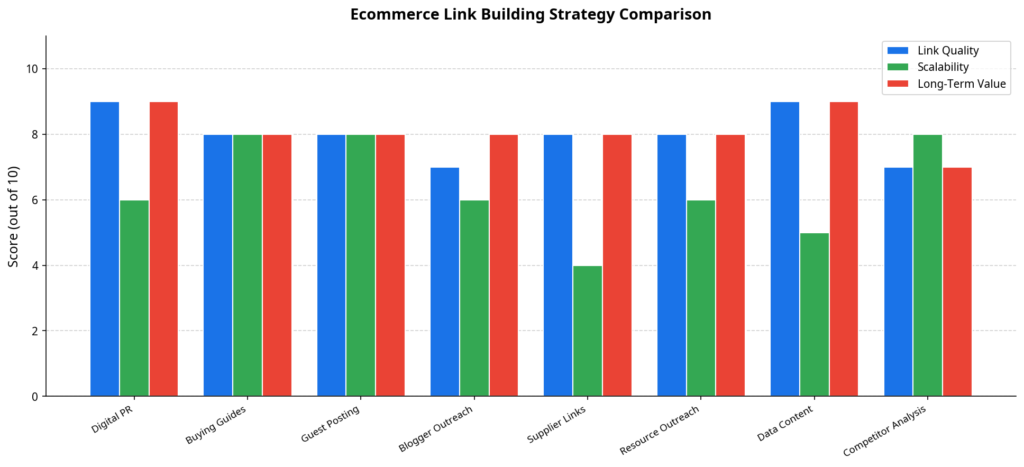
Chart: Ecommerce link building strategies scored on Link Quality, Scalability, and Long-Term Value (out of 10).
| Strategy | Link Quality | Scalability | Long Term Value |
|---|---|---|---|
| Digital PR | 9/10 | 6/10 | 9/10 |
| Buying Guides | 8/10 | 8/10 | 8/10 |
| Guest Posting | 8/10 | 8/10 | 8/10 |
| Blogger Outreach | 7/10 | 6/10 | 8/10 |
| Supplier Links | 8/10 | 4/10 | 8/10 |
| Resource Page Outreach | 8/10 | 6/10 | 8/10 |
| Data Driven Content | 9/10 | 5/10 | 9/10 |
| Competitor Analysis | 7/10 | 8/10 | 7/10 |
What Is Not Working in Ecommerce Link Building?
Some tactics that were once common are now actively harmful. Knowing what to avoid protects your site from penalties and wasted budget.
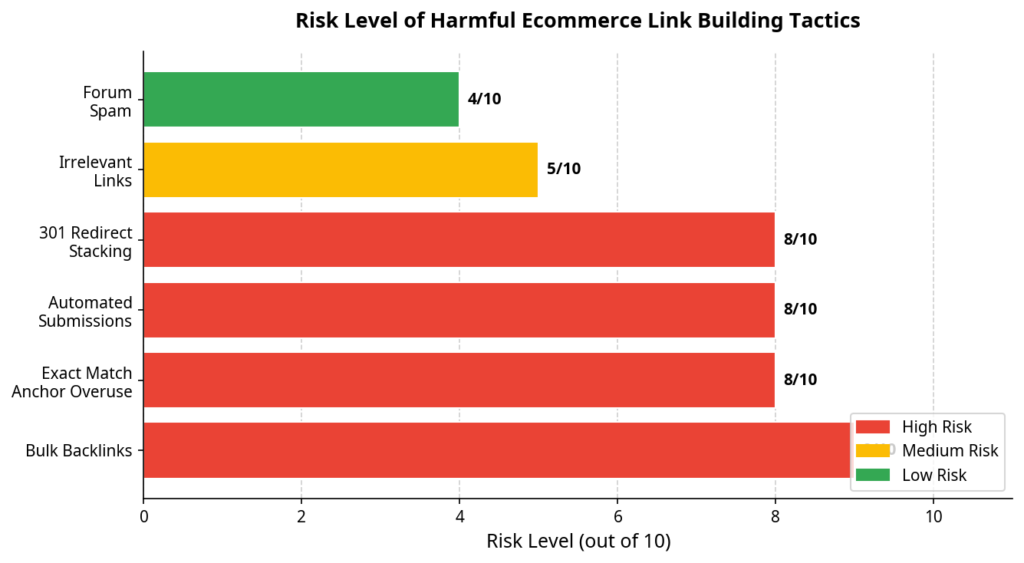
Chart: Risk levels of common harmful ecommerce link building tactics (out of 10).
| Tactic | Why It Fails | Risk Level |
|---|---|---|
| Buying Bulk Backlinks | Search engines detect and penalize link farms. | High |
| Irrelevant Links | No topical relevance means no SEO value. | Medium |
| Exact Match Anchor Overuse | Triggers spam filters and over-optimization penalties. | High |
| Automated Submissions | Poor quality placements damage brand reputation. | High |
| Low Quality Directories | Ignored by modern search algorithms. | Low-Medium |
| Comment and Forum Spam | Weak signals that can harm brand credibility. | Medium |
| Homepage 301 Redirect Stacking | Treated as soft 404s, passing no link equity. | High |
Buying cheap bulk backlinks is the most common and most damaging mistake. Link farms and private blog networks offer short term gains but carry a high risk of manual penalties that can wipe out rankings entirely.
Irrelevant links from unrelated industries provide no topical signal to search engines. A link from an unrelated niche does nothing for rankings and can look unnatural in a link audit.
Excessive exact match anchor text is a clear over-optimization signal. If every backlink to your site uses the exact keyword phrase you are targeting, search engines flag it as manipulative. Natural anchor text variation is essential.
Automated link building through mass submission tools generates low quality placements on sites with no real audience. These links add noise to your backlink profile without adding authority.
Focusing only on product pages is a structural mistake. Product pages rarely earn organic links. Without supporting content that attracts links, the entire site misses out on the authority needed to rank competitively.
Why Link Quality Always Outperforms Link Volume
One high quality backlink from a trusted, relevant website is worth more than hundreds of links from low quality sources. This is not just a best practice, it reflects how search engine algorithms actually work.
Search engines evaluate backlinks based on the authority of the linking domain, the relevance of the linking page to your content, and the context in which the link appears. A single link from a respected industry publication can move rankings more than an entire campaign of low quality directory submissions.
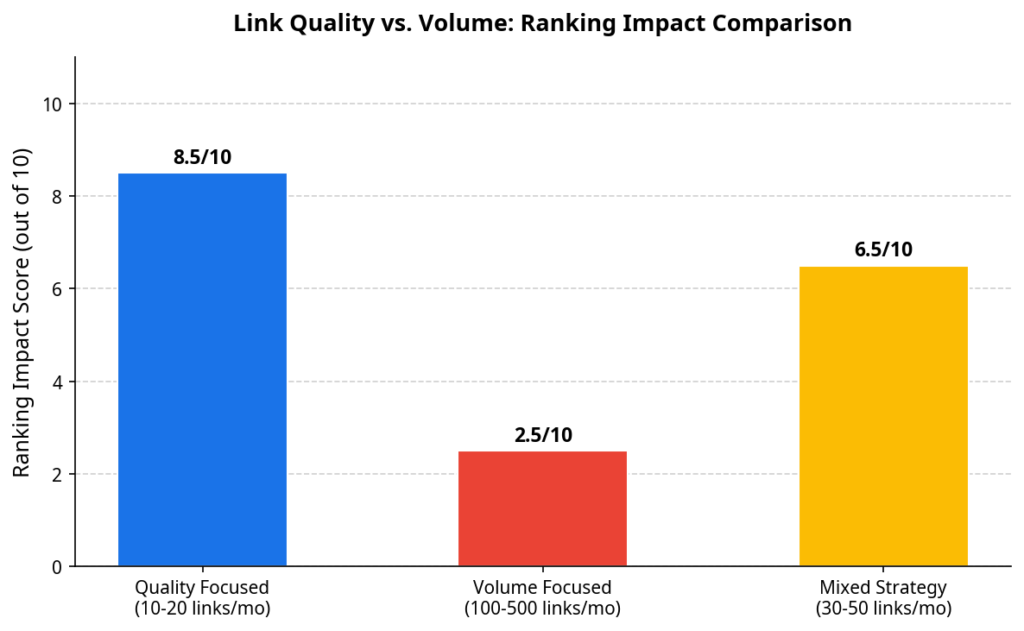
Chart: Quality focused link building scores 8.5/10 on ranking impact versus 2.5/10 for volume focused approaches.
| Approach | Links Per Month | Avg. Domain Authority | Ranking Impact |
|---|---|---|---|
| Quality Focused | 10-20 | 50-80 | High (8.5/10) |
| Volume Focused | 100-500 | 10-25 | Low (2.5/10) |
| Mixed Strategy | 30-50 | 35-60 | Medium-High (6.5/10) |
Quality links also generate real referral traffic. When a relevant, high traffic website links to your store, their audience follows. That traffic tends to convert at higher rates because the visitor arrives with context and intent. Volume based link building rarely produces this secondary benefit.
Building a Future-Proof Ecommerce Link Profile
The most durable link profiles are built on three foundations: relevance, authority, and genuine value. Every link should come from a site that is relevant to your industry, carries real domain authority, and links to your content because it genuinely adds value to their audience.
Start by auditing your existing link profile to understand where your authority currently comes from. Identify gaps in your content strategy where linkable assets are missing. Build a consistent outreach process that targets relevant sites in your niche.
The goal is not to accumulate the most links. The goal is to build a profile that search engines trust and that drives real traffic from real shoppers. That kind of profile takes time to build, but it is the only kind that delivers sustainable ecommerce growth.
For a complete link building strategy tailored to your store, explore our Link Building Services or contact our team at Eyes On Solution to get started.
FAQs
What is ecommerce link building?
Ecommerce link building is the process of acquiring hyperlinks from other websites to your online store. These links help search engines measure your site’s authority and relevance, which directly impacts keyword rankings and organic traffic.
Why are backlinks important for ecommerce SEO?
Backlinks act as trust signals to search engines. They help your store rank higher for buyer intent keywords, drive organic traffic, and build brand credibility without relying entirely on paid advertising.
How many backlinks does an ecommerce site need?
There is no fixed number. Ten high quality, relevant backlinks from trusted sites will outperform hundreds of low quality links. Focus on relevance and authority rather than volume.
Which ecommerce pages should receive backlinks first?
Prioritize buying guides, category pages, and blog content before individual product pages. Supporting content attracts links naturally and passes authority to product pages through internal linking.
Are paid backlinks safe for ecommerce websites?
Buying cheap, bulk backlinks is risky and can result in search engine penalties. Focus on earning links through high quality content, outreach, and genuine industry relationships.
How long does ecommerce link building take to show results?
Link building is a long term strategy. Most ecommerce stores begin to see measurable improvements in rankings and traffic within three to six months of consistent, quality focused effort.
What is the best ecommerce link building strategy?
The most effective strategy combines digital PR, linkable content assets like buying guides and original research, and targeted outreach through guest posting and blogger collaborations. Our SEO services are designed to execute this approach for ecommerce businesses.
How do I find link building opportunities for my ecommerce store?
Start with competitor backlink analysis to identify where similar stores earn their links. Then build outreach lists from resource pages, industry blogs, and niche publications in your product category.
What is the difference between guest posting and blogger outreach?
Guest posting involves writing and publishing content on another website to earn a backlink. Blogger outreach involves connecting with existing content creators to earn placements within their existing content. Both are effective and complement each other well.
Can link building help a new ecommerce store rank faster?
Yes. A focused link building strategy helps new stores build domain authority faster than relying on on-page SEO alone. Starting with a few high quality placements on relevant sites can accelerate early ranking gains significantly.