

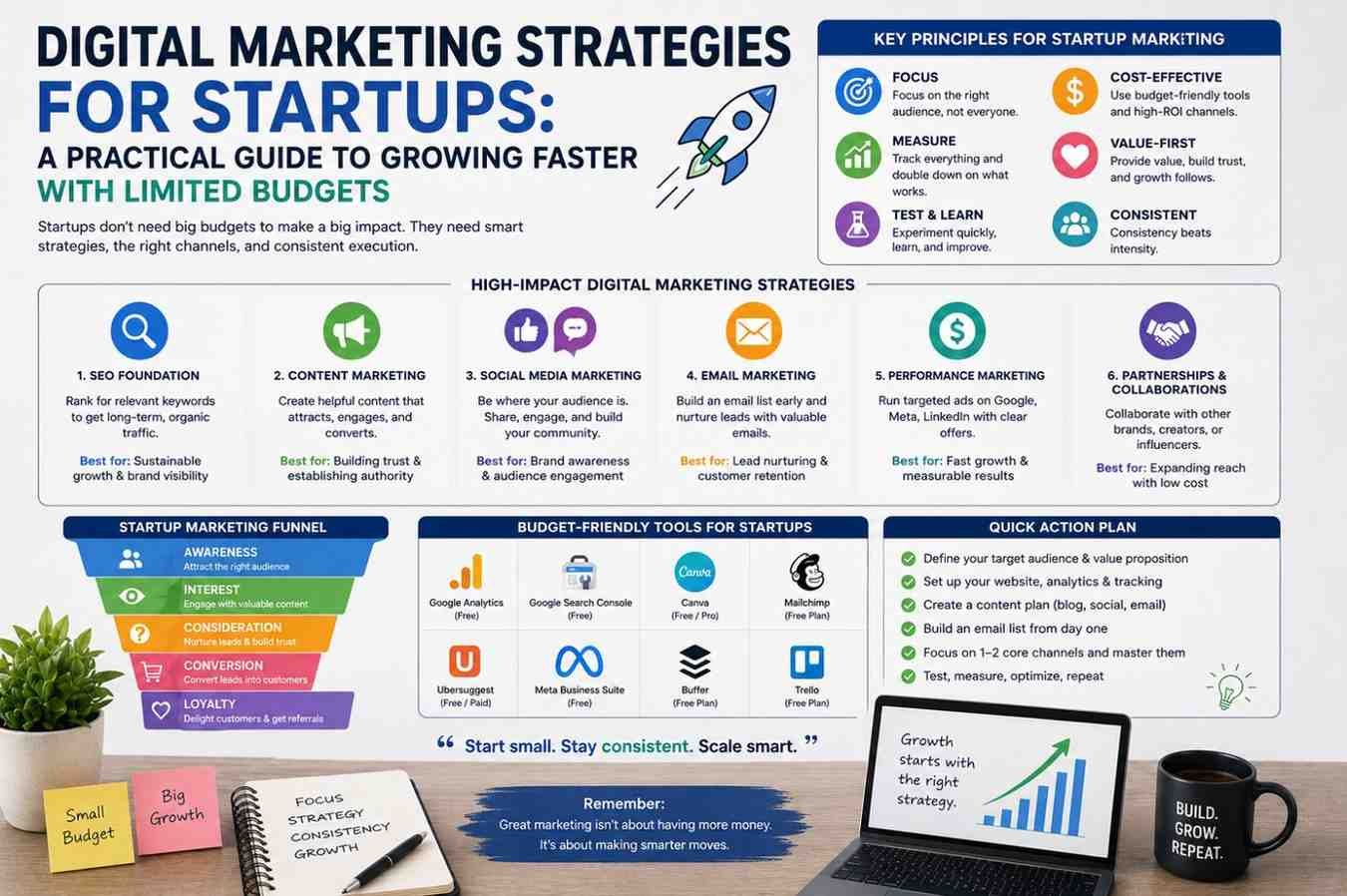
Startups grow faster when they stop trying every channel at once and start building a focused digital foundation. That means a fast, optimized website, a clear SEO strategy, content that answers real questions, targeted paid ads, and email sequences that nurture leads into customers. This guide shows you exactly how to do that, in the right order, without wasting budget.
Why Digital Marketing Gives Startups a Real Competitive Edge
Digital marketing levels the playing field. A startup with a smart strategy can outrank, outperform, and outgrow a larger competitor that relies on brand recognition alone.
The core advantage is precision. You can target the exact audience you want, measure every click and conversion, and adjust your approach in real time. Traditional advertising does not offer that. You spend and hope. Digital marketing lets you spend and know.
For startups specifically, the stakes are higher. You are building brand awareness from zero, generating leads without an established reputation, and competing for attention in crowded markets. The right digital marketing strategy turns those challenges into advantages. You move faster, test smarter, and scale what works.
| Challenge Startups Face | How Digital Marketing Solves It |
|---|---|
| No brand recognition | SEO and content build authority over time |
| Limited budget | Targeted ads reduce wasted spend |
| No existing audience | Social media and email grow a loyal base |
| Competing with larger brands | Strategic content outranks brand size |
| Hard to measure results | Analytics track every action and outcome |
Set Clear Business Goals Before You Pick a Channel
Before you choose a single marketing channel, define what success looks like for your startup. Picking channels before setting goals is one of the most common and costly mistakes startups make.
Your goals should be SMART: Specific, Measurable, Achievable, Relevant, and Time-bound. A vague goal like “get more customers” does not tell you which channels to use or how to measure progress. A goal like “generate 50 qualified leads per month through organic search within 90 days” gives you a clear target and a clear strategy.
Align your goals with the right KPIs. If you are focused on brand awareness, track impressions and reach. If you are focused on lead generation, track form submissions and cost per lead. If you are focused on sales, track conversion rate and customer acquisition cost. Every channel decision flows from this foundation.
Build a High-Converting Website Before You Spend on Traffic
Your website is the center of every digital marketing strategy. Sending traffic to a slow, confusing, or untrustworthy website is like filling a leaky bucket. Fix the bucket first.
A high-converting website for a startup needs five things: fast load times, mobile-friendly design, clear messaging, strong calls to action, and trust signals. Visitors decide within seconds whether to stay or leave. If your homepage does not immediately communicate what you do, who it is for, and why they should trust you, they will leave.
From an SEO and AI search perspective, structured and well-organized content is non-negotiable. AI search engines like Google’s AI Overviews favor websites that are easy to understand, clearly structured, and factually trustworthy. Technical SEO basics such as clean URL structures, proper heading hierarchies, fast page speeds, and schema markup all contribute to how well your site performs in both traditional and AI-powered search results.
Invest in SEO for Long-Term Organic Growth
SEO is the most cost-effective long-term digital marketing strategy for startups. Unlike paid ads, which stop generating traffic the moment you stop spending, SEO builds compounding value over time. A well-optimized page can attract qualified traffic for months or years without additional investment.
Effective SEO for startups starts with keyword research rooted in search intent. You need to understand not just what people are searching for, but why. Informational queries need educational content. Commercial queries need comparison pages and case studies. Transactional queries need optimized product or service pages with clear CTAs.
On-page SEO covers title tags, meta descriptions, heading structure, internal linking, and content quality. Technical SEO covers site speed, crawlability, mobile optimization, and structured data. Local SEO matters if your startup serves a specific city or region. Content clusters and internal linking build topical authority, which signals to search engines that your site is a reliable source on a given subject.
For GEO optimization, which is the process of making your content visible in AI-generated answers, you need entity-rich content, E-E-A-T signals (Experience, Expertise, Authoritativeness, and Trustworthiness), question-based formatting, and schema markup. Our SEO Company Dubai team builds all of this into every strategy we deliver.
If you need a deeper technical audit of your site, our Technical Seo service identifies and fixes the issues that hold your rankings back.
Create Content That Solves Real Problems for Your Audience

Content marketing works because it builds trust before a sale. When a potential customer finds your blog post, guide, or FAQ that directly answers their question, they associate your brand with expertise and reliability. That association drives conversions.
The types of content that perform best for startups are blog posts that answer specific questions, buying guides that help customers make decisions, comparison pages that address alternatives, case studies that demonstrate results, and FAQs that cover objections. Video content and infographics extend your reach and improve engagement, especially on social media.
The key is to create content with a clear purpose. Every piece should target a specific search query, address a specific pain point, and guide the reader toward a next step. Content that exists just to fill a blog calendar does not rank and does not convert. Content that genuinely helps people does both.
Helpful content also improves your visibility in AI-generated answers. When your content is structured clearly, answers questions directly, and demonstrates real expertise, AI systems are more likely to cite it. Our Content Writing service produces content built for both human readers and AI search engines.
Use Social Media to Build Brand Visibility and Community
Social media is not where most startups make their first sale. It is where they build the trust that makes the sale possible. The goal is consistent visibility, not viral moments.
Platform selection matters. LinkedIn is the right choice for B2B startups targeting decision-makers. Instagram and TikTok work well for consumer brands that benefit from visual storytelling. Facebook remains effective for community building and targeted advertising. X is useful for thought leadership and real-time engagement in specific industries.
Short-form video consistently outperforms static content across every major platform. Founder-led content, where the person behind the brand shares their perspective and experience, builds authenticity that polished brand content cannot replicate. User-generated content from customers adds social proof that accelerates trust.
The most important thing is consistency. Posting three times a week for six months beats posting daily for two weeks and then going silent. Build a content calendar, stick to it, and engage with your audience genuinely.
Run Paid Advertising to Generate Results While Organic Grows
Paid advertising fills the gap while your organic strategies build momentum. SEO and content marketing take time. Paid ads can generate qualified leads from day one, if they are set up correctly.
Google Ads targets users who are actively searching for what you offer. This is high-intent traffic with a strong likelihood of converting. Meta Ads on Facebook and Instagram are better for awareness and retargeting. LinkedIn Ads are expensive but highly effective for B2B startups targeting specific job titles or industries. YouTube Ads work well for brands that can communicate their value visually.
Budget planning is critical. Start small, test multiple ad variations, and scale what converts. Retargeting campaigns, which show ads to people who have already visited your website, consistently deliver the highest return on ad spend because the audience already knows who you are.
Never run paid ads to a page that is not optimized for conversion. The ad gets people to your site. The landing page is what turns them into leads or customers.
Build Customer Relationships Through Email Marketing
Email marketing delivers the highest return on investment of any digital marketing channel. It is also the channel you own. Social media platforms change their algorithms. Search rankings fluctuate. Your email list belongs to you.
The foundation of email marketing is a strong lead magnet. Offer something genuinely useful in exchange for an email address. A free guide, a checklist, a discount, or a free consultation all work well depending on your industry and audience.
Once someone subscribes, a welcome sequence introduces them to your brand, communicates your value, and guides them toward a first action. From there, automated sequences nurture leads based on their behavior. Someone who reads three blog posts about SEO should receive different emails than someone who visited your pricing page.
A consistent newsletter keeps your audience engaged between purchase decisions. Share insights, updates, and useful content. Do not just send promotional emails. The goal is to stay top of mind so that when the reader is ready to buy, your brand is the first one they think of.
Optimize for AI Search and Generative Engine Optimization

AI search is changing how people find information online. Google’s AI Overviews, conversational search tools, and AI assistants now answer questions directly, often without requiring users to click through to a website. If your content is not optimized to appear in those answers, you are invisible to a growing segment of your audience.
Generative Engine Optimization (GEO) is the practice of making your content visible and citable in AI-generated responses. It requires a different approach than traditional SEO.
Traditional SEO vs GEO Strategy: What Has Changed
| Dimension | Traditional SEO | GEO Strategy |
|---|---|---|
| Primary Focus | Keyword targeting | Intent and entity optimization |
| Output Format | Blue link rankings | AI-generated answers |
| Success Metric | Search rankings | Visibility in AI platforms |
| Authority Signal | Backlinks | Trusted citations and E-E-A-T |
| Content Format | Long-form articles | Structured, question-based content |
| Discovery Method | Search result snippets | Direct AI references |
To optimize for GEO, your content needs topical authority across a subject area, not just individual keyword rankings. It needs to be structured with clear headings, direct answers, and factual accuracy. Schema markup helps AI systems understand what your content is about. Original insights and data points make your content more likely to be cited as a source.
Use Local SEO if Your Startup Serves a Specific Area
If your startup operates in a specific city or region, local SEO is one of the highest-ROI strategies available. Most people searching for local services click on one of the first three results. If you are not there, you do not exist for that search.
Start with a fully optimized Google Business Profile. This is the single most important local SEO asset. Complete every field, add photos, respond to reviews, and post regular updates. Local citations, which are consistent mentions of your business name, address, and phone number across directories, reinforce your local authority.
Customer reviews are both a trust signal and a ranking factor. Actively ask satisfied customers to leave reviews. Respond to every review, positive or negative. Local landing pages with location-specific content help you rank for searches in specific areas. Our Local Seo service covers all of this in a structured, results-focused approach.
Track Performance and Improve Continuously
Data is what separates startups that scale from startups that stall. Every strategy in this guide produces measurable results. You need to track those results consistently and use them to make better decisions.
The most important metrics for startups are organic traffic, qualified leads, conversion rate, cost per acquisition, customer acquisition cost, and customer lifetime value. Engagement rate and bounce rate reveal how well your content and website are performing. ROI ties everything back to business impact.
Key Metrics and What They Tell You
| Metric | What It Measures | Why It Matters |
|---|---|---|
| Organic Traffic | Visitors from search engines | Indicates SEO performance |
| Conversion Rate | % of visitors who take action | Measures website effectiveness |
| Cost Per Acquisition | Cost to acquire one customer | Evaluates paid ad efficiency |
| Customer Lifetime Value | Total revenue per customer | Guides long-term investment |
| Bounce Rate | % who leave without engaging | Reveals content or UX issues |
| Email Open Rate | % who open your emails | Measures email list health |
Use Google Analytics 4 for traffic and behavior data. Google Search Console shows how your site performs in search. Ahrefs and Semrush provide keyword and backlink intelligence. Microsoft Clarity shows heatmaps and session recordings that reveal exactly how users interact with your pages. Looker Studio brings all of this data into one visual dashboard.
Common Mistakes That Prevent Startups From Growing
Most startup marketing failures come down to a handful of avoidable mistakes. Trying to be active on every channel at once spreads resources too thin and produces mediocre results everywhere. Ignoring SEO in favor of only paid ads creates a dependency that becomes expensive and unsustainable.
Publishing low-quality content that does not genuinely help the reader damages your brand and your rankings. Poor website UX drives visitors away before they convert. Not tracking conversions means you have no idea what is working. Weak branding and inconsistent messaging confuse potential customers and reduce trust.
Ignoring AI search optimization is an increasingly costly mistake. As more users rely on AI tools to answer their questions, brands that are not optimized for GEO will lose visibility to those that are. Our Blogger Outreach and Custom Outreach services help build the authority signals that both traditional SEO and GEO require.
Which Digital Marketing Strategy Should Startups Prioritize First?

The right order depends on your goals, but for most startups, this sequence works:
- Optimize your website for speed, mobile, and conversions
- Implement technical SEO and on-page optimization
- Build a content marketing strategy targeting high-intent keywords
- Set up local SEO if you serve a specific area
- Launch email marketing with a lead magnet and welcome sequence
- Build a consistent social media presence on one or two platforms
- Run targeted paid advertising to accelerate lead generation
- Optimize for GEO and AI search visibility
- Track performance continuously and scale what works
This is not a rigid checklist. It is a priority framework. Start with the foundation, build the organic channels, add paid acceleration, and optimize for the future of search. Our Guest Post Services and Link Building programs support every stage of this sequence by building the authority your site needs to rank and be cited.
Ready to Build a Digital Marketing Strategy That Works?
Startups do not need to invest in every marketing channel immediately. They need to invest in the right ones, in the right order, with a clear strategy behind every decision.
Eyes On Solution helps startups build digital marketing strategies that generate real results. From Technical Seo and Local Seo to Content Writing, Blogger Outreach, Guest Post Services, and Custom Outreach, we build the foundation that drives sustainable growth.
Contact us today for a tailored startup digital marketing strategy built around your goals, your audience, and your budget.
Frequently Asked Questions
What are the most effective digital marketing strategies for startups?
The most effective combination for startups includes SEO, content marketing, a conversion-optimized website, email marketing, and targeted paid advertising. These channels work together to build both immediate visibility and long-term organic growth. Learn more about how our SEO Company Dubai team builds these strategies for startups.
How much should a startup budget for digital marketing?
Most startups allocate between 7% and 15% of revenue to digital marketing. Early-stage startups with aggressive growth targets often invest closer to 15%, while bootstrapped startups may start lower and scale as revenue grows. View our pricing options to find a plan that fits your stage.
Is SEO or paid advertising better for a startup with a small budget?
SEO delivers better long-term ROI but takes time to build. Paid advertising generates immediate results but requires ongoing spend. The smartest approach is to invest in SEO from day one while using paid ads selectively to generate leads while organic traffic grows. Our Technical Seo service gets your site ready to rank from the start.
How do I know which digital marketing channel is right for my startup?
Start with your audience. Where do they spend time online? What questions are they searching for? What problems are they trying to solve? Your audience behavior determines which channels will deliver the best results for your specific startup.
What is GEO and why does it matter for startups in 2025 and 2026?
GEO stands for Generative Engine Optimization. It is the practice of optimizing your content to appear in AI-generated search answers, such as Google AI Overviews. As more users rely on AI tools to find information, GEO ensures your startup remains visible in those results. Structured content, E-E-A-T signals, and original insights are the foundation of a strong GEO strategy.
How long does it take for digital marketing to show results for a startup?
Paid advertising can generate results within days. SEO and content marketing typically take three to six months to show meaningful organic growth. Email marketing builds momentum over time as your list grows. The key is consistency and measurement from the start.
Do startups need a digital marketing agency or can they do it in-house?
Many startups start with in-house marketing and bring in an agency for specialized services like SEO, technical audits, or link building. An experienced agency accelerates results by applying proven strategies without the learning curve of building expertise from scratch. Explore our full range of services to see how we support startup growth at every stage.

