Answer Engine Optimization (AEO) is the process of optimizing content and technical elements so AI powered search engines, voice assistants, and generative platforms can easily understand, extract, and cite information as direct answers. Unlike traditional SEO, which focuses on rankings and clicks, AEO focuses on becoming the trusted source behind AI generated responses and increasing visibility across modern search experiences.
The digital search landscape is undergoing its most profound transformation since the inception of the commercial internet. For decades, businesses and digital marketers have structured their online presence around traditional Search Engine Optimization, a methodology designed to rank webpages in a linear list of blue links. Today, however, search engines are rapidly evolving into “answer engines.” Powered by advanced artificial intelligence, LLMs, and sophisticated natural language processing, these platforms no longer merely point users to external sources; they synthesize, format, and deliver direct answers on the search results page itself.
This fundamental shift has given rise to Answer Engine Optimization. While traditional SEO focuses on maximizing click-through rates and driving organic traffic to a website, AEO focuses on optimizing content so that AI-driven platforms can easily extract, comprehend, and cite it as the definitive source of truth. In this new reality, being cited as the foundational source that powers an AI-generated summary is the ultimate currency of digital visibility. For businesses operating in highly competitive markets like Dubai, adapting to AEO is no longer optional, it is a critical requirement for long-term digital survival.
| Traditional SEO | AEO (Answer Engine Optimization) |
| Focuses on keyword-based search queries | Focuses on conversational prompts and natural language questions |
| Users type short search phrases | Users ask complete questions or use voice search |
| Search engines crawl and index webpages | Answer engines use NLP and semantic analysis |
| Goal is to rank pages on SERPs | Goal is to provide direct, accurate answers |
| Results appear as blue links in search engines | Results appear as AI-generated answers and summaries |
| Success depends on rankings and click-through rates | Success depends on visibility in AI answers and citations |
| Users must click through to websites | Users often receive instant answers without leaving the platform |
| Keyword optimization is the primary strategy | Context, intent, and entity optimization are prioritized |
| Backlinks improve page authority | Brand trust, authority, and structured data improve answer visibility |
| Optimized mainly for Google SERPs | Optimized for AI platforms, voice assistants, and generative search |
| Traditional content targets search engines | AEO content targets users and AI understanding simultaneously |
| Metadata and keyword density play a major role | Schema markup and semantic structure are critical |
| Traffic comes from organic search clicks | Visibility comes from featured snippets, AI summaries, and voice responses |
| SEO measures rankings and traffic | AEO measures answer inclusion, authority, and AI visibility |
| Primarily text-link driven | Conversational, contextual, and intent-driven |
The growth of conversational AI and voice-activated assistants has accelerated this transition. With hundreds of millions of users interacting weekly with platforms like ChatGPT, Google Gemini, and Microsoft Copilot, search behavior has shifted from fragmented keywords to natural, conversational sentences. This guide, prepared by the digital marketing and technical experts at Eyes On Solution, provides a comprehensive blueprint of the core standards, essential practices, and technical protocols required to master Answer Engine Optimization.
How Does Answer Engine Optimization (AEO) Differ from Traditional SEO?
To implement a successful search strategy in the modern era, one must first understand the fundamental differences between traditional SEO and AEO. Traditional SEO is inherently page-centric and keyword-driven. It relies on optimizing specific webpages for target search terms, building backlink profiles, and improving domain authority to secure a top position on Google’s Search Engine Results Pages (SERPs). The ultimate goal is to entice the user to click a link and visit the website, where engagement and conversion can occur.
In contrast, AEO is answer-centric and entity-driven. It focuses on how search platforms interpret, structure, and deliver information. Instead of presenting a user with a list of ten blue links and requiring them to visit multiple websites to piece together an answer, an answer engine uses generative AI to compile a single, comprehensive response directly on the SERP.
| Aspect | Traditional SEO | Answer Engine Optimization (AEO) |
|---|---|---|
| Primary Platforms | Google, Bing, Yahoo (Text-based search engines) | ChatGPT, Google AI Overviews, Gemini, Perplexity, Siri, Alexa |
| Query Structure | Short, keyword-centric phrases (e.g., “SEO company Dubai”) | Conversational questions and prompts (e.g., “Which is the best SEO company in Dubai for local businesses?”) |
| Primary Goal | Maximize organic rankings and drive click-throughs to the site | Position brand content as the definitive answer and secure AI citations |
| Content Format | In-depth, comprehensive articles; answers may be placed anywhere | Structured, clear, and direct question-and-answer formats placed upfront |
| Technical Focus | Crawlability, page speed, mobile-friendliness, standard meta tags | Advanced Schema.org markup, JSON-LD, entity optimization, API accessibility |
| Key Metrics | Keyword rankings, organic traffic, CTR, bounce rate, backlinks | AI citations, featured snippet share, voice search share, AI referral traffic |
| User Experience | User navigates to the website to read and interact with content | User consumes synthesized answers directly on the search platform |
This shift has created a phenomenon known as “zero-click searches.” According to recent industry data, the percentage of Google searches that end without a user clicking through to an external website rose from 56% in 2024 to a staggering 69% in 2025. Furthermore, studies show that over 58% of Google searches now end without a single click, as AI-generated summaries provide users with the exact information they need instantly.
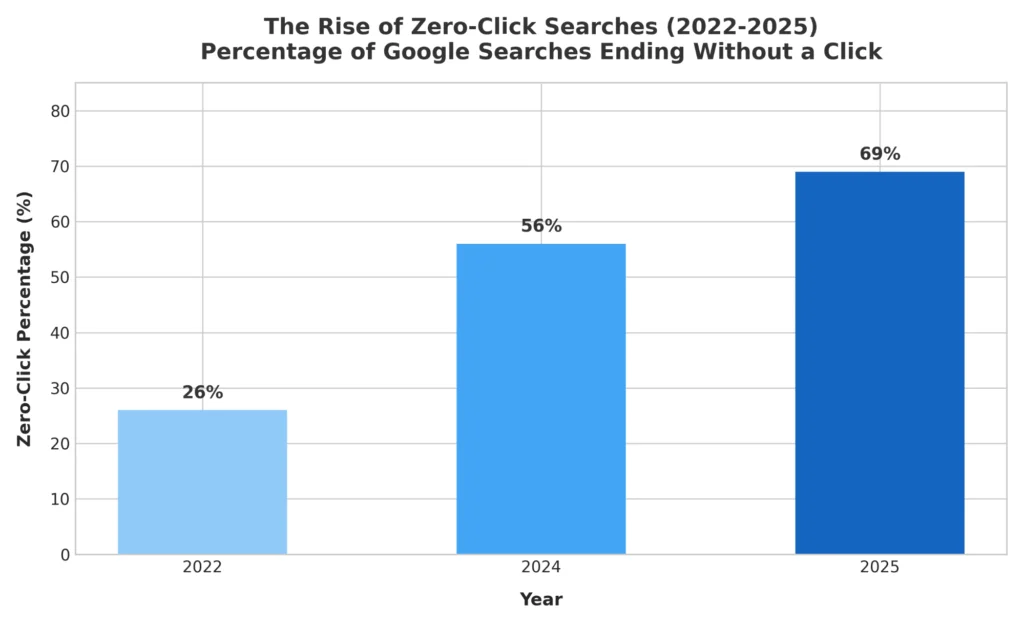
While these statistics may initially seem alarming to traditional digital marketers, they represent an unprecedented opportunity. While overall website traffic may experience a decline, the quality of traffic that does click through from an AI citation is significantly higher. In fact, early adopters of dedicated AEO strategies have reported a 3.4x increase in answer engine referral traffic and 27% higher conversion rates when users click through from an AI-generated citation [2]. By aligning your content with AEO standards, your brand becomes the trusted authority that powers the AI’s response, establishing immediate credibility with the user.
For businesses looking to dominate their local market, partnering with an experienced SEO Company Dubai is essential to navigate this transition and implement a future-proof SEO Optimisation Service.
Why Do AEO Standards Matter for Modern Businesses?
The rapid adoption of artificial intelligence has fundamentally altered the path to customer acquisition. When a user asks an AI assistant for a recommendation or a solution to a complex problem, they are not looking for a list of options; they are looking for the single best recommendation. If your business is not recognized by the AI as a trusted entity, you are effectively invisible to a rapidly growing segment of your target audience.
The Benefits of Adopting AEO Standards
Following established AEO standards offers several transformative benefits for modern enterprises:
- Enhanced Visibility in Generative Answers: By structuring your content according to AEO guidelines, you increase the likelihood of your brand being featured in Google’s AI Overviews, ChatGPT responses, and Perplexity citations.
- Superior Voice Search Performance: Voice queries are inherently conversational. AEO directly targets the natural language patterns used in voice search, ensuring your business is the one spoken back to the user by smart assistants.
- Higher Traffic Quality and Conversions: Users who click through to your site from an AI citation have already had their initial questions answered. They are further down the purchasing funnel, leading to a 31% increase in engagement metrics and significantly higher conversion rates.
- Elevated Brand Authority and Trust: Being cited by an AI engine as a primary source of information acts as a powerful third-party endorsement, immediately elevating your brand’s perceived expertise and trustworthiness.
- Optimized User Experience: AEO requires clean, structured, and easily digestible content. This naturally improves the readability and usability of your website for human visitors, leading to longer dwell times and lower bounce rates.
Industries That Stand to Gain the Most from AEO
While AEO is beneficial for all online businesses, certain sectors are experiencing a more immediate and dramatic impact due to the informational nature of their customer queries:
| Industry | AI Overview Trigger Rate | AI Visibility Level | AEO Priority Recommendation |
| Health | 60.7% | Very High | Strong focus on authoritative content, schema markup, and E-E-A-T signals |
| Home & Garden | 50.4% | High | Optimize how-to guides, FAQs, and conversational search content |
| Transportation | 31.4% | Moderate | Improve local SEO, structured data, and informational content |
| Animal & Pet | 30.9% | Moderate | Use educational blogs, Q&A content, and voice search optimization |
| Food & Beverage | 24.9% | Medium | Focus on recipe schema, local intent, and featured snippets |
| Professional Services | 23.8% | Medium | Build trust signals, service pages, and entity authority |
| Retail | 23.2% | Medium | Optimize product information and conversational shopping queries |
| Finance | 22.9% | Medium | Emphasize accuracy, trust, and compliance-focused content |
| Legal | 21.5% | Medium-Low | Prioritize expert-driven content and semantic SEO structure |
As illustrated in the data above, informational industries such as healthcare and home services trigger AI-generated summaries at exceptionally high rates. However, professional services, retail, finance, and legal sectors also present significant opportunities for optimization. For service providers in these spaces, delivering clear, factual, and highly structured answers is the key to capturing high-intent leads.
To capitalize on these trends, businesses must invest in professional Content Writing Services that understand how to craft copy that appeals to both human readers and AI crawlers.
What Are the Core AEO Standards Every Website Must Implement?
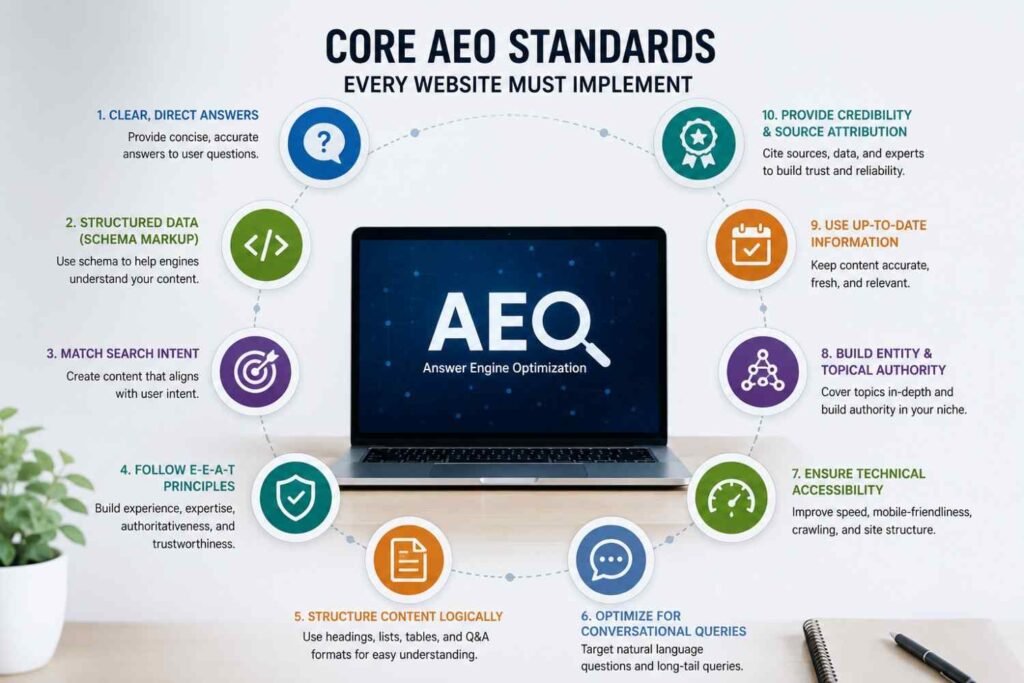
To ensure your website’s content is easily digestible for AI models and answer engines, you must adhere to a set of core structural and conceptual standards. These standards form the foundation of any successful AEO strategy.
1. Advanced Structured Data Implementation
Structured data, or schema markup, is the language that allows search engines to understand the context of your content. While traditional search engines can parse HTML to find text, answer engines rely heavily on schema markup to construct their internal knowledge graphs and understand the relationship between different entities.
Without structured data, an AI model must guess the meaning of your content. With proper schema, you explicitly define the entities, relationships, and facts presented on your page. The most critical schema types for AEO include:
- FAQPage Schema: This defines a list of frequently asked questions and their corresponding answers, making it incredibly easy for AI engines to extract direct Q&A pairs.
- HowTo Schema: Perfect for step-by-step guides, this schema outlines the precise sequence of actions required to complete a task, which is frequently used to power AI-generated instructions.
- Article and Product Schema: These schemas provide essential metadata about your written content and commercial offerings, ensuring that AI models can accurately cite your authors, publication dates, and product details.
- Organization and LocalBusiness Schema: Critical for local businesses, this markup defines your physical location, operating hours, contact information, and service areas, ensuring your business is recommended for geo-specific queries.
2. Content Clarity, Simplicity, and Readability
AI models are trained on massive datasets to recognize patterns in human language. They favor content that is written with absolute clarity rather than creative cleverness. To optimize for AI readability, your content should adhere to the following guidelines:
- Write with Clarity, Not Cleverness: Avoid overly complex metaphors, industry jargon, or flowery language. Use direct, active verbs and straightforward sentence structures.
- The “Answer-First” Structure: Place the direct answer to a query at the very beginning of the section or paragraph. Keep this summary concise (between 40 to 60 words). Follow this immediate answer with deeper analysis, data, and context for users who choose to read further.
- Use Short Paragraphs and Clear Headings: Break your content into digestible paragraphs of no more than 3 to 4 sentences. Use a logical heading hierarchy (H1, H2, H3) to organize your topics, and phrase your subheadings as direct questions.
3. Entity Optimization and Semantic Search
Modern search engines do not just look at individual keywords; they analyze “entities” uniquely identifiable concepts, people, places, or things—and the relationships between them. This is known as semantic search.
To optimize for entities, you must build deep topical relevance around your core subjects. Instead of stuffing a page with a single keyword, integrate a rich vocabulary of semantically related terms, synonyms, and subtopics. This helps the AI build a comprehensive conceptual map of your page, signaling that your website is a highly authoritative source on the subject.
4. Flawless Mobile and Page Experience
Answer engines prioritize websites that deliver an exceptional user experience. Because a significant portion of voice and AI-driven searches occur on mobile devices, your site must be fully responsive, lightning-fast, and technically optimized.
| Core Web Vital Metric | Target Threshold | Impact on AEO & User Engagement |
|---|---|---|
| Largest Contentful Paint (LCP) | Under 2.5 seconds | Measures loading performance; faster loading prevents user abandonment. |
| First Input Delay (FID) / INP | Under 100 milliseconds | Measures page interactivity; critical for smooth mobile browsing. |
| Cumulative Layout Shift (CLS) | Under 0.1 | Measures visual stability; prevents accidental clicks and frustration. |
| Mobile Responsiveness | 100% Pass | Ensures content is fully readable and navigable on all screen sizes. |
If your website is slow, unresponsive, or visually unstable, search crawlers will struggle to index your content, and AI models will deprioritize your brand in favor of faster, more reliable sources. To address these technical requirements, it is vital to work with an agency that excels in Website Design & Development and provides specialized Technical SEO Services.
What Are the Essential AEO Best Practices for Content Creation?
Implementing AEO requires a shift in how you plan, write, and format your website’s content. The following best practices will help you transition from keyword-focused copywriting to answer-focused authority building.
1. Optimize for Conversational and Long-Tail Queries
Traditional search queries are often short and fragmented (e.g., “Dubai SEO”). Conversational queries, however, are phrased as full sentences or questions (e.g., “How do I choose the best SEO company in Dubai for my small business?”).
To optimize for these queries, conduct deep research into the exact questions your target audience is asking. Use natural language patterns and write in the first person plural (“we,” “our”) to match the conversational tone of LLM interactions. This ensures that when a user asks an AI assistant a question, your content matches the semantic intent of the query perfectly.
2. Craft Dedicated Question-and-Answer Content
One of the most effective ways to secure AI citations and featured snippets is to structure your content as direct question-and-answer pairs.
- Create Robust FAQ Sections: Add comprehensive FAQ sections to your core service pages, product pages, and blog posts. Each question should be phrased exactly as a user would type or speak it into an AI assistant.
- Optimize for “People Also Ask” (PAA): Analyze the PAA boxes in Google search results for your target topics. Craft clear, concise, and highly accurate answers to these specific questions within your content.
| Content Element | Optimized AEO Structure | Purpose for AI Visibility |
| H2 Heading | Phrase headings as direct questions | Helps AI engines match conversational search intent |
| Example Heading | “How does Answer Engine Optimization improve local search?” | Targets voice search and long-tail queries |
| Direct Answer Block | Provide a concise 40–60 word answer immediately below the heading | Increases chances of featured snippets and AI extraction |
| Keyword Placement | Bold important keywords naturally within the answer | Strengthens semantic relevance and entity recognition |
| Answer Style | Clear, direct, and conversational language | Improves readability for AI and users |
| Supporting Content | Expand with bullet points, examples, and contextual explanations | Adds depth and topical authority |
| Step-by-Step Formatting | Break down processes into actionable steps | Helps AI summarize procedural content |
| Structured Lists | Use bullets and numbered lists | Improves scannability and answer parsing |
| Tables and Comparisons | Include visual content structures where relevant | Enhances AI comprehension and user experience |
| Schema Markup | Add FAQ, HowTo, and LocalBusiness schema | Improves eligibility for rich results and AI summaries |
| Local Optimization | Mention services, locations, and trust signals clearly | Supports local AI search visibility |
| Conversational Tone | Write naturally as users speak | Aligns with voice search behavior |
| Semantic Context | Include related entities and supporting keywords | Improves NLP understanding |
| Mobile Readability | Use short paragraphs and simple formatting | Enhances accessibility and engagement |
3. Build Deep Topical Authority with Content Clusters
AI engines favor websites that demonstrate deep, comprehensive knowledge of a subject. Rather than writing isolated articles, build “topic clusters.”
A topic cluster consists of a single, highly comprehensive “pillar page” that provides an overview of a broad topic, surrounded by multiple “supporting pages” that dive deep into specific subtopics (such as structured data, voice search, or entity optimization). Link all supporting pages back to the pillar page using descriptive anchor text. This clear internal linking structure helps AI crawlers map your site’s architecture and recognizes your domain as a primary authority on the subject.
4. Enhance E-E-A-T Signals (Experience, Expertise, Authoritativeness, Trustworthiness)
AI models are programmed to prioritize safe, accurate, and highly credible information, especially in “Your Money or Your Life” (YMYL) industries like finance, healthcare, and legal services. To satisfy Google’s E-E-A-T guidelines, your content must project absolute trustworthiness:
- Showcase Real Human Experience: Share case studies, real-world examples, and unique insights gained from your business operations. AI models are trained to detect and favor genuine human experience over generic, AI-generated text.
- Highlight Author Expertise: Include detailed author bios for your writers, highlighting their professional credentials, industry experience, and links to their social profiles or academic publications.
- Build Backlink Authority: Secure high-quality, relevant backlinks from respected industry websites, news outlets, and academic directories. This off-site validation remains one of the strongest signals of authority for both traditional and AI-driven search engines.
To build this off-site authority effectively, consider leveraging professional SEO Link Building, Blogger Outreach Service, and high-quality Guest Post Services.
What Technical Protocols and Requirements Govern AEO?
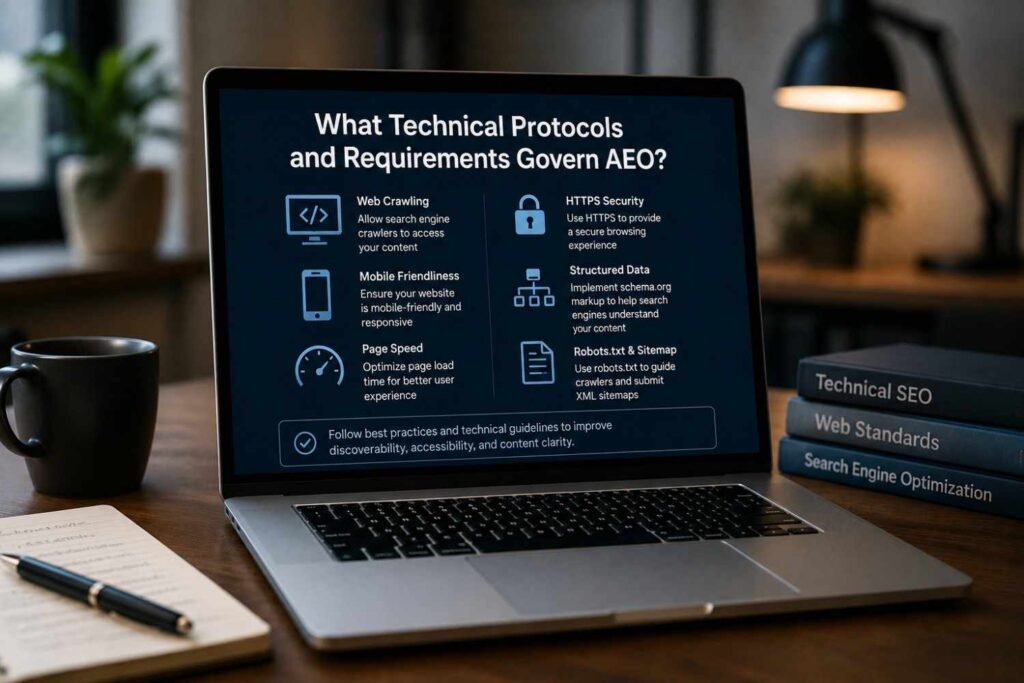
While content structure and formatting are vital, AEO also requires a rigorous technical foundation. You must ensure that your website’s technical infrastructure allows AI bots and search crawlers to access, parse, and index your data without friction.
1. Schema Markup Protocols (JSON-LD)
The gold standard for implementing structured data is JSON-LD (JavaScript Object Notation for Linked Data). Unlike older formats like Microdata or RDFa, JSON-LD is a clean, script-based block of code that is placed in the header of your HTML document, making it incredibly easy for search bots to read.
{
“@context”: “https://schema.org”,
“@type”: “FAQPage”,
“mainEntity”: [{
“@type”: “Question”,
“name”: “What is the difference between SEO and AEO?”,
“acceptedAnswer”: {
“@type”: “Answer”,
“text”: “Traditional SEO focuses on ranking webpages in a list of blue links to drive organic traffic, while Answer Engine Optimization (AEO) optimizes content so AI models and voice assistants can directly extract and cite it as a synthesized answer.”
}
}]
}
To ensure your structured data is technically valid, you must regularly test your code using Google’s Rich Results Test and the Schema Markup Validator. Any errors or warnings in your schema can prevent AI engines from parsing your data correctly, neutralizing your optimization efforts.
2. Crawlability and Indexing Protocols
An AI engine cannot cite content it cannot find. You must ensure your website’s crawl budget is optimized and that AI crawlers have unrestricted access to your valuable content:
- Optimize Your Robots.txt File: Ensure you are not accidentally blocking AI search crawlers (such as GPTBot, Google-Extended, or ClaudeBot) from accessing your informational pages. While you may choose to block them from scraping proprietary data, they must have access to your public blog posts, FAQs, and service descriptions if you want to be cited in their answers.
- Maintain an Active XML Sitemap: Submit a clean, updated XML sitemap to Google Search Console and Bing Webmaster Tools. Ensure that only high-quality, indexable canonical URLs are included in your sitemap.
- Eliminate Technical Errors: Regularly audit your site to identify and resolve broken links (404 errors), redirect loops, duplicate content issues, and server errors that can disrupt crawling activity.
3. Semantic HTML Structure
AI engines read HTML code to understand the hierarchy and flow of your content. A clean, semantic HTML structure is essential for accurate data extraction:
- Use Proper Heading Hierarchy: Ensure your page uses exactly one <h1> tag for the main title, followed by sequential <h2> and <h3> tags for subsections. Never skip heading levels (e.g., jumping from an <h1> directly to an <h3>), as this confuses the structural flow of the document.
- Leverage Semantic HTML5 Tags: Use descriptive HTML5 tags such as <article>, <section>, <aside>, and <footer> to define the different functional areas of your webpage. This helps crawlers isolate your main informational content from navigation menus, sidebars, and footers.
How Do AI and Machine Learning Interpret Web Content?
To optimize your website for AI engines, it is helpful to understand the underlying technology that powers these platforms. Answer engines do not read text the way humans do; they use complex mathematical models to analyze and interpret language.
Natural Language Processing and Search Intent
At the heart of every answer engine is Natural Language Processing. NLP is a branch of artificial intelligence that helps computers understand, interpret, and manipulate human language. Modern NLP models use “transformers” deep learning models that analyze the context of a word by looking at the words that come before and after it.
This allows the AI to perform deep search intent analysis. Instead of simply matching the keywords in a query to the keywords on a webpage, the AI seeks to understand the meaning behind the query. It analyzes the user’s context, history, and phrasing to determine whether they are looking for a quick fact, a step-by-step guide, a product recommendation, or a local service provider.
The Landscape of Modern AI Search Platforms
Different AI search platforms utilize different models and search behaviors, requiring a versatile approach to optimization:
- Google AI Overviews: Integrated directly into Google’s traditional search results, this feature uses Google’s Gemini models to synthesize answers from high-ranking search results, heavily favoring sites that already rank well in traditional SEO and feature clean structured data.
- ChatGPT Search: Powered by OpenAI’s advanced models, ChatGPT Search browses the web in real-time to answer user queries, citing trusted news sources, authoritative blogs, and official business websites.
- Perplexity AI: Designed from the ground up as a conversational answer engine, Perplexity synthesizes answers from multiple web sources, providing clear numerical citations for every claim it makes.
- Voice Assistants (Siri, Alexa, Google Assistant): These assistants rely heavily on featured snippets, local business directories, and structured FAQ data to deliver a single, spoken answer to the user.
By understanding these technologies, an experienced SEO Company Dubai can craft a multi-layered optimization strategy that ensures your brand is visible across all major AI and voice search platforms.
What Are the Most Common AEO Mistakes to Avoid?
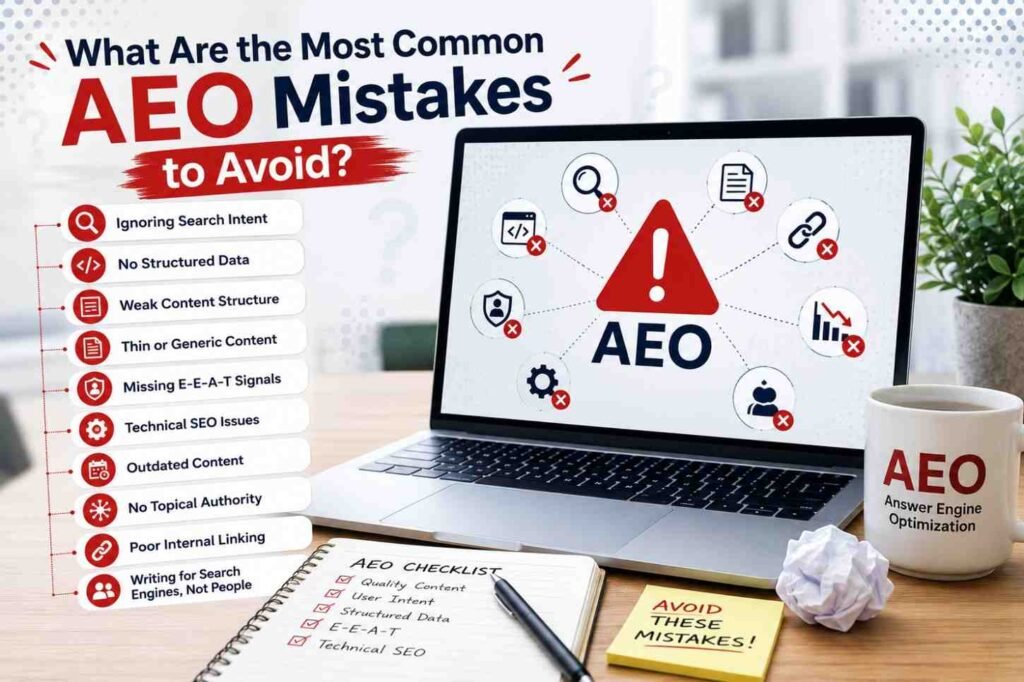
As businesses rush to adapt to AI-driven search, many fall victim to common pitfalls that can harm their visibility and search engine rankings.
1. Keyword Stuffing in Natural Language Content
One of the most frequent mistakes is applying outdated SEO tactics to modern AEO content. AI models are highly sophisticated and can easily detect keyword stuffing, repetitive phrasing, and unnatural language. Writing for AI does not mean repeating your target keyword ten times in an article; it means writing high-quality, natural, and semantically rich content that provides genuine value to a human reader.
2. Ignoring Structured Data and Schema Markup
Many businesses publish exceptional content but fail to include the structured data required for AI engines to parse it. As noted in recent studies, approximately 31.2% of websites still do not use any form of structured data. This represents a massive competitive gap. By failing to implement schema markup, you are forcing AI models to guess the meaning of your content, significantly reducing your chances of being cited.
3. Publishing Thin, Generic, or Low-Quality Content
With the rise of generative AI writing tools, it has become incredibly easy to publish thousands of generic blog posts at the click of a button. However, AI engines are trained to recognize and deprioritize thin, unoriginal, and repetitive content. To stand out, your content must offer deep analysis, unique data points, real-world case studies, and authoritative insights that cannot be easily replicated by an AI writer.
4. Neglecting Website Performance and Mobile Usability
An outstanding content strategy can be completely undermined by a slow, poorly designed website. If your page takes five seconds to load on a mobile device, or if your text is too small to read on a smartphone, AI engines will deprioritize your content in favor of faster, more user-friendly domains. Technical performance is a critical prerequisite for AEO success.
What Are the Future Trends in Answer Engine Optimization?
The field of AI-driven search is evolving at a breakneck pace. To maintain a competitive advantage, businesses must look ahead and prepare for the emerging trends that will define the future of search.
1. The Rise of Multimodal Search
We are rapidly moving beyond text-only search. Modern AI models are multimodal, meaning they can process, understand, and synthesize information across multiple formats, including text, images, video, and audio.
In the near future, a user might take a photo of a broken appliance and ask an AI assistant how to fix it. The AI will analyze the image, search the web for step-by-step guides, and present a synthesized video tutorial. To prepare for this shift, businesses must optimize their visual assets, including high-quality images with descriptive alt text, structured video schema, and clear, descriptive audio transcriptions.
2. Highly Personalized Search Experiences
As AI assistants become more integrated into our daily lives, search results will become highly personalized. AI models will analyze a user’s past preferences, search history, location, and real-time context to deliver tailored recommendations. For businesses, this highlights the importance of building a strong, consistent brand presence across the entire web, ensuring that the AI recognizes your brand as a highly relevant recommendation for specific user profiles.
3. The Dominance of Generative Search Summaries
Generative search summaries and zero-click searches will continue to grow, making traditional search traffic harder to capture. However, the websites that are cited as the sources for these summaries will experience a significant boost in brand credibility, authority, and high-intent referral traffic. The ultimate goal of search marketing will shift from capturing raw clicks to capturing “brand mentions” and “source citations” within the AI’s response.
How Can Your Business Successfully Implement an AEO Strategy?
Transitioning your digital marketing strategy to align with AEO requires a systematic, step-by-step approach.
| Implementation Step | AEO Action | Purpose & SEO Impact |
| Step 1 | Conduct intent-focused keyword and question research | Identifies conversational queries and user intent for AI-driven search optimization |
| Step 2 | Restructure content into clear, answer-first formats | Helps AI systems quickly extract concise and relevant answers |
| Step 3 | Implement advanced JSON-LD schema markup | Improves structured data understanding for FAQs, How-Tos, and rich results |
| Step 4 | Optimize website speed, Core Web Vitals, and mobile UX | Enhances user experience and supports AI ranking signals |
| Step 5 | Build E-E-A-T signals through quality link building | Strengthens trust, authority, and credibility for AI citations |
| Step 6 | Monitor AI citations, snippets, and search visibility | Tracks AEO performance and identifies optimization opportunities |
A Step-by-Step Implementation Guide
- Conduct Intent-Focused Question Research: Identify the exact questions, pain points, and conversational queries your target audience is asking. Use tools like Google’s “People Also Ask” boxes and conversational search logs to build a comprehensive list of target queries.
- Restructure Your Content: Rewrite your core pages and blog posts to feature clear, concise, and bolded answers at the very beginning of each section, followed by deep-dive analysis and supporting data.
- Implement JSON-LD Schema Markup: Add robust FAQPage, HowTo, Article, and LocalBusiness schema to your website’s code, ensuring that all markup is technically valid and error-free.
- Optimize Technical Performance: Work with your web development team to ensure your site is lightning-fast, fully responsive, and passes all Google Core Web Vitals assessments.
- Build E-E-A-T and Off-Site Authority: Invest in high-quality link building, blogger outreach, and guest posting to establish your domain as a trusted, authoritative source of information.
- Monitor and Refine: Keep a close eye on your brand’s visibility in Google’s AI Overviews, featured snippets, and AI search citations. Continuously test, refine, and update your content to maintain your authority.
Why Partnering with a Professional Agency Matters

Answer Engine Optimization is a highly complex, technical, and rapidly evolving discipline. It requires a deep understanding of natural language processing, advanced web development, structured data coding, and authoritative content creation.
For businesses looking to secure a dominant position in the digital landscape, partnering with a professional agency is the most effective path to success. At Eyes On Solution, we feature a dedicated team of technical SEO specialists, expert copywriters, and advanced web developers who specialize in preparing brands for the future of AI-driven search. From comprehensive technical audits to advanced schema implementation and authoritative content writing, we provide the end-to-end expertise required to turn the challenges of AI search into your greatest competitive advantage.
Frequently Asked Questions (FAQ)
What does AEO stand for in digital marketing?
AEO stands for Answer Engine Optimization. It is the digital marketing practice of optimizing a website’s content and technical structure so that AI-driven search engines, large language models, and voice assistants can easily extract, synthesize, and present that content as a direct answer to a user’s conversational query.
How is AEO different from traditional SEO?
Traditional SEO focuses on ranking webpages in a linear list of blue links to drive organic click-through traffic to a website. Answer Engine Optimization focuses on positioning a brand’s content as the definitive source of truth, ensuring it is directly cited and featured within the AI-generated summaries and conversational answers provided on the search results page itself.
Why is AEO important for AI-driven search engines?
AEO is critical because modern search engines are rapidly transitioning into answer engines. With over 58% of Google searches ending without a click and conversational platforms like ChatGPT serving 800 million users weekly, businesses must optimize their content for AI extraction to remain visible, trusted, and discoverable in the era of generative search.
What are the most important AEO practices I should follow?
The most important AEO practices include structuring your content in an “answer-first” format with concise 40-to-60-word summaries, phrasing your subheadings as direct conversational questions, implementing advanced JSON-LD schema markup, building deep topical authority through content clusters, and projecting strong E-E-A-T signals.
Does schema markup help with Answer Engine Optimization?
Yes, schema markup is the foundation of technical AEO. By implementing advanced structured data formats like JSON-LD (including FAQPage, HowTo, and LocalBusiness schema), you provide AI crawlers with explicit facts, entities, and relationships, making it significantly easier for answer engines to comprehend and cite your content.
How can businesses improve their visibility in Google AI Overviews?
Businesses can improve their visibility in Google AI Overviews by combining a strong traditional SEO foundation with targeted AEO practices. This includes ranking well in organic search results, formatting content into clear bullet points and structured tables, adding valid FAQ schema, and maintaining exceptional page speed and mobile responsiveness.
Is voice search optimization considered a part of AEO?
Yes, voice search optimization is a core component of AEO. Because voice queries are naturally conversational and phrased as full sentences, optimizing your content to answer direct questions clearly and concisely ensures that smart assistants like Siri, Alexa, and Google Assistant select your brand as the single spoken answer.
Can small and local businesses benefit from implementing AEO?
Absolutely. Local and small businesses can benefit immensely from AEO by optimizing for geo-specific conversational queries (e.g., “Where is the closest digital marketing agency near me?”). By implementing robust LocalBusiness schema and maintaining an active, optimized Google Business Profile, local businesses can ensure they are the primary recommendation delivered by AI assistants.