Dental SEO is the process of optimizing a dental website/business to rank higher in Google, attract local patients, and increase appointment bookings. It combines local SEO, content optimization, technical SEO, and reputation management to help dental practices appear when people search for treatments and dentists in their area.
If patients in your city are searching “dentist near me,” “dental implants Dubai,” or “emergency dentist,” and your clinic is not showing up, you are handing those patients to the practice that ranks above you. This guide explains exactly how dental SEO works, who it is for, and the steps that move a clinic from invisible to fully booked.
What Is Dental SEO, and Who Is It Actually For?
Dental SEO is search engine optimization built specifically for dental practices. It combines local SEO, optimized treatment pages, technical fixes, helpful content, and reviews so search engines confidently match your clinic to nearby patient searches.
It is for any practice that depends on local patients, including:
- New or growing clinics that need a reliable flow of patients without burning budget on ads.
- Established practices losing visibility to newer, better-optimized competitors.
- Multi-location groups that need each branch to rank in its own neighborhood.
- Specialists (orthodontists, implant dentists, cosmetic dentists) competing on high-value treatments.
The common thread is simple: these practices want to be found at the exact moment a patient decides to book. That is the problem dental SEO solves. Most clinics do not lose patients because their care is poor; they lose them because they are buried below practices that invested in being found. Understanding how that ranking actually happens is the next step.
How Does Dental SEO Work to Bring In New Patients?
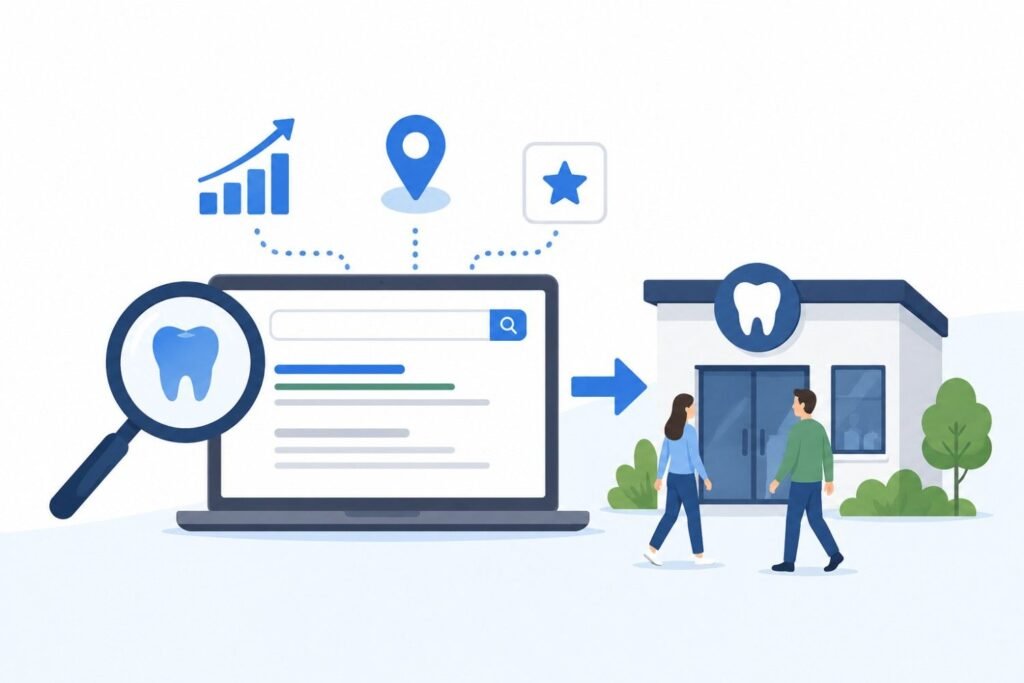
Dental SEO works by sending clear signals to Google about three things: what you do, where you do it, and how trustworthy you are. When those signals are strong and consistent, Google shows your practice to patients searching nearby.
The mechanism breaks down into a logical sequence:
- Patients search using specific terms (“Invisalign near me,” “root canal cost,” “pediatric dentist [city]”).
- Google interprets intent and location, then looks for the most relevant, credible local options.
- Your website and profile supply the signals: service pages, location data, reviews, speed, and authority; that tell Google you are the right match.
- Google ranks you in the map pack, the local results, or the organic listings.
- Patients click, trust, and book.
Every tactic in this guide exists to strengthen one of those signals. SEO is not a single trick; it is a system where each part reinforces the others. That is also why it compounds over time, which leads directly to the question most practice owners ask first.
Why Does Dental SEO Matter More Than Relying on Ads Alone?
Dental SEO matters because it builds an asset you own, while paid ads only rent visibility for as long as you keep paying. The moment your ad budget stops, your visibility disappears. Rankings you earn through SEO keep working.
For dentists, the payoff shows up in five ways:
- Higher local visibility in Google Maps and “near me” searches.
- Qualified traffic from people actively looking for treatment, not casual browsers.
- More appointment requests through calls and form submissions.
- Stronger trust, because patients associate top rankings with credibility.
- Lower long-term cost per patient, since organic clicks do not carry a per-click fee.
The pain point most practices feel is rising acquisition cost: ad clicks get more expensive every year, and the patients still vanish when the campaign pauses. SEO reverses that curve. The earlier you start, the lower your cost per new patient becomes over time. To get there, you need to know what Google actually rewards.
Which Ranking Factors Decide Where Your Dental Practice Appears?
Three things decide your rankings: local relevance, website quality, and authority. A practice that gets all three right consistently outranks competitors that focus on only one.
Here is how the most important factors break down and what to do about each:
| Ranking Factor | Why It Matters | What to Improve |
|---|---|---|
| Google Business Profile | Drives map pack and “near me” visibility | Complete every field, add correct categories, post photos and updates |
| NAP consistency | Confirms your location is real and reliable | Keep Name, Address, Phone identical everywhere online |
| Website speed & mobile design | Most patients search on phones | Fast load times, responsive layout, secure HTTPS |
| Service & location pages | Match specific patient searches | One page per treatment and per area |
| Patient reviews | Signal trust to both Google and patients | Steady review flow, professional replies |
| Backlinks & citations | Prove authority and legitimacy | Listings in dental directories, local and industry sites |
| Helpful content | Captures research-stage patients | FAQs, treatment guides, cost explainers |
Notice that none of these works in isolation. A fast website with no reviews underperforms. A great profile attached to a thin website stalls. The strongest results come from improving these together and it all starts with knowing the exact words your patient types.
How Do You Find the Keywords Patients Are Really Searching?
You find dental keywords by mapping the real language patients use at each stage of their decision, from broad curiosity to ready-to-book intent. Targeting the wrong terms wastes effort; targeting buyer-intent terms fills the calendar.
Patient searches fall into four clear categories:
| Keyword Type | Example Searches | Patient Intent |
|---|---|---|
| General / local | dentist near me, family dentist, emergency dentist | Ready to choose a practice |
| Treatment | dental implants, Invisalign, teeth whitening, veneers, root canal | Researching a specific service |
| Location | dentist in [city], cosmetic dentist in [city] | High intent, local |
| Informational | how long do implants last, does Invisalign hurt, implant cost | Early research, building trust |
The highest-converting terms combine treatment and location (“dental implants Dubai,” “cosmetic dentist Jumeirah”). Informational searches matter too, because they let you earn trust early and they are exactly the queries that AI Overviews and chat assistants now answer. Once you know the terms, you need pages built to win them.

How Do You Build Dental Service Pages That Rank and Convert?
You build service pages that rank by giving every treatment its own dedicated, optimized page instead of cramming all services onto one. Google cannot rank a single page for “implants,” “Invisalign,” and “whitening” at the same time, and patients cannot find clear answers on a crowded page.
Each treatment, general dentistry, cosmetic dentistry, implants, Invisalign, whitening, veneers, root canal, pediatric, and emergency care, deserves a standalone page. Every one of those pages should include:
- A clear, keyword-matched SEO title and H1
- A plain-language explanation of the treatment and its benefits
- Service FAQs that answer real patient questions
- Internal links to related treatments
- A visible call to action to call or book
This structure does double duty: it ranks for specific searches and converts the visitor once they land. But ranking pages only help if patients in your city can find your clinic on the map, which is where local SEO becomes essential.
How Does Local SEO Put Your Clinic on the Map?
Local SEO is the part of dental SEO that makes your clinic appear in Google Maps and location-based searches. For a practice that serves one city or a few neighborhoods, it is the single highest-impact area to get right.
Three pillars carry local SEO:
- Google Business Profile optimization: Correct category, hours, services, photos, and active review management.
- Local citations: Consistent listings across dental directories, local business platforms, and healthcare sites.
- Location pages: Dedicated pages for each city, area, or branch you serve.
Get these aligned and your clinic starts showing up in the map pack, the prime real estate above the regular results. That visibility depends heavily on how Google judges your prominence locally, which is worth understanding on its own.
How Can a Dental Practice Rank Higher in Google Maps?
A practice ranks higher in Google Maps when it scores well on Google’s three local signals: relevance, distance, and prominence. You cannot move your clinic, but you can strongly influence the other two.
The proven levers are:
- Optimize your Google Business Profile fully and keep it active.
- Collect patient reviews consistently, not in occasional bursts.
- Add fresh photos of your clinic, team, and results.
- Maintain NAP consistency across every listing.
- Earn local backlinks from community and industry sources.
Reviews and photos signal an active, trusted practice; consistent data signals a legitimate one. Together they lift your prominence. Reviews carry so much weight that they deserve a closer look, but first, content is what turns one-time searchers into loyal patients.
What Content Should a Dental Practice Publish to Earn Trust?
The content that earns trust answers the questions patients ask before they ever pick up the phone. Educational content positions your practice as the expert and captures patients early in their research, long before they are ready to book.
The topics that consistently perform fall into four buckets:
| Content Type | Example Topics |
|---|---|
| Treatment questions | How long do dental implants last? Does Invisalign hurt? Are veneers worth it? |
| Oral health | How often should you visit the dentist? Signs you need a root canal |
| Cost-related | Dental implant costs, Invisalign costs, teeth whitening prices |
| Emergency care | What to do after a chipped tooth, when to see an emergency dentist |
Cost and “is it worth it” content performs especially well because it meets real hesitation head-on. This is also the content AI search engines pull from when answering patient questions, so clear, accurate answers now earn visibility in both Google and AI assistants. Once a patient trusts your expertise, reviews seal the decision.
How Much Do Reviews Influence Rankings and Bookings?
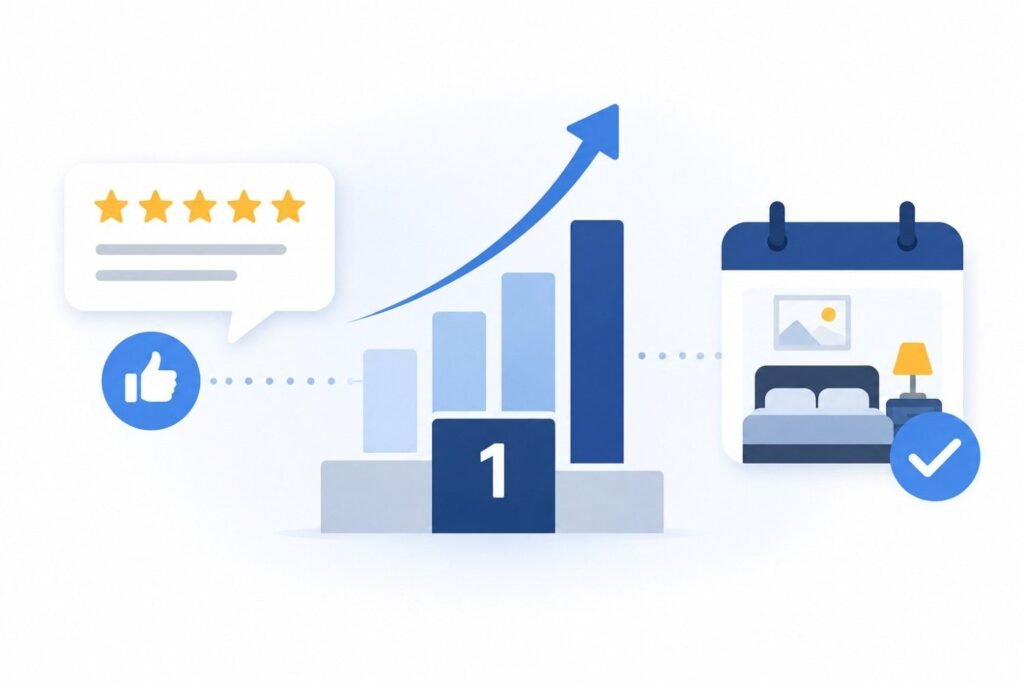
Reviews influence both your local rankings and a patient’s decision to book, making them one of the highest-leverage assets a practice has. Google treats a steady stream of positive, well-answered reviews as proof of a trustworthy practice, and patients treat them as a personal recommendation.
The practices that win at reviews follow a simple routine:
- Request a review after every positive appointment.
- Respond to every review, positive or negative, professionally.
- Address concerns calmly and publicly to show you care.
- Encourage detail, since specific reviews build more trust than generic ones.
Google, Facebook, and healthcare directories are the platforms worth focusing on. Reviews are the human signal; the next set of factors is the technical foundation that lets all of this work.
Which Technical SEO Issues Quietly Cost Dental Practices Patients?
Technical SEO problems quietly cost you patients by making your site hard for Google to crawl and slow for visitors to use. A clinic can do everything else right and still stall because of issues no one can see on the surface.
Here is the checklist every dental website should pass:
| Technical Factor | Why It Matters |
|---|---|
| Fast page speed | Slow sites lose patients before the page loads |
| Mobile-friendly design | Most dental searches happen on phones |
| HTTPS security | Builds trust and is a ranking signal |
| XML sitemap | Helps Google find and index your pages |
| Schema markup | Helps you appear in rich results and AI answers |
| Internal linking | Spreads authority and guides patients |
| Image optimization | Speeds the site and improves accessibility |
| Fixed broken links | Prevents dead ends that frustrate visitors |
These fixes rarely excite anyone, but they remove the invisible friction holding your rankings back. With a clean technical base, the final growth lever is authority and that comes from links.
How Does Link Building Strengthen a Dental Website’s Authority?
Link building strengthens your authority by earning mentions from other credible websites, which tells Google your practice is established and trustworthy. Each quality link acts like a vote of confidence that lifts your whole site.
The link sources that genuinely move the needle for dental practices include:
- Dental associations and professional bodies
- Local directories and business listings
- News and community websites in your city
- Guest posts on relevant health and local blogs
- Community organizations you sponsor or partner with
Quality matters far more than quantity here; a handful of relevant, trusted links outperforms dozens of low-value ones. With keywords, pages, local signals, reviews, technical health, and links in place, the natural question becomes how this stacks up against simply buying ads.
Should a Dental Practice Choose SEO or Google Ads?
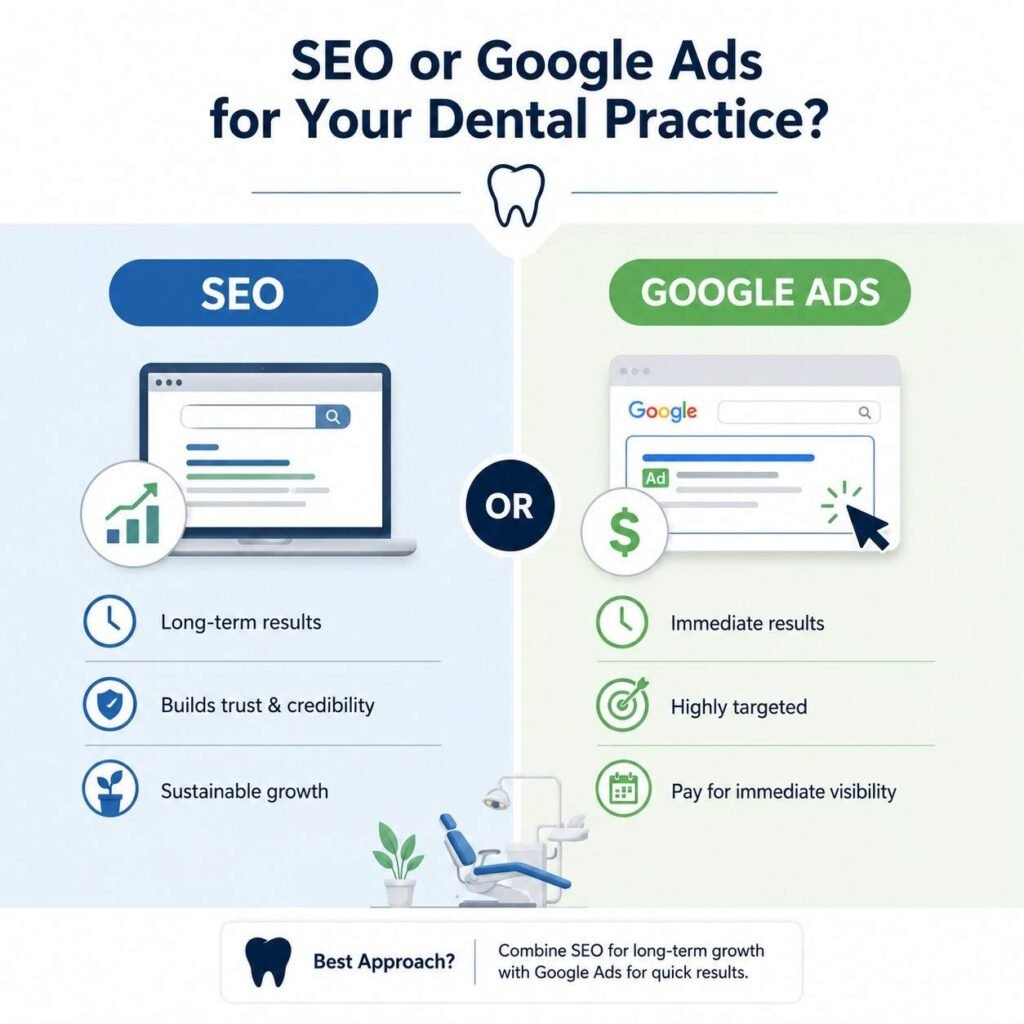
A dental practice should use SEO for sustainable, long-term growth and treat paid ads as a short-term tool for immediate visibility. They solve different problems, and the smartest practices understand the trade-off before spending a dirham.
| Factor | SEO | Google Ads |
|---|---|---|
| Speed of results | Builds over months | Immediate |
| Longevity | Keeps working over time | Stops when budget stops |
| Cost trend | Lower cost per patient over time | Ongoing, often rising |
| Authority | Builds lasting credibility | Builds none |
| Lead type | Organic, high-trust | Paid, immediate |
The honest answer is that they complement each other: ads fill the gap while SEO ramps up, and SEO eventually reduces your dependence on paid traffic. For most practices, the long-term priority should be the asset you own, your organic and local presence, because that is what keeps producing patients after the spending stops. Which raises the timing question every owner wants answered.
How Long Does Dental SEO Take, and How Do You Measure It?
Dental SEO usually takes several months to produce sustainable rankings, with early movement often visible within the first few months and stronger results compounding from there. Anyone promising overnight page-one results is misreading how Google works.
Your timeline depends on a handful of factors:
| Factor | Effect on Timeline |
|---|---|
| Local competition | More competitive cities take longer |
| Existing website quality | A weak site needs fixing first |
| Current authority | Established sites move faster |
| Content strategy | Consistent publishing speeds progress |
| Link profile strength | More authority accelerates ranking |
You measure progress not by vanity numbers but by patient outcomes. The metrics that matter are organic traffic, keyword rankings, Google Maps visibility, phone calls, form submissions, appointment requests, and conversion rate. When calls and bookings rise, your SEO is working. Knowing the timeline also helps you avoid the mistakes that reset the clock.
What Are the Most Common Dental SEO Mistakes to Avoid?
The most common dental SEO mistakes share one root cause: treating SEO as a one-time task instead of an ongoing system. These errors quietly cap a practice’s growth even when the care is excellent.
| Mistake | Impact | Fix |
|---|---|---|
| One page for all services | Ranks for nothing specific | Build a page per treatment |
| Ignoring local SEO | Invisible in map results | Optimize profile and citations |
| Slow website | Loses patients on load | Improve speed and hosting |
| Thin content | Fails to build trust | Publish helpful, detailed answers |
| Neglecting reviews | Weak local signals | Request and respond consistently |
| Targeting broad keywords only | Attracts unqualified traffic | Add location and treatment terms |
Avoiding these is often the fastest win available, because it removes the brakes before adding the accelerator. For most busy practice owners, though, managing all of this in-house is the real challenge; which is where a focused partner changes the equation.
How Can Eyes On Solution Help Your Dental Practice Grow?
Eyes On Solution helps dental practices turn search into a dependable patient pipeline by managing the full SEO system so you can focus on patient care. We build the strategy, do the work, and report on the outcomes that actually matter to your practice.
Our dental SEO work covers the areas that move rankings and bookings:
- Keyword research focused on high-intent, local patient searches
- Local SEO and Google Business Profile optimization to win the map pack
- Service and location page creation built to rank and convert
- Content writing that answers patient questions and builds trust
- Technical SEO to clear the issues holding your site back
- Link building and outreach to grow your authority
- Generative Engine Optimization so your practice appears in AI Overviews and AI assistant answers
- Transparent monthly reporting tied to calls and appointments
As a Dubai-based agency, we understand UAE search behaviour and the local market, and we build strategies that fit how patients here actually search. If your practice deserves to be found and is not, that is a fixable problem.
Dental SEO helps your practice get found by the patients already searching for the treatments you offer, then turns that visibility into booked appointments. The practices that win combine an optimized Google Business Profile, treatment and location pages, helpful content, steady reviews, a fast technical foundation, and trusted links and they treat it as an ongoing system rather than a one-time fix.
You do not have to build that system alone. If patients in your area are choosing the practice that ranks above you, the gap is fixable, and the sooner you start, the lower your cost per patient becomes.
Frequently Asked Questions
What is dental SEO?
Dental SEO is the process of optimizing a dental website, Google Business Profile, and online presence so the practice ranks higher in search results and attracts more local patients without paying for ads.
How much does dental SEO cost?
Costs vary based on your local competition, the services included, and your market size. The more meaningful number is cost per new patient, which SEO lowers over time as your rankings compound.
How long does dental SEO take to work?
Most practices see early movement within a few months and stronger, sustainable results after several months of consistent work. Competition and your starting website quality affect the pace.
Is local SEO important for dentists?
Yes. Local SEO is what makes your clinic appear in Google Maps and location-based searches, which is where most ready-to-book patients find a dentist.
Can a dental practice get patients without paid ads?
Yes. Strong SEO generates organic traffic and patient inquiries on its own, so your visibility no longer depends on an active ad budget.
Is SEO better than Google Ads for dentists?
SEO delivers long-term, lower-cost growth, while Google Ads deliver immediate but temporary visibility. Most practices benefit from leaning on SEO for sustainable growth and using ads selectively for short-term needs.
What is the most important part of dental SEO?
For local practices, a fully optimized Google Business Profile combined with consistent reviews and treatment-specific pages tends to drive the fastest, most reliable results.
Does dental SEO help my practice appear in AI search results?
Yes. Clear, well-structured answers to common patient questions help your practice appear in AI Overviews and AI assistants, which increasingly answer dental queries directly, a focus area known as Generative Engine Optimization.