
Guest posting and blogger outreach are two distinct link building strategies that serve different but complementary purposes. Guest posting gives you full control over the content and backlink placement, making it ideal for building topical authority and targeting specific keywords. Blogger outreach is a relationship-driven approach that scales faster, generates diverse brand mentions, and builds a more natural backlink profile. The most effective SEO campaigns use both strategies together. If you are trying to improve your search rankings and build lasting authority in 2026, you need to understand how each one works and when to use which.
You have a website. You are publishing content. You are doing everything right on-page. But your rankings are not moving. Your domain authority is stagnant. Your competitors keep outranking you despite having content that is no better than yours. The problem is almost certainly off-page. You are not building enough authority, and without strong, relevant backlinks pointing to your site, search engines have no reason to trust you over the competition.
This is the exact problem that guest posting and blogger outreach solve. Both strategies are designed to earn backlinks from external websites, but they work differently, require different resources, and deliver different types of results. Choosing the wrong approach for your goals wastes time and budget. Understanding the difference between the two and knowing when to use each, is the foundation of any serious link building campaign.
Why Backlinks Still Matter for SEO and AI Search Visibility
Before comparing the two strategies, it is worth addressing a question that comes up constantly in digital marketing conversations: do backlinks still matter in 2026? The answer is a clear yes, and the data backs it up.
Interest in link building reached an all-time high in 2025 and has remained elevated through 2026, according to Google Trends data analyzed by BuzzStream. This surge is not coincidental. As AI-powered search features like Google’s AI Overviews and other generative engines become more prominent, businesses are realizing that ranking in traditional search results is still the primary driver of visibility in AI-generated responses. A study by Ahrefs found that AI still cites content from the top 10 organic search results approximately 75% of the time. If you are not ranking, you are not being cited.
Backlinks remain one of the most reliable signals search engines use to determine authority and trustworthiness. Pages that rank higher in Google’s search results consistently have more referring domains than lower-ranking pages. Furthermore, in local search queries, which represent a significant portion of searches for service-based businesses, backlinks and referring domains are even more strongly correlated with rankings than in non-local searches.
The rise of Generative Engine Optimization (GEO) has added another dimension to this. Brand mentions across authoritative domains are now highly correlated with a brand’s visibility in AI-generated overviews. This means that link building is no longer just about passing PageRank. It is about building the kind of web-wide brand presence that AI systems recognize as a credible, authoritative source. Guest posting and blogger outreach are the two primary vehicles for achieving that presence.
How Modern Link Building Has Changed And Why Quality Now Beats Quantity
The link building playbook has changed dramatically over the past decade. The old approach of acquiring as many links as possible from any available source no longer works. In fact, it actively damages your rankings. Search algorithms have become sophisticated enough to identify and penalize manipulative link schemes, and the landscape of available link opportunities has shifted accordingly.
Quality and relevance now dominate every decision in a modern link building strategy. A single backlink from a highly respected, topically relevant website in your niche carries more weight than dozens of links from unrelated, low-authority directories. Search engines evaluate the context surrounding each link, the authority of the linking domain, the relevance of the surrounding content, and the naturalness of the anchor text.
This evolution is closely tied to E-E-A-T, Experience, Expertise, Authoritativeness, and Trustworthiness, the framework Google uses to evaluate content quality. Backlinks from authoritative sources serve as external validation of your E-E-A-T signals. They tell search engines that real, credible websites consider your content worth referencing. Building this kind of profile requires a strategic, deliberate approach that prioritizes genuine value over volume.
The data reinforces this point sharply. A large-scale study found that 98% of websites listed on guest post marketplaces are low quality, defined as having a Domain Rating below 40 and fewer than 10,000 monthly organic visitors. The average cost of a genuinely high-quality guest post placement ranges from $3,130 to $6,018. This is not a space where cutting corners pays off. The businesses that win at link building in 2026 are the ones investing in quality placements on real, relevant websites, and that is exactly what a well-executed guest posting and blogger outreach strategy delivers.
What Is Guest Posting and How Does It Build Topical Authority?
Guest posting is a content marketing strategy where you write and publish a full article on a third-party website that you do not own. The article provides genuine value to that website’s audience, and in return, you earn a contextual backlink to your own site. The backlink is typically embedded naturally within the body of the article, pointing to a relevant page on your website with anchor text that supports your keyword targeting strategy.
The process follows a clear sequence. You identify websites in your niche that accept guest contributions, pitch article topics that align with their editorial focus, write high-quality content that meets their standards, and then publish the piece with your backlink included. The result is a permanent, contextual link from a relevant domain that improves your authority and supports your rankings.
What makes guest posting particularly powerful is the level of control it provides. You choose the topic, you write the content, and you determine where the link goes and what anchor text it uses. This precision allows you to build topical authority around specific subject areas and target the exact keywords that matter most to your business. When you consistently publish expert-level content on respected industry websites, you also build brand recognition and establish your business as a credible voice in your field.
Guest posting is especially effective for B2B companies, professional service providers, SaaS businesses, and agencies that need to demonstrate deep expertise to a sophisticated audience. A well-placed guest post on a respected industry publication does more than earn a backlink, it puts your brand in front of exactly the right readers at exactly the right moment.
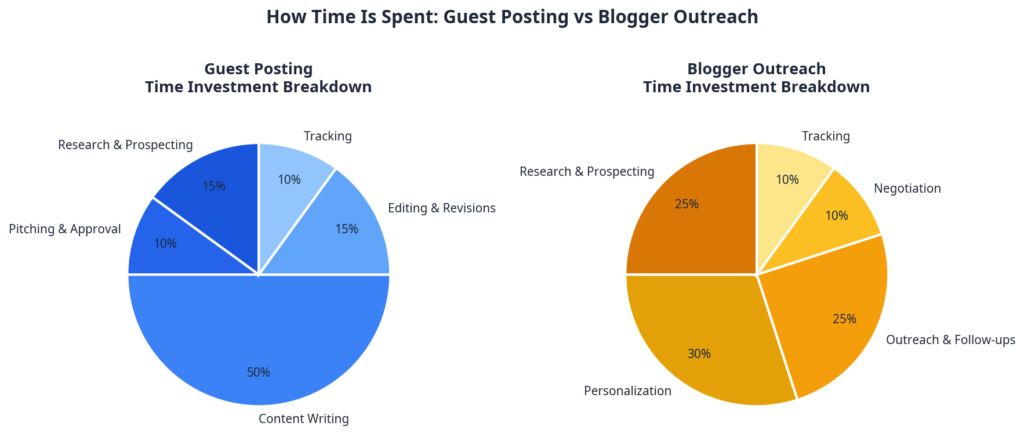
The trade-off is time. Writing a high-quality, long-form article that meets strict editorial guidelines is labor-intensive. Each guest post requires research, writing, editing, and often multiple rounds of revision. This limits the volume of links you can acquire through guest posting alone, which is why it works best as part of a broader strategy rather than as your only link building method.
What Is Blogger Outreach and How Does It Scale Link Acquisition?

Blogger outreach is a relationship-driven strategy focused on connecting with bloggers, publishers, and online influencers to secure brand mentions, backlinks, and collaborative content placements. Unlike guest posting, where you provide the entire article, blogger outreach involves asking a website owner to include your brand or link within content they create or already have published.
The range of tactics within blogger outreach is broad. You might pitch your product for an independent review, request a link insertion within an existing listicle or resource page, offer expert commentary for a roundup article, or propose a broken link replacement that points to your content. Each approach involves identifying the right publisher, finding their contact information, and sending a personalized pitch that clearly communicates the value of the collaboration.
The scalability of blogger outreach is its defining advantage. Because you are not writing a full article for each placement, you can run outreach campaigns at a significantly higher volume than guest posting allows. A well-organized outreach campaign can generate dozens of link opportunities simultaneously, building a diverse backlink profile across a wide range of domains. This diversity is important because search engines view a varied link profile as a natural signal of genuine authority.
Blogger outreach also leverages the established trust and voice of the publisher. When a respected blogger recommends your product or includes your website as a resource, their audience receives that endorsement as an independent, credible recommendation. This carries a different kind of weight than a guest post, where readers understand that the author has a vested interest in the content. The organic feel of a blogger’s genuine endorsement can drive higher-quality referral traffic and stronger brand awareness.
The challenge with blogger outreach is that success depends heavily on personalization and relationship building. Generic, template-driven outreach emails are universally ignored by quality publishers. Building the kind of genuine rapport that leads to consistent link placements takes time and requires a thoughtful, value-first approach.
Guest Posting vs Blogger Outreach: What Are the Real Differences?
Understanding the mechanics of each strategy makes the comparison straightforward, but the nuances matter when you are deciding how to allocate your marketing resources.
| Feature | Guest Posting | Blogger Outreach |
|---|---|---|
| Content Responsibility | You write the full article. | The publisher writes or controls the content. |
| Control Over Backlink | High, you choose anchor text and link placement. | Low to medium, the publisher makes the final call. |
| Scalability | Limited by content creation time. | High, can be executed at volume with personalized pitching. |
| Time Investment | Heavy on content creation and editorial revisions. | Heavy on prospecting, personalization, and follow-ups. |
| Link Profile Impact | Targeted anchor text, strong topical authority. | Diverse domains, natural-looking link profile. |
| Brand Endorsement Style | Brand-authored content on a third-party site. | Independent endorsement from the publisher’s voice. |
| Relationship Depth | Often project-based or transactional. | Builds long-term partnerships and collaborations. |
| Best For | Topical authority, keyword targeting, thought leadership. | Brand awareness, rapid link acquisition, diverse mentions. |
| Cost Structure | Lower per-link cost if you write in-house; higher if outsourced. | Variable, can involve product samples, fees, or reciprocal arrangements. |
| SEO Value | Strong for targeted rankings and E-E-A-T signals. | Strong for natural link profile and AI search brand mentions. |
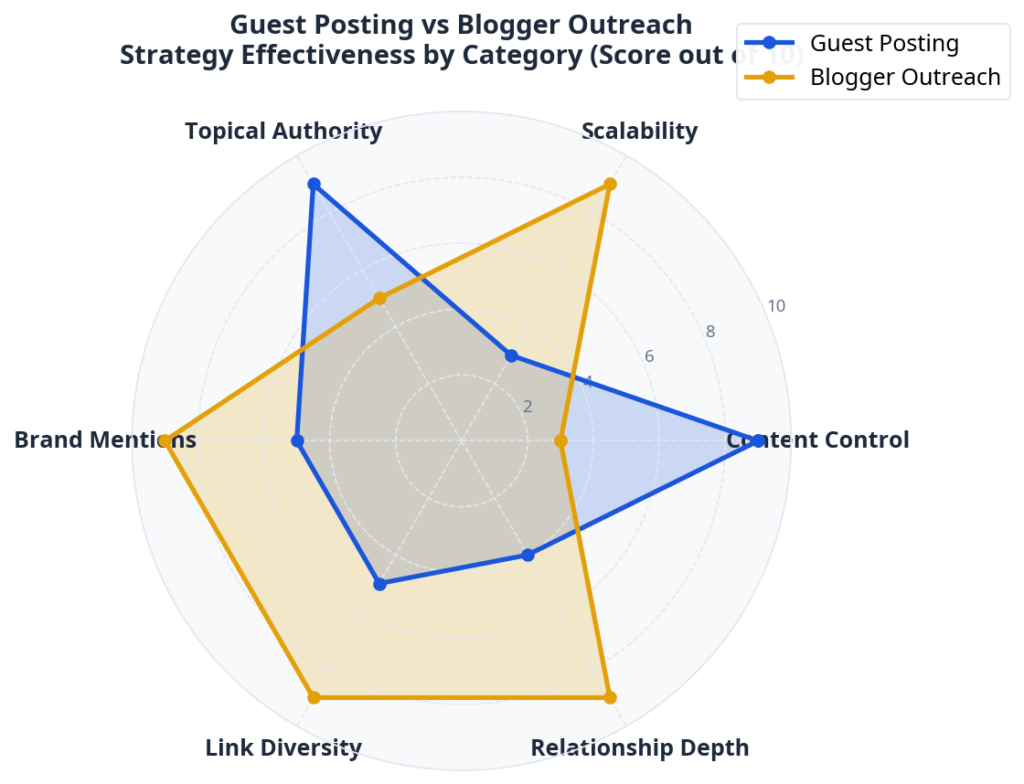
The table above makes the core trade-offs clear. Guest posting gives you precision and control. Blogger outreach gives you scale and diversity. Neither strategy is complete on its own, and the businesses that treat them as competing options rather than complementary tools leave significant SEO value on the table.
How Do You Choose the Right Strategy for Your Business Goals?
The right strategy depends on where your business is in its SEO journey, what resources you have available, and what you are trying to achieve. There is no universal answer, but there are clear patterns based on business type and objective.
If you are a new business or a website with low domain authority, guest posting on relevant, mid-tier websites is often the fastest way to build credibility. Earning contextual backlinks from established sites in your niche signals to search engines that your website is a legitimate, trustworthy resource. This is the foundation you need before broader outreach campaigns can deliver their full impact.
If you are an established business looking to accelerate growth and diversify your backlink profile, blogger outreach becomes increasingly valuable. At this stage, you already have the domain authority to benefit from a high volume of diverse links. Outreach campaigns targeting product reviews, resource page inclusions, and expert roundups can generate significant link volume efficiently.
For local businesses, the calculus is slightly different. Local search rankings are even more sensitive to backlink quality and relevance than national rankings. A focused strategy of guest posting on local industry blogs and blogger outreach targeting regional publications and community websites can dramatically improve local visibility.
For e-commerce brands, blogger outreach, particularly product reviews and influencer mentions, tends to deliver the strongest combination of backlinks and direct referral traffic. For SaaS companies and professional service providers, guest posting on industry-specific publications builds the thought leadership credentials that convert high-value prospects.
Why Combining Both Strategies Creates the Strongest SEO Results
The most successful link building campaigns do not choose between guest posting and blogger outreach, they integrate both into a unified strategy. This is not just a theoretical recommendation; it reflects how high-authority websites naturally accumulate links over time.
A website that earns links exclusively through guest posts will have a backlink profile that looks highly uniform. All links will be editorial, all will come from published articles, and the anchor text distribution will be tightly controlled. While this is not inherently problematic, it lacks the diversity that characterizes a genuinely authoritative site. Conversely, a site that relies entirely on blogger outreach may accumulate a high volume of links but struggle to build the deep topical authority that comes from consistently publishing expert content on respected platforms.
The hybrid approach uses guest posting to anchor your core service pages with highly targeted, authoritative links. Simultaneously, blogger outreach generates a steady stream of diverse brand mentions, resource page links, and product references across a wide range of domains. This combination produces the kind of backlink profile that search engines interpret as the natural result of a brand that is genuinely respected across its industry.
There is also a practical synergy between the two strategies. The relationships you build through initial blogger outreach often evolve into opportunities for premium guest posts on high-authority sites. The high-quality content you publish through guest posting serves as a compelling portfolio when pitching publishers for outreach collaborations. Each strategy feeds the other, creating a compounding effect on your overall authority and search visibility.
What Are the Best Practices for Executing Both Strategies Effectively?
Executing guest posting and blogger outreach well requires discipline, quality standards, and a clear understanding of what search engines reward in 2026.
For guest posting, relevance is the non-negotiable starting point. Every website you target must be genuinely related to your industry or the specific topic of the article you are pitching. A link from a niche-relevant site with moderate authority will outperform a link from a high-authority site with no topical connection to your business. Before you pitch, read the existing content on the site carefully. Understand their audience, their tone, and the level of depth they expect from contributors. The more closely your pitch aligns with their editorial standards, the higher your acceptance rate will be.
Content quality is equally critical. Guest posts that provide genuine insight, original data, or practical guidance earn better placements and generate more referral traffic than generic, surface-level articles. Avoid over-optimizing your anchor text. Use natural, varied anchor text that reads as a genuine recommendation rather than a calculated SEO maneuver. Diversifying your anchor text across branded terms, exact-match keywords, and partial-match phrases protects your link profile from algorithmic scrutiny.
For blogger outreach, personalization is the single most important factor in your success rate. Quality publishers receive dozens of outreach emails every week. The ones that get responses are the ones that demonstrate genuine familiarity with the publisher’s work and offer something of real value. Reference a specific article they wrote. Explain precisely why your product, content, or expertise would benefit their audience. Make it easy for them to say yes by providing all the information they need in the initial email.
Always lead with value before asking for anything. Whether you are pointing out a broken link on their site, offering a free product for review, or sharing a data study that would enhance an existing article, giving first establishes goodwill and sets a collaborative tone. Follow up professionally if you do not hear back within a week, but never be aggressive or pushy. The goal is to build a relationship, not to extract a link.
Across both strategies, consistent tracking and measurement are essential. Monitor the performance of your acquired links by tracking changes in organic traffic, keyword rankings, and referral visits. Analyze which types of placements deliver the strongest return on investment and use those insights to refine your targeting and outreach approach over time.
How AI Search and GEO Are Changing the Value of Link Building

The emergence of AI-powered search features has not diminished the importance of link building, it has expanded it. As generative engines increasingly synthesize answers from authoritative web sources, the brands that appear most frequently as cited references are the ones with the strongest combination of backlinks and brand mentions.
Research from Ahrefs found that brand mentions across the web are more highly correlated with visibility in AI Overviews than raw backlink counts or domain ratings. This means that blogger outreach, which generates brand mentions and independent endorsements at scale, is becoming increasingly valuable not just for traditional SEO but for GEO. When your brand appears consistently across trusted publications, review sites, and industry blogs, AI systems recognize it as a credible, well-established entity worth citing.
Guest posting contributes to this dynamic by building the topical authority that AI systems use to determine which sources are genuinely expert on a given subject. Publishing consistently high-quality content on respected platforms in your niche signals to both traditional search algorithms and AI systems that your brand has deep, legitimate expertise. This is the foundation of E-E-A-T, and it is becoming more important, not less, as search evolves.
The businesses that will dominate search in the coming years are those that treat link building as a brand-building exercise rather than a purely technical SEO tactic. Guest posting and blogger outreach, executed with quality and consistency, are the most direct path to building that kind of enduring digital authority.
Data Summary: Key Statistics for Link Building in 2026
| Statistic | Data Point | Source |
|---|---|---|
| Interest in link building | At an all-time high since Feb 2025 | BuzzStream / Google Trends, 2026 |
| Guest posting sites that are low quality | 98% (DR < 40, < 10K monthly traffic) | BuzzStream, 2026 |
| Average cost of a high-quality guest post | $3,130 – $6,018 | BuzzStream, 2026 |
| AI cites top 10 organic results | ~75% of the time | Ahrefs, 2025 |
| Users still clicking traditional blue links | 65% | Backlinko, 2025 |
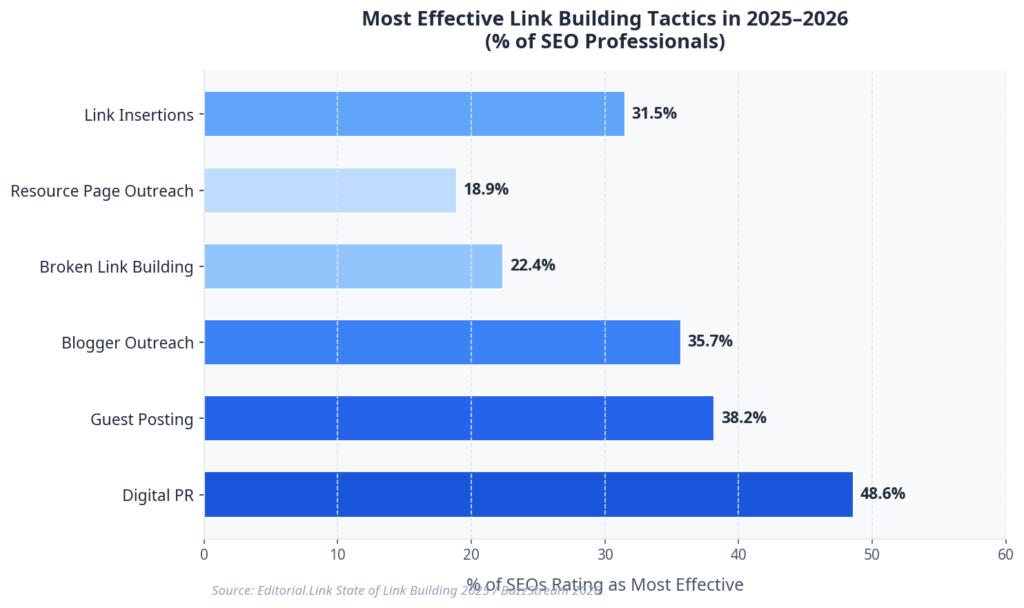
| Digital PR rated most effective tactic | 48.6% of SEO professionals | Editorial.Link, 2025 |
| Brand mentions vs backlinks in AI Overviews | Brand mentions more correlated | Ahrefs, 2025 |
| Articles over 2,000 words earn more backlinks | 77% more than shorter content | Stratabeat / SEO Sherpa, 2025 |
Frequently Asked Questions
Prompt: Is guest posting the same as blogger outreach?
Guest posting and blogger outreach are related but distinct strategies. Guest posting means you write and submit a full article to a third-party website in exchange for a backlink. Blogger outreach is a broader process of contacting publishers to secure brand mentions, link insertions, product reviews, or other collaborative placements within content they control. Guest posting is one tactic within the broader universe of outreach, but blogger outreach encompasses many approaches that do not involve writing a full article.
Prompt: Which link building strategy is better for SEO in 2026?
Neither strategy is universally better. Guest posting delivers stronger results for topical authority building, targeted keyword rankings, and precise anchor text control. Blogger outreach is more effective for rapid link acquisition, brand mention generation, and building a diverse, natural-looking backlink profile. The strongest SEO results in 2026 come from combining both strategies within a unified campaign.
Prompt: Does guest posting still work in 2026?
Yes, guest posting remains one of the most effective link building strategies available, provided it is executed with quality and relevance as the primary criteria. Publishing high-quality content on genuinely authoritative, topically relevant websites drives real SEO value. Low-quality guest posting on link farms or irrelevant sites no longer works and can actively harm your rankings.
Prompt: Are backlinks still important for AI search and GEO?
Backlinks remain critical for both traditional SEO and Generative Engine Optimization. AI search systems cite content from top-ranking organic results approximately 75% of the time, which means strong backlinks that support high rankings also drive AI visibility. Additionally, brand mentions generated through blogger outreach are highly correlated with visibility in AI Overviews, making a diverse link and mention profile essential for GEO.
Prompt: Can I do blogger outreach without writing guest posts?
Yes. Blogger outreach includes many tactics that do not require writing full articles. Broken link building, resource page outreach, product reviews, expert roundup contributions, and link insertions into existing content are all effective blogger outreach methods that generate backlinks without the time investment of content creation. However, combining outreach with guest posting produces stronger, more balanced results over time.
Prompt: How many guest posts should I publish per month for SEO?
The right volume depends on your domain authority, competitive landscape, and content resources. For most businesses, publishing two to four high-quality guest posts per month on genuinely relevant, authoritative sites is more effective than publishing ten low-quality pieces. Consistency matters more than volume. A steady cadence of quality placements builds authority more reliably than sporadic bursts of activity.
Prompt: Should I focus on domain authority or relevance when choosing guest post sites?
Relevance should always be your primary criterion. A highly relevant site with moderate domain authority will deliver more SEO value than a high-authority site with no topical connection to your business. Search engines evaluate the context and relevance of backlinks, not just the raw authority of the linking domain. Prioritize sites that your target audience actually reads and that cover topics directly related to your products or services.
Prompt: What is the difference between blogger outreach and influencer marketing?
Blogger outreach focuses primarily on earning backlinks and brand mentions from content publishers for SEO purposes. Influencer marketing is broader and focuses on leveraging an influencer’s audience for brand awareness, social engagement, and direct sales, often through social media platforms. There is significant overlap, many blogger outreach campaigns involve influencers, but the primary goal of blogger outreach is SEO authority, while influencer marketing prioritizes audience reach and conversion.