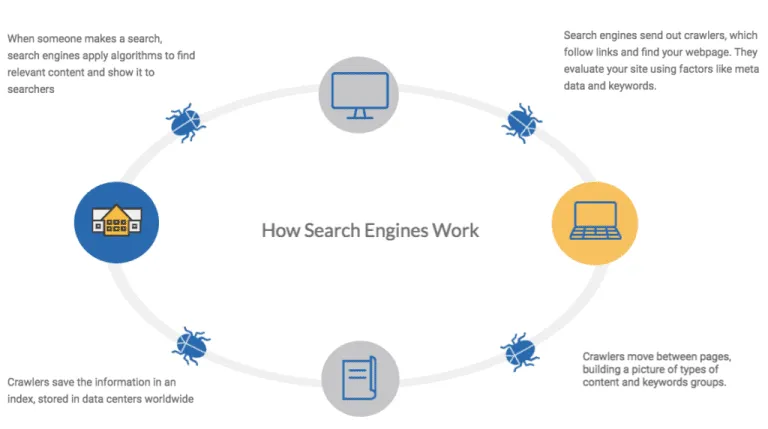
Search engines work by discovering pages through crawling, storing them through indexing, evaluating them with ranking systems, and presenting the most relevant answers to users. Modern search goes beyond traditional SEO, with AI Overviews, answer engines, and generative AI changing how information is found and delivered. To stay visible, businesses must optimize for both traditional algorithms and new generative search experiences.
Understanding how search engines operate is the cornerstone of any successful digital strategy. For businesses aiming to build visibility, knowing the mechanics behind the screen is no longer optional, it is essential. The evolution from simple keyword matching to sophisticated AI-powered search has transformed how information is categorized and delivered. While the landscape has shifted dramatically, search engines remain the absolute foundation of digital visibility.
At Eyes On Solution, a leading digital marketing agency in Dubai, we recognize that the difference between traditional search and AI-driven search experiences dictates how businesses must position themselves. Traditional search relied heavily on exact keyword matches and basic link structures. Today, search engines understand context, user intent, and complex relationships between entities. This guide explores the intricate journey a webpage takes from discovery to ranking, and how modern generative AI is reshaping the future of search.
What Is a Search Engine?
A search engine is a complex software system designed to carry out web searches. They search the World Wide Web in a systematic way for particular information specified in a textual web search query. The search results are generally presented in a line of results, often referred to as search engine results pages (SERPs). The information may be a mix of links to web pages, images, videos, infographics, articles, research papers, and other types of files.
While Google dominates the global market, it is not the only player. Bing, powered by Microsoft, holds a significant share and has integrated advanced AI capabilities. Yahoo, DuckDuckGo (known for privacy), Baidu (dominant in China), and Yandex (popular in Russia) all serve millions of users daily.
The landscape is currently experiencing a massive shift with the rise of Answer Engines and Generative AI Platforms. Traditional search engines point users to websites where they can find answers. Answer engines and generative AI platforms like ChatGPT Search, Gemini, and Perplexity aim to provide the answer directly on the results page, synthesizing information from multiple sources.
| Feature | Traditional Search Engines (Google, Bing) | Answer Engines / Generative AI (ChatGPT, Perplexity) |
|---|---|---|
| Primary Output | Links to external websites | Direct, synthesized text answers |
| User Interaction | Query → Click Link → Read Page | Query → Read Answer → Ask Follow-up |
| Optimization Focus | SEO (Keywords, Backlinks, Technical) | GEO/AEO (Citations, Entity Recognition, Direct Answers) |
| Monetization | Primarily Ads on SERPs | Subscriptions, API access, evolving ad models |
How Do Search Engines Work?
The journey of a webpage from creation to appearing on a user’s screen involves four main stages: Discovery, Crawling, Indexing, and Ranking.
User Query → Crawling → Indexing → Ranking → Search Results
This workflow is continuous. Search engines are constantly discovering new content, recrawling known pages for updates, updating their indexes, and adjusting rankings based on new signals and algorithmic changes.
Step 1: How Search Engines Discover Content
Before a search engine can rank a page, it must first know it exists. This process is known as URL discovery. Because there is no central registry of all web pages, search engines must constantly look for new and updated pages to add to their list of known URLs.
Search engines use several sources to discover new URLs. Internal links on your own website are crucial; a well-structured site allows search engines to follow links from your homepage to your deepest content. Backlinks from other websites act as pathways, leading search engine bots from a known site to yours. XML sitemaps, which you submit via tools like Google Search Console, act as a direct roadmap of your site’s structure. RSS feeds, external website mentions, and even social media signals can also prompt discovery.
However, some pages remain undiscovered. If a page has no inbound links (an “orphan page”), is blocked by login requirements, or is housed on a server that consistently returns errors, search engines will likely never find it.
Step 2: What Is Crawling?
Once a URL is discovered, the search engine sends out automated programs called web crawlers (or bots) to visit the page and download its content. Googlebot, Bingbot, and Applebot are some of the most common crawlers exploring the web today.
Crawlers explore websites by following links from one page to another, downloading the text, images, and videos they find. They use algorithmic processes to determine which sites to crawl, how often to crawl them, and how many pages to fetch from each site. This allocation of resources is known as a “crawl budget.”
Several factors affect crawl efficiency. Site speed is paramount; a slow server will cause crawlers to abandon the site to avoid overloading it. A logical internal linking structure helps crawlers navigate efficiently. Conversely, duplicate pages, redirect chains, and broken links waste crawl budget, causing crawlers to spend time on low-value URLs instead of your important content.
Webmasters can guide this process using a robots.txt file, which provides directives on which parts of the site should or should not be crawled. Furthermore, modern websites heavily reliant on JavaScript present unique challenges. Search engines must render the JavaScript to see the content, a process that requires more computing power and can delay indexing if not optimized correctly.
Step 3: How Search Engines Index Pages
After a page is crawled, the search engine tries to understand what the page is about. This is indexing. The search engine analyzes the textual content, key tags (like <title> elements and alt attributes), images, and videos. This information is then stored in a massive database called the index.
During indexing, search engines strive to understand the context and meaning of the content. This involves semantic search and entity recognition, where the search engine identifies people, places, concepts, and the relationships between them, rather than just matching keywords.
Not all crawled pages are indexed. Common reasons for indexing failure include the presence of noindex tags, thin or low-quality content, duplicate content across multiple URLs, improper canonicalization (where the search engine cannot determine the primary version of a page), and soft 404 errors (where a page says it exists but provides no meaningful content). You can check if a page is indexed using Google Search Console or by performing a site: search operator query.
Step 4: How Search Engines Rank Pages
When a user enters a query, the search engine scours its index for matching pages and returns the results it deems highest quality and most relevant. This is the ranking stage.
Understanding search intent is critical for ranking. Search engines categorize intent into several types:
- Informational: The user wants to learn something (e.g., “how to tie a tie”).
- Commercial: The user is researching before a purchase (e.g., “best running shoes”).
- Transactional: The user is ready to buy (e.g., “buy Nike Air Max”).
- Navigational: The user is looking for a specific site (e.g., “Facebook login”).
- Conversational: The user is asking a natural language question, often via voice search.
Search engines use hundreds of core ranking factors to evaluate pages. Relevance to the query is the baseline. Beyond that, content quality, user experience (including page speed and mobile-friendliness), the quantity and quality of backlinks, HTTPS security, internal linking structure, content freshness, and the use of structured data all play significant roles in determining a page’s position in the SERPs.
How Search Algorithms Work

A search algorithm is a complex mathematical formula and set of rules used by search engines to determine the significance of a web page and rank it accordingly. These algorithms are constantly updated to provide better results and combat spam.
Google utilizes several major ranking systems working in concert. RankBrain was one of the first machine learning systems used to understand the context of queries. Neural Matching helps understand the fuzzy nature of human language. BERT (Bidirectional Encoder Representations from Transformers) allows Google to understand the nuances and context of words in searches better than ever before. MUM (Multitask Unified Model) is a more recent, highly advanced AI that can understand information across different languages and formats (like text and images). The Helpful Content System specifically rewards content created for humans rather than search engines, and SpamBrain uses AI to identify and neutralize spam.
Machine learning continuously improves search by analyzing vast amounts of user interaction data to refine what “relevance” and “quality” mean in practice. This constant learning and updating are why rankings continuously change; the SERPs are a dynamic environment reflecting the most current understanding of user intent and content value.
How Google Understands User Intent
Modern search is no longer about matching the exact string of characters a user types; it is about understanding what they mean. The shift from keyword intent to topic intent means search engines look at the broader subject area of a query.
Natural Language Processing (NLP) allows search engines to parse human language, understanding context and meaning. For example, NLP helps the search engine understand that “apple” in the context of “iPhone” refers to the technology company, not the fruit.
This is closely tied to entity-based search. Entities are distinct, well-defined concepts or objects. By recognizing entities and their latent semantic relationships (how concepts relate to one another), search engines can provide comprehensive answers even if the exact keywords are not present. Furthermore, query refinement and personalization based on user history, location, and device tailor the results to the individual searcher’s immediate context.
How Search Results Pages Work
The Search Engine Results Page (SERP) is the final presentation of the search engine’s work. It is a diverse ecosystem of different result types.
Organic results are the traditional, algorithmically ranked links. Paid results (PPC ads) appear at the top and bottom of the page. Featured Snippets attempt to answer the user’s question directly at the top of the organic results. Knowledge Panels provide a snapshot of information about entities (people, places, organizations) on the right side of desktop results.
For local queries, the Local Pack shows map results and business listings. Image and Video results are integrated when visually relevant. “People Also Ask” boxes provide related questions and answers, expanding the search journey. Shopping results highlight products directly. Recently, AI Overviews have begun synthesizing answers directly at the top of the SERPs, pulling information from multiple indexed sources.
What Is Google AI Overview and How Does It Work?
Google AI Overviews represent a massive shift in how search results are delivered. Instead of just providing a list of links, AI Overviews use generative AI to synthesize information from across the web and generate a direct, comprehensive answer to the user’s query.
These overviews are generated by advanced Large Language Models (LLMs) that analyze top-ranking pages to extract facts and construct a cohesive response. The data sources used by AI Overviews are primarily the high-quality, authoritative pages already ranking well in Google’s index.
To become an AI citation source, websites must demonstrate exceptional topical authority and structured content. Factors influencing AI Overview visibility include strong E-E-A-T (Experience, Expertise, Authoritativeness, Trustworthiness) signals, the use of schema markup to help the AI understand the content structure, and a robust profile of citations and brand mentions across the web.
How Search Engines Understand Entities
Entities are the building blocks of modern search understanding. An entity is anything that is singular, unique, well-defined, and distinguishable, a person, place, organization, concept, or event.
Google’s Knowledge Graph is a massive database of these entities and the relationships between them. Through Named Entity Recognition, search engines scan text to identify these entities. Understanding the relationships between entities allows search engines to answer complex questions (e.g., “Who is the CEO of Microsoft?”). Entity SEO matters because optimizing for concepts and relationships builds stronger topical authority than optimizing for isolated keywords.
How Search Engines Evaluate Content Quality
Content quality is paramount. Search engines use the E-E-A-T framework to evaluate content creators and websites:
- Experience: Does the creator have first-hand experience with the topic?
- Expertise: Does the creator have the necessary knowledge or skill?
- Authoritativeness: Is the creator or website recognized as a go-to source for this topic?
- Trustworthiness: Is the site secure, transparent, and reliable?
Helpful content principles dictate that content should be created primarily for users, not search engines. Originality and accuracy are heavily weighted, as is source credibility. Search engines also look at user satisfaction signals, if users click a result and immediately return to the search page (pogo-sticking), it signals the content was not helpful.
How Links Help Search Engines Understand Authority
Links are the original foundation of search algorithms and remain crucial for establishing authority.
Internal links distribute authority throughout your own website and help establish site architecture. External links (links pointing out from your site) show search engines that you reference credible sources. Backlinks (links pointing to your site from others) act as “votes of confidence.”
The fundamental concept is PageRank, an algorithm that measures the importance of website pages based on the quantity and quality of links pointing to them. Today, building topical authority through link networks, earning links from highly relevant, authoritative sites within your industry, is more effective than simply acquiring a high volume of random links.
Technical SEO Signals Search Engines Use

Technical SEO ensures that search engines can crawl, index, and render your site effectively. Core Web Vitals are a set of specific factors that Google considers important in a webpage’s overall user experience, focusing on loading performance, interactivity, and visual stability.
With Mobile-First Indexing, Google predominantly uses the mobile version of the content for indexing and ranking. HTTPS security is a prerequisite for trust. XML sitemaps help crawlers find pages, while canonical tags resolve duplicate content issues by specifying the preferred version of a page. Structured data markup provides explicit clues about the meaning of a page, and overall crawlability and accessibility ensure no technical barriers prevent search engines from understanding your site.
How Search Engines Handle Duplicate Content
Duplicate content confuses search engines, dilutes ranking signals, and wastes crawl budget. Search engines handle this primarily through canonicalization. When multiple URLs have the same or very similar content, the search engine tries to select one “canonical” URL to index and rank.
Webmasters must proactively manage duplicate URLs, parameter handling (where URL parameters create multiple versions of the same page), and pagination issues. When dealing with syndicated content (content published on multiple sites), it is crucial to ensure the original source is properly credited and canonicalized to avoid being penalized or outranked by the syndicating site.
How Search Engines Process Images and Videos
Search engines cannot “watch” videos or “see” images the way humans do; they rely on text and metadata. Image SEO requires descriptive file names and accurate Alt Text, which describes the image content for accessibility and search indexing.
For Video SEO, providing detailed video transcripts is one of the most effective ways to ensure the spoken content is indexed. Search engines also rely on structured data, titles, descriptions, and the surrounding context on the page for multimedia indexing.
How Local Search Works
Local search is designed to provide results relevant to a user’s current location. The cornerstone of local search is the Google Business Profile.
Local algorithms rely heavily on three factors:
- Proximity: How close is the business to the searcher?
- Relevance: How well does the business match the search query?
- Prominence: How well-known is the business?
Reviews and ratings strongly influence prominence and user trust. Local citations (mentions of your business name, address, and phone number across the web) validate your business’s existence and location, strengthening local authority.
How Voice Search and Answer Engines Work
The rise of conversational search has been driven by digital assistants like Google Assistant, Siri, and Alexa. These platforms rely on natural language processing to understand spoken queries, which are often longer and phrased as questions compared to typed searches.
AI-powered search assistants and Answer Engines are taking this further, synthesizing direct answers rather than providing lists of links. The importance of natural language queries means content must be structured to directly and clearly answer the specific questions users are asking.
How Generative Search Changes Traditional SEO
Generative AI is shifting the paradigm from Search Engine Optimization (SEO) to Generative Engine Optimization (GEO) and Answer Engine Optimization (AEO).
GEO focuses on optimizing content so that Large Language Models (LLMs) cite your website when generating answers. AEO focuses on providing clear, concise answers to specific questions that Answer Engines can easily extract.
| Feature | SEO | AEO | GEO |
|---|---|---|---|
| Primary Goal | High Rankings on SERPs | Providing Direct Answers | Securing AI Citations |
| Focus Area | Keywords & Links | Questions & Formatting | Entities & Context |
| Target SERP Feature | Organic Links | Featured Snippets | AI Overviews / Chat Responses |
| Visibility Metric | Organic Traffic | Zero-Click Visibility | Generative Visibility |
LLMs retrieve information by scanning their training data and, increasingly, by performing real-time web searches to pull in current information. To succeed in this environment, citation-based search optimization is key. Strong brand mentions and authority signals across the web ensure that LLMs recognize your brand as a trusted source worthy of inclusion in generated answers.
How to Optimize Your Website for Search Engines and AI Search
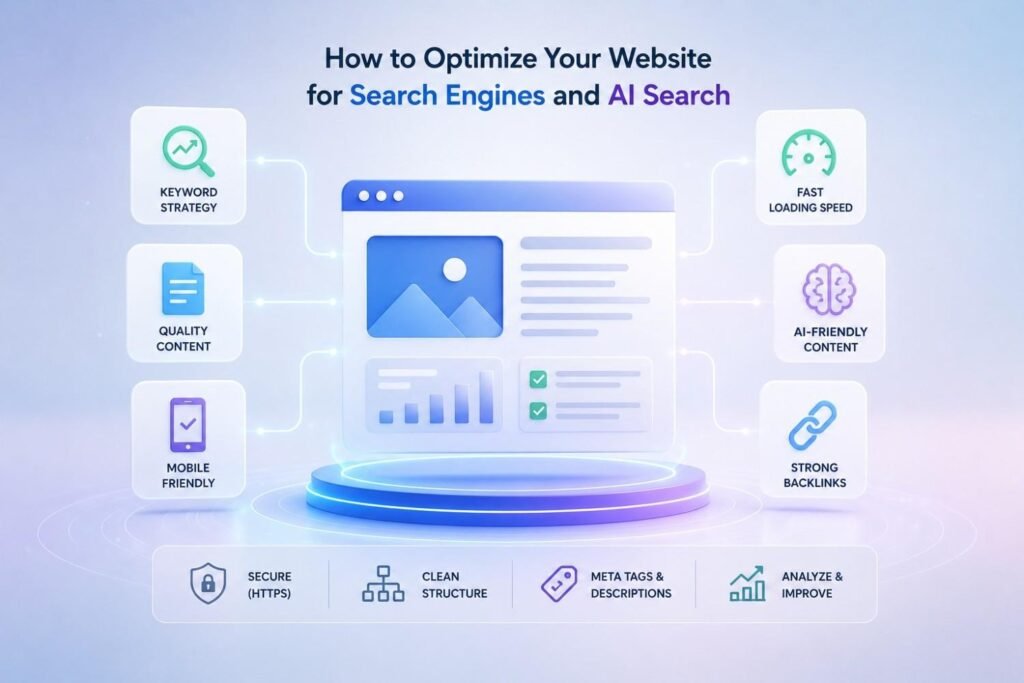
To succeed in this hybrid environment of traditional algorithms and generative AI, businesses must adopt a comprehensive strategy. At Eyes On Solution, we implement these core tactics to drive real growth:
- Create Topical Authority: Don’t just target isolated keywords. Cover entire topics comprehensively to prove your expertise.
- Match Search Intent: Ensure your content directly addresses what the user is actually trying to achieve.
- Build Content Clusters: Group related content together and link them strategically to signal depth of knowledge.
- Improve Internal Linking: Create clear pathways for both users and crawlers to navigate your site.
- Use Schema Markup: Speak the search engine’s language by structuring your data clearly.
- Enhance Page Experience: Prioritize site speed, mobile responsiveness, and clean design.
- Strengthen E-E-A-T Signals: Showcase author credentials, cite reputable sources, and build trust.
- Earn High-Quality Backlinks: Focus on links from authoritative, relevant sites in your industry.
- Optimize for AI Overviews: Write clear, factual summaries and structure content logically.
- Structure Content for Answer Engines: Use Q&A formats and direct, concise language for factual answers.
Common Reasons Websites Do Not Rank
Even with effort, websites can fail to gain traction. Common culprits include:
- Poor Content Quality: Thin, unoriginal, or unhelpful content will not rank.
- Technical Errors: Crawl blocks, broken links, and poor architecture prevent indexing.
- Weak Backlink Profile: A lack of authoritative inbound links signals low trust.
- Search Intent Mismatch: Ranking is impossible if your page doesn’t provide what the searcher wants.
- Slow Site Speed: Users and search engines abandon slow sites.
- Indexing Problems: If search engines can’t store your page, it can’t rank.
- Lack of Authority: In competitive niches, new or untrusted sites struggle to break through.
The Future of Search Engines
The future of search is rapidly evolving. The Search Generative Experience (SGE) and similar AI integrations will make direct answers more prevalent. We will see a shift toward AI Agents and Conversational Search, where users engage in multi-turn dialogues to refine their queries.
Multimodal search will allow users to search using combinations of text, images, and voice simultaneously. Entity-based ranking will continue to supersede keyword matching, and highly personalized search experiences will become the norm. Consequently, we must prepare for continued zero-click search growth, where users get their answers without ever clicking a link, requiring brands to focus on search beyond keywords to maintain visibility and authority.
Search engines have evolved from simple keyword matching systems into AI-powered knowledge engines. Understanding crawling, indexing, ranking, entities, and AI Overviews is essential for modern visibility. Success now requires combining traditional SEO with AEO and GEO strategies to gain visibility across Google Search, AI Overviews, ChatGPT, Gemini, and emerging answer engines. Partnering with a reliable digital marketing agency in Dubai like Eyes On Solution ensures your business stays ahead of these rapid changes and turns your website into a powerful growth engine.
Frequently Asked Questions
How do search engines crawl websites?
Search engines use automated bots, known as crawlers or spiders, to follow links from known pages to new pages, downloading the content and code they find along the way.
What is indexing in SEO?
Indexing is the process where search engines analyze the crawled content, understand its context and entities, and store it in a massive database so it can be retrieved for relevant search queries.
How does Google decide rankings?
Google uses complex algorithms that evaluate hundreds of factors, primarily focusing on relevance to the user’s intent, content quality (E-E-A-T), user experience, and the authority of the page demonstrated through backlinks.
What is a search algorithm?
A search algorithm is a complex set of mathematical rules and machine learning models used by search engines to evaluate, sort, and rank indexed web pages based on their relevance and quality for a specific query.
What is Googlebot?
Googlebot is the generic name for Google’s web crawler, the automated software that constantly browses the internet to discover new and updated pages to add to the Google index.
Why are some pages not indexed?
Pages may not be indexed due to technical directives like ‘noindex’ tags, poor content quality, duplication of existing content, or severe technical errors that prevent the crawler from accessing the page.
How often does Google crawl websites?
Crawl frequency varies significantly; highly authoritative news sites may be crawled every few minutes, while smaller, less frequently updated sites might only be crawled every few weeks.
What is crawl budget?
Crawl budget is the number of pages a search engine bot will crawl and index on a website within a given timeframe, determined by the site’s size, health, and server capacity.
What are AI Overviews?
AI Overviews are AI-generated summaries that appear at the top of Google search results, synthesizing information from multiple authoritative sources to provide a direct answer to the user’s query.
How does AI search differ from traditional search?
Traditional search provides a list of links to websites where answers might be found, whereas AI search uses generative models to synthesize and provide the answer directly on the results page.
What is GEO in SEO?
Generative Engine Optimization (GEO) is the practice of optimizing content so that it is cited as a source by Large Language Models (LLMs) and AI-driven answer engines when they generate responses.
Can AI generated content rank in Google?
Yes, AI-generated content can rank in Google if it is high-quality, accurate, helpful, and aligns with E-E-A-T principles; Google’s algorithms focus on the quality of the content, not how it was produced.
What role does E-E-A-T play in rankings?
E-E-A-T (Experience, Expertise, Authoritativeness, Trustworthiness) is a framework Google uses to assess the credibility and quality of content, heavily influencing rankings, especially for topics impacting health or finances.
How long does it take for pages to rank?
Ranking timelines vary widely; while indexing can happen in days, achieving significant rankings for competitive terms often takes several months of consistent SEO effort and authority building.
What are the most important ranking factors today?
The most critical ranking factors today include satisfying user search intent, demonstrating high topical authority and E-E-A-T, providing an excellent page experience, and acquiring high-quality backlinks.