
This guide covers everything businesses in the Middle East need to know about local search engine optimization. With smartphone penetration at near-universal levels across the GCC, consumers in Dubai, Riyadh, Abu Dhabi, and Doha rely on location-based searches to find nearby services. This article explains how local SEO works, who it is for, and what specific strategies drive results in the regional market. Readers will learn how to optimize their Google Business Profile, build consistent citations, create bilingual content, earn local backlinks, and track performance. Supported by current data and comparison tables, this is a practical roadmap for turning local search visibility into consistent business growth.
Local search visibility has become the defining factor between businesses that thrive and those that struggle to maintain consistent foot traffic in the Middle East. As smartphone adoption across the Gulf Cooperation Council (GCC) continues to climb, consumer behavior has shifted dramatically toward immediate, location-based discovery. When residents in Dubai, Riyadh, or Doha need a service, they no longer rely on traditional directories; they pull out their smartphones and search for solutions nearby. This shift makes local search engine optimization an indispensable tool for regional business growth.
The growth of mobile and location-based searches has transformed the digital landscape. Nearly half of all Google searches carry local intent, meaning the user is actively looking for a product or service within their immediate vicinity. For businesses in the Middle East, this represents a massive opportunity. A well-executed local SEO strategy ensures that when a potential customer searches for a nearby clinic, salon, or retail store, your business appears prominently in the search results. This visibility directly correlates with increased foot traffic, higher call volumes, and a steady stream of qualified leads.
Understanding how local SEO helps businesses attract nearby customers requires looking at the mechanics of search engines. Search algorithms prioritize relevance, distance, and prominence when delivering local results. By optimizing your digital footprint to align with these factors, you signal to search engines that your business is the most appropriate answer to a user’s query. Key local SEO strategies involve a combination of optimizing your Google Business Profile, managing online reviews, ensuring consistent business information across directories, and developing location-focused website content. Together, these elements build the trust and authority necessary to dominate local search rankings.
How Does Local SEO Differ From Traditional SEO and Why Does It Matter for My Business?
Local SEO focuses specifically on optimizing a business’s online presence to attract more customers from relevant local searches. While traditional SEO aims to improve a website’s visibility on a national or global scale, local SEO targets a specific geographic area. The goal is to appear in the “Local Pack”, the block of business listings that appears beneath a map in Google search results, and in Google Maps itself. This distinction is crucial because the intent behind local searches is inherently different; users are typically looking for immediate solutions nearby, making them highly motivated to make a purchase or visit a physical location.
The benefits of local SEO extend across various industries, proving particularly valuable for restaurants, clinics, salons, retail stores, and service providers. For a restaurant in Dubai, appearing in local search results for “best seafood near me” can be the difference between a fully booked evening and empty tables. Similarly, a dental clinic in Riyadh relies on local visibility to attract patients searching for emergency dental care in their neighborhood. Local SEO levels the playing field, allowing smaller businesses to compete effectively against larger corporations by dominating their immediate geographic area.
The impact of local SEO on foot traffic, calls, and leads is measurable and significant. Research shows that 76% of people who search for something nearby visit a business within 24 hours, and 78% of local mobile searches result in an offline purchase within 48 hours. By ensuring that your business information is accurate, easily accessible, and accompanied by positive reviews, you reduce the friction between a customer’s search and their decision to choose your services.
Traditional SEO vs. Local SEO: A Side-by-Side Comparison
| Feature | Traditional SEO | Local SEO |
|---|---|---|
| Primary Goal | Rank for broad, non-location-specific keywords nationally or globally | Rank for location-specific queries and “near me” searches in a defined area |
| Target Audience | Broad audience regardless of physical location | Highly targeted audience in the same city or neighborhood |
| Key Ranking Factors | Domain authority, backlinks, content depth, technical performance | Google Business Profile, local citations, reviews, proximity to searcher |
| Search Intent | Often informational or research-based | Highly transactional and immediate |
| Primary Real Estate | Standard organic results (blue links) | Google Local Pack (Map Pack) and Google Maps |
| Content Strategy | In-depth articles, guides, industry thought leadership | Location-specific landing pages, localized service descriptions |
| Conversion Timeline | Longer consideration cycle | Immediate , most visits happen within 24 hours of search |
| Best For | E-commerce, SaaS, national brands | Restaurants, clinics, salons, retail stores, service providers |
Who Is Local SEO For? Understanding Your Target Audience in the Middle East
Local SEO is built for businesses that rely on customers in a specific geographic area. If your revenue depends on people walking through your door, calling your office, or booking an appointment in your city, then local SEO is your most direct path to growth. This includes restaurants and cafes in Dubai Marina, medical clinics in Riyadh, beauty salons in Abu Dhabi, retail stores in Doha, and service providers across the entire GCC region.
The target audience for local SEO in the Middle East is a mobile-first, review-driven, and increasingly bilingual consumer base. These are people who search on their smartphones while commuting, who check Google reviews before choosing a restaurant, and who expect to find accurate business hours and directions without needing to call ahead. They are residents, expatriates, and visitors who rely on local search to navigate their daily lives. Reaching them requires a strategy that speaks their language, literally and figuratively.
Local Search Behavior Data: Middle East Context
| Metric | Global Figure | Relevance to Middle East |
|---|---|---|
| Internet Penetration | 67.5% globally | UAE: 100%, Saudi Arabia: 99% |
| Smartphone Penetration | ~65% globally | GCC countries consistently above 90% |
| Searches with Local Intent | 46% of all Google searches | Consistent across GCC markets |
| Near-Me Visit Rate (24h) | 76% of local searchers | High in urban centres like Dubai, Riyadh, Doha |
| Consumers Reading Reviews | 87% before choosing a business | Review culture is strong across the Middle East |
| Mobile Local Searches Resulting in Purchase | 78% within 48 hours | Driven by high mobile commerce adoption in GCC |
| GBP Action Growth (Year-over-Year) | 41% increase | Reflects growing reliance on Google for local discovery |
What Are the Current Local Search Behavior Trends in the Middle East?

How Do Mobile-First Search Trends Impact GCC Countries?
The Middle East, particularly the GCC countries, boasts some of the highest smartphone penetration rates globally. Saudi Arabia recorded 48.1 million cellular mobile connections in early 2025, equivalent to 140% of the total population, while the UAE achieved 100% internet penetration. This widespread adoption of mobile technology has fundamentally altered how consumers interact with businesses. Consumers rely on their devices for everything from researching products to finding directions to a local store. This behavior underscores the necessity for businesses to ensure their digital presence is fully optimized for mobile viewing, offering fast load times and intuitive navigation.
The prevalence of “near me” and location-based searches has skyrocketed alongside smartphone usage. These queries carry immense transactional intent; the user is ready to engage. Globally, “open now near me” searches have grown 900% since 2020, and “best [service] near me” queries have grown 350% year-over-year. Businesses that fail to optimize for these location-based searches miss out on a critical segment of ready-to-buy consumers.
Why Are Multilingual Search Habits Crucial for Middle East Businesses?
Search behavior in the Middle East is distinctly multilingual, with Arabic and English serving as the primary languages for online queries. This duality requires businesses to adopt a bilingual approach to their local SEO efforts. While English is widely used in business and expatriate communities, Arabic remains the dominant language for a significant portion of the local population. Understanding the nuances of Arabic and English search behavior is essential for capturing the full spectrum of potential customers in markets like Saudi Arabia and the UAE.
The importance of localized content cannot be overstated. Direct translation is often insufficient; content must be culturally adapted to resonate with the target demographic. This involves using the correct regional terminology, understanding local search phrasing, and ensuring that your website and business listings reflect the cultural context of your audience.
How Do Trust and Reviews Influence Consumer Decisions Locally?
Consumer reliance on ratings and reviews is a defining characteristic of local search behavior. Before visiting a new business, 87% of consumers turn to online reviews to gauge quality. A strong portfolio of positive reviews acts as powerful social proof, significantly influencing purchasing decisions. Research shows that 49% of consumers need at least a 4-star rating before choosing a business, and businesses with 50 or more reviews receive 35% more Local Pack clicks.
Local reputation management is an ongoing process. Encouraging satisfied customers to leave reviews and responding professionally to all feedback demonstrates a commitment to customer service. Search engines factor review quantity, quality, and velocity into their local ranking algorithms, making active reputation management a critical component of improving local search visibility.
What Are the Best Practices for Optimizing a Google Business Profile?
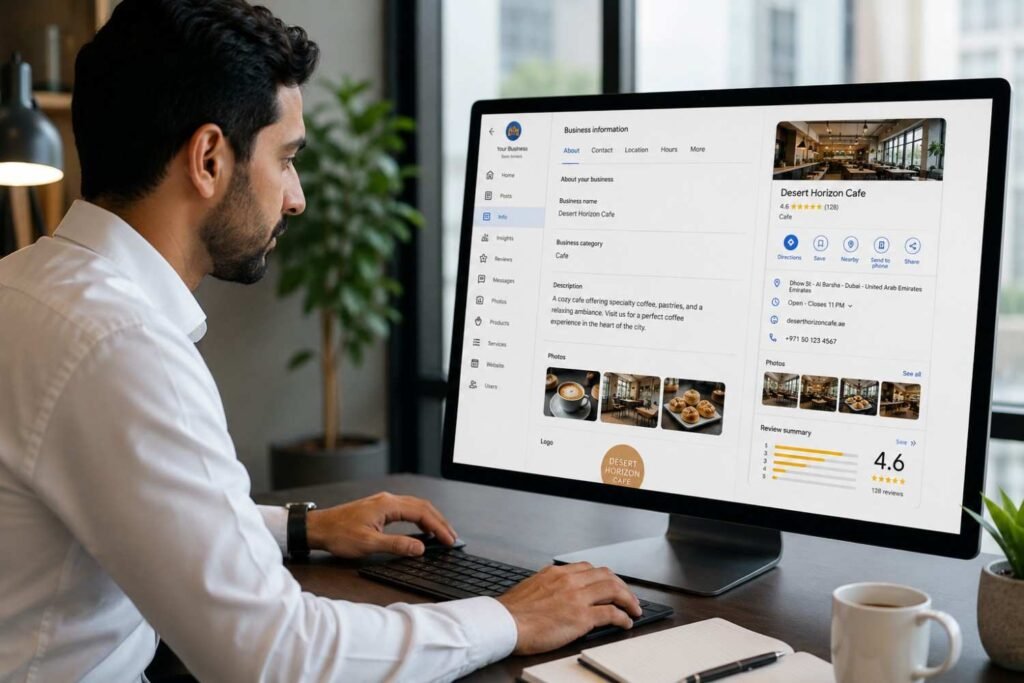
Your Google Business Profile is the cornerstone of your local SEO strategy. It serves as your digital storefront, providing potential customers with essential information directly within search results. Research shows that customers are 2.7 times more likely to consider a business reputable if they find a complete Business Profile on Google Search and Maps, and 70% more likely to visit a business with a fully optimized profile.
How Should I Complete Every Business Detail Accurately?
Completing every business detail accurately is the first and most crucial step in optimization. Ensure your business name matches exactly what appears on your physical signage and other online directories. The address must be precise, the phone number should connect directly to your business, and business hours must be current and accurate. A single inconsistency can erode trust with both search engines and potential customers.
Why Is Adding High-Quality Photos Important for Engagement?
Visual content plays a significant role in user engagement. Profiles with updated photos monthly receive 42% more direction requests. Storefront images help users identify your location, team photos humanize your brand, and product or service photos showcase your offerings. Regularly updating your profile with new photos signals to search engines that your business is active and engaged.
Google Business Profile Optimization Checklist
| Optimization Area | Action Required | SEO Impact |
|---|---|---|
| Core NAP Information | Verify accurate Name, Address, Phone Number | Establishes foundational trust for search algorithms |
| Business Categories | Select the most specific primary category; add secondary categories | Determines which queries trigger your profile |
| Operating Hours | Update regular hours and specify holiday/special event hours | Prevents customer frustration; signals active management |
| Visual Assets | Upload high-resolution exterior, interior, team, and product photos | Increases engagement, click-through rates, and profile views |
| Customer Reviews | Implement a strategy to request reviews; respond to all reviews promptly | Major ranking factor and primary trust signal for conversions |
| Business Description | Write a comprehensive description with relevant local keywords | Helps search engines understand your services |
| Services/Products | List all services with descriptions and pricing where applicable | Improves relevance for specific service-based queries |
| Q&A Section | Populate with common customer questions and answers | Provides additional keyword-rich content on your profile |
How Can I Build Consistent Local Citations to Improve Rankings?
What Are Local Citations and Why Do They Matter?
Local citations are online mentions of your business’s Name, Address, and Phone number (NAP). These mentions can occur on local business directories, websites, apps, and social platforms. When Google sees consistent NAP information across multiple authoritative websites, it increases confidence in the accuracy of your business data, which positively impacts your local search rankings. Research confirms that businesses with consistent NAP across 40 or more directories achieve a 4.1x improvement in local ranking positions.
NAP consistency is the most important factor when building citations. Even minor variations, such as using “St.” instead of “Street” or having a different phone number on an old directory, can confuse search engines and dilute the effectiveness of your citations.
Citation Management Best Practices
| Best Practice | Why It Matters |
|---|---|
| Ensure NAP Consistency | Inconsistent information confuses search engines and erodes trust |
| Avoid Duplicate Listings | Multiple listings on one directory split authority and can trigger penalties |
| Update Outdated Information | Outdated addresses or phone numbers lead to lost customers and poor user experience |
| Prioritize Authoritative Directories | High-authority directories pass more SEO value to your business |
| Target Industry-Specific Platforms | Relevant industry directories signal niche authority to search engines |
| Include Regional Platforms | GCC-specific directories strengthen local relevance in the Middle East |
How Do I Create Location-Focused Website Content?
Why Should I Develop Dedicated Location Landing Pages?
Creating location-focused website content is essential for signaling local relevance to search engines. If your business serves multiple cities or neighborhoods, developing dedicated location landing pages is a highly effective strategy. City-specific service pages allow you to target local keywords and tailor your content to the unique needs of that specific area. For instance, a digital marketing agency might have separate pages for “SEO Services in Dubai” and “Digital Marketing in Abu Dhabi.”
Area-based content strategies involve creating content that highlights your involvement and relevance within a specific community. This could include blog posts about local events you’ve sponsored, case studies featuring local clients, or guides specific to the area. By consistently producing high-quality, location-specific content, you establish your website as a valuable resource for the community.
How Can I Use Local Keywords Naturally in My Content?
Integrating local keywords into your website content is crucial, but it must be done naturally. Incorporating city names and neighborhood names into your headings, body text, and meta tags helps search engines understand the geographic focus of your content. Using service plus location keywords, such as “digital marketing agency in Dubai” or “SEO services Riyadh”, clearly defines both what you do and where you do it. Write for the user first, ensuring the content is informative and engaging, while strategically placing local keywords to signal relevance.
Your website should also clearly display your local business information. Contact details, including your NAP, should be accessible in the header or footer of every page. Embedding interactive maps on your contact page or location-specific landing pages provides a visual aid for users trying to find your physical location.
How Do I Optimize for Both Arabic and English Searches?
What Are the Benefits of Bilingual SEO in the GCC?
In the diverse markets of the Middle East, a bilingual SEO strategy is not just an advantage; it is a necessity. By offering your website and content in both Arabic and English, you cater to the linguistic preferences of a significantly larger portion of the population. Search engines strive to deliver results in the language of the user’s query. If a user searches for a service in Arabic, a website optimized with Arabic content is far more likely to appear in the results than an English-only site.
Bilingual SEO: Key Localization Best Practices
| Localization Area | Best Practice | Common Mistake to Avoid |
|---|---|---|
| Translation Quality | Use professional human translators with regional expertise | Relying solely on automated translation tools |
| Cultural Adaptation | Adapt messaging to reflect local customs, values, and holidays | Translating English content word-for-word without cultural context |
| Keyword Research | Conduct separate keyword research for Arabic and English queries | Assuming the same keywords perform equally in both languages |
| Local Terminology | Use region-specific terms and dialects (e.g., Gulf Arabic vs. Modern Standard Arabic) | Using generic Arabic that doesn’t resonate with the target region |
| URL Structure | Use language-specific subdirectories (e.g., /ar/ for Arabic pages) | Mixing languages on a single page without clear structure |
| Hreflang Tags | Implement hreflang tags to tell search engines which language version to serve | Ignoring hreflang, causing search engines to show the wrong language version |
How Can I Improve On-Page Local SEO Signals?
On-page local SEO signals are the technical and content-based elements on your website that communicate your geographic relevance to search engines. Optimizing title tags involves including your primary keyword and the target location near the beginning of the tag. A well-crafted meta description that includes local keywords and a clear call to action can significantly increase click-through rates from search results.
Using local keywords in headings (H1, H2, H3) reinforces the geographic relevance of the page. The H1 tag should clearly state the service and location, while subsequent headings can incorporate variations of local keywords. Implementing Local Business Schema Markup provides search engines with explicit details about your business, such as your NAP, operating hours, and reviews, which can enhance the way your business is displayed in search results and lead to rich snippets.
Image optimization is frequently overlooked in local SEO strategies. Using descriptive file names that include local keywords and writing alt text that incorporates relevant local terms strengthens the overall local relevance of your website. Compressing image file sizes ensures fast page load times, which is critical for mobile users.
How Can I Earn Local Backlinks and Mentions?
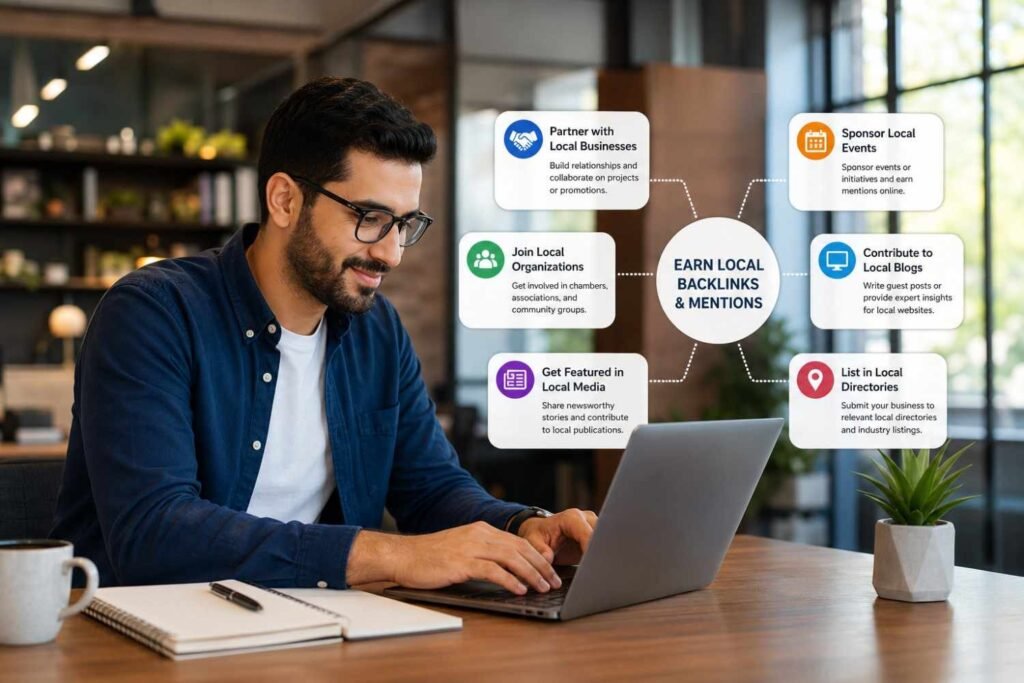
Earning backlinks from reputable local websites is a powerful way to boost your local search authority. Partnering with local organizations, such as chambers of commerce, industry associations, or local charities, often results in a backlink from their member directory or partner page. Sponsoring community events generates valuable local backlinks from event organizers’ promotional pages and demonstrates your commitment to the local community.
Collaborating with local influencers or bloggers can introduce your business to a highly targeted audience and generate backlinks from their platforms. Getting featured in regional publications, such as local newspapers, online news portals, or community magazines, earns authoritative local backlinks and establishes your business as a thought leader in the local market.
Local Link Building Opportunities
| Strategy | Expected Outcome | Effort Level |
|---|---|---|
| Partner with Local Organizations | Directory listing backlink, community credibility | Low |
| Sponsor Community Events | Event page backlink, brand awareness | Medium |
| Collaborate with Local Influencers | Blog/social media mention, targeted audience reach | Medium |
| Get Featured in Regional Publications | High-authority backlink, thought leadership positioning | High |
| Issue Press Releases | News site mentions, brand visibility | Medium |
| Guest Articles on Local Blogs | Contextual backlink, audience engagement | Medium |
Why Is Focusing on Mobile User Experience Critical?
With the majority of local searches conducted on mobile devices, the mobile user experience is a critical ranking factor. Research shows that 53% of mobile users will abandon a website if it takes longer than three seconds to load. Search engines recognize this user preference and penalize slow-loading sites in their rankings. Optimizing images, leveraging browser caching, and minimizing code are crucial steps in ensuring your website loads quickly on mobile networks.
A mobile-friendly design ensures that your website is easily readable and navigable on smaller screens. Text should be legible without zooming, buttons and links should be easily tappable, and the overall design should be uncluttered. Implementing click-to-call features on your mobile website makes it incredibly easy for users to contact you directly from search results with a single tap. Research shows that 68% of users use click-to-call from mobile local search results, making this a high-value conversion feature.
Contact forms should also be optimized for mobile input. Minimizing the number of required fields and using appropriate input types makes the process of submitting an inquiry as frictionless as possible.
How Can I Leverage Customer Reviews for Local Rankings?
Customer reviews are one of the most prominent factors influencing both local search rankings and consumer behavior. Search engines view a high volume of positive reviews as a strong indicator of a business’s quality and relevance, rewarding them with higher placement in the Local Pack. Review signals account for approximately 16% of the local ranking algorithm, making active review management a non-negotiable component of any local SEO strategy.
Developing effective review acquisition strategies is essential. Timing is critical, ask for a review when the customer’s positive experience is fresh in their mind. Automating the process through email or SMS follow-ups ensures consistent requests. Providing clear instructions and direct links to your preferred review platforms makes it easy for customers to leave feedback.
Managing negative reviews requires prompt, professional responses. Acknowledge the customer’s frustration, apologize for their negative experience, and offer to resolve the issue offline. Research shows that 89% of consumers are likely to use a business that responds to all reviews, demonstrating that how you handle criticism is just as important as the positive feedback you receive.
Local SEO Ranking Factors: Weight Distribution
| Ranking Factor | Weight in Local Pack Rankings |
|---|---|
| Google Business Profile Signals (proximity, categories, keyword in title) | 32% |
| On-Page Signals (NAP, local keywords, domain authority) | 19% |
| Review Signals (quantity, velocity, diversity, sentiment) | 16% |
| Link Signals (inbound anchor text, domain authority, local links) | 15% |
| Behavioral Signals (CTR, mobile clicks-to-call, dwell time) | 8% |
| Citation Signals (NAP consistency, citation volume) | 7% |
| Personalization Signals (search history, location history) | 3% |
Source: Whitespark Local Search Ranking Factors 2025
How Do I Track Local SEO Performance?
Tracking your local SEO performance is crucial for understanding the effectiveness of your strategies and identifying areas for improvement. Google Business Profile Insights provides data on how many times your profile appeared in search results, the number of direction requests, website clicks, and phone calls generated directly from your listing.
Monitoring local keyword rankings allows you to track your visibility for specific search terms in your target geographic area. Rankings can vary significantly depending on the searcher’s location, so using rank tracking tools with local search capabilities is essential. Website traffic and conversions are the ultimate indicators of success. Setting up conversion tracking enables you to measure specific actions, such as form submissions, appointment bookings, or online purchases, and attribute them directly to your local SEO efforts.
Key Local SEO Metrics to Track
| Metric | Tracking Tool | What It Tells You |
|---|---|---|
| GBP Profile Views | Google Business Profile Insights | How often your profile appears in search and maps |
| Direction Requests | Google Business Profile Insights | Strong intent to visit your physical location |
| Phone Calls from GBP | Google Business Profile Insights / Call Tracking | Direct leads generated from local search |
| Local Keyword Rankings | Rank Tracking Tools | Visibility for target keywords in your area |
| Organic Traffic from Local Pages | Google Analytics | Volume of visitors from location-specific content |
| Conversion Rate | Google Analytics / CRM | Percentage of visitors taking a desired action |
| Review Volume and Rating | Google Business Profile / Review Platforms | Trust signals and ranking factor performance |
What Are Common Local SEO Mistakes to Avoid?
Avoiding common pitfalls is just as important as implementing best practices. Inconsistent business information (NAP) across different directories is a frequent mistake that severely damages local search authority, 62% of consumers would avoid using a business if they found incorrect information online. Ignoring customer reviews, particularly negative ones, signals a lack of engagement and can deter potential customers.
Poor mobile optimization, such as slow load times or unreadable text, frustrates users and leads to high bounce rates, negatively impacting rankings. Keyword stuffing, unnaturally forcing local keywords into content, can result in search engine penalties and a poor user experience. Finally, neglecting Arabic search optimization in the Middle East market is a significant missed opportunity, alienating a large portion of the potential customer base and leaving considerable revenue on the table.
Why Professional Local SEO Services Can Help Your Business Grow?
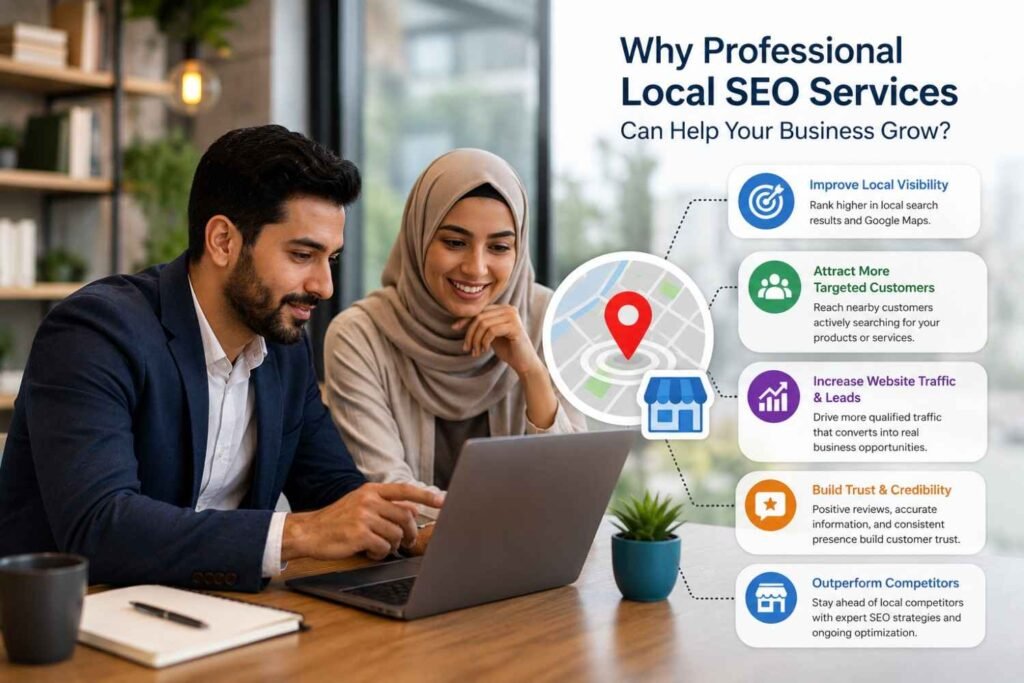
Navigating the complexities of local SEO requires specialized knowledge and ongoing effort. Professional local SEO services provide the expertise in regional markets necessary to develop highly effective, culturally relevant strategies. At Eyes On Solution, we understand the nuances of search behavior in the Middle East and possess the tools and experience to implement best practices efficiently. Our team manages the full scope of local SEO, from Google Business Profile optimization and citation building to bilingual content creation and review management, so you can focus on running your business.
Partnering with professionals ensures faster implementation of critical optimizations, leading to better ranking opportunities in a shorter timeframe. Ultimately, investing in professional local SEO services is an investment in long-term business growth, ensuring sustainable visibility and a consistent stream of local customers. Our proven track record across industries in the GCC region means we bring practical, results-driven expertise to every campaign.
Conclusion
Local SEO is no longer an optional marketing tactic; it is a fundamental requirement for business success in the Middle East. As consumer reliance on mobile search continues to grow, ensuring your business is highly visible in local search results is critical for attracting foot traffic and generating leads. From optimizing your Google Business Profile and managing online reviews to creating bilingual, location-focused content, a comprehensive local SEO strategy builds the trust and authority necessary to dominate your local market.
Consistent optimization is key to maintaining and improving your local search rankings. The digital landscape is constantly evolving, and businesses must adapt their strategies to remain competitive. By investing in local search visibility, Middle East businesses can establish a strong digital foundation that drives sustainable growth and ensures they remain the top choice for consumers in their area.
Frequently Asked Questions
How long does local SEO take to show results in the Middle East?
Local SEO is a\ long-term strategy, and results typically become noticeable within 3 to 6 months of consistent optimization. Factors such as market competition, current website authority, and the specific strategies implemented can influence this timeline. Businesses in highly competitive markets like Dubai may see initial improvements in Google Business Profile visibility within the first 4 to 8 weeks.
Is local SEO important for small businesses in the UAE and Saudi Arabia?
Yes, local SEO is especially crucial for small businesses. It levels the playing field, allowing them to compete with larger corporations by targeting consumers in their immediate geographic area who are actively searching for their products or services. With 97% of consumers searching for local businesses online, a strong local presence is essential for survival and growth.
Can local SEO help businesses in Dubai, Abu Dhabi, Riyadh, and Doha?
Absolutely. With near-universal internet penetration and a strong reliance on “near me” searches in these cities, local SEO is highly effective for capturing local market share and driving foot traffic across the GCC. Each city has its own competitive landscape, and a tailored local SEO strategy ensures your business stands out in the specific market you serve.
Should my website be available in both Arabic and English for better local SEO?
Yes, a bilingual website is highly recommended in the Middle East. It ensures you reach the broadest possible audience, catering to both the local Arabic-speaking population and the English-speaking expatriate community. Search engines serve results in the language of the query, so Arabic-optimized content is essential for capturing searches conducted in Arabic.
How do customer reviews affect local search rankings in the Middle East?
Customer reviews are a major ranking factor for local SEO, accounting for approximately 16% of the local ranking algorithm. Search engines use the quantity, quality, and velocity of reviews to determine a business’s prominence and trustworthiness. Businesses with a strong review profile receive significantly more visibility in the Local Pack, and 87% of consumers read reviews before choosing a local business.
What is a Google Business Profile and how does it help Middle East businesses?
A Google Business Profile is a free listing that allows your business to appear in Google Search and Google Maps. It displays your address, phone number, hours, photos, and reviews directly in search results. For Middle East businesses, an optimized Google Business Profile is the single most impactful local SEO action you can take, as it directly determines your visibility in the Local Pack for location-based searches.
What is the difference between local SEO and regular SEO for a business in Dubai?
Regular SEO focuses on improving your website’s visibility for broad, non-location-specific keywords on a national or global scale. Local SEO specifically targets consumers searching for services within a defined geographic area, such as a specific city or neighborhood. For a business in Dubai, local SEO ensures you appear when someone searches for “digital marketing agency Dubai” or “SEO company near me,” capturing high-intent, ready-to-buy local customers.
“`html “`