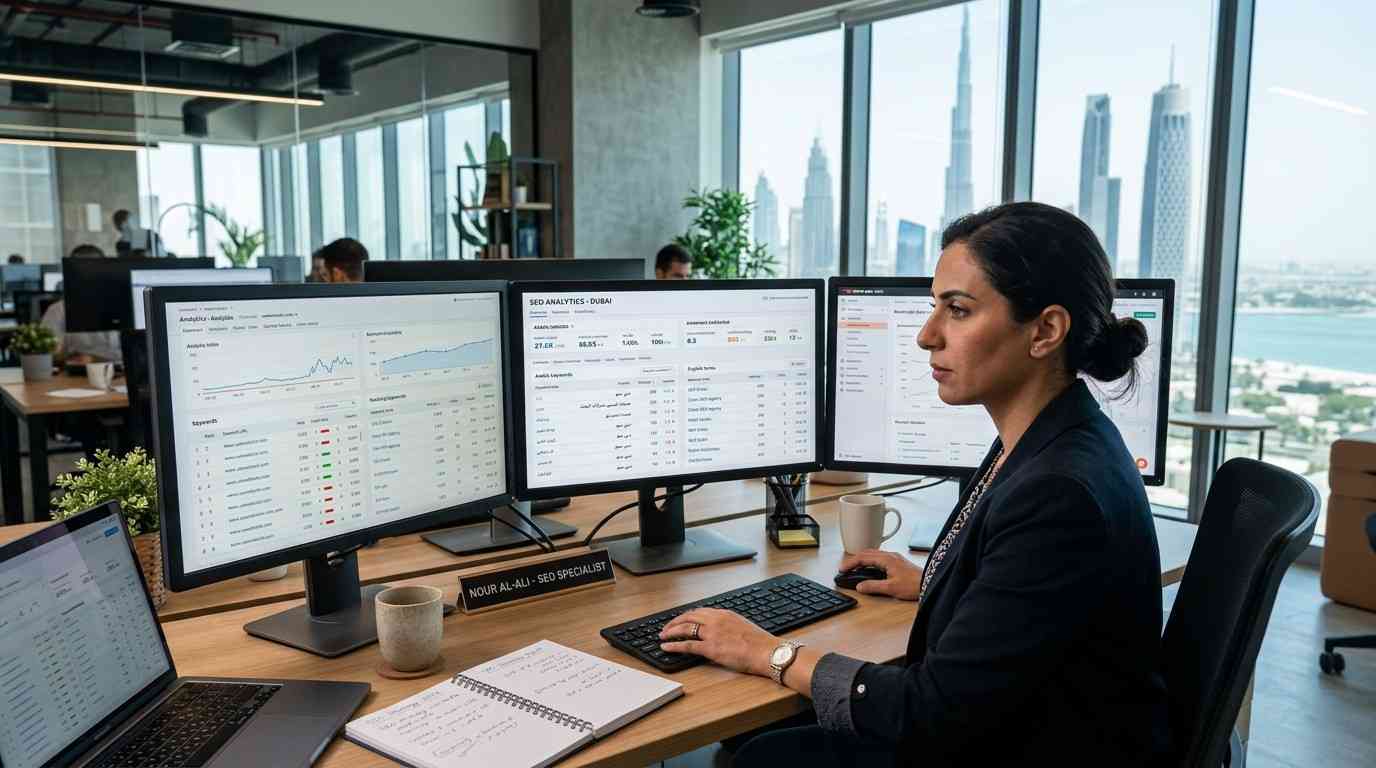
Multilingual SEO Dubai is the process of building and optimizing separate language versions of your website so each one ranks on its own in Google UAE. It is not translation. Translation copies your words. Multilingual SEO rebuilds your keyword targeting, page structure, technical signals, and local trust markers for every language you serve.
If you translated your site last year and traffic never moved, this article explains why and what to do about it.
What Is Multilingual SEO and Why Does Dubai Need It More Than Most Cities?
Multilingual SEO makes your website discoverable in more than one language by giving each language its own URLs, its own keyword research, and its own technical signals to search engines.
Dubai forces the issue in a way that London or Singapore does not. Your customer base splits across Arabic-speaking nationals and GCC visitors, English-speaking expats, South Asian communities searching in Urdu and Hindi, Russian-speaking property investors, and Persian-speaking medical tourists. These groups sit in the same city and search for the same services using completely different words.
When you run an English-only site, you are invisible to everyone who types in another script. Not ranked low. Invisible.
Who Needs Multilingual SEO in Dubai?
You need multilingual SEO if your revenue depends on customers who do not think in English. Below are the business types where it consistently pays back.
Real estate and property brokerages. Russian, Arabic, and Persian buyers research in their own language before they ever call an agent. Pair this with strong local SEO for real estate in the UAE and you capture both the map pack and the language search.
Clinics, dental practices, and medical tourism providers. Health queries are emotional and personal. People search in their mother tongue even when they speak fluent English at work.
Law firms and corporate service providers. Arabic carries legal authority in the UAE. Firms already investing in SEO for law firms in Dubai leave money on the table by skipping Arabic entirely.
Ecommerce and retail brands. Product discovery in Arabic is far less competitive than in English.
Hospitality, tourism, and events. Your visitors arrive from dozens of markets and plan before they land.
Government-adjacent and B2B service companies. Arabic signals credibility with local stakeholders and tender committees.
You probably do not need it if you sell exclusively to Western enterprise buyers, your traffic already converts well in English, or your budget cannot yet support proper English SEO. Fix the foundation first.
Why Your Translated Website Still Gets No Traffic
Translated sites fail because translation solves a language problem while search engines have a signals problem. Here are the four causes we find in almost every audit.
Your Keywords Were Translated Instead Of Researched
A word-for-word Arabic version of your English keyword list rarely matches what Arabic speakers type. People search using dialect, shortened phrases, and transliterated spellings. Many UAE searchers also mix scripts inside one query. Real keyword research in each language finds those patterns. A translator never will.
Your Hreflang Tags Are Broken Or Missing
Hreflang tells Google which language version belongs to which audience. Two errors dominate in the UAE. The first is using generic ar and en instead of region-specific ar-ae and en-ae, which leaves Google guessing whether your page belongs to Dubai or Cairo. The second is one-way tagging, where your English page points to the Arabic version but the Arabic page never points back. Google requires reciprocal tags. When they are missing, it ignores the annotations completely, so your setup does nothing at all. This sits squarely inside technical SEO and it is the single most common thing we repair.
Both Languages Share The Same Url
If a language switcher swaps content without changing the URL, only one version can be indexed. Use clear path prefixes such as /en/ and /ar/. They are crawlable, shareable, and easy to separate in analytics.
Your Arabic Pages Read Like A Copy
Google treats a thin, machine-translated page as duplicate filler. Arabic pages need genuine depth: UAE examples, AED pricing, references to Dubai neighbourhoods, and a tone that matches how the audience actually talks. Right-to-left layout matters too. Flipping the text direction is not enough if your font stack has no Arabic fallback, because the page renders badly and people leave.
How Multilingual SEO Works: The Six-Step Process
Multilingual SEO works by treating every language as a full website with its own research, content, technical setup, and authority building. Here is the sequence that produces results.
Step 1: Audit Your Current Language Setup
Start with what exists. Check indexation for each language, hreflang validity in Google Search Console, URL structure, duplicate content, and which language your existing traffic already speaks. This tells you whether you are building or repairing.
Step 2: Choose Your Url Structure
Subdirectories on one domain work best for most UAE businesses. Your Arabic and English pages then share the same domain authority instead of competing as separate properties. Subdomains and country domains make sense only for large brands running genuinely separate operations per market.
Step 3: Research Keywords Natively In Each Language
Run fresh keyword research inside each target language. Look for dialect variations, transliterated spellings, and question phrasing. Search volumes in Arabic look smaller than English, but competition is far lower, so ranking is faster and cheaper.
Step 4: Localize The Content, Do Not Translate It
Rewrite for the audience rather than converting sentences. Change examples, currency, service area names, and cultural references. Strong content writing in the target language beats a polished translation every time.
Step 5: Fix The Technical Layer
Implement reciprocal hreflang with region codes, add an x-default for first-time visitors, set self-referencing canonicals per language, and submit language-specific sitemaps. Confirm right-to-left rendering and Arabic font support on both desktop and mobile.
Step 6: Build Local Signals Per Language
Add Arabic descriptions to your Google Business Profile, collect reviews in multiple languages, and earn links from regional publications. If local visibility drives your leads, our guide on attracting nearby customers through local search pairs directly with this step.
Which Language Should You Add First?
Add Arabic first if you sell to UAE residents, government bodies, or GCC buyers. Add Russian, Hindi, Urdu, or Persian first only when your existing enquiry data shows those buyers already reaching you.
Check three things before deciding: the languages in your current enquiry log, the languages your competitors have ignored, and the deal size each audience brings. One properly built second language beats four half-finished ones. Every time.
How Multilingual SEO Affects AI Search and AI Overviews
Clean multilingual signals decide whether AI systems can cite you in a given language. This is where most Dubai competitors are still doing nothing.
AI Overviews and assistants like ChatGPT pull from sources they can confidently attribute to a language and region. Broken hreflang creates ambiguity, so your brand gets skipped in both languages rather than cited in one. Well-structured Arabic content with clear headings and direct answers gives these systems something quotable, and Arabic AI answers face far less competition than English ones right now.
If you want the full picture on this shift, read our breakdown of AI Overviews SEO and how GEO, AEO, and AIO differ from traditional optimization.
How Long Does Multilingual SEO Take in Dubai?
Expect early movement in 6 to 10 weeks and meaningful commercial rankings in 4 to 8 months.
Technical fixes such as hreflang corrections often show up in Search Console within days. New language pages need time to be crawled, indexed, and trusted. Arabic usually moves faster than English because the competition is thinner. Anyone promising first-page Arabic rankings in a month is guessing.
Choosing a Multilingual SEO Company in Dubai
Choose a partner who audits before they quote. Ask three questions and listen carefully to the answers.
Ask who writes the Arabic content and whether that person is a native speaker or a translation tool. Ask them to explain how they will handle hreflang and what they will do about return tags. Ask what they will report on per language, because a single blended traffic number hides which language is actually working.
At Eyes On Solution, we start with a technical audit, show you exactly which signals are broken, and build one language properly before adding the next. If you want to see where your site stands, get in touch for a free audit.
Frequently Asked Questions
What is multilingual SEO in Dubai?
Multilingual SEO in Dubai is the practice of optimizing separate language versions of your website so each ranks independently in Google UAE. It covers language-specific keyword research, localized content, hreflang tags, URL structure, and local trust signals for every language you target.
Is multilingual SEO the same as translation?
No. Translation converts your existing words into another language. Multilingual SEO researches how the new audience actually searches, rewrites content around those queries, and adds the technical signals search engines need to serve the right version to the right person.
Do I need an Arabic version of my website in the UAE?
You need Arabic if you serve UAE residents, government entities, or GCC buyers. English dominates business communication in Dubai, but Arabic is the language many people use when they are ready to enquire or buy, and far fewer competitors have optimized for it.
What is the most common hreflang mistake UAE websites make?
Missing return tags. Your English page references the Arabic version, but the Arabic page never references back. Google requires reciprocal annotations and ignores the entire setup when they are incomplete. Using generic ar instead of ar-ae is the second most common error.
Will Google penalize me for having the same content in two languages?
No. Genuinely translated content across language versions is not duplicate content. Problems start when pages are machine-translated so poorly that they read as thin filler, or when hreflang is broken and Google cannot tell which version to serve.
How much do multilingual SEO services in Dubai cost?
Cost depends on how many languages you add, how many pages need localizing, and how much technical repair your site requires. A single additional language on a small site costs far less than a full multi-market rollout. Ask for a scoped audit before accepting any fixed monthly price.
Can multilingual SEO help me appear in AI search results?
Yes. AI systems need clear language and region signals to cite a source confidently. Correct hreflang, well-structured content, and direct answers in each language all improve your chances of being referenced in AI Overviews and assistant responses, particularly in Arabic where competition remains low.
Should I use subdomains or subdirectories for different languages?
Subdirectories such as yoursite(.)ae/ar/ suit most UAE businesses because all language versions share one domain's authority. Subdomains and separate country domains only make sense for large organizations running distinct operations in each market.