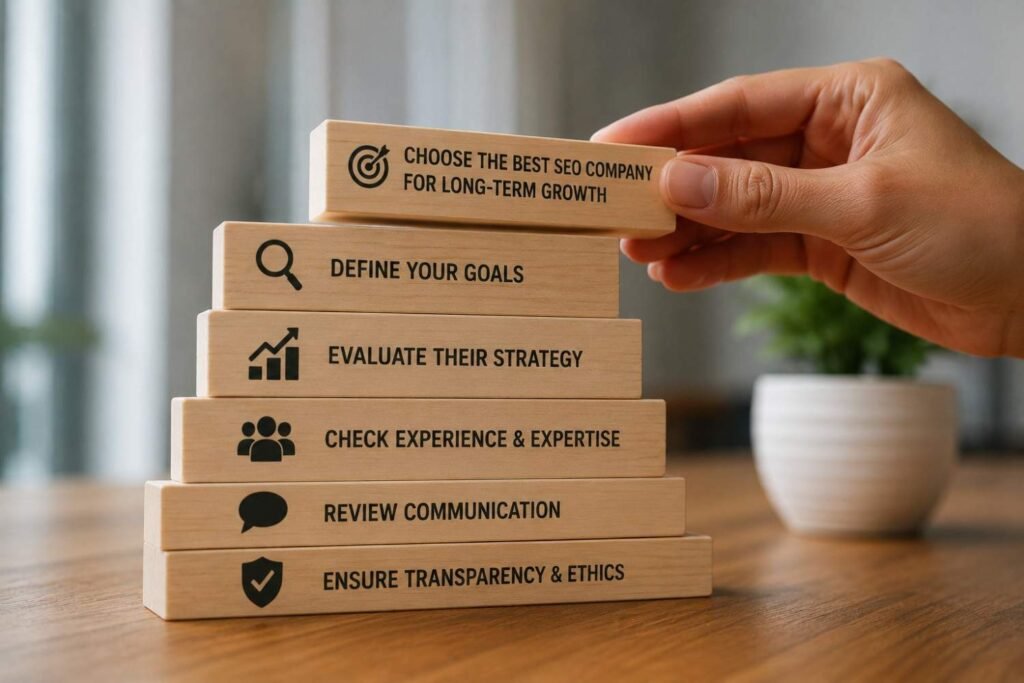
The best SEO company is not the one promising the fastest rankings or the lowest price. It is the one that combines technical SEO, content strategy, ethical link building, local optimization, and AI search readiness into one plan built around your business goals, not vanity metrics. The right partner is transparent about process, honest about timelines, and focused on traffic that turns into leads and revenue. The wrong partner costs you months of wasted budget and, in some cases, a Google penalty that takes years to undo. This guide walks through exactly how to tell the difference, what to ask before you sign a contract, and what realistic results look like at every stage.
If you are evaluating SEO companies right now, you already know the problem: every agency website looks the same, every sales call sounds confident, and every proposal promises growth. The difference only shows up months later, in your analytics. This article is built to help you spot that difference before you sign anything.
Why The Wrong SEO Company Costs You More Than Money
A poor SEO agency does not just fail to grow your traffic, it can actively damage your domain’s trust with Google, sometimes taking 12 months or longer to recover from.
Most businesses do not lose money on SEO because the service is too expensive. They lose money because they hire based on price or promises rather than process. A cheap package that relies on spammy backlinks, duplicate content, or keyword stuffing can trigger a manual action or algorithmic penalty from Google. Once that happens, recovering lost rankings takes far longer than building them would have in the first place.
The less dramatic version of this problem is more common: an agency that is not technically incompetent, just generic. It runs the same checklist for every client regardless of industry, publishes the same templated blog content, and reports on activity (blogs published, links built) instead of outcomes (traffic, leads, revenue). Nothing breaks. Nothing grows either.
This is the real pain point behind almost every search for “best SEO company.” Business owners are not just looking for a vendor. They are looking for a way to stop guessing and start seeing a return on what they spend on search visibility.
What Does an SEO Company Actually Do for Your Business
A full-service SEO company manages five connected areas, technical SEO, on-page optimization, content, off-page authority building, and increasingly, AI search optimization, so your site is both crawlable and genuinely useful to the people searching for it.
These pieces only work when they work together, which is why understanding how they connect matters more than memorizing the list.
Technical SEO comes first because it controls whether Google can even read and index your site properly. This covers site speed, mobile usability, crawl structure, sitemaps, and fixing indexing errors. Without this foundation, great content simply does not get discovered.
On-page SEO is where research meets writing. A skilled team studies how real people search, including how they phrase questions to AI tools and search engines, and naturally builds those terms into title tags, headings, meta descriptions, and body content. The goal is content that reads smoothly for a human first, while still giving search engines clear signals about what the page is about.
Content marketing is the engine that keeps a site relevant over time. Instead of one-off blog posts, the strongest strategies build topic clusters: a core page supported by related articles that all link to one another, signaling depth and authority on a subject to both Google and AI search tools.
Off-page SEO, most visibly link building, tells search engines that other credible sites vouch for yours. Ethical link building looks like earning placements through guest content, fixing broken links on relevant sites in exchange for a new link, and building real relationships with publishers and industry sites. It does not look like buying links in bulk.
Local SEO matters enormously for any business that serves customers in a specific area. This means optimizing a Google Business Profile, keeping business listings and citations consistent across directories, and building location-specific content so a business shows up when someone nearby searches for its services.
Finally, AI search optimization (often called Generative Engine Optimization or Answer Engine Optimization) is the newest layer. As more people get answers directly from AI tools and AI-generated search overviews instead of clicking through ten blue links, structuring content so it can be clearly understood, quoted, and trusted by these systems is becoming as important as ranking on page one.
Who Needs a Professional SEO Partner Right Now

Any business that depends on being found online to generate leads or sales, not just large enterprises, benefits from professional SEO, but the right scope of work depends heavily on business type and growth stage.
| Business Type | Primary SEO Need | Why It Matters |
|---|---|---|
| Local service businesses | Local SEO, Google Business Profile optimization | Customers search “near me” before they ever visit a website |
| Startups and new websites | Technical SEO foundation, content strategy | No history means search engines need clear signals fast |
| E-commerce stores | Product and category page optimization, structured data | Buyers compare options across many similar listings |
| Growing small businesses | On-page SEO, content marketing | Organic traffic lowers cost-per-lead compared to ads alone |
| Established or multi-location brands | Ongoing technical audits, authority building, AI search readiness | Protecting existing rankings while expanding into new markets |
The common thread across every row in that table is the same: if customers use a search engine or an AI assistant to find businesses like yours, your visibility is not optional. It is infrastructure.
What Separates the Best SEO Companies From the Rest
The best SEO companies are defined by transparency, customization, and a focus on business outcomes, not by promises of guaranteed top rankings.
A strong agency builds a strategy around your specific business, competitors, and goals rather than reusing a generic template. It explains its process in plain language, shows you what work is being done and why, and reports on metrics that connect to revenue, not just activity counts. It uses white-hat techniques exclusively, because anything else borrows growth from the future to fake progress today. And it treats rankings as a means to an end, traffic, leads, and sales, rather than the end goal itself.
The table below makes the contrast concrete, because the difference often isn’t obvious from a sales pitch:
| Signal | Trustworthy SEO Company | Risky SEO Provider |
|---|---|---|
| Rankings promise | Realistic ranges based on competition data | “Guaranteed #1 rankings” |
| Pricing | Clear scope, no hidden fees | Unusually cheap, vague deliverables |
| Strategy | Customized to your industry and goals | Identical checklist for every client |
| Link building | Earned, relevant, white-hat | Bulk, low-quality, or paid link networks |
| Reporting | Regular reports tied to traffic, leads, conversions | Little or no reporting, or only vanity metrics |
| Communication | Direct access to the person managing your account | Reroutes to a different rep every time |
If a provider’s answers line up consistently with the left-hand column, that’s a strong signal you are looking at a genuine long-term partner rather than a short-term vendor.
How to Vet an SEO Company Before You Sign a Contract
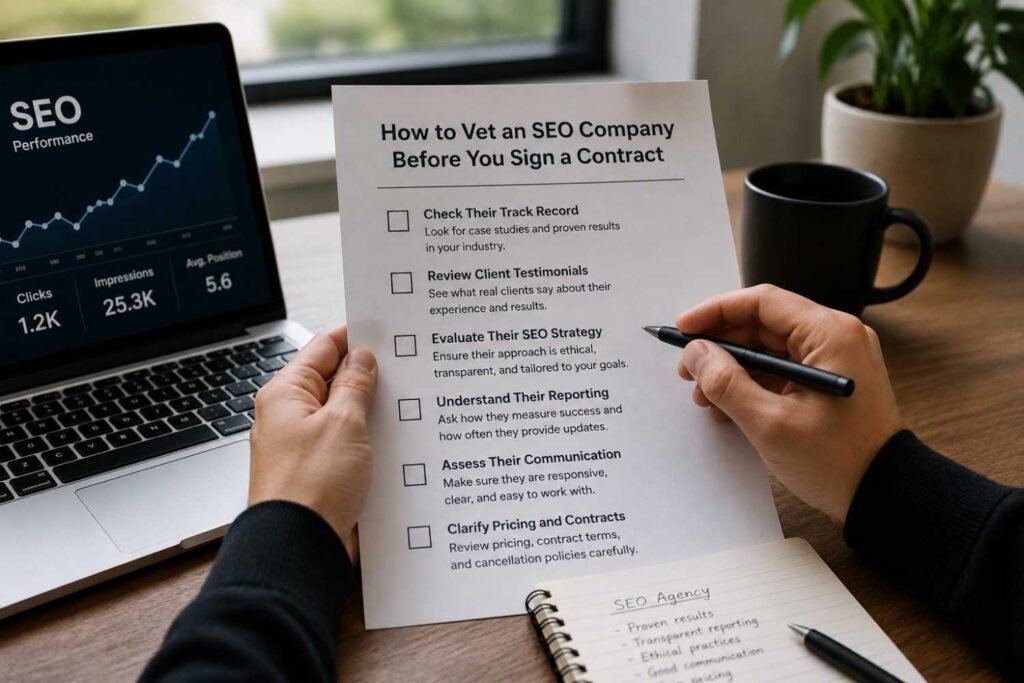
Before hiring, ask to see real case studies, get a written explanation of their link-building and reporting methods, and confirm they follow Google’s published guidelines rather than relying on tactics that work only until the next algorithm update.
Start with proof, not promises. Ask for case studies or examples from businesses similar in size or industry to yours, and look closely at what actually changed: traffic, rankings, leads, or revenue, over a stated time period. Client testimonials matter too, but they carry more weight when they describe specific outcomes rather than general satisfaction.
Then ask direct questions about the method. How exactly do they build backlinks, and can they walk you through one recent example? How will they measure success, and how often will you receive a report you can actually understand without a glossary? Who, specifically, will manage your account day to day, and can you talk to that person directly?
Finally, ask about philosophy. A company confident in its process will tell you plainly that no one can guarantee a #1 ranking, because no agency controls Google’s algorithm. What they can commit to is a clear strategy, consistent execution, and guidelines-compliant practices that protect your site rather than put it at risk. That honesty is itself one of the clearest signals you are talking to the right partner.
What Does SEO Cost and Why Cheap Packages Backfire
SEO pricing varies by website size, industry competition, and scope of work, and the businesses that pay less upfront for vague, low-quality work often end up paying more later to fix the damage.
Most agencies price their work in one of a few common ways, and understanding the model helps you compare offers on equal terms.
| Pricing Model | Typical Structure | Best Fit |
|---|---|---|
| Monthly retainer | Fixed ongoing fee for continuous work | Businesses wanting steady, long-term growth |
| Project-based | One-time fee for a defined scope (e.g., a technical audit) | Businesses with a specific, time-boxed need |
| Hourly consulting | Billed by time spent | Businesses needing strategic guidance, not full execution |
The factors that move price up or down are predictable: how competitive your industry is, how large and complex your website already is, and how broad the scope of work is, from a single local listing cleanup to a full technical, content, and link-building program.
The reason cheap SEO so often costs more in the long run is straightforward. Low-cost packages frequently cut corners on the parts of SEO that take real time and skill, like manual outreach for links or properly researched content, and substitute volume for quality. When that approach triggers a ranking drop or a penalty, the cost of recovery, plus the lost months of opportunity, usually exceeds whatever was saved on the original invoice. The better question is never “what does this cost,” but “what return does this generate relative to what I’m spending,” the same way you would evaluate any other investment in your business.
How Long Does SEO Take to Show Real Results
Most businesses see early technical improvements within one to three months, measurable keyword and traffic growth within three to six months, and strong, compounding results after six to twelve months of consistent work.
| Timeframe | What Typically Happens |
|---|---|
| 1–3 months | Technical fixes, on-page improvements, foundational content |
| 3–6 months | Early keyword movement, initial traffic growth |
| 6–12 months | Noticeable increases in organic traffic and leads |
| 12+ months | Compounding authority, sustainable rankings, lower customer acquisition cost |
Several factors shift this timeline in either direction: how competitive your industry is, how old and trusted your domain already is, how much content and technical work was needed at the start, and how consistently the strategy is executed month over month. SEO rewards patience and consistency far more than it rewards intensity in short bursts. Any agency that promises results in a matter of days is either describing paid advertising or describing something that will not last.
Why AI Search Optimization Now Decides Who Gets Found Online
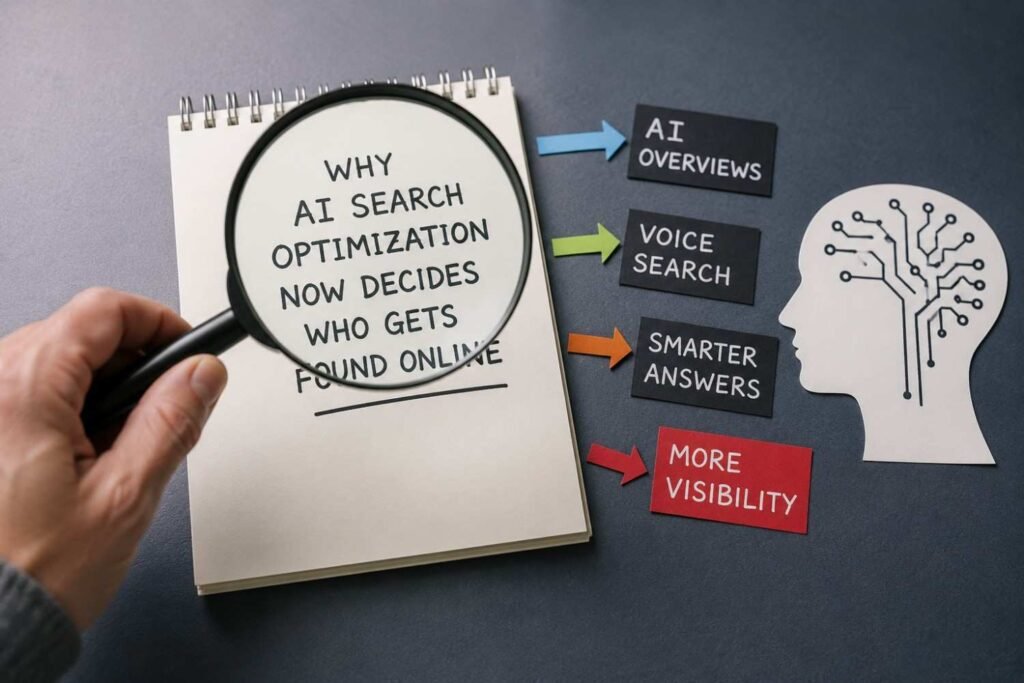
As more people get answers directly from AI tools and AI-generated overviews instead of clicking through search results, content also needs to be optimized to be understood, summarized, and trusted by those systems, not just ranked by traditional search algorithms.
This shift does not replace traditional SEO; it builds on it. Clear, well-structured content with strong E-E-A-T signals, experience, expertise, authority, and trust, was always good practice for search engines, and it is exactly what AI systems need to confidently summarize and cite a page. Entity-based SEO, structured data, and direct, well-organized answers to common questions all help both a search engine and an AI assistant understand a page quickly and accurately.
Voice search and zero-click searches, where someone gets their answer without visiting a website at all, follow the same logic. The businesses that adapt are the ones writing content that answers real questions clearly and proves expertise, rather than chasing keywords for their own sake. This is also exactly why Core Web Vitals and overall user experience continue to matter: a fast, well-structured, genuinely useful site performs better across every one of these search surfaces at once.
The Bottom Line on Choosing an SEO Partner Built for Growth
SEO is not a quick fix, and it never has been. It is a long-term investment that compounds in value the longer it runs, provided it is built on technical accuracy, genuine content, ethical authority building, and now, AI search readiness. The best SEO company for your business is the one that explains its process clearly, sets honest expectations about timelines, reports on results you actually care about, and adapts its strategy to your industry instead of running a one-size-fits-all checklist.
At Eyes On Solution, this is the standard we hold our own work to: transparent pricing with no hidden fees, white-hat strategies across technical, on-page, content, local, and link-building SEO, and a focus on the metrics that actually move your business forward, traffic, leads, and revenue, not just rankings on their own. If you are evaluating SEO partners right now, use the framework in this guide. It will tell you more about an agency in one conversation than any sales page can.
Frequently Asked Questions About Choosing an SEO Company
How do I choose the best SEO company for my business?
Look for transparency in process and pricing, real case studies relevant to your industry, white-hat practices, and reporting tied to traffic, leads, and revenue rather than activity alone.
How much does an SEO company typically charge?
Pricing depends on your website’s size, your industry’s competitiveness, and the scope of work, and is usually structured as a monthly retainer, a project-based fee, or hourly consulting.
Can an SEO company guarantee #1 rankings?
No legitimate agency can guarantee a specific ranking, since no one controls Google’s algorithm. A guarantee like this is one of the clearest warning signs to avoid a provider.
How long does SEO take to work?
Most businesses see initial technical progress in one to three months, measurable traffic growth in three to six months, and strong, compounding results after six to twelve months of consistent work.
Is SEO worth it for a small business?
Yes. Organic traffic typically costs less per lead over time than paid advertising and keeps generating results long after the initial work is done, which makes it especially valuable for small businesses with limited budgets.
What services should a full-service SEO company provide?
At minimum: technical SEO, on-page optimization, content strategy, ethical link building, local SEO if you serve a specific area, and increasingly, AI search optimization.
What’s the difference between local SEO and general SEO?
Local SEO focuses on appearing in location-based searches and maps results through tools like Google Business Profile and consistent local listings, while general SEO targets visibility for broader, non-location-specific search terms.
Will AI replace the need for SEO companies?
No. AI search tools still rely on well-structured, trustworthy, expertly written content to generate their answers, which means the fundamentals of good SEO, clarity, authority, and technical accuracy, matter just as much, if not more.
How do SEO companies measure success?
Strong agencies track organic traffic growth, keyword ranking improvements, conversion rates, lead generation, and revenue impact, not just the number of blog posts published or links built.
Should I hire an SEO agency or handle it with a freelancer?
An agency typically offers broader expertise across technical, content, and link-building disciplines plus more consistent capacity, while a freelancer can be a fit for narrower, well-defined tasks; the right choice depends on your budget and how complex your SEO needs are.
“`html “`