Increasing blog traffic requires more than just publishing articles and hoping for the best. Consistent, sustainable growth comes from a strategic combination of search engine optimization, high-quality content creation, effective distribution, exceptional user experience, and active audience engagement. By aligning your content with user intent and technical best practices, you can transform your blog into a powerful engine for brand visibility and lead generation.
| Strategy | Primary Goal | Time to See Results | Difficulty Level | Long-Term Impact |
|---|---|---|---|---|
| 1. Search Intent Optimization | Attract targeted visitors | 2–4 months | Medium | Very High |
| 2. High-Quality Content Creation | Build authority and trust | 3–6 months | High | Very High |
| 3. On-Page SEO Optimization | Improve search rankings | 1–3 months | Medium | High |
| 4. Topic Clusters & Content Hubs | Establish topical authority | 4–8 months | High | Very High |
| 5. Updating Old Content | Recover and sustain traffic | 1–2 months | Low | High |
| 6. Content Promotion | Expand reach and awareness | Immediate | Medium | Medium |
| 7. Internal Linking | Improve crawlability and UX | 1–2 months | Low | High |
| 8. High-Quality Backlink Building | Boost domain authority | 3–6 months | High | Very High |
| 9. Website Speed & UX Improvement | Reduce bounce rate | 1–2 months | Medium | High |
| 10. AI, GEO & Answer Engine Optimization | Capture AI-driven search traffic | 2–4 months | Medium | Very High |
Building a successful blog is a marathon, not a sprint. While many businesses focus on quick wins, the most reliable path to increasing blog traffic involves a cohesive approach that addresses both the needs of search engines and the desires of your human audience. This comprehensive guide explores the proven strategies that Eyes On Solution uses to help businesses attract both search engine traffic and loyal readers, ensuring that your digital marketing efforts yield tangible, long-term results.
Why Does Blog Traffic Matter For Long-Term Business Growth?
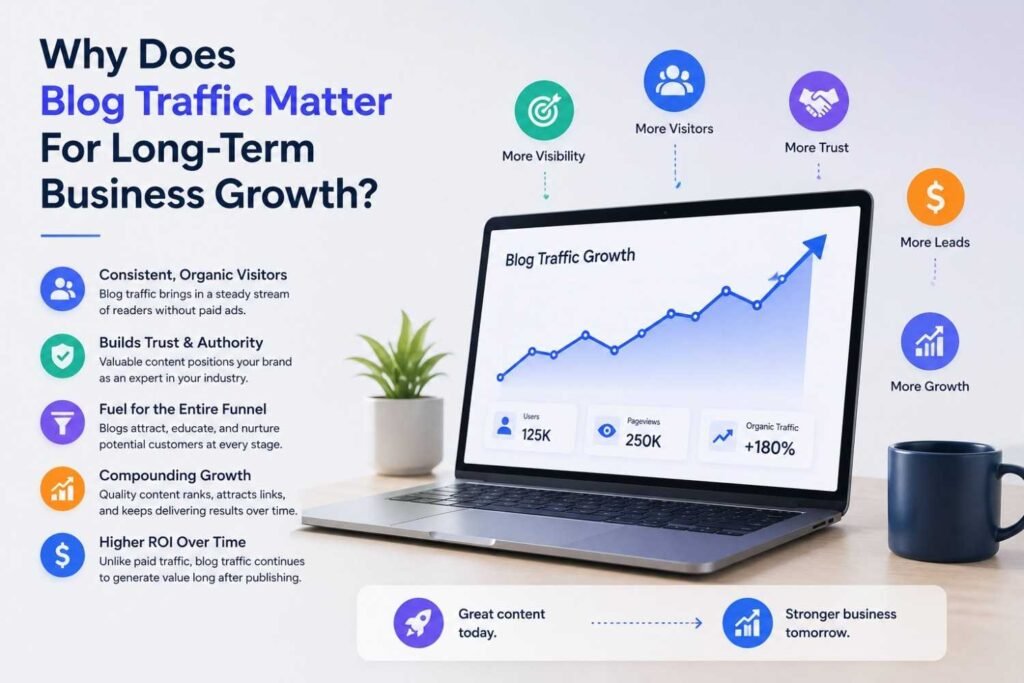
Understanding the underlying value of blog traffic is essential before diving into specific tactics. Blog traffic is not merely a vanity metric; it is a fundamental driver of business growth. When you attract more visitors to your website, you increase your brand’s visibility in a crowded digital marketplace. This enhanced visibility naturally leads to higher lead generation, as more potential customers discover your products or services through informative and relevant content.
Furthermore, consistently publishing high-quality blog posts establishes your business as an authority in your industry. When readers find valuable solutions to their problems on your site, they develop trust in your brand. This trust is a critical component in the customer journey, ultimately leading to increased conversions and sales. A well-maintained blog serves as a continuous touchpoint, nurturing relationships with prospects until they are ready to make a purchasing decision.
Comparing Traffic Sources: Organic, Social, And Referral
To effectively increase your blog traffic, it is important to understand the different channels through which visitors arrive at your site. Each traffic source has its own characteristics, advantages, and limitations.
| Traffic Source | Definition | Advantages | Limitations |
|---|---|---|---|
| Organic Traffic | Visitors who find your blog through search engine results (e.g., Google, Bing). | Highly targeted, sustainable long-term growth, high conversion potential. | Takes time to build, requires ongoing SEO efforts. |
| Social Traffic | Visitors who arrive via social media platforms (e.g., LinkedIn, Facebook, X). | Great for brand awareness, potential for viral reach, immediate traffic spikes. | Traffic can be fleeting, depends heavily on platform algorithms. |
| Referral Traffic | Visitors who click a link to your blog from another website. | Builds authority, taps into established audiences, high trust factor. | Requires active relationship building and outreach efforts. |
By diversifying your traffic sources, you create a more resilient digital presence. However, organic traffic remains the most reliable foundation for sustainable growth, which is why SEO should be a central focus of your content strategy.
How Can I Focus On Search Intent Instead Of Just Keywords?
Historically, SEO relied heavily on stuffing articles with specific keywords. Today, search engines are far more sophisticated, prioritizing the intent behind a user’s search query. Understanding what readers actually want when they type a phrase into a search engine is the key to creating content that ranks well and satisfies your audience.
Search intent generally falls into three main categories: informational, commercial, and transactional. Informational searches occur when users are looking for answers or knowledge (e.g., “how to fix a leaky faucet”). Commercial intent involves users researching products or services before making a decision (e.g., “best SEO agencies in Dubai“). Transactional intent indicates a user is ready to buy (e.g., “hire content writer Dubai”).
Matching Your Content With User Intent
To effectively increase blog traffic, your content must precisely match the user’s intent. If a user is searching for an informational guide, providing a hard-sell sales page will result in a high bounce rate. Instead, focus on creating problem-solving content that directly addresses the user’s pain points.
For commercial queries, comprehensive buying guides, comparisons, and detailed tutorials are highly effective. By aligning your content format with the user’s expectations, you provide a better user experience, which search engines reward with higher rankings. Additionally, targeting long-tail keywords, longer, more specific phrases, can help you capture highly motivated traffic with less competition than broad keywords.
What Makes Content Valuable Enough To Deserve High Rankings?
Creating content that ranks well requires more than just meeting a word count; it demands genuine value. Search engines aim to provide the best possible answers to their users, so your content must be accurate, deep, and insightful. Accuracy builds trust, while depth ensures that all facets of a topic are covered, preventing the user from needing to return to the search results for more information.
Original insights and practical examples elevate your content above generic articles. When you share unique perspectives or case studies, you provide value that cannot be found elsewhere. This uniqueness not only attracts readers but also encourages other websites to link to your content, further boosting your SEO efforts.
Writing Comprehensive And Authoritative Articles
A comprehensive article anticipates the reader’s needs. It should answer related questions, include detailed FAQ sections, and cover subtopics thoroughly. This approach ensures that your blog post serves as a definitive resource on the subject.
Furthermore, adhering to the E-E-A-T principles, Experience, Expertise, Authority, and Trustworthiness, is crucial. Search engines, particularly Google, use these criteria to evaluate the quality of content. Demonstrating firsthand experience, showcasing your professional expertise, building your site’s authority through backlinks, and maintaining a secure, trustworthy website are all essential for achieving and sustaining high rankings.
How Do I Optimize Every Blog Post For Maximum SEO Impact?
Even the most valuable content will struggle to attract traffic if it is not properly optimized for search engines. On-page SEO involves optimizing individual web pages to rank higher and earn more relevant traffic. This starts with crafting compelling title tags and meta descriptions that accurately reflect the content and entice users to click.
A clear header structure (H1, H2, H3) is also vital. Headers break the content into digestible sections, making it easier for both readers and search engines to understand the hierarchy of information. Internal linking, connecting your blog post to other relevant pages on your website, helps search engines crawl your site more effectively and distributes page authority throughout your domain.
Optimizing Images And Improving Readability
Images enhance the visual appeal of your blog, but they must also be optimized for SEO. This includes using descriptive alt text, which helps search engines understand the image content and improves accessibility for visually impaired users. Compressing images ensures fast loading times, while using descriptive file names provides additional context.
Readability is another critical factor. Online readers tend to scan rather than read word-for-word. To accommodate this behavior, use short paragraphs, bullet points, and clear formatting. A well-structured, easy-to-read article keeps visitors on your page longer, signaling to search engines that your content is valuable and engaging.
How Do Topic Clusters And Content Hubs Improve Rankings?
As search engines evolve, they increasingly favor websites that demonstrate topical authority. Topical authority is established when a website covers a specific subject area comprehensively across multiple related articles, rather than just having a single, isolated post on the topic. Building topic clusters and content hubs is a highly effective strategy for demonstrating this authority and increasing blog traffic.
A topic cluster consists of a broad “pillar page” that covers a core topic comprehensively, surrounded by several supporting articles that delve into specific subtopics. These supporting articles all link back to the pillar page, and the pillar page links out to the supporting articles.
The Strategic Value Of Internal Linking In Clusters
The success of a topic cluster relies heavily on strategic internal linking. Contextual links within the body of your articles help users navigate to related posts, keeping them engaged on your site longer. Optimizing the anchor text, the clickable text in a hyperlink, with relevant keywords provides search engines with clear signals about the content of the linked page.
This interconnected structure helps search engines understand the breadth and depth of your expertise on a particular subject. When one page in the cluster performs well, the internal linking structure helps elevate the rankings of all the connected pages, leading to a significant overall increase in blog traffic.
Why Is Updating Old Content Crucial For Sustained Traffic?
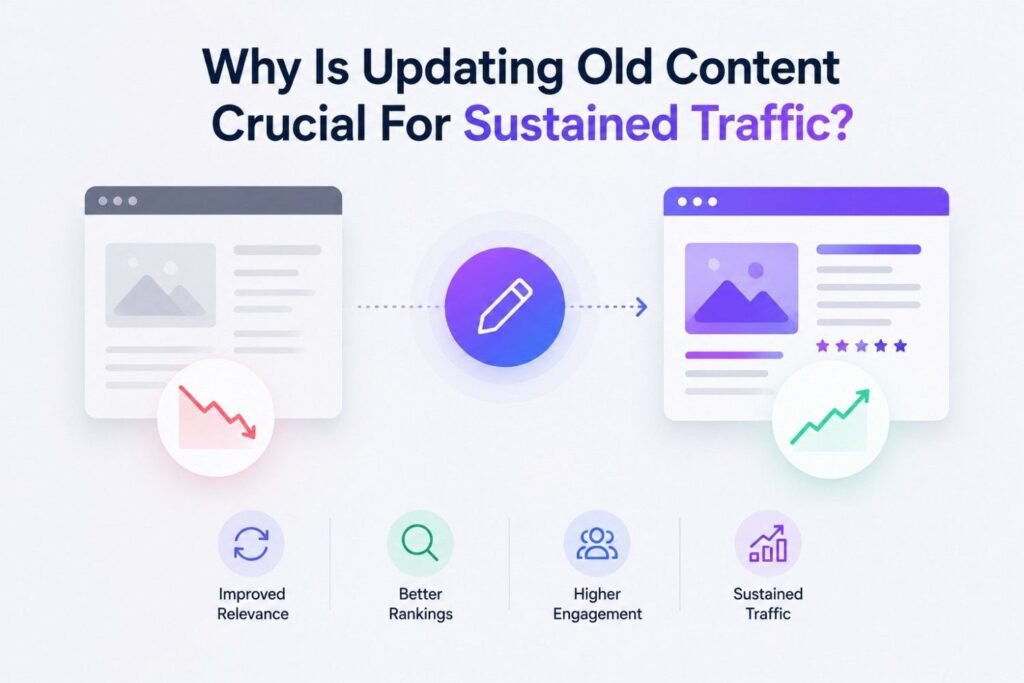
Many businesses make the mistake of publishing a blog post and then forgetting about it. However, content freshness is a significant ranking factor. Search engines prefer to serve users the most up-to-date information available. Regularly updating your old content is often a faster and more efficient way to increase blog traffic than writing entirely new articles.
You should monitor your analytics to identify signs that a blog post needs updating. A steady decline in traffic to a specific post, outdated information, or the realization that important subtopics are missing are all clear indicators that a refresh is necessary.
Effective Methods For Refreshing Existing Articles
When updating an article, the goal is to make it significantly better than the original version. This can involve adding recent statistics or data points to ensure the information is current. Expanding thin sections to provide more depth and improving the heading structure for better readability can also have a major impact.
Additionally, updating screenshots, replacing broken links, and optimizing for new, relevant keywords can breathe new life into an old post. By consistently maintaining and improving your existing content library, you ensure that your blog remains a valuable resource that continues to attract traffic over time.
How Can I Promote Content Across Multiple Channels Effectively?
Creating exceptional content is only half the battle; effective promotion is essential to ensure that your target audience actually sees it. Relying solely on organic search traffic can limit your growth potential. Promoting your content across multiple channels helps you reach a broader audience and drives immediate traffic to your blog.
Social media platforms are powerful tools for content distribution. Sharing your articles on LinkedIn, Facebook, X (formerly Twitter), and Instagram can help you connect with your followers and tap into new networks. However, it is important to tailor your message to each platform’s unique audience and format.
Leveraging Email Marketing And Content Repurposing
Email marketing remains one of the most effective ways to drive repeat traffic to your blog. Building a subscriber list allows you to communicate directly with an audience that has already expressed interest in your content. Sending regular newsletters featuring your latest blog posts encourages subscribers to return to your site.
Furthermore, repurposing your content into other formats can significantly expand its reach. A comprehensive blog post can be transformed into a video, an infographic, a series of short social media posts, or a carousel. By presenting your information in various formats, you cater to different learning styles and consumption preferences, maximizing the impact of your content creation efforts.
How Does Strengthening Internal Linking Boost SEO Performance?
Internal linking is often an underutilized strategy, yet it plays a crucial role in both user experience and SEO. Internal links connect different pages within your own website, establishing an information hierarchy and helping search engines understand the structure of your site.
When you link to other relevant pages naturally within your content, you provide readers with additional resources and encourage them to explore your site further. This reduces bounce rates and increases the average session duration, both of which are positive signals to search engines.
Best Practices For An Effective Internal Linking Strategy
To maximize the benefits of internal linking, it is important to follow best practices. Use descriptive anchor text that accurately reflects the content of the linked page, rather than generic phrases like “click here.” Ensure that you link to relevant pages naturally, providing genuine value to the reader.
Additionally, it is crucial to avoid “orphan pages”, pages that have no internal links pointing to them. Orphan pages are difficult for search engines to find and index, which means they are unlikely to receive any organic traffic. Regularly auditing your site to ensure all pages are interconnected helps maintain a healthy and effective site structure.
Why Do High-Quality Backlinks Still Matter For Search Rankings?
Despite the evolution of search engine algorithms, backlinks, links from other websites to your blog, remain one of the strongest indicators of authority and trustworthiness. A backlink acts as a “vote of confidence” from one site to another. When reputable websites link to your content, search engines interpret this as a signal that your content is valuable and deserves to rank higher.
However, not all backlinks are created equal. Search engines prioritize the quality and relevance of the linking site over the sheer quantity of links. A few high-quality backlinks from authoritative sites in your industry are far more beneficial than hundreds of low-quality links from irrelevant or spammy domains.
Proven Methods For Building A Strong Backlink Profile
Earning high-quality backlinks requires a proactive and strategic approach. Guest posting on reputable industry blogs allows you to showcase your expertise and earn a link back to your site. Digital PR involves creating newsworthy content and pitching it to journalists and publications, often resulting in high-authority links.
Resource page outreach involves identifying pages that curate helpful links in your industry and requesting that your content be included. Broken link building is another effective tactic, where you find broken links on other websites and suggest your content as a replacement. It is crucial, however, to avoid low-quality link schemes, such as buying links or participating in link farms, as these tactics can result in severe penalties from search engines.
How Does Website Speed And User Experience Affect Traffic?

Search engines prioritize websites that offer a superior user experience (UX). If your blog takes too long to load or is difficult to navigate, users will quickly abandon it, leading to a high bounce rate. Search engines interpret this behavior as a sign that your site is not providing value, which can negatively impact your rankings and, consequently, your traffic.
Technical improvements are essential for ensuring a positive UX. Faster loading times, mobile responsiveness, and adherence to Core Web Vitals (metrics that measure loading performance, interactivity, and visual stability) are critical factors that search engines use to evaluate your site’s performance.
Reducing Bounce Rate Through Better UX Design
A well-designed blog keeps visitors engaged and encourages them to explore further. Clear navigation, intuitive layout, and easily readable typography all contribute to a positive user experience. Optimizing images and minimizing the use of heavy scripts can significantly improve loading times.
By focusing on UX, you not only satisfy search engine algorithms but also create a more enjoyable environment for your human audience. A seamless experience reduces friction, keeping readers on your site longer and increasing the likelihood that they will return in the future.
How Can I Use AI, GEO, And Answer Engine Optimization To Increase Visibility?
The landscape of search is rapidly changing with the integration of Artificial Intelligence (AI) and Generative Engine Optimization (GEO). Traditional search engines are evolving into “answer engines,” providing users with direct, synthesized answers to their queries, often powered by AI overviews. To maintain and increase blog traffic, your content strategy must adapt to these new technologies.
Optimizing for AI overviews and generative search requires a focus on providing clear, concise, and direct answers to common questions. Structured headings and well-organized FAQ sections make it easier for AI models to extract and present your information.
Increasing Visibility Beyond Traditional Search Engines
In addition to optimizing for Google, it is increasingly important to ensure your content is visible to users of AI-powered platforms like ChatGPT, Perplexity, and Bing Copilot. These platforms rely on authoritative and well-structured content to generate their responses.
By establishing strong topical authority, maintaining high E-E-A-T standards, and formatting your content clearly, you increase the chances that your blog will be cited as a source by these AI engines. This emerging area of optimization offers a new avenue for driving traffic and building brand awareness in an AI-driven digital environment.
What Are Some Bonus Strategies To Increase Blog Traffic Faster?
While the core strategies discussed above form the foundation of sustainable growth, several additional tactics can help accelerate your progress. Targeting featured snippets, the highlighted answers that appear at the top of Google search results, can provide a significant traffic boost. This involves structuring your content to directly answer specific questions concisely.
Adding schema markup (structured data) to your blog posts helps search engines understand the context of your content, which can lead to enhanced search results, such as rich snippets. Encouraging social sharing by adding visible share buttons to your posts can also amplify your reach.
Building An Email List And Publishing Consistently
Building an email subscriber list is one of the most valuable assets for a blog. It provides a direct line of communication with your most engaged readers, allowing you to drive traffic on demand. Creating evergreen content, articles that remain relevant and valuable over a long period, ensures a steady stream of organic traffic over time.
Finally, publishing consistently is key. A regular publishing schedule signals to search engines that your site is active and provides your audience with a reason to keep coming back.
Why Do Many Blogs Fail To Attract Meaningful Traffic?
Understanding the common pitfalls that prevent blogs from succeeding is just as important as knowing the right strategies. Many blogs fail to attract traffic because they publish content without a clear strategy or purpose. Writing about random topics without considering search intent or audience needs rarely leads to sustained growth.
Ignoring basic SEO principles, such as proper keyword research and on-page optimization, is another common mistake. Additionally, targeting highly competitive keywords when your site lacks authority makes it nearly impossible to rank on the first page of search results.
The Impact Of Weak Promotion And Technical Issues
Even great content will fail if it is not promoted effectively. Relying solely on the “publish and pray” approach is rarely successful. A lack of internal links makes it difficult for search engines to crawl your site and for users to discover related content.
Furthermore, slow website performance and a poor user experience can drive visitors away before they even read your content. Addressing these common issues is essential for building a blog that consistently attracts and retains traffic.
How Can I Measure And Track My Blog Traffic Growth?
To understand the effectiveness of your strategies and make informed decisions, you must consistently measure and track your blog’s performance. Relying on guesswork is not a sustainable approach. Tracking key metrics allows you to identify what is working, what needs improvement, and where you should focus your efforts.
Important metrics to track include organic traffic (visitors from search engines), page views, click-through rate (CTR), bounce rate, average session duration, and conversion rate. Analyzing these metrics provides a comprehensive view of how users are interacting with your content.
| Metric | What It Measures | Why It Matters | Benchmark to Aim For |
|---|---|---|---|
| Organic Traffic | Visitors from search engines | Core indicator of SEO performance | Steady month-over-month growth |
| Page Views | Total number of pages viewed | Measures overall content consumption | Increasing trend over time |
| Click-Through Rate (CTR) | % of searchers who click your result | Indicates how compelling your title/meta is | 3–5% average for organic results |
| Bounce Rate | % of visitors who leave after one page | Signals content relevance and UX quality | Below 60% for blog content |
| Avg. Session Duration | Time spent on site per visit | Indicates content depth and engagement | 2–4 minutes for blog articles |
| Conversion Rate | % of visitors who complete a desired action | Measures business impact of traffic | Varies by industry; track trends |
Essential Tools For Tracking Performance
Several powerful tools are available to help you track and analyze your blog’s performance. Google Analytics provides in-depth data on user behavior, traffic sources, and conversions. Google Search Console is essential for monitoring your site’s presence in Google search results, tracking keyword rankings, and identifying technical issues.
Premium SEO tools like Ahrefs and Semrush offer advanced features for keyword research, competitor analysis, and backlink tracking. Utilizing these tools empowers you to refine your strategy based on hard data, ensuring continuous improvement and sustained growth.
Consistent Strategies Create Sustainable Blog Growth
Successfully increasing blog traffic is not the result of a single “hack” or a temporary surge in activity. It requires a commitment to a cohesive, long-term strategy that combines technical SEO, high-quality content creation, active promotion, and continuous optimization. By focusing on user intent, building topical authority, and ensuring a seamless user experience, you can transform your blog into a reliable source of traffic and leads.
At Eyes On Solution, we understand that building a powerful digital presence takes time and expertise. By implementing the strategies outlined in this guide and continuously refining your approach based on performance data, you can achieve sustainable blog growth that drives real business results. Focus on the long game, provide genuine value to your audience, and your traffic will steadily increase.
If you are ready to accelerate your blog growth and turn traffic into tangible business opportunities, contact us today. Our team can help you create a tailored SEO and content strategy that attracts qualified visitors, strengthens your online presence, and delivers lasting results.
Frequently Asked Questions
How long does it take to increase blog traffic using SEO?
SEO is a long-term strategy. While you might see initial improvements in 2-3 months, significant and consistent traffic growth typically takes 4-6 months or more, depending on your industry’s competitiveness and the consistency of your efforts.
What is the fastest way to get more visitors to my blog immediately?
For immediate traffic, leveraging your existing email list or promoting content across active social media channels are the fastest methods. Paid advertising can also drive instant traffic, but organic SEO provides the most sustainable long-term growth.
How often should I publish new blog posts for optimal growth?
Consistency is more important than sheer volume. Publishing 1-2 high-quality, well-researched, and SEO-optimized articles per week is generally more effective than publishing lower-quality content daily.
Can social media promotion actually increase my blog traffic?
Yes, social media can drive significant referral traffic. By sharing engaging snippets, infographics, or videos that link back to your full articles, you can tap into new audiences and encourage your followers to visit your site.
Do backlinks still help improve search engine rankings today?
Absolutely. High-quality backlinks from authoritative and relevant websites remain one of the strongest signals to search engines that your content is trustworthy and deserves to rank higher.
How important is internal linking for my blog’s SEO?
Internal linking is critical. It helps search engines understand the structure of your site, distributes page authority, and keeps readers engaged by guiding them to related content, which reduces bounce rates.
Can using AI-generated content help increase my blog traffic?
While AI can assist with outlining and brainstorming, purely AI-generated content often lacks the unique insights, depth, and human touch required to satisfy the E-E-A-T principles. Content should always be reviewed, refined, and enhanced by a human expert to ensure quality and originality.
What are the best tools available for tracking my blog’s performance?
Google Analytics and Google Search Console are essential free tools for tracking traffic and search performance. For advanced keyword research and competitor analysis, premium tools like Ahrefs and Semrush are highly recommended.
Why is my blog traffic dropping suddenly?
A sudden drop in traffic could be due to a search engine algorithm update, technical issues on your site (like slow loading speeds or broken pages), increased competition, or outdated content that needs to be refreshed.
How does website speed impact my blog’s ability to rank?
Website speed is a direct ranking factor. Slow-loading pages frustrate users, leading to high bounce rates. Search engines prioritize sites that offer a fast, seamless user experience, particularly on mobile devices.