
This comprehensive guide defines keyword research, details its foundational role in search engine optimization and generative engine optimization, and explains how modern search behavior has evolved. Written from the perspective of Eyes On Solution, a leading digital marketing agency in Dubai, this article provides actionable, step-by-step strategies to discover, group, and target high-converting search terms. Business owners, marketers, and content creators will learn how to align content with user search intent, build topical authority, and optimize for both traditional search engines and conversational AI assistants.
Every digital marketing strategy that succeeds in attracting qualified organic traffic begins with a single, foundational question: What is keyword research?
What Is Keyword Research and Why Is It Essential for SEO, GEO, and AI Search Visibility?
At its core, keyword research is the systematic process of identifying, analyzing, and prioritizing the specific words, phrases, and questions that your target audience enters into search engines and conversational AI assistants. It is not merely about finding words with high search volumes; it is about uncovering the language of your customers, decoding their underlying needs, and positioning your business to deliver the exact solutions they seek.
In the early days of the internet, keyword research was a simple, transactional task. Marketers would compile a list of generic terms, look up their monthly search volumes, and distribute those words across their website pages. Today, search behavior has undergone a profound evolution. The rise of voice search, mobile-first indexing, and AI-powered platforms has transformed search from a rigid query-and-response mechanism into an interactive, conversational dialogue.
As search engines have grown more sophisticated, the methods we use to optimize content must also evolve. Traditional Search Engine Optimization is now accompanied by Generative Engine Optimization, Answer Engine Optimization, and AI Optimization. These modern frameworks focus on ensuring that your content is not only indexed by search engines but is also selected, cited, and summarized by advanced artificial intelligence models like ChatGPT, Google Gemini, and Perplexity.
For businesses aiming to secure long-term digital visibility, understanding what keyword research is and executing it with modern search dynamics in mind, is no longer optional. It is the core engine of organic growth, brand credibility, and digital authority.
How Does Keyword Research Work in the Era of AI Search?
To understand how keyword research works today, we must first define what a “keyword” actually is in a modern context. A keyword is any search term, whether a single word, a multi-word phrase, or a complete question, that a user submits to find information online.
When you conduct keyword research, you are performing a deep analysis of market demand. You are seeking to understand:
- What are users searching for? (The exact terminology, phrasing, and syntax they use)
- How many people are searching for it? (The monthly search volume, indicating demand)
- In what format do they want the answer? (The search intent, whether informational, commercial, or transactional)
- How difficult will it be to rank for this term? (The organic competition and authority required)
Consider a real-world scenario. If a business owner in the United Arab Emirates is looking to improve their online presence, they might start by searching for a broad, highly competitive term like “keyword research tools”. As they refine their search, they might look for guidance on “how to do keyword research”. Eventually, when they decide to hire professional assistance, their search query shifts to a highly localized, transactional phrase such as “best SEO agency in Dubai”.
Each of these searches represents a different stage of the customer journey. Effective keyword research allows you to map your content to each of these stages, ensuring that you meet your prospects exactly where they are with the precise information they need.
Why Is Keyword Research the Foundation of Digital Growth?
Keyword research is the blueprint for your entire digital presence. Without it, you are essentially building a house without architectural drawings, relying on guesswork rather than data-driven insights.
At Eyes On Solution, we view keyword research as a strategic diagnostic tool that serves multiple critical business functions.
1. It Helps You Understand Your Audience
Keyword research is the closest thing to digital mind-reading. By analyzing search queries, you gain direct access to the actual pain points, questions, and desires of your target market. You learn the specific terminology they use, which often differs significantly from your internal industry jargon.
For example, while an enterprise software company might describe their product as an “integrated cloud-based human capital management suite”, their actual customers are likely searching for “simple payroll software for small businesses”. Keyword research bridges this communication gap, allowing you to speak the exact language of your audience.
2. It Drives High-Quality Organic Traffic
Ranking at the top of search results is meaningless if the visitors you attract have no interest in your services. Keyword research ensures that you target terms with high commercial relevance, bringing qualified leads to your website who are actively looking to engage or buy.
According to organic click-through rate data, the top three organic results on Google capture 68.7% of all clicks. Securing these coveted positions requires targeting the right keywords with content that perfectly matches user expectations.
3. It Structures Your Content Strategy
Instead of writing random blog posts and hoping they rank, keyword research allows you to build a structured, logical content plan. By grouping related keywords into “topic clusters,” you can create comprehensive hubs of information that establish your website as an authority in your industry. This systematic approach signals to search engine crawlers that your website possesses deep, specialized knowledge, which dramatically improves your overall rankings.
4. It Increases Your AI Search Visibility (GEO)
As search engines increasingly integrate generative AI summaries, such as Google’s AI Overviews, your content must be structured to satisfy these models. AI systems do not just look for matching words; they analyze semantic relationships and topical authority.
To be cited as a trusted source by ChatGPT, Gemini, or Perplexity, your content must address the precise, question-based prompts that users input into these platforms. Modern keyword research identifies these conversational queries, allowing you to optimize your pages for both traditional algorithms and generative AI models.
How Has Search Behavior Changed in the AI Era?
To fully appreciate the importance of modern keyword research, we must analyze the shift from traditional search engines to conversational answer engines.
Historically, search engines operated on a “lexical match” system, matching the exact words in a user’s query to the words on a webpage. Today, search engines utilize advanced natural language processing and semantic understanding to grasp the context, intent, and meaning behind a search.
The digital landscape is currently defined by four overlapping optimization frameworks, which we have outlined in the comparison table below:
| Optimization Framework | Core Objective | Primary Target Channels | Key Ranking Signals |
|---|---|---|---|
| Traditional SEO | Ranking individual webpages at the top of organic search results. | Google, Bing, Yahoo | Backlinks, page speed, on-page keyword placement, mobile-friendliness. |
| AEO (Answer Engine Optimization) | Optimizing content to secure direct answers, featured snippets, and voice search results. | Google Featured Snippets, Apple Siri, Amazon Alexa | Question-and-answer formatting, structured schema markup, concise definitions. |
| GEO (Generative Engine Optimization) | Ensuring content is cited, quoted, and referenced within AI-generated search summaries. | Google AI Overviews, Perplexity, ChatGPT Search, Gemini | Context-rich data, expert statistics, unique citations, semantic depth. |
| AIO (AI Optimization) | Structuring site-wide content so AI crawlers can easily interpret, categorize, and store your brand’s entities. | Large Language Models, AI scrapers, semantic indexes | Entity relationships, clear topical authority, structured data, clean code. |
As these frameworks converge, the definition of search success is shifting. In the past, ranking in the number one organic spot was the ultimate goal. Today, search engine result pages are highly dynamic, often dominated by local map packs, sponsored ads, and AI-generated summaries.
Indeed, recent CTR studies show a dramatic difference in user behavior when AI elements are present on the screen:
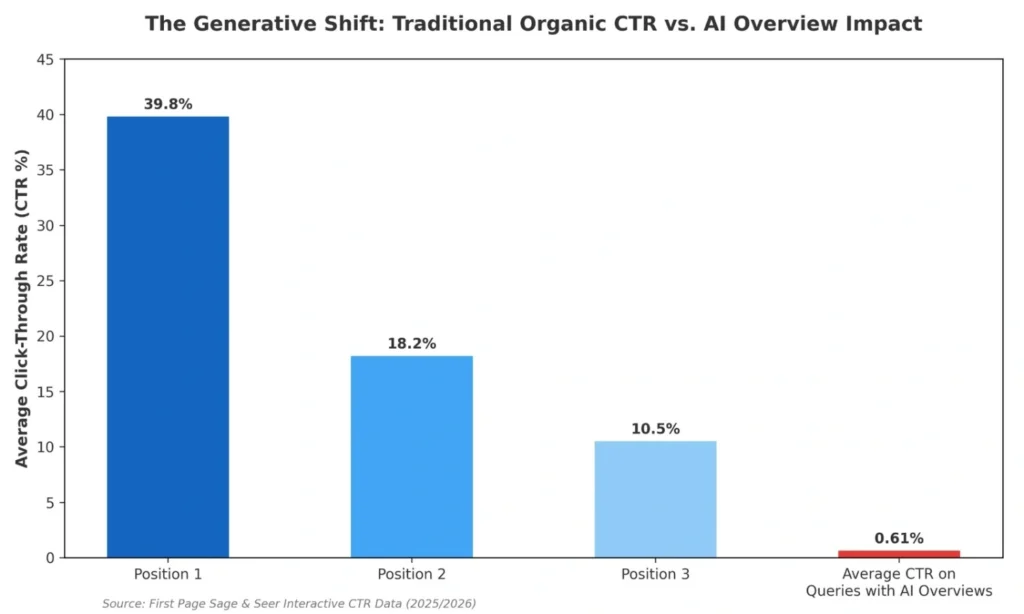
As shown in the chart above, while a traditional position one organic ranking can yield an impressive 39.8% click-through rate in standard search layouts, queries that trigger Google AI Overviews see a significant redistribution of clicks. In queries where an AI summary is present, the average CTR for organic results drops significantly, with some studies showing an average organic click-through rate of just 0.61% on highly impacted queries.
This does not mean organic search is dying; rather, it means your content must be optimized to be the source that the AI engine cites. If your website is cited as a reference within the AI Overview or ChatGPT response, you capture highly qualified, high-intent traffic that is ready to convert. Achieving this level of visibility requires a deep understanding of conversational keyword research.
What Types of Keywords Should You Target?
A successful digital strategy does not rely on a single type of keyword. Instead, it balances a diverse portfolio of search terms, each serving a specific purpose in your marketing funnel. When conducting keyword research, we categorize keywords based on two main criteria: length (or specificity) and search intent.
1. Keyword Length: Short-Tail vs. Long-Tail
Keywords are generally divided into three categories based on their length and specificity:
- Short-Tail Keywords (Head Terms): Broad, generic terms consisting of one or two words (e.g., “SEO” or “marketing”). These terms have massive search volumes but are highly competitive, extremely expensive to target, and suffer from very low conversion rates because the user’s intent is unclear.
- Medium-Tail Keywords: Phrases of two to three words that offer slightly more specificity (e.g., “SEO services” or “digital agency Dubai”). These have moderate search volume and competition.
- Long-Tail Keywords: Specific, highly focused phrases of four or more words, often written as questions or complete sentences (e.g., “what is keyword research for SEO success” or “best SEO agency in Dubai for real estate companies”).
To understand why targeting long-tail keywords is the most profitable strategy for most businesses, let us look at the relationship between search volume and conversion rates:
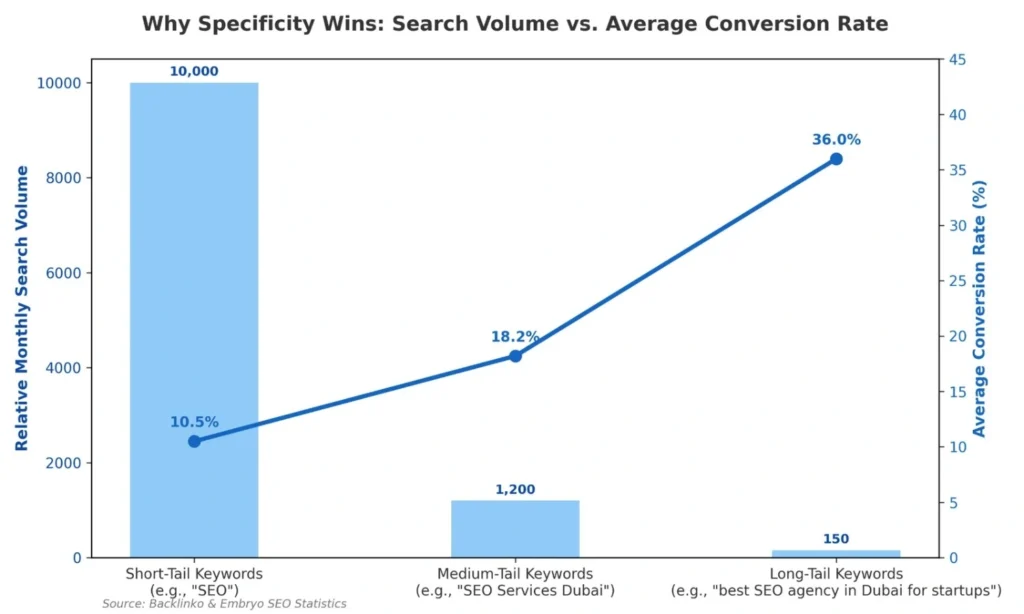
As illustrated in the chart above, short-tail keywords command massive relative search volumes but yield an average conversion rate of only 10.5%. In contrast, long-tail keywords, which represent highly specific, low-volume searches, deliver an outstanding average conversion rate of 36.0%.
This occurs because a user searching for a long-tail term is much further along in the buying cycle. A person searching for “SEO” is likely looking for a basic definition. A person searching for “affordable SEO services package JVC Dubai” is holding a credit card and looking for a service provider.
Furthermore, long-tail keywords dominate the internet. When we analyze the global search landscape, we find that the vast majority of search terms are highly specific, low-volume queries:
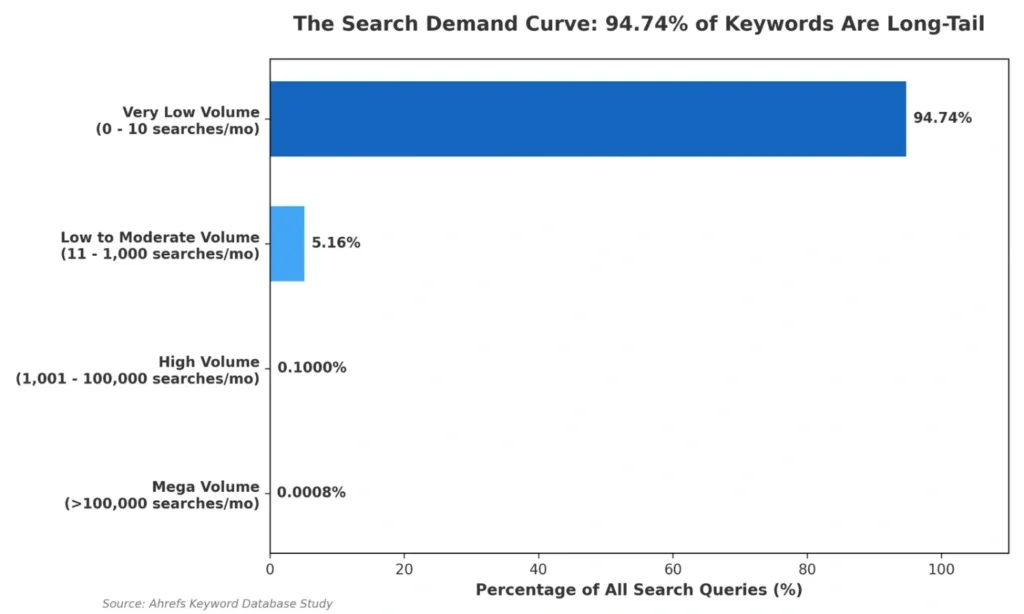
Ahrefs’ database studies reveal that a staggering 94.74% of all keywords get 10 or fewer monthly searches. Only a microscopic fraction (0.0008%) of keywords receive more than 100,000 monthly searches. By focusing your content strategy on capturing hundreds of highly specific, long-tail search terms, you can build a massive, highly stable stream of organic traffic that is protected from sudden algorithmic shifts.
2. Categorizing Keywords by Search Intent
Search intent is the “why” behind a search query. Understanding intent is the single most critical factor in modern keyword research. If you write the best article in the world but fail to match the user’s search intent, your page will never rank.
We classify search intent into four primary categories:
- Informational Intent: The user is seeking knowledge, answers, or explanations.
- Examples: “what is keyword research”, “how does SEO work”, “why is organic traffic important”.
- Content Format: Comprehensive blog posts, detailed guides, whitepapers, educational videos.
- Commercial Investigation Intent: The user is researching options, comparing services, or looking for reviews. They know what they want to buy, but they are deciding who to buy it from.
- Examples: “best SEO agency in Dubai”, “top content writing services reviews”, “Ahrefs vs Semrush comparison”.
- Content Format: Comparison tables, case studies, listicles, service packages.
- Transactional Intent: The user is ready to complete an action or make a purchase.
- Examples: “hire SEO consultant Dubai”, “buy blogger outreach service”, “contact digital marketing agency”.
- Content Format: Landing pages, contact forms, pricing tables, checkout pages.
- Navigational Intent: The user is trying to find a specific brand, website, or physical location.
- Examples: “Eyes On Solution home”, “Google Search Console login”, “JVC Dubai location”.
- Content Format: Clean homepage design, optimized brand profiles, clear contact pages.

How to Conduct Keyword Research Step-by-Step
Now that we have established the theoretical foundations of modern search, let us walk through the practical, step-by-step process of conducting keyword research. This is the exact, rigorous methodology we employ at Eyes On Solution to build high-performing digital campaigns for our clients.
Step 1: Identify Your Core Topics (Topical Seed Generation)
Every keyword research project begins with brainstorming. Before opening any software, write down the core topics that define your business. These are broad categories that represent your services, products, or industry expertise.
For a digital marketing agency, these core topics might include:
- Search Engine Optimization
- Content Writing
- Blogger Outreach
- Link Building
- Website Design & Development
These broad topics are not your target keywords; they are the “seeds” that you will use to generate highly specific search terms.
Step 2: Brainstorm Seed Keywords
Once you have your core topics, brainstorm specific terms that a customer might use to find those services. Think about the questions your sales team answers every day. What are the common pain points your clients express?
If your core topic is Blogger Outreach, your seed keywords might include:
- “get guest posts”
- “how to build backlinks”
- “blogger outreach service”
- “high authority guest blogging”
Step 3: Analyze and Filter by Search Intent
With your initial list of seed keywords, you must analyze the search engine results pages to determine what Google and AI engines believe the search intent is.
Type your seed keywords into search. What do you see?
- If the page is filled with blog posts and definitions, the intent is informational.
- If the page is filled with product category pages or service pricing, the intent is transactional.
- If the page is dominated by comparison lists and “top 10” articles, the intent is commercial.
Align your proposed content format with the dominant intent of the SERP. If you try to rank a transactional service landing page for a keyword that has strictly informational intent, you will fail.
Step 4: Find Related and Conversational Keywords
To expand your list, utilize search engines to discover related queries. Look at the “People Also Ask” boxes on Google, which represent direct questions users are searching for. Scroll to the bottom of the page to analyze “Related Searches.”
To capture generative AI search traffic, brainstorm conversational prompts. Instead of just targeting “link building”, optimize for prompts like “How does a professional link building campaign improve my Google rankings?” or “What is the difference between white-hat and black-hat SEO?”
Step 5: Study Competitor Keywords
Analyze the websites that are currently ranking for your target terms. What keywords are they targeting? Where are the “keyword gaps” terms your competitors are ranking for, but your website is completely missing?
By identifying these gaps, you can create superior, more comprehensive content that targets those exact terms, allowing you to capture their market share.
Step 6: Group Keywords into Topic Clusters
Do not treat keywords as isolated targets. Instead, organize them into logical, structured “topic clusters.” A topic cluster consists of a single, comprehensive “pillar page” (targeting a broad, high-volume keyword) surrounded by multiple “cluster pages” (targeting specific, long-tail, question-based keywords). All of these pages are linked together using natural, strategic internal links.
Here is an actionable example of a keyword cluster structured for digital marketing success:
[Pillar Page: SEO Company Dubai]
[Cluster Page 1: What is keyword research for SEO success?]
[Cluster Page 2: How does technical SEO improve site speed?]
[Cluster Page 3: Why is local SEO vital for JVC Dubai businesses?]
[Cluster Page 4: How to design a high-converting website?]
This interlinked structure helps search engine crawlers understand that your website possesses complete, authoritative coverage of the topic, which lifts the rankings of every page in the cluster.
Step 7: Prioritize Opportunities based on Value
You cannot target thousands of keywords at once. You must prioritize your opportunities based on three key metrics:
- Relevance: How closely does this keyword align with your actual services? A keyword with 10,000 searches that has low relevance is far less valuable than a keyword with 100 searches that has 100% commercial relevance.
- Difficulty: How strong are the websites currently ranking on page one? If page one is dominated by massive global directories, it may be wiser to target lower-competition, long-tail terms first.
- Search Volume: While volume is important, it must always be balanced against intent and difficulty.
What Are the Best Keyword Research Tools?
To execute keyword research at a professional level, you must utilize specialized software that provides accurate data on search volume, keyword difficulty, competitor rankings, and semantic entities.
Here is an overview of the industry-leading tools we recommend:
1. Google Keyword Planner
- How It Works: A free tool provided within the Google Ads platform. It is designed primarily for paid advertising campaigns but provides excellent baseline data on search volumes and keyword ideas.
- Best For: Brainstorming initial seed keywords and identifying seasonal search trends.
2. Ahrefs
- How It Works: A premium, industry-standard SEO suite with a massive keyword database of over 28 billion terms. It offers highly accurate keyword difficulty scores, backlink analysis, and competitor tracking.
- Best For: In-depth competitor analysis, keyword gap discovery, and backlink monitoring.
3. Semrush
- How It Works: Another leading premium SEO platform, boasting a keyword database of over 25 billion terms. It features advanced tools for content optimization, search intent classification, and market research.
- Best For: Search intent mapping, on-page SEO recommendations, and tracking daily keyword rankings.
4. Google Search Console (GSC)
- How It Works: A free tool provided by Google that shows the actual search queries that are driving traffic to your existing website.
- Best For: Identifying “low-hanging fruit” keywords where your site is currently ranking on pages two or three, which can be easily boosted to page one with minor content improvements.
5. AnswerThePublic
- How It Works: A visual search listening tool that extracts the actual questions, comparisons, and prepositions that users search for around a specific seed keyword.
- Best For: Discovering question-based, long-tail keywords that are perfect for AEO and GEO optimization.
6. AI-Powered Discovery Tools
- How It Works: Utilizing large language models to analyze topical entities and extract semantic relationships. Tools like ChatGPT and Perplexity can be prompted to identify logical subtopics and conversational queries that traditional keyword tools might miss.
- Best For: Entity extraction, building semantic topical maps, and generating conversational FAQ prompts.

How Does Keyword Research Support Professional SEO Services?
Keyword research is not an isolated exercise; it is the vital fuel that powers every single component of a professional search engine optimization campaign.
At Eyes On Solution, we integrate keyword research into our full suite of digital services to deliver comprehensive, compounding growth for our clients.
1. On-Page SEO Optimization
On-page SEO is the process of optimizing individual webpages to rank higher and earn more relevant traffic. Keyword research dictates exactly how we structure these pages. We place your primary and semantic keywords naturally within critical HTML elements, including:
- Title Tags & Meta Descriptions
- H1, H2, and H3 Headers
- Body Content & Image Alt Text
- URL Structures & Internal Link Anchor Text
By ensuring that these elements are perfectly aligned with your target keywords, we make it incredibly easy for search engine crawlers to understand the exact purpose of your page.
2. Strategic Content Writing Services
Great content is the vehicle that delivers your keywords to your audience. We use our keyword research to draft detailed content briefs for our professional writers. This ensures that every blog post, service page, and landing page we write is designed with a clear target keyword, a defined search intent, and a logical structure that answers real user questions.
Our Content Writing Services focus on producing clear, structured, and highly engaging content that turns passive readers into active customers.
3. High-Impact Link Building
Backlinks, links from other websites pointing to your site, are the primary currency of search engine trust. However, building links to random pages is highly inefficient. Keyword research tells us which pages have the highest commercial value.
Through our professional SEO Link Building campaigns, we secure high-quality backlinks pointing directly to these high-value pages, which rapidly accelerates their ranking progress.
4. Blogger Outreach Services
To secure trustworthy, natural backlinks, we perform direct, manual outreach to respected bloggers and publishers within your industry niche. We write valuable, informative articles that naturally reference your website and publish them on these trusted platforms.
Our targeted Blogger Outreach Service ensures that your brand gains powerful authority signals and highly relevant referral traffic from websites that your audience already trusts.
5. Advanced Local SEO Company Dubai
For businesses serving a specific geographic region, local search visibility is paramount. We perform localized keyword research to identify terms that include specific neighborhoods, landmarks, and regional phrasing in the UAE.
As an established SEO Company Dubai, we optimize your Google Business Profile and local landing pages to ensure you dominate local map packs and location-based searches, driving immediate foot traffic and local inquiries to your business.
What Common Keyword Research Mistakes Should You Avoid?
Even experienced marketers can fall into common traps that derail their search campaigns. When executing your digital strategy, ensure you avoid these six critical mistakes:
1. Chasing Search Volume Only
One of the most common mistakes is selecting keywords based solely on high search volume. A keyword with 50,000 monthly searches might look attractive, but if it is highly competitive and has low commercial relevance, you will waste months of effort attracting visitors who will never buy. Prioritize high-intent, long-tail keywords with moderate volume and low competition.
2. Ignoring Search Intent
If you write a detailed, informational blog post for a keyword that has strictly transactional intent, your page will never rank on page one. Search engines analyze user behavior to determine exactly what format of content users want. Always analyze the SERP before writing to ensure your content format matches user expectations.
3. Neglecting the Long-Tail
Many businesses ignore keywords with low search volumes (e.g., 20 or 50 searches per month). However, these specific, long-tail terms are incredibly easy to rank for and boast the highest conversion rates. A portfolio of hundreds of optimized long-tail pages will consistently outperform a few pages targeting highly competitive head terms.
4. Keyword Stuffing
Repeating your target keyword unnaturally throughout your content is a practice of the past. Modern search engines utilize semantic analysis and will penalize websites that engage in keyword stuffing. Write naturally, focus on clarity, and use semantic variations and synonyms that flow logically within your sentences.
5. Ignoring AI Search and GEO Trends
If you only optimize for traditional, short-tail keywords, you are missing out on the massive wave of conversational AI search. Ensure your content structures include clear, question-based headers and concise, direct answers that can be easily crawled, summarized, and cited by generative AI engines.
6. Failing to Update Your Research
Search behavior is dynamic. New trends emerge, competitor strategies shift, and search engine algorithms are constantly updated. Keyword research is not a one-time project; it is an ongoing process. You must regularly review your search data, identify new keyword opportunities, and update your existing content to maintain your rankings.
What Is the Future of Keyword Research?
As we look toward the future, the field of keyword research is set to become even more integrated with artificial intelligence, semantic understanding, and multi-platform discovery.
1. Entity-Based Search and Knowledge Graphs
Search engines are moving away from analyzing isolated keywords and are instead focusing on “entities” uniquely identifiable concepts, brands, people, and locations. The future of keyword research lies in understanding how your brand relates to other industry entities within Google’s Knowledge Graph. Optimizing for these relationships requires building deep, site-wide topical authority rather than optimizing individual pages in isolation.
2. Conversational Search Modeling
As users become more comfortable talking to AI assistants, search queries will continue to grow longer, more complex, and highly conversational. Keyword research will shift from analyzing static search phrases to modeling complete user dialogues and multi-turn search paths, where the AI assistant guides the user through a series of connected questions.
3. Multi-Platform Search Discovery
Search is no longer confined to a single search box on Google. Users are increasingly discovering brands, products, and services across a diverse ecosystem of platforms, including:
- Conversational AI Assistants (ChatGPT, Gemini, Claude)
- Social Media Platforms (TikTok, Instagram, LinkedIn)
- E-commerce Directories (Amazon, local business directories)
- Voice-Activated Devices and Smart Assistants
The future of keyword research requires analyzing search behavior across all of these platforms, ensuring that your brand is discoverable wherever your target audience chooses to search.
Turning Search Data into Business Growth
Keyword research remains the absolute foundation of digital visibility, brand credibility, and organic business growth. Whether you are optimizing for traditional search engines, voice assistants, or advanced generative AI models, the core principle remains exactly the same: you must understand the language of your audience and deliver content that perfectly satisfies their needs.
By combining traditional SEO practices with modern GEO, AEO, and AIO strategies, you can future-proof your digital presence. Focus on uncovering highly specific, long-tail keywords, organizing your content into comprehensive topic clusters, and writing with absolute clarity and purpose.
At Eyes On Solution, we are dedicated to helping businesses turn complex search data into clear, actionable growth strategies. Our team of digital marketing experts combines deep technical SEO, strategic content writing, and advanced outreach campaigns to help your website rise above the competition and attract the audience that truly matters.
Frequently Asked Questions (FAQ)
What is keyword research in SEO?
Keyword research in SEO is the systematic process of discovering, analyzing, and prioritizing the specific words, phrases, and questions that your target audience enters into search engines. The primary goal is to identify high-value search terms that align with your business offerings, allowing you to create optimized content that ranks higher in search results and attracts qualified organic traffic.
Why is keyword research important?
Keyword research is important because it provides a data-driven blueprint for your entire digital marketing strategy. It helps you understand your audience’s language, discover their pain points, structure your content strategy, and drive highly targeted visitors to your website who are actively looking to buy your services or products. Without it, your digital marketing efforts are based on guesswork rather than real market demand.
How do beginners do keyword research?
Beginners can start keyword research by listing the core topics that define their business, brainstorming basic “seed” keywords, and using free tools like Google Keyword Planner or Google Search Console to check search volumes and trends. Additionally, analyzing the “People Also Ask” boxes on Google search results is an excellent, free way to discover the exact questions and long-tail phrases that users are searching for.
What are long-tail keywords?
Long-tail keywords are highly specific search phrases consisting of four or more words, often phrased as questions or complete sentences (e.g., “best digital marketing company in Dubai for startups”). While they have lower individual search volumes than broad head terms, they are much less competitive to rank for and boast significantly higher conversion rates because they target users who are further along in the buying cycle.
What tools are used for keyword research?
Professional marketers utilize a variety of specialized tools for keyword research, including free tools like Google Keyword Planner, Google Search Console, and Google Trends. For deep competitor analysis, keyword difficulty metrics, and semantic entity tracking, premium industry-standard suites like Ahrefs, Semrush, and AnswerThePublic are highly recommended.
How does keyword research help AI search engines?
Keyword research helps AI search engines by identifying the conversational, question-based prompts that users input into platforms like ChatGPT, Gemini, and Perplexity. By structuring your content to answer these precise queries and using rich semantic variations, you make it incredibly easy for AI crawlers to understand your topical authority, increasing the likelihood that your website will be cited as a trusted source in AI-generated answers.
What is the difference between SEO, GEO, AEO, and AIO?
Traditional SEO focuses on ranking webpages in standard organic search engine results. AEO (Answer Engine Optimization) optimizes content to secure direct answers, voice search results, and featured snippets. GEO (Generative Engine Optimization) ensures content is cited and quoted within AI-generated search summaries like Google AI Overviews. AIO (AI Optimization) is the site-wide structuring of content so AI crawlers can easily interpret, categorize, and index your brand’s entities.
How often should keyword research be updated?
Keyword research should be reviewed and updated regularly, ideally every six to twelve months. Search behavior is dynamic; new trends emerge, competitor strategies change, and search engine algorithms are constantly updated. Regularly updating your keyword research allows you to discover fresh search opportunities, optimize your existing content for shifting search intent, and maintain your organic rankings over time.