

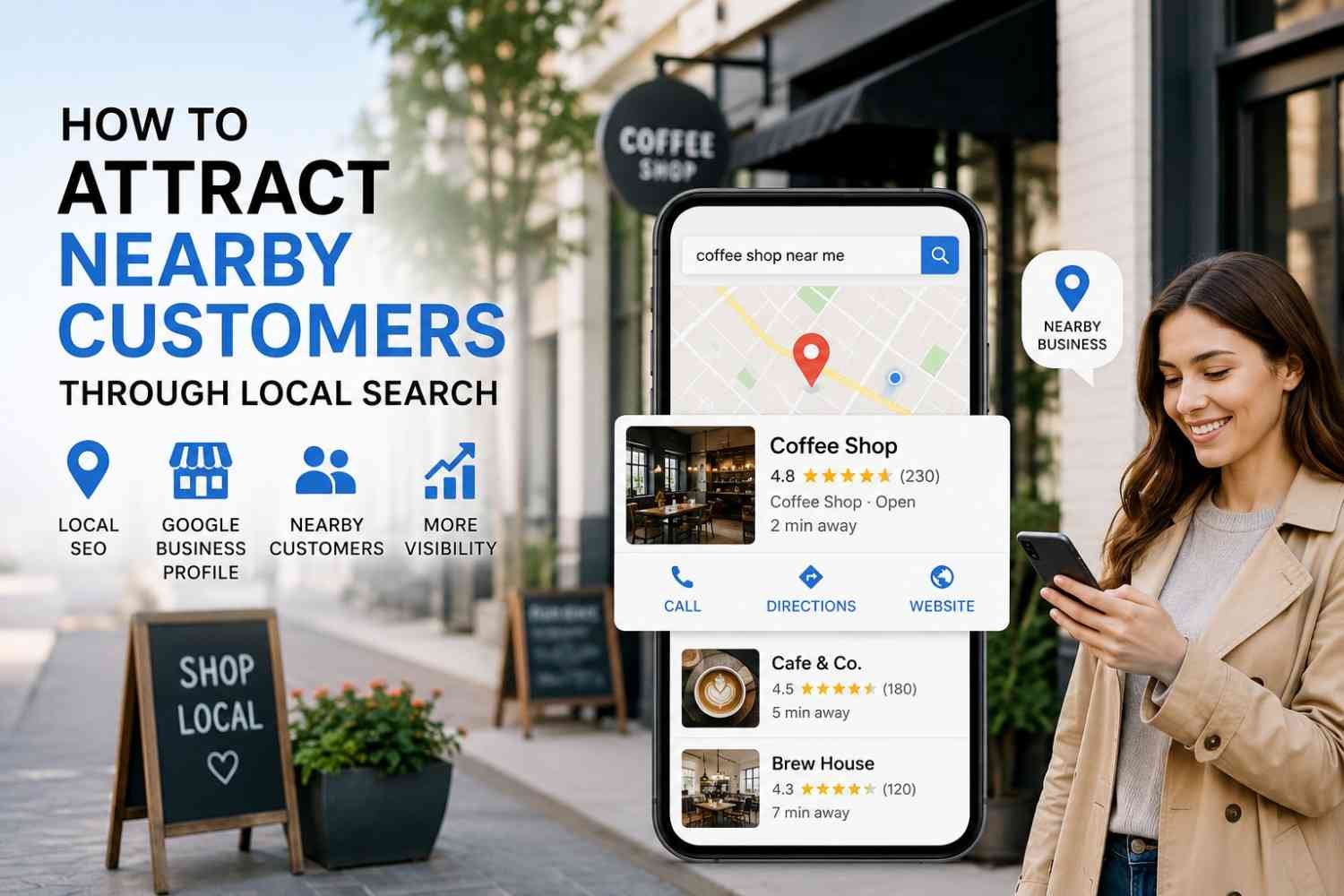

Every day, millions of people pull out their phones and type “coffee shop near me,” “dentist open now,” or “best pizza in Dubai.” These are not casual searches, they are buying signals. According to Google, 46% of all searches have local intent, and 76% of people who search for something nearby on their smartphone visit a business within 24 hours.
If your business is not showing up in those moments, you are handing customers directly to your competitors.
This is exactly where Local SEO becomes your most powerful growth tool. Local search optimization ensures your business appears in front of the right people, in the right location, at the exact moment they are ready to act. Whether you run a restaurant, a clinic, a law firm, or a retail store, investing in a strong local SEO strategy can transform your online presence into a steady stream of real, nearby customers.
In this guide, you will learn exactly how Local SEO works, why it matters, and the specific steps to improve your local rankings and attract more customers from your area.
What Is Local SEO and How Does It Differ From Traditional SEO?
Local SEO is the process of optimizing your online presence so your business ranks higher in location-based search results. While traditional SEO focuses on ranking nationally or globally for broad keywords, Local SEO targets customers searching within a specific city, neighborhood, or region.
When someone searches “plumber in Dubai” or “best salon near me,” Google uses a combination of relevance, distance, and prominence to decide which businesses appear in the local pack; that three-business map results at the top of the page. Local SEO is the discipline of earning that prime real estate.
Local SEO vs. Traditional SEO, Key Differences
| Factor | Traditional SEO | Local SEO |
| Target Audience | National / Global | City, neighborhood, region |
| Search Intent | Broad information seeking | Ready-to-buy, location-specific |
| Key Ranking Factor | Domain authority, backlinks | Proximity, NAP consistency, reviews |
| Main Platforms | Google Search | Google Search + Google Maps + Local Pack |
| Content Focus | General industry topics | Location-specific pages and content |
| Primary Tool | Google Search Console | Google Business Profile |
| Conversion Speed | Slower (awareness stage) | Faster (purchase-intent stage) |
Google determines local rankings using three core factors: relevance (how well your listing matches the search), distance (how close your business is to the searcher), and prominence (how well-known and trusted your business is online). Local SEO is the art of winning across all three.

Why Local SEO Is Important for Businesses That Want to Grow
Local SEO is not just a marketing trend, it is a business survival strategy. Here is what the data tells us:
- “Near me” searches have grown by more than 500% in the past five years (Google)
- 28% of local searches result in a purchase within 24 hours
- 97% of consumers use the internet to search for local businesses
- Businesses with complete Google Business Profiles are 2.7x more likely to be considered reputable
- Mobile voice searches for local businesses have increased by over 58% since 2020
Business Impact of Local SEO Across Industries
| Industry | Primary Local Search Keyword Type | Avg. Conversion from Local Search |
| Restaurant / Cafe | “best [cuisine] near me” | 70–80% |
| Healthcare Clinic | “[specialty] doctor in [city]” | 65–75% |
| Legal Services | “lawyer near me” | 55–65% |
| Home Services | “plumber / electrician in [area]” | 60–70% |
| Real Estate | “property agent in [city]” | 45–55% |
| Retail Store | “shop open near me” | 65–75% |
Example: A local restaurant in Dubai that ranks for “best biryani near me” or “French restaurant in Deira” will receive more direct calls, reservation requests, and walk-in customers than a competitor with no local SEO presence, even if that competitor has a better physical location.
Local SEO converts because the intent is already there. You are not convincing people to want what you offer. You are simply making sure they can find you when they already do
How to Optimize Your Google Business Profile to Dominate Local Search
Your Google Business Profile is the single most important asset for local visibility. It controls what appears in the Google Map Pack, Google Maps, and knowledge panels, all premium positions that do not require paid ads.
Core optimization steps:
1. Complete Every Section Accurately: Fill out your business name, address, phone number, website, and hours of operation with 100% accuracy. Inconsistency here directly hurts your rankings.
2. Choose the Right Business Categories: Your primary category signals to Google exactly what you do. A dentist should select “Dentist”, not “Healthcare.” Add secondary categories to cover related services.
3. Add Services, Products, and Descriptions: List every service you offer with descriptions. This gives Google more signals to match your profile with relevant searches.
4. Upload High-Quality Photos Regularly: Businesses with photos receive 42% more direction requests and 35% more website clicks than those without. Upload interior, exterior, team, and product photos.
5. Use Google Posts: Publish weekly updates, offers, or events through Google Posts. This keeps your profile active and increases engagement signals.
6. Collect and Respond to Reviews: Reviews are a top-three local ranking factor. Ask satisfied customers for reviews after each interaction, and respond to every review, positive or negative, professionally.
Google Business Profile Optimization Checklist
| Optimization Element | Completed? | Impact Level |
| Business name (exact match) | ✅ / ❌ | High |
| Accurate address | ✅ / ❌ | High |
| Local phone number | ✅ / ❌ | High |
| Primary + secondary categories | ✅ / ❌ | High |
| Business description with keywords | ✅ / ❌ | Medium |
| Services / products listed | ✅ / ❌ | Medium |
| 10+ photos uploaded | ✅ / ❌ | Medium |
| Weekly Google Posts | ✅ / ❌ | Medium |
| 20+ reviews with responses | ✅ / ❌ | High |
| Q&A section answered | ✅ / ❌ | Low–Medium |
How to Target the Right Local Keywords to Rank Higher in Your City
Ranking locally starts with using the language your customers actually search. Local keyword targeting is about combining your service with your location to capture high-intent traffic.
Keyword Formula: [Service] + [Location]
- “SEO agency in Dubai”
- “Italian restaurant in Business Bay”
- “Pediatric dentist in Jumeirah”
- “Digital marketing company near me”
Types of Local Keywords to Target:
| Keyword Type | Example | Search Intent |
| Service + City | “web design company Dubai” | Commercial |
| Near Me | “accountant near me” | High purchase intent |
| Long-tail local | “affordable SEO services for small business in Dubai” | Very high conversion |
| Neighborhood-specific | “gym in Dubai Marina” | High local intent |
| Question-based | “which digital agency is best in Abu Dhabi” | Research intent |
Tools to Find Local Keywords:
- Google Keyword Planner, search volume by location
- Google Autocomplete, type your service and see what Google suggests
- Google Trends, compare keyword interest by region
- Google Search Console, see what terms already bring visitors
Place your target keywords naturally in your page title, H1, meta description, first paragraph, and throughout body content. Avoid keyword stuffing, Google rewards natural, readable content.

Why Creating Location-Specific Landing Pages Attracts More Local Customers
If your business serves multiple areas, a single generic homepage is not enough. Location-specific landing pages allow you to rank for searches in multiple neighborhoods or cities simultaneously.
Each location page should include:
- A unique H1 targeting the specific area (e.g., “SEO Services in Dubai Marina”)
- A brief introduction mentioning the neighborhood or city
- Local testimonials from customers in that area
- An embedded Google Map showing your business or service area
- Local phone number and address
- Area-specific FAQs
Example page structure:
Title: “Digital Marketing Services in Jumeirah, Dubai” Content: Discuss how your services help businesses specifically in Jumeirah, include a client story from the area, and add a map and direct contact CTA.
Do not copy-paste the same content across location pages and just swap the city name. Google penalizes thin duplicate content. Every page must offer genuine, unique value for that location.
How Local Citations and Directory Listings Build Trust With Google
A local citation is any online mention of your business’s Name, Address, and Phone number (NAP). Google uses citations to verify that your business is legitimate, active, and trustworthy.
Top Directories for Local Citations:
- Google Business Profile
- Apple Maps
- Bing Places
- Yelp
- TripAdvisor (for hospitality)
- Foursquare
- Yellow Pages
- Industry-specific directories
NAP Consistency Is Non-Negotiable
If your address appears as “Sheikh Zayed Road” in one directory and “SZR” in another, or your phone number varies by one digit, these inconsistencies confuse Google’s algorithms and damage your rankings.
Citation Health Impact on Local Rankings
| Citation Status | Ranking Impact |
| Consistent NAP across 50+ directories | Strong positive signal |
| Inconsistent NAP | Moderate ranking penalty |
| Missing from major directories | Reduced trust and visibility |
| Duplicate listings | Negative impact, must be resolved |
Audit your citations at least twice per year using tools like BrightLocal or Moz Local to catch and fix any inaccuracies.
How Customer Reviews Can Make or Break Your Local SEO Rankings
Reviews are one of the top three ranking factors in Google’s local algorithm. They influence not only where you rank, but whether searchers choose to click, or call.
What the data shows:
- 93% of consumers say online reviews impact their purchase decisions
- Businesses with a 4.0+ star rating receive significantly more clicks in local search
- Responding to reviews increases consumer trust by 45% (BrightLocal, 2024)
- Google prioritizes businesses with a consistent stream of recent reviews over those with many old reviews
Review Generation Strategy:
- Ask at the right moment, right after a positive interaction
- Make it easy, send a direct Google review link via SMS or email
- Respond to every review within 24–48 hours
- Address negative reviews calmly and professionally
- Never buy fake reviews, Google penalizes this severely
What Type of Localized Content Attracts Customers in Your Area
Content is the fuel that powers Local SEO. Publishing high quality localized content regularly signals to Google that your business is active, relevant, and authoritative in your area.
Localized content ideas:
| Content Type | Example Topic | Purpose |
| Local blog posts | “5 Digital Marketing Trends for Dubai Startups in 2026” | Drives local traffic |
| Community coverage | “Our Participation in the Dubai SME Expo” | Builds local authority |
| Area-specific FAQs | “How long does SEO take to work for Dubai businesses?” | Captures question searches |
| Client success stories | “How We Helped a Jumeirah Restaurant Rank #1 on Google Maps” | Trust + local relevance |
| Seasonal content | “Ramadan Marketing Tips for Dubai Restaurants” | Timely local searches |
Post consistently, at minimum two to four times per month. Each piece of local content is another opportunity to rank for a search that drives real foot traffic or inquiries.
Why Mobile Optimization and User Experience Determine Your Local Search Rankings
More than 60% of all local searches happen on mobile devices. If your website delivers a poor mobile experience, you will lose customers before they ever contact you and Google will penalize your rankings for it.
Mobile UX factors that affect local rankings:
- Page load speed: Pages that load in under 2 seconds have significantly lower bounce rates. Use Google PageSpeed Insights to test yours.
- Responsive design: Your website must adapt perfectly to any screen size.
- Click-to-call buttons: Local searchers want to call instantly. A visible tap-to-call button on mobile increases conversions dramatically.
- Easy navigation: Visitors should find your address, hours, and contact info within two taps.
- Voice search readiness: Optimize for natural language queries like “Where can I find the best SEO agency in Dubai?” These are increasingly common via Siri, Google Assistant, and Alexa.
How Building Local Backlinks or Link Building Increases Your Authority in Local Search
Backlinks, links from other websites pointing to yours, remain a major ranking signal. For local SEO, the quality and local relevance of those links matters most.
High-value local backlink sources:
| Backlink Source | How to Get It | Authority Impact |
| Local news websites | Press releases, community stories | Very High |
| Chamber of commerce | Business membership listing | High |
| Local bloggers / influencers | Collaboration, product review | Medium–High |
| Industry associations | Membership or sponsorship | High |
| Community sponsorships | Event sponsorship credit | Medium |
| Guest posts on local blogs | Pitch relevant content | Medium |
| University / government sites | Partnerships or resource links | Very High |
One strong backlink from a respected local news site is worth more than twenty generic directory links. Focus on building relationships within your community first.
How to Track and Measure Whether Your Local SEO Strategy Is Actually Working
Without measurement, SEO is guesswork. Track these KPIs consistently to understand what is working and where to improve.
Key Local SEO Metrics to Monitor:
| Metric | Tool | What It Tells You |
| Local keyword rankings | Google Search Console / SEMrush | Are you climbing for target terms? |
| Google Maps impressions | Google Business Profile Insights | How often do you appear in map searches? |
| Phone calls from GBP | GBP Insights | Direct business impact |
| Direction requests | GBP Insights | Foot traffic intent |
| Website traffic | Google Analytics 4 | Volume of search-driven visitors |
| Bounce rate | Google Analytics 4 | Content relevance quality |
| Conversion rate | Google Analytics 4 | Leads / sales from organic traffic |
| Review score | GBP / BrightLocal | Reputation trend |
Review these metrics monthly, identify patterns, and adjust your strategy accordingly. Local SEO is a long game, but businesses that stay consistent see compounding results over time.
Local SEO is no longer optional for businesses that want to grow. It is the bridge between your business and the nearby customers actively searching for exactly what you offer. From a fully optimized Google Business Profile to targeted local keywords, location-specific landing pages, consistent citations, and genuine customer reviews, every element works together to build your local authority and drive real results.
The businesses appearing at the top of Google Maps and local search today are not there by luck. They invested in a deliberate, consistent local SEO strategy and it is paying off in the form of more calls, more walk-ins, and more revenue.
Whether you are starting from scratch or looking to improve your existing local presence, the strategies in this guide give you a clear roadmap. The best time to start was yesterday. The second best time is now.Ready to attract more nearby customers and grow your local presence?
Contact Eyes On Solution today for a tailored Local SEO strategy built specifically for your business, your location, and your goals.
Frequently Asked Questions About Local SEO
What is Local SEO and how does it work for small businesses?
Local SEO is the process of optimizing your online presence so your business appears in location-based search results on Google Search and Google Maps. For small businesses, it levels the playing field by helping you compete with larger brands within your specific city or neighborhood, without needing a massive advertising budget.
How long does Local SEO take to show results for a new business?
Most businesses begin to see noticeable improvements within 3–6 months of consistent optimization. However, timelines vary based on competition in your area, the current state of your website, and the quality of your Google Business Profile. Highly competitive markets like Dubai may take 6–12 months to see significant ranking movement.
Does having a Google Business Profile really help my Local SEO rankings?
Yes, a complete and actively managed Google Business Profile is one of the most powerful Local SEO tools available. Businesses with optimized profiles are 2.7x more likely to be considered reputable, and they rank significantly higher in both Google Maps and the local pack results.
What are the best Local SEO strategies for restaurants and cafes?
Restaurants benefit most from Google Business Profile optimization (especially photos and reviews), ranking for “near me” and cuisine-specific searches, publishing localized blog content, and maintaining consistent NAP information across all food directories like Zomato, TripAdvisor, and Yelp.
How do customer reviews affect Local SEO rankings?
Reviews are one of Google’s top three local ranking factors. Both the quantity and recency of reviews matter. Businesses that consistently generate new positive reviews and respond professionally to all feedback rank higher and receive more clicks than competitors with outdated or fewer reviews.
What is the difference between Local SEO and regular SEO?
Traditional SEO targets broad, national, or global audiences. Local SEO specifically targets customers in a defined geographic area using location signals, Google Maps, the local pack, and proximity-based ranking factors. Local SEO converts faster because searchers already have purchase intent.
How much does Local SEO cost for a small business?
Local SEO costs vary widely depending on your industry, location, and the level of competition. DIY efforts (managing your own GBP, creating content, building citations) can be done at minimal cost. Hiring a professional local SEO agency typically ranges from a few hundred to several thousand dollars per month, depending on the scope of work and market competition.
Which industries benefit most from Local SEO services?
Any business that serves customers in a specific geographic area benefits from Local SEO. This includes restaurants, healthcare providers, legal firms, real estate agencies, home service companies, retail stores, gyms, beauty salons, and educational institutions. If your customers need to visit you or you serve a defined area, Local SEO is essential.
