Search is changing. The way people find information, compare services, and make buying decisions online looks different today than it did three years ago. AI-powered answer engines are now responding to queries with direct summaries instead of a list of links. Users are getting answers without clicking through to a website. And businesses are wondering: does traditional SEO still matter?
This is where the debate between SEO and GEO begins.
SEO has been the foundation of digital visibility for decades. It is how businesses rank on Google, attract organic traffic, and build long-term authority online. GEO is the practice of optimizing content so that it gets cited, surfaced, and recommended by AI-driven search experiences.
Both matter. Neither is going away. But the businesses that understand how they work together will have a significant advantage over those that ignore the shift.
This article is for business owners, marketing managers, and digital teams who want to understand the real relationship between SEO and GEO and how to position their business for long-term search visibility in an AI-driven world.
At Eyes On Solution, we work with businesses across industries to build search strategies that combine both. Here is everything you need to know.
What Is SEO and Why Has It Driven Business Growth for So Long?
What Does SEO Actually Mean for Your Business?
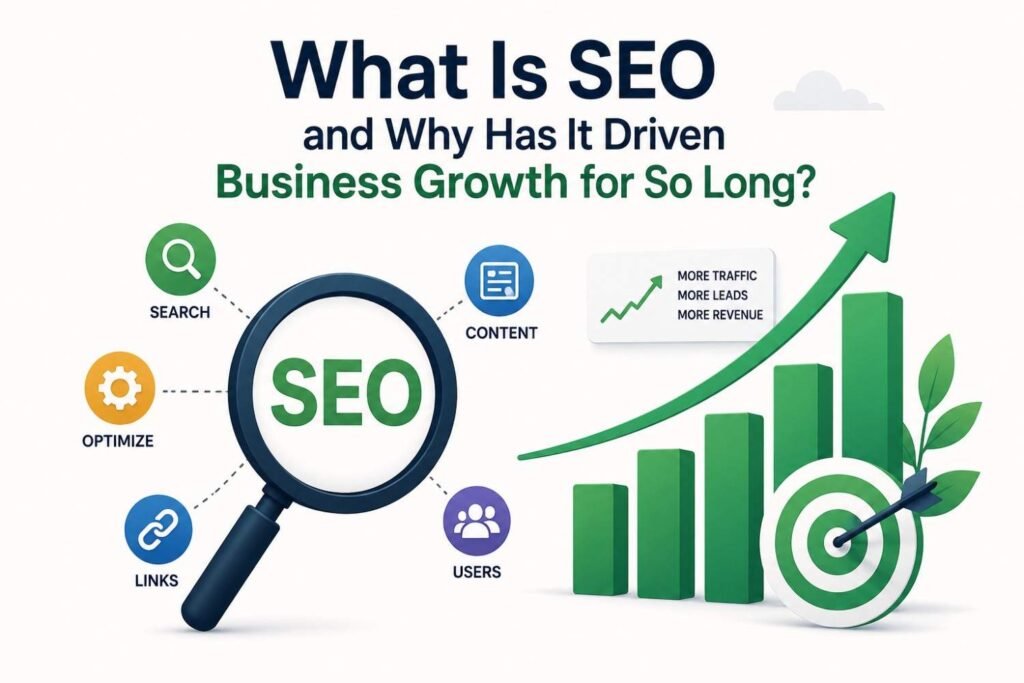
Search Engine Optimization is the process of improving a website so that it ranks higher in search engine results pages, primarily on Google. When someone searches for a service, product, or answer, SEO determines whether your website appears at the top of those results or gets buried on page three where no one looks.
SEO works by aligning your website with the signals search engines use to evaluate quality: relevance, authority, technical performance, and user experience. Done well, it brings a consistent stream of potential customers to your website without paying for every click.
If you are new to search optimization, understanding what SEO means and how it works can help you see why it still plays a major role in digital visibility.
What Are the Core Components of SEO That Still Drive Results?
SEO is not a single tactic. It is a combination of strategies that work together:
On-Page SEO involves optimizing the content, headings, meta tags, and keyword usage on each page of your website. It ensures that search engines understand what your page is about and that users find it relevant.
Technical SEO covers the structural and performance aspects of your website, page speed, mobile-friendliness, crawlability, site architecture, and schema markup. A technically sound website is easier for search engines to index and rank.
Off-Page SEO refers to the external signals that build your website’s authority, primarily backlinks from other reputable websites. When trusted sources link to your content, it signals to search engines that your website is credible and worth ranking.
Content Optimization is the process of creating content that answers real questions, targets relevant search terms, and provides genuine value. High-quality, well-structured content is the foundation of both SEO and GEO performance.
Link Building is a focused strategy within off-page SEO. Through services like guest posting, blogger outreach, and custom outreach, businesses earn links from authoritative websites that strengthen their domain authority and improve rankings across the board.
Why Does SEO Still Matter?
Despite the rise of AI, SEO continues to deliver measurable results for businesses. Here is why it remains essential:
- Organic search is still the largest driver of website traffic for most industries
- Search engines still rely on website content to generate their results, including AI-generated summaries
- Long-term SEO investment compounds over time, making it one of the highest ROI channels in digital marketing
- Brand credibility is built through consistent search visibility, appearing on page one signals trust to potential customers
- Paid advertising stops the moment you stop spending; organic SEO rankings continue to generate traffic
SEO is not a legacy strategy. It is an evolving discipline that adapts to how search engines change and right now, the most significant change is the integration of AI.
What Is GEO and How Does It Work Differently from SEO?
What Does GEO Stand for in Digital Marketing?
Generative Engine Optimization is the practice of optimizing your content so that AI-powered search tools and answer engines choose to surface, cite, or recommend your business when users ask questions.
Where traditional SEO targets how search engines rank and display links, GEO targets how AI models select and present information in direct responses. Think of the difference between your website appearing as a link in search results versus your business being mentioned by name in an AI-generated answer.
How Does GEO Work in Practice?
When a user asks an AI-powered search engine a question, the AI does not search the web in real time and display links. Instead, it draws on indexed content, authoritative sources, and structured data to generate a direct, conversational answer. It may cite sources, but the primary output is a synthesized response.
For your business to appear in that response, your content needs to:
- Be recognized as authoritative and credible by AI models
- Be written in clear, structured language that AI can parse accurately
- Cover topics comprehensively with expert-level depth
- Use semantic signals, entities, relationships, and context, rather than just keywords
- Be cited or referenced by other trusted sources across the web
GEO is not about gaming AI systems. It is about producing the kind of content that AI models trust enough to recommend.
Which Platforms and Search Experiences Use GEO Principles?
GEO is relevant across the growing range of AI-powered search and answer experiences that users are increasingly turning to for information and recommendations. These include AI-generated overview panels in traditional search, conversational AI assistants, voice search, and AI-driven product recommendation tools.
The common thread is that all of these experiences prioritize authoritative, well-structured, semantically rich content, the same principles that underpin a strong GEO strategy.
GEO vs SEO: What Is the Difference Between the Two Strategies?
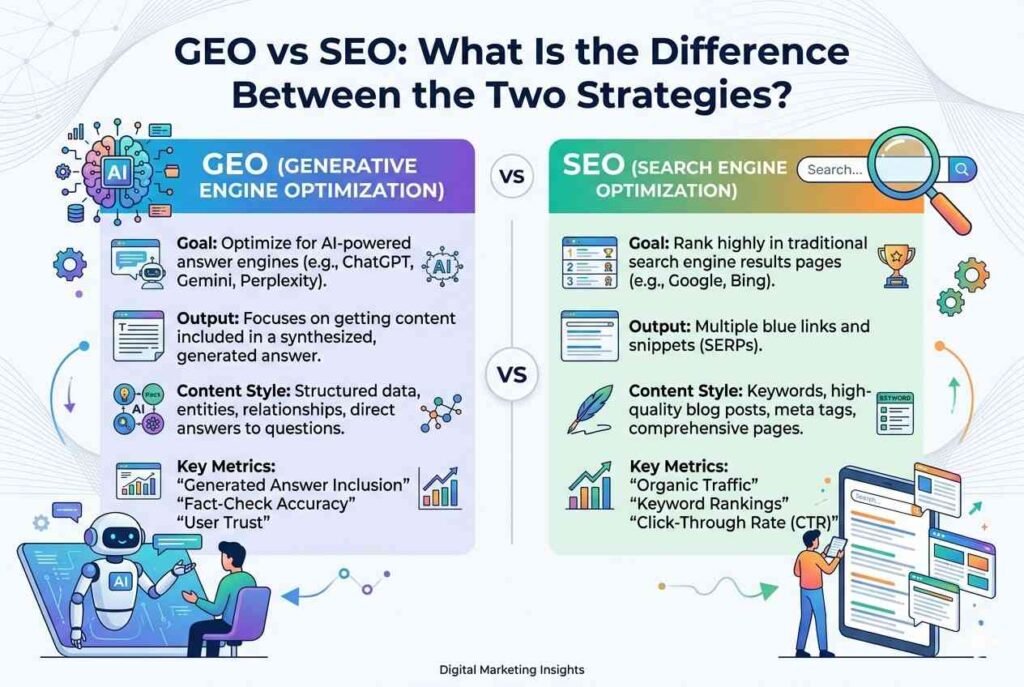
Understanding how GEO and SEO differ helps clarify why both are necessary and why neither replaces the other.
Traditional Search vs AI Search: How the User Experience Has Changed
In traditional search, a user types a query, receives a page of ranked links, and clicks through to find their answer. Your website’s job is to rank highly enough to get that click.
In AI-powered search, a user asks a question in natural language and receives a direct answer. Your content’s job is to be the source that the AI draws from, whether or not the user clicks through to your website.
Both types of search still happen simultaneously, which is why both SEO and GEO need to be part of your strategy.
How Do the Ranking Factors Compare Between SEO and GEO?
| Factor | SEO (Traditional Search) | GEO (AI-Powered Search) |
|---|---|---|
| Primary focus | Keywords and search intent | Context, entities, and semantic meaning |
| Authority signals | Backlinks from trusted domains | Citations, brand mentions, and credibility |
| Visibility metric | SERP ranking position | Cited in AI-generated answers |
| Technical requirements | Site speed, crawlability, structured data | Structured information, clear formatting |
| Content approach | Keyword-optimized pages | Expert-driven, conversational, comprehensive |
| User journey | User clicks through to website | AI synthesizes and summarizes your content |
| Time to results | 3–6 months typically | Ongoing — tied to AI model training and indexing |
| Link building role | High importance for domain authority | Builds credibility signals that AI models recognize |
Businesses comparing long-term organic growth with paid acquisition should also understand the differences between SEO vs PPC comparison strategies before deciding where to invest marketing budgets.
How Has the User Experience Changed?
Users now expect faster, more direct answers. Conversational queries, the kind typed as full questions or spoken via voice search, have increased significantly. Users are less patient with long pages of links and more responsive to direct, structured answers.
This means content that is written in a clear, question-and-answer format, with concise summaries and well-organized sections, performs better in both traditional search and AI-generated responses.
Will GEO Completely Replace SEO? Here Is the Honest Answer
This is the question most businesses want answered directly, so here it is: No. GEO will not replace SEO. But it will change how SEO is practiced.
Why SEO Remains Essential Even as AI Search Grows
Search engines do not operate independently of websites. They index website content, follow links, evaluate structured data, and use all of the signals that SEO has always targeted to determine what content is credible and relevant. AI-generated answers are built on the same web that SEO has always shaped.
If your website is not well-optimized, AI models are less likely to find, index, and trust your content. Technical SEO remains the infrastructure on which everything else depends, including GEO performance.
Consider these realities:
- AI models need trusted content sources to generate accurate answers and those sources are primarily well-optimized websites
- Google’s core ranking algorithm continues to power the majority of global search traffic
- Local search, transactional queries, and comparison searches still heavily rely on traditional search results
- High-authority backlinks continue to signal credibility to both search engines and AI systems
Why GEO Is Growing Rapidly and Cannot Be Ignored
AI-powered search is not a trend, it is a structural shift in how people access information. The growth of conversational search, voice queries, and AI-assisted research means a growing share of search behavior is being handled by AI tools rather than traditional search results pages.
Businesses that optimize only for traditional search risk losing visibility in these growing channels. GEO is how you stay relevant as that shift accelerates.
Key drivers of GEO growth:
- Users increasingly prefer direct answers over browsing multiple pages
- Voice search queries are conversational and better served by AI responses
- Younger audiences are more likely to use AI tools as their primary research channel
- AI-generated overviews and answer panels are now appearing on traditional search results pages
What Does the Real Future Look Like? SEO and GEO Working Together
The most effective search strategy for any business combines SEO and GEO. They are not competitors, they are complementary.
| Goal | SEO Contribution | GEO Contribution |
|---|---|---|
| Drive website traffic | High-ranking organic results | AI citations that mention your brand |
| Build brand authority | Domain authority via backlinks | Trust signals recognized by AI models |
| Target specific keywords | On-page and technical optimization | Semantic relevance and entity recognition |
| Capture local customers | Local SEO and map listings | AI-generated local recommendations |
| Support long-term growth | Compounding organic traffic | Increasing AI visibility over time |
How Should Businesses Adapt Their Strategy to Account for GEO?
Why Does High-Quality Content Now Matter More Than Ever?
The single most important thing you can do for both SEO and GEO performance is to produce content that genuinely helps your audience. This is not new advice, but the standard has risen considerably.
AI models are trained to distinguish between content written to rank and content written to inform. The former is becoming less effective. The latter helpful, expert-driven content that demonstrates real knowledge is exactly what both search engines and AI models reward.
This is the principle behind Google’s E-E-A-T framework (Experience, Expertise, Authoritativeness, and Trustworthiness), which guides how content is evaluated. Content that demonstrates real expertise, cites authoritative sources, and provides accurate, useful information performs better in both traditional and AI-powered search.
How Does Semantic Search Change the Way You Should Optimize Your Content?
Semantic search means that AI and search engines understand the meaning behind a query, not just the exact words. Optimizing for semantic search means:
Topic clusters: Instead of creating individual pages for every keyword variation, build content that covers a topic comprehensively. A pillar page on “SEO for Dubai businesses” supported by related articles on local SEO, technical SEO, and link building creates semantic depth that search engines and AI models recognize.
Natural language content: Write the way your customers speak and ask questions. Use full questions as headings. Answer them directly. This mirrors the conversational queries that AI search tools receive.
FAQ sections: Structured FAQ content directly matches how AI models synthesize answers. When your page includes a clear question-and-answer format, it becomes a more accessible source for AI-generated responses.
A strong semantic strategy still begins with understanding user intent, which is why learning how to do keyword research for SEO remains essential for building topic-focused content.
Why Does Brand Authority Still Drive Both SEO and GEO Performance?
Authority is the common currency of both SEO and GEO. In traditional search, authority is primarily built through backlinks, links from other trusted websites that signal credibility. In AI-powered search, authority comes from the same sources, combined with brand mentions, citations, and consistent visibility across authoritative platforms.
This is why strategies like guest posting, blogger outreach, and custom outreach remain powerful in an AI-driven search environment. When your content appears on respected industry websites with a link back to your domain, you are building the credibility signals that both Google and AI models use to evaluate trustworthiness.
A backlink from a high-authority website does not just improve your search ranking. It tells AI models that other trusted sources consider your content worth referencing.
Many businesses also use tools featured in this Ahrefs vs Semrush comparison to monitor backlinks, keyword visibility, and overall authority growth across search channels.
What Technical SEO Practices Are Most Critical for AI-Driven Search?
Technical SEO is not just about traditional search engine crawling, it directly impacts how well AI tools can parse and use your content.
Schema markup: Structured data tells search engines and AI tools exactly what your content is about. FAQ schema, organization schema, and article schema all help AI models understand and categorize your content more accurately.
Page speed and mobile optimization: AI-driven search experiences draw on indexed content. Pages that load slowly or perform poorly on mobile are less likely to be indexed thoroughly, which limits their GEO performance as well as their traditional search ranking.
Clear site structure: A logical, well-organized website with clear internal linking makes it easier for both search engines and AI to understand the relationship between your pages and the depth of your expertise on a given topic.

GEO Strategies That Businesses Should Start Implementing Now
How Do You Create Content That AI Search Tools Are Likely to Cite?
AI models favor content that is clear, accurate, and structured for easy comprehension. Here is what that looks like in practice:
Use direct, descriptive headings that match how people ask questions. Keep your answers concise at the top of each section, then provide supporting detail below. Avoid ambiguity, state your points clearly rather than relying on implication. Use specific data points, examples, and expert perspectives to demonstrate depth.
The goal is to make your content so clearly useful and well-organized that an AI model would naturally choose it as a reliable source.
How Does Structured Data Help Your Content Get Surfaced in AI Answers?
Structured data is code added to your website that explicitly tells search engines and AI tools what type of content each page contains. For GEO specifically, the most valuable schema types are:
| Schema Type | What It Does for GEO |
|---|---|
| FAQ Schema | Marks question-and-answer content so AI can surface it directly in responses |
| Article Schema | Identifies content as editorial and signals authorship and publication date |
| Organization Schema | Tells AI tools who your business is, what you do, and where you operate |
| Local Business Schema | Supports local AI recommendations with accurate business information |
| Review Schema | Surfaces ratings and social proof in AI-generated recommendations |
Implementing structured data is a technical SEO task, but the benefits extend directly into GEO performance.
Why Does Content Depth Give You a Long-Term Advantage in AI Search?
Shallow content: Short articles that skim the surface of a topic, performed reasonably well in early search environments. In AI-driven search, depth is a significant competitive advantage.
AI models are better at evaluating whether content genuinely covers a topic than traditional keyword matching ever was. Comprehensive guides that address a topic from multiple angles, incorporate original insights, and answer the follow-up questions users are likely to have are far more likely to be trusted and cited by AI tools.
This means that investing in high-quality, long-form content is not just good SEO practice, it is directly aligned with GEO performance.
While quality matters more than word count alone, understanding the ideal content length for SEO can help businesses create pages with enough depth to compete in both traditional and AI-powered search.
How Do You Optimize for Featured Snippets and AI Overviews?
Featured snippets: The highlighted answers that appear at the top of traditional search results and AI overview panels are closely related. Both reward content that provides a direct, clear answer to a specific question.
To optimize for both:
- Frame headings as questions (e.g., “What Is the Difference Between SEO and GEO?”)
- Provide a concise answer in the first two to three sentences following the heading
- Use structured formatting, bullet points, numbered lists, comparison tables to organize supporting information
- Keep your most important answer content near the top of each section, not buried halfway through a paragraph
Which Industries Are Most Affected by the Rise of GEO?
How Is GEO Changing How E-Commerce Businesses Get Found?
In e-commerce, AI-powered search tools are increasingly being used for product research, comparison, and recommendation. A customer asking an AI tool “What is the best accounting software for a small business in Dubai?” is not going to receive a list of links, they are going to receive a recommendation. For your product or service to appear in that recommendation, your brand needs to be present across authoritative content sources with strong credibility signals.
Why Are Technology and SaaS Businesses Particularly Exposed to AI Search Changes?
Technology buyers increasingly use AI tools for research at every stage of the buying process, from initial discovery to vendor shortlisting. If your SaaS product or technology service is not appearing in AI-generated comparisons and recommendations, you are invisible during the research phase for a significant and growing segment of your audience.
How Does GEO Affect Healthcare and Informational Businesses?
Healthcare and informational businesses are among the most heavily affected by AI search because users are increasingly turning to AI tools for medical information, symptom guidance, and healthcare recommendations. Content that demonstrates genuine expertise and complies with authoritative sourcing standards is far more likely to be surfaced in AI-generated healthcare responses.
What Does GEO Mean for Local Businesses Operating in Dubai and the UAE?
Local businesses are seeing AI-generated recommendations increasingly appear for searches like “best digital marketing agency in Dubai” or “top SEO company in UAE.” These recommendations pull from local business data, review signals, authoritative mentions, and website content. A strong local SEO strategy, including Google Business Profile optimization, local citations, and location-specific content, directly supports AI-powered local recommendations.
Clearing Up the Biggest Myths About GEO Replacing SEO
Is SEO Really Dead? Here Is Why That Claim Keeps Getting Made and Why It Is Wrong
The “SEO is dead” claim resurfaces every time a significant change affects search, when Google introduced algorithm updates, when social media grew, and now with AI. Each time, the claim turns out to be wrong.
What is true is that SEO evolves. The tactics that worked ten years ago are not the same as those that work today. But the core principle, making your website more visible and credible to the channels your customers use, remains as relevant as ever. AI-powered search has not eliminated the need for SEO; it has raised the bar.
Does AI-Powered Search Mean That Websites Are No Longer Necessary?
This is a common misunderstanding. AI-generated answers do not exist independently of websites. They are built from website content, structured data, backlinks, and all of the signals that SEO has always been about. Without websites as the underlying source layer, AI search tools have nothing to work with.
A well-optimized website is more important in an AI-driven search environment than ever, because AI tools favor sources that are authoritative, well-structured, and consistently updated.
Do Backlinks Still Matter When AI Is Generating the Answers?
Yes, and arguably more than before. Backlinks from authoritative websites do not just influence how Google ranks your pages. They are one of the primary signals that AI models use to assess whether a source is credible and worth citing.
When a respected industry publication links to your website, or when your content appears as a guest post on a high-authority platform, those signals feed into the authority score that AI systems use to evaluate your content. Link building remains one of the most powerful long-term investments in both SEO and GEO performance.
How Eyes On Solution Helps Businesses Prepare for Both SEO and GEO
What Advanced SEO Strategies Does Eyes On Solution Deliver?
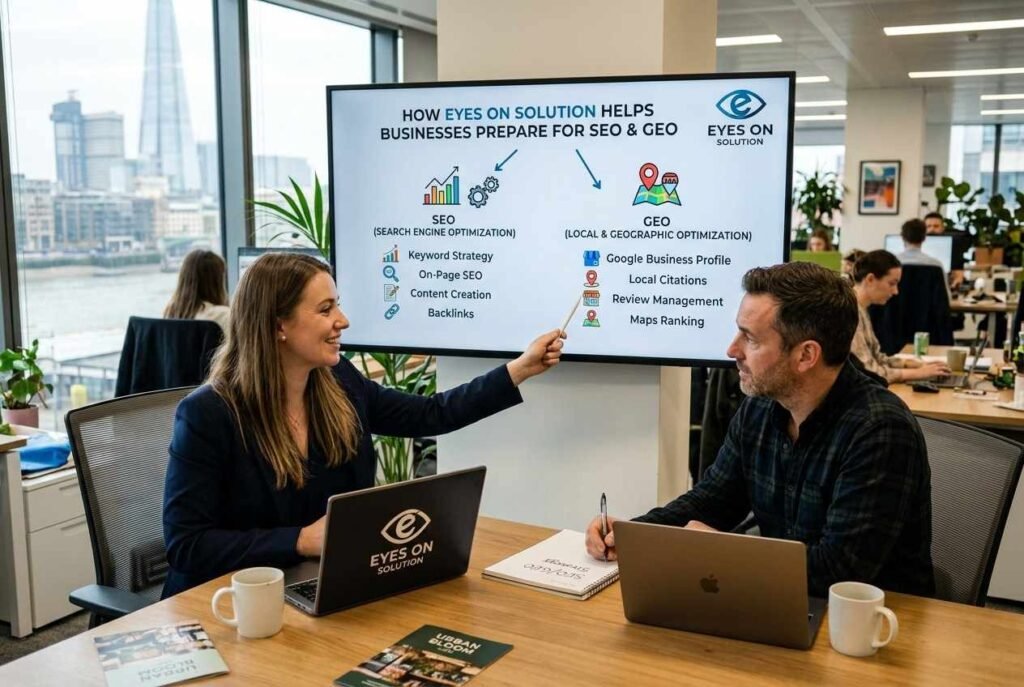
At Eyes On Solution, our SEO services are built around the strategies that drive sustainable, long-term visibility. This includes full technical SEO audits that identify and resolve the structural issues holding your website back, on-page optimization that aligns your content with search intent, and comprehensive link building campaigns that build domain authority through guest posting, blogger outreach, and custom outreach.
Our approach is not about short-term ranking boosts. It is about building the kind of authority that compounds over time and supports strong performance in both traditional search and AI-powered channels.
How Does Eyes On Solution Create AI-Ready Content That Performs in GEO?
Our content writing service is designed around the principles that matter most in AI-driven search: clarity, depth, semantic structure, and genuine expertise. We produce content that is written for human readers first, because that is exactly what both search engines and AI models reward.
Every piece of content we create is optimized for semantic search, structured with schema markup where appropriate, and built to answer the specific questions your target audience is asking. This gives our clients’ content the best possible chance of being surfaced in AI-generated answers alongside traditional search results.
How Does a Combined SEO and GEO Strategy Deliver Long-Term Search Growth?
The businesses that will maintain visibility over the next five years are those that treat SEO and GEO as a unified strategy rather than separate tactics. SEO builds the technical foundation, content authority, and backlink profile that establish your website as a credible source. GEO extends that credibility into AI-powered search channels where a growing share of your potential customers are looking for answers.
At Eyes On Solution, we work with clients to develop integrated search strategies that cover both. Whether you are a local business looking to dominate Dubai search results or an international brand building authority across multiple markets, we combine technical SEO, content creation, link building, and AI visibility strategies to build a search presence that performs across every channel.
The Businesses That Adapt Early Will Win
GEO is not replacing SEO. It is expanding what search optimization means. The question for every business is not whether to choose between them, it is how quickly you can build a strategy that covers both.
The fundamentals have not changed: authoritative content, strong technical foundations, credible backlinks, and a clear understanding of what your audience is searching for. What has changed is the environment in which those fundamentals need to perform and that environment now includes AI-powered search experiences that are growing in use every month.
Businesses that invest in both SEO and GEO today will be better positioned to capture organic traffic, AI-generated citations, and long-term search visibility than those that continue to rely on tactics built for a search environment that is already evolving.
At Eyes On Solution, we help businesses in Dubai and across international markets build search strategies designed for this new reality. If you are ready to future-proof your digital visibility, we are ready to help.
Learn More About: What is GEO vs AEO vs AIO?
Frequently Asked Questions
What Does GEO Stand for in Digital Marketing?
GEO stands for Generative Engine Optimization. It is the practice of optimizing your website content so that AI-powered search tools and answer engines choose to surface, cite, or recommend your business when users ask relevant questions. Unlike traditional SEO, which focuses on ranking in search results pages, GEO focuses on being selected as a trusted source by AI-generated responses.
Is SEO Becoming Obsolete Because of AI Search?
No. SEO is evolving, not disappearing. AI-powered search tools depend on website content, backlinks, and structured data, the same signals SEO has always optimized. A well-executed SEO strategy is the foundation on which GEO performance is built. Businesses that abandon SEO in favor of GEO alone will undermine both strategies.
How Does AI Affect SEO Rankings on Google?
AI integration in search has raised the importance of content quality, semantic relevance, and E-E-A-T signals (Experience, Expertise, Authoritativeness, and Trustworthiness). AI-generated overview panels are now pulling content directly from web pages, meaning that well-optimized, authoritative content has more opportunities to appear prominently in search results than before. Technical SEO, structured data, and high-quality backlinks remain central to ranking performance.
Can GEO Improve Website Traffic?
GEO can improve brand visibility, citation frequency, and the share of users who encounter your business through AI-generated answers. However, because AI responses often provide direct answers without requiring a click-through, GEO does not always drive direct traffic in the same way SEO does. The strongest traffic strategy combines SEO (for click-through organic traffic) with GEO (for brand presence and authority in AI-driven channels).
Should Businesses Invest in Both SEO and GEO at the Same Time?
Yes. The two strategies are complementary and share a common foundation: authoritative content, strong technical infrastructure, and credible external links. Investing in SEO builds the domain authority and content depth that GEO performance depends on. Investing in GEO improves the structure and semantic clarity of your content in ways that also benefit traditional SEO. A combined approach is more effective than either strategy in isolation.
How Long Does It Take to See Results from GEO?
GEO results depend on several factors including your existing domain authority, the quality and depth of your content, and how quickly AI tools index and evaluate your website. Unlike paid advertising, both SEO and GEO are long-term strategies. Businesses typically begin seeing meaningful improvements in AI visibility within three to six months of implementing a structured GEO strategy, particularly when it is built on a solid SEO foundation.
What Is the Most Important Thing a Business Can Do to Improve GEO Performance?
The single most impactful action is to invest in high-quality, expert-driven content that genuinely answers the questions your audience is asking. This means well-structured articles with clear headings, concise answers, semantic depth, and authoritative sourcing, supported by a technically sound website and strong backlinks from credible external sources. All of these elements signal to AI tools that your content is worth recommending.
How Is GEO Different from Traditional SEO in Terms of Day-to-Day Optimization?
Traditional SEO optimization focuses heavily on keyword targeting, meta tag optimization, and link acquisition. GEO optimization focuses on content structure, entity recognition, semantic relevance, and ensuring that your content is formatted in a way that AI tools can easily parse and summarize. In practice, the two approaches overlap significantly, which is why an integrated strategy is more efficient than managing them separately.