

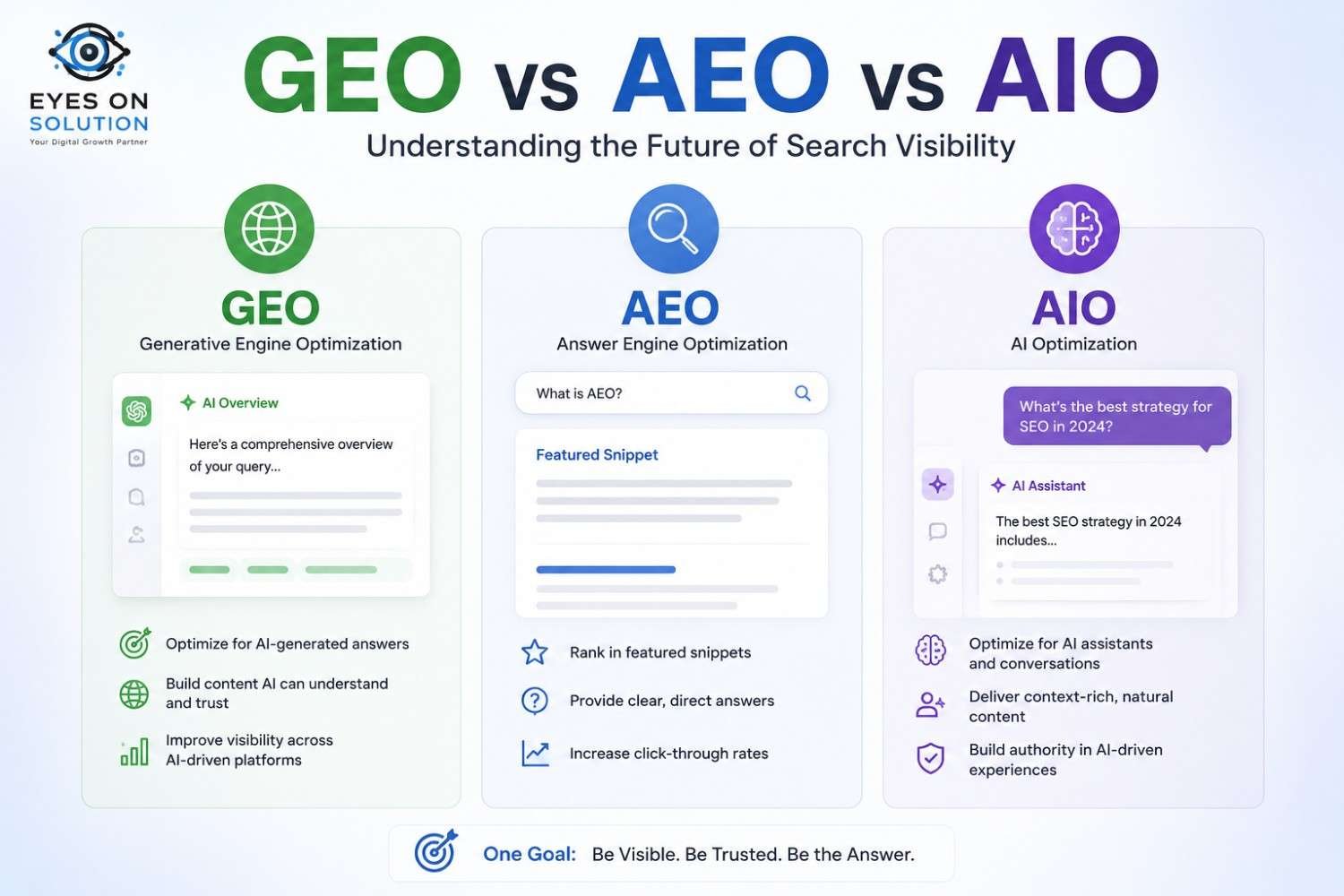

The digital search landscape is undergoing its most significant structural shift since the inception of the commercial internet. For over two decades, search engine optimization followed a predictable playbook: identify high-volume keywords, optimize on-page elements, build authoritative backlinks, and rank in the “10 blue links” on Google. However, the rapid proliferation of generative artificial intelligence has fundamentally disrupted this model. Today, users are increasingly bypassing traditional search engine results pages in favor of direct, conversational answers provided by large language models (LLMs) and AI-powered assistants.
This evolution has introduced three critical methodologies that extend beyond traditional SEO: Generative Engine Optimization (GEO), Answer Engine Optimization (AEO), and AI Optimization (AIO). While these acronyms are frequently used interchangeably, they represent distinct strategic approaches to modern organic visibility. Understanding how these strategies differ, and how they intersect, is no longer optional for brands investing in organic growth. It is the foundation of modern digital survival.
At Eyes on Solution, we have spent years helping business owners, marketing managers, and enterprise brands navigate the complexities of search algorithms. As search transitions from a system of referral links to a network of synthesized answers, our mission remains unchanged: to ensure your brand is discovered, trusted, and recommended by both human users and the AI systems they rely on. This guide provides an exhaustive, data-driven analysis of GEO, AEO, and AIO, mapping out how your business can adapt and thrive in the generative era.
What Is GEO (Generative Engine Optimization) in Modern Search?
Who Is It For?
Generative Engine Optimization is specifically designed for brands, SaaS companies, professional service providers, and content publishers that need to maintain visibility within generative AI search summaries. If your target audience uses platforms like ChatGPT, Google Gemini, Perplexity, or Google AI Overviews to research products, compare solutions, or seek detailed industry analyses, GEO is the exact strategy you need. It is particularly vital for business-to-business organizations and high-consideration consumer brands where purchase decisions are preceded by extensive informational research.
How Does It Work?
GEO focuses on optimizing digital content so that generative AI engines select, synthesize, and cite your website as a primary source in their conversational responses. Unlike traditional search engines that rank URLs based on keyword density and link equity, generative engines use advanced machine learning algorithms to evaluate content based on factual accuracy, authority, semantic depth, and trust signals.
When a user inputs a complex prompt into an AI assistant, the model performs a real-time retrieval-augmented generation (RAG) search. It scans the web for authoritative documents, extracts the most relevant information, synthesizes a cohesive response, and embeds citations (links) to the source material. GEO is the practice of structuring and enriching your content so that LLMs recognize your brand as the definitive authority on a given topic, leading to your inclusion in those highly coveted citation slots.
To understand GEO in action, consider a user prompting Perplexity: “What are the best enterprise technical SEO practices for a multi-regional SaaS platform?”
An optimized GEO strategy ensures that your content contains the precise semantic entities, structured schema, and authoritative data points that the AI engine needs to synthesize its answer. Instead of hoping a user clicks your link at position three, GEO ensures your brand is explicitly named and cited within the AI-generated summary itself. This is achieved through several core pillars:
- Topical and Entity Authority: AI models understand the world through entities (people, places, concepts, and organizations) and their relationships. GEO requires building deep topical hubs that cover a subject exhaustively, establishing your brand as an authoritative entity in your niche.
- Data and Fact Density: Academic research has demonstrated that content containing rich, quantitative data, statistics, and structured tables receives a massive visibility boost in generative engine responses [2]. AI models favor precise, verifiable facts over generic marketing copy.
- Semantic Relevance and Natural Phrasing: Content must be written to align with conversational search queries. This means using natural, explanatory language that directly addresses complex, multi-turn prompts rather than focusing on rigid, isolated keywords.
By aligning your content creation with these algorithmic preferences, our Content Writing Services ensure your brand remains highly visible in the summaries generated by ChatGPT, Gemini, and Google AI Overviews.
What Is AEO (Answer Engine Optimization) and How Does It Capture Direct Answers?
Who Is It For?
Answer Engine Optimization is essential for local businesses, e-commerce brands, transactional platforms, and consumer-facing service providers whose audience is looking for immediate, unambiguous answers. If your customers frequently use voice assistants (like Siri, Alexa, or Google Assistant) or perform quick, mobile-based factual queries, AEO is your primary battleground. It is designed for businesses that need to capture “zero-click” searches, where the user’s intent is fully satisfied directly on the search results page without needing to click through to a website.
How Does It Work?
AEO is the practice of optimizing content to supply direct, concise, and structured answers to specific, question-based queries. While GEO optimizes for synthesized, multi-paragraph AI summaries, AEO optimizes for rapid extraction by “answer engines”, which include Google’s featured snippets, People Also Ask boxes, knowledge panels, and voice search databases.
Answer engines operate on a retrieval model that prioritizes speed, conciseness, and structural clarity. When a user asks a direct question, the engine scans its index for a highly specific block of text, typically 40 to 60 words, that answers the query perfectly. If the content is wrapped in clean HTML markup, supported by schema data, and written with absolute clarity, the engine extracts it and presents it as “Position Zero”.
[User Question: “What is the difference between SEO and AEO?”]
│
▼
[Answer Engine Scans Index for Concise 40-60 Word Definition]
│
▼
[Extracts Structured Paragraph/List and Displays at Position Zero]
To win in AEO, your content must be structured to accommodate this rapid extraction. This involves a highly tactical approach to content layout:
- The Q&A Format: Structure your headings as direct questions (e.g., “How does technical SEO improve website speed?”) and follow them immediately with a concise, authoritative 40-to-60-word answer. This paragraph serves as the perfect target for a featured snippet or voice search response.
- Schema Markup Integration: Implementing structured data schema (such as FAQ schema, Product schema, and Local Business schema) is non-negotiable. Schema provides a machine-readable translation of your content, allowing answer engines to parse and display your data with 100% accuracy.
- Conversational Voice Optimization: Voice search queries are inherently conversational and longer than typed searches. AEO requires optimizing for spoken language patterns, focusing on long-tail, natural-sounding question phrases that users are likely to speak aloud to their devices.
At Eyes on Solution, our SEO Optimization Services and Technical SEO strategies are engineered to capture these direct-answer opportunities. We ensure your website’s underlying code and content architecture are perfectly aligned with the extraction mechanisms of modern answer engines.
What Is AIO (AI Optimization) and Why Is It the Broadest Strategy?
Who Is It For?
AI Optimization is a comprehensive, sitewide strategy designed for enterprise organizations, large-scale SaaS platforms, multi-category e-commerce sites, and forward-thinking digital agencies. It is for brands that recognize that AI is not just a search feature, but the very infrastructure of the modern internet. If you want to ensure your entire digital footprint is completely readable, understandable, and crawlable by machine learning algorithms, LLMs, and autonomous AI agents, AIO is the overarching framework you must adopt.
How Does It Work?
AIO is the broadest of the three strategies because it focuses on making your entire website and digital presence inherently “AI-friendly.” While AEO targets short answers and GEO targets generative summaries, AIO addresses the technical, structural, and semantic foundations of your site to ensure seamless integration with all AI-driven systems.
AIO operates on the principle of machine readability. AI systems do not read websites the way humans do; they parse code, analyze semantic networks, map entity relationships, and ingest data structures. If your website is plagued by technical bloat, convoluted navigation, or unstructured data, AI crawlers (such as GPTBot or Google-Extended) will struggle to comprehend your content, leading to exclusion from AI recommendations and search results.
AIO encompasses several critical technical and architectural optimizations:
- Technical Crawlability and Accessibility: Ensuring that AI crawlers can access your content without being blocked by misconfigured firewalls or slow server response times. This includes optimizing your robots.txt file and implementing the emerging llms.txt standard, a developer-friendly file that provides a concise, markdown-formatted summary of your site specifically for LLM ingestion.
- Semantic HTML and Clean Code: Utilizing semantic HTML5 tags (like <article>, <section>, <aside>, and <nav>) to provide structural context to AI parsers. Eliminating excessive JavaScript bloat and CSS rendering obstacles ensures that AI engines can extract your content instantly and accurately.
- Entity and Knowledge Graph Alignment: Structuring your site’s internal linking and content hierarchy to mirror a logical knowledge graph. This helps AI systems map the relationships between your products, services, and core concepts, reinforcing your brand’s topical authority.
- E-E-A-T (Experience, Expertise, Authoritativeness, Trustworthiness) Signals: AI models are heavily programmed to prioritize trustworthy sources. AIO involves optimizing sitewide trust signals, including clear author bios, robust about pages, citations to reputable sources, and verifiable brand mentions across the web.
Through our Website Design & Development and comprehensive Technical SEO services, Eyes on Solution builds the clean, high-performance digital infrastructure required for complete AI compatibility. We prepare your site not just for today’s search engines, but for the autonomous AI agents of tomorrow.
GEO vs AEO vs AIO: What Are the Key Differences and How Do They Compare?
To effectively allocate your marketing resources, it is vital to understand how GEO, AEO, and AIO differ across key operational dimensions. While they share the ultimate goal of improving visibility in an AI-dominated digital landscape, their platforms, content styles, and technical requirements vary significantly.
The table below provides a detailed comparison of these three critical strategies:
| Operational Feature | Generative Engine Optimization (GEO) | Answer Engine Optimization (AEO) | AI Optimization (AIO) |
|---|---|---|---|
| Primary Strategic Focus | Securing citations and mentions inside AI-synthesized summaries. | Capturing direct, immediate answers in featured snippets and voice search. | Maximizing sitewide machine readability and AI crawler compatibility. |
| Target Platforms | ChatGPT, Google Gemini, Perplexity, Google AI Overviews. | Google Featured Snippets, Siri, Alexa, Google Assistant, PAA Boxes. | All search LLMs, machine learning algorithms, and autonomous AI agents. |
| Optimal Content Style | Deep, authoritative, data-rich, and semantically exhaustive articles. | Concise, direct Q&A paragraphs (40–60 words) and structured lists. | Structurally clean, semantically marked-up, and logically organized sitewide content. |
| Technical Requirements | Entity optimization, semantic markup, and citation integration. | Strict FAQ/QA schema markup, clean HTML, and rapid page load speeds. | Clean code, llms.txt files, crawl budget management, and E-E-A-T signals. |
| Primary Marketing Goal | Brand recommendation and citation in conversational search. | Capturing zero-click search visibility and driving high-intent traffic. | Long-term indexing, sitewide AI compatibility, and agent-readability. |
| Role in Modern SEO | Future-proofing brand authority in generative ecosystems. | Optimizing for immediate user query resolution and voice search. | Building the foundational technical infrastructure for AI search. |
This strategic division highlights why a one-size-fits-all approach to SEO is no longer viable. A modern organic visibility strategy must integrate all three components: AIO builds the machine-readable foundation, AEO captures the immediate transactional and voice queries, and GEO secures your brand’s authority in complex, conversational research journeys.
Why Do GEO, AEO, and AIO Matter for Your Digital Marketing Strategy?
The transition toward AI-driven search is not a temporary trend or a minor algorithmic update; it is a permanent realignment of user behavior and search engine architecture. Traditional search metrics are shifting rapidly, and businesses that fail to adapt risk becoming entirely invisible to their target audience.
The Rise of the Zero-Click Search
For years, the primary goal of SEO was to drive traffic to a website. However, data shows that 64.82% of all Google searches now end without a single click to the open web. This means nearly two-thirds of searchers find the information they need directly on the search results page, courtesy of featured snippets, knowledge panels, and Google AI Overviews.

As shown in the trend chart above, the zero-click rate has climbed steadily from approximately 50% in 2019 to nearly 65% in 2026. This structural shift means that optimizing exclusively for click-through traffic is a losing battle. To maintain brand equity and market share, businesses must optimize for on-SERP visibility, ensuring that even if a user does not click, they are repeatedly exposed to your brand name, data, and authoritative recommendations within the search interface.
The Impact of AI Overviews on Click-Through Rates
The integration of Google AI Overviews has had a profound impact on traditional organic click-through rates. When Google generates an AI-powered summary at the top of the search results page, it pushes traditional organic listings down, absorbing a significant portion of user attention.
Industry data indicates that organic click-through rates drop by an average of 18% to 34.5% on SERPs where an AI Overview is present. The impact is most severe for the absolute top rankings:

As visualized in the comparison chart above, the click-through rate for the position one organic result plummets from 31.7% to just 19.8% when an AI Overview is introduced. This represents a massive loss of potential traffic for brands relying solely on traditional rankings. However, this challenge presents a major opportunity: brands that are cited within the AI Overview itself experience a substantial visibility boost, effectively bypassing the traditional organic ranking hierarchy.
The Referral Quality Paradox
While AI-driven search undoubtedly reduces raw click volume, it introduces a highly beneficial phenomenon known as the Referral Quality Paradox. While total traffic may decline, the quality of the visitors arriving at your site from AI search engines and cited summaries is significantly higher.
According to recent clickstream analyses, users who click through to a website after reading an AI Overview or Perplexity summary exhibit dramatically higher engagement metrics:
- +23% Higher Conversion Rate: Visitors have already consumed a summary of the topic and are clicking through with a specific, high-intent purpose, making them much more likely to convert into leads or customers.
- +34% Longer Average Session Duration: AI-referred users spend significantly more time engaging with your content, as they are seeking deep, detailed information rather than quick, surface-level answers.
- -41% Lower Bounce Rate: Because the search engine has already pre-qualified the user’s intent and matched it with your specific content, bounce rates for AI referral traffic are exceptionally low.
- 2.7x More Pages per Session: Qualified visitors are highly motivated to explore your site further, researching related services, case studies, and resource pages.
| Traffic Quality Metric | Traditional Organic Referral | Post-AI Overview Referral | Net Strategic Benefit |
|---|---|---|---|
| Raw Click Volume | High (spread across 10 blue links) | Moderate to Low (concentrated on citations) | Shift focus from quantity to high-intent quality |
| Conversion Rate | Baseline | +23% Higher | More qualified leads and lower acquisition costs |
| Session Duration | Baseline | +34% Longer | Deeper brand engagement and content consumption |
| Bounce Rate | Baseline | -41% Lower | Highly relevant matching of user intent to content |
| Pages per Session | Baseline | 2.7x More Pages | Increased exploration of brand services and assets |
This data proves that the goal of modern SEO is no longer to capture empty, high-volume keyword clicks. Instead, the goal is to build deep, authoritative content that secures AI citations, driving highly qualified, pre-vetted buyers directly to your conversion funnels.
How Can Your Business Optimize Content for GEO, AEO, and AIO?
Transitioning your digital marketing strategy to align with GEO, AEO, and AIO requires a deliberate, structured approach. It involves moving away from thin, keyword-stuffed pages and embracing high-performance, authoritative, and technically flawless content.
Here are the actionable steps your business must take to dominate AI-powered search:
1. Create Authoritative, Data-Rich, Long-Form Content
Generative engines are designed to synthesize comprehensive answers. To be cited, your content must be deep, exhaustive, and backed by verifiable data. Academic research on GEO has shown that including quantitative data and statistics in your content increases your visibility in AI search responses by up to 115.1%.
At Eyes on Solution, our Content Writing Services focus on producing comprehensive, long-form content that incorporates original research, proprietary data, and expert insights. We help you move beyond generic summaries to create the definitive resource guides that LLMs love to cite.
2. Implement Clear, Question-Based Headings and Direct Answers
To capture featured snippets, voice search, and PAA boxes, structure your content to mirror human curiosity. Use H2 and H3 headings phrased as natural questions, and follow them immediately with a direct, 40-to-60-word answer.
This structural pattern satisfies both AEO and GEO requirements: it provides the immediate, extractable paragraph that answer engines look for, while establishing a clear semantic structure that generative engines can easily parse.
3. Integrate Advanced Schema Markup
Schema markup is the primary language of AI search. It translates your human-readable content into structured, machine-readable data. By implementing a comprehensive schema (including Article, FAQ, Product, and Local Business schema), you provide search engines with explicit context about your brand, services, and expertise.
Our Technical SEO experts specialize in auditing and implementing advanced schema architectures, ensuring your site’s code is fully optimized for rapid AI indexing and extraction.
4. Build Entity Authority and Quality Backlinks
AI models evaluate trust by looking at your brand’s digital footprint. Earning high-quality, relevant backlinks from authoritative industry publications is still one of the most powerful signals of trust. Furthermore, academic studies show that adding citations to authoritative external sources within your own content boosts your visibility in generative search responses by roughly 40%.
Through our SEO Link Building and Blogger Outreach Services, we help your brand secure high-authority mentions and editorial backlinks, solidifying your position as a trusted entity in your industry’s knowledge graph.
5. Prioritize Sitewide Technical Excellence
An AI-optimized website must be fast, secure, and clean. Eliminate render-blocking resources, optimize mobile responsiveness, and manage your crawl budget effectively to ensure AI bots can crawl your site without friction.
Additionally, implementing a sitewide llms.txt file provides a clean, markdown-formatted map of your site’s key assets, giving you a massive first-mover advantage, as fewer than 0.001% of websites currently utilize this emerging standard.
Our Website Design & Development team builds lightning-fast, secure, and technically flawless websites designed from the ground up for complete AI compatibility and exceptional user experience.
What Is the Future of SEO in the Generative AI Era?
As we look toward the horizon of digital marketing, one thing is abundantly clear: search is becoming an active assistant rather than a passive directory. The future of discovery belongs to brands that build a cohesive, multi-platform presence. Users will no longer rely solely on a single search bar; they will discover brands through conversational prompts on their phones, smart home devices, desktop AI assistants, and autonomous agents.
In this new reality, traditional keyword rankings are losing their monopoly on digital success. The new currency of organic marketing is citation equity, brand trust, and semantic authority. To stay competitive, businesses must partner with digital experts who understand the underlying mechanics of machine learning, natural language processing, and technical search architecture.
At Eyes on Solution, we do not just react to algorithmic changes, we anticipate them. Whether you need to overhaul your site’s technical infrastructure, execute a high-impact blogger outreach campaign, or produce deep, AI-friendly content, our team has the expertise and tools to future-proof your digital presence. The AI era of search is already here, and the brands that adapt early will secure a compounding visibility advantage that competitors will struggle to overcome.
Frequently Asked Questions (FAQ)
To help you navigate this transition, we have compiled answers to the most common questions regarding GEO, AEO, and AIO. These FAQs are structured as natural, conversational prompts, mirroring the exact way modern users search for digital marketing insights.
How do I optimize my website for ChatGPT search recommendations?
To optimize your website for ChatGPT search and other LLM recommendations, you must focus on building topical authority, data density, and verifiable trust signals. Ensure your content is highly comprehensive, contains original statistics, and includes clear citations to reputable external sources.
Technically, you should implement an llms.txt file in your root directory to provide a clean, machine-readable summary of your website for AI crawlers. Finally, secure high-quality backlinks through authoritative SEO Link Building Services to prove to OpenAI’s retrieval algorithms that your brand is a trusted industry leader.
Will AI search engines completely replace traditional Google search?
AI search engines are not replacing search; rather, they are merging with traditional search into a hybrid ecosystem. Traditional search engines like Google are heavily integrating generative AI (such as Google AI Overviews), while AI-native platforms like Perplexity are relying on traditional web indexes to retrieve real-time data.
While raw click-through rates are declining due to zero-click answers, the traffic that does reach your website is highly qualified, resulting in significantly higher conversion rates. Adapting your strategy to include GEO and AEO ensures you maintain visibility across both conversational AI interfaces and traditional search layouts.
What is the difference between GEO and AEO in digital marketing?
The primary difference lies in the complexity of the query and the format of the output. Answer Engine Optimization targets short, direct, and factual queries, optimizing for extraction into featured snippets, voice search, and People Also Ask boxes.
Generative Engine Optimization targets complex, conversational, and research-oriented prompts, optimizing your content to be synthesized and cited within multi-paragraph, AI-generated summaries. While AEO relies heavily on strict Q&A formatting and FAQ schema, GEO requires deep, authoritative, and data-rich long-form articles.
How does voice search optimization connect to AEO?
Voice search optimization is a core component of Answer Engine Optimization. Because voice queries are spoken aloud, they are inherently longer, more conversational, and phrased as complete questions rather than fragmented keywords.
To optimize for voice search, your content must use natural language patterns and directly address who, what, where, when, why, and how questions. Partnering with professional Content Writing Services ensures your copy is structured with conversational headings and concise answers that voice assistants can easily read aloud to users.
Why is structured content and schema markup critical for AI search?
Structured content and schema markup are critical because they serve as a machine-readable translator for AI crawlers and LLMs. While human users can infer context from design and layout, AI algorithms rely on explicit code to understand entity relationships, product specifications, and business details.
By implementing advanced schema (such as Local Business, Product, and FAQ schema), you eliminate algorithmic ambiguity, making it significantly easier for answer engines to extract your data and cite your brand. Our Technical SEO team ensures your site’s schema architecture is flawlessly configured for maximum AI discoverability.
How can a B2B SaaS company adapt to generative search?
A B2B SaaS company can adapt by transitioning from thin, keyword-focused landing pages to deep, authoritative resource hubs and original data reports. Generative engines favor content that contains quantitative data, detailed comparison tables, and expert analysis.
Additionally, SaaS brands must optimize their sitewide technical architecture through Website Design & Development to ensure AI crawlers can seamlessly parse their documentation. Building strong brand mentions and editorial backlinks through Blogger Outreach Services is also vital to establish your software as a trusted entity in the AI’s knowledge graph.
What are the best tools to measure my brand’s visibility in AI search?
Measuring AI search visibility requires specialized tools that track citation rates, brand mentions, and conversational share-of-voice rather than traditional keyword rankings. Emerging enterprise platforms like BrightEdge, Semrush GEO tracking, and specialized AI citation checkers allow brands to monitor how often they appear in Google AI Overviews, Perplexity citations, and ChatGPT responses.
At Eyes on Solution, our SEO Optimization Services include comprehensive reporting that tracks your brand’s organic visibility across both traditional search layouts and generative AI ecosystems, giving you a clear picture of your digital market share.
