

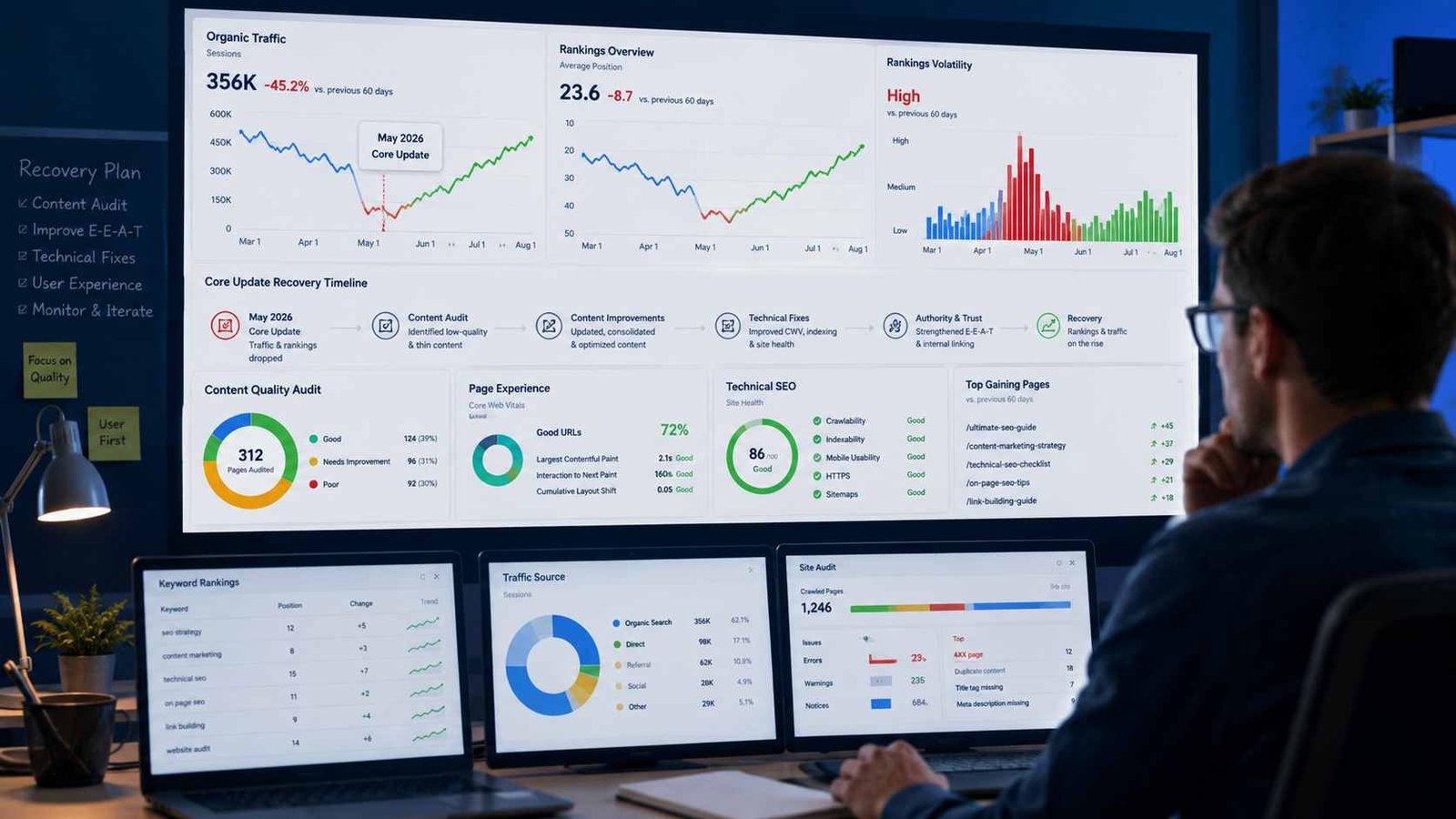

The Google May 2026 Core Update represents the most significant structural shift in search engine history, accelerating the transition from traditional keyword ranking to AI-driven answer synthesis. With AI Overviews now appearing on nearly half of all queries and zero-click searches hitting 68%, optimizing for traditional SEO is no longer enough. This comprehensive, 4,500+ word guide breaks down the exact timeline of the May 2026 update, explains why traditional informational content was decimated, and provides a step-by-step recovery framework. By mastering Generative Engine Optimization (GEO) and Answer Engine Optimization (AEO), strengthening E-E-A-T signals, and structuring content for Large Language Models (LLMs), businesses can reclaim lost visibility and dominate the new era of AI search.
The Impact of Google May 2026 Core Update | Key Changes, SEO Insights & Recovery Tips
Your rankings dropped overnight. Your organic traffic is down significantly. You checked Google Search Console, and there are no manual penalties or technical errors. You did everything “right” according to the old rules of SEO, so what just happened to your website?
On May 21, 2026, Google released a major core update that fundamentally rewrote the rules of digital visibility. Coming immediately after their major I/O developer conference and the rollout of new AI search capabilities, this update was not a minor algorithm tweak. It was a clear, aggressive shift toward an AI-first search ecosystem. For business owners, marketing managers, and digital strategists in Dubai and globally, understanding this shift is an existential necessity.
If you are wondering why your perfectly optimized, 2,000-word blog posts suddenly lost their top spots to AI Overviews and different competitors, you are not alone. The digital landscape is experiencing unprecedented volatility. However, panic is not a strategy. Recovery requires a deep, structural understanding of how Google’s AI now evaluates content, the critical differences between traditional SEO and Generative Engine Optimization, and exactly what steps you must take to make your brand visible to Large Language Models (LLMs).
What Is the Google May 2026 Core Update and Why Is It Different?
When organic traffic drops suddenly, the immediate reaction for most website owners is to assume they have been penalized. Understanding the nature of a core update, especially one deployed in the AI era, is the first step toward recovery.
Google core updates are broad, sweeping changes to the search ranking algorithm designed to improve the overall quality, relevance, and usefulness of search results. Unlike targeted spam updates that penalize specific manipulative tactics (like buying links or scraping content), core updates affect websites across all industries, languages, and regions simultaneously.
A critical distinction must be made: a ranking drop during a core update is rarely a manual penalty. It does not mean your page was punished for doing something explicitly wrong. Instead, it means that the algorithm’s definition of “quality” and “relevance” has changed, and another page (or an AI-generated response) now better satisfies the user’s search intent. It is a reassessment of value. Treating ranking drops as signals rather than punishments allows you to approach recovery strategically.
The timeline of recent updates highlights an accelerating, relentless pace of change. With multiple ranking incidents already reported in 2026, including the February Discover update, the March spam update, and the massive March core update, the May rollout confirms that the transition to AI search is moving faster than anticipated. The days of “set it and forget it” optimization are officially over.
The May 2026 Rollout Timeline and Volatility Spikes
The rollout of the May 2026 Core Update began at 08:40 PDT on May 21 and took approximately two weeks to complete, wrapping up around June 4. Rather than a smooth, gradual shift, tracking tools flagged three distinct periods of extreme volatility.

- May 23 (Spike 1): The initial shockwave hit over the weekend, severely impacting thin informational content and sites relying heavily on unedited AI generation.
- May 30 (Spike 2): A massive secondary spike reshuffled e-commerce category pages and YMYL (Your Money or Your Life) queries.
- June 2 (Spike 3): A final burst of movement occurred just before the update officially concluded, locking in the new ranking hierarchy.
Google did not share a separate goal, target list, or specific recovery document for this rollout. They clarified that it was not a spam update, manual action, product reviews update, or site reputation abuse update. It was a broad, systemic quality reassessment focused heavily on conversational intent, AI-assisted content evaluation, and multimedia signals.
The Rise of Zero-Click Search and AI Overviews
To understand why your traffic dropped, you must understand the environment in which the May 2026 update was deployed. We are no longer operating in a traditional “10 blue links” paradigm. We are operating in the era of the Answer Engine.
According to recent 2026 data, 68% of all Google searches now end without a single click to an external website. This is known as a zero-click search. Users ask a question, Google’s AI Overview (or a featured snippet) provides the answer directly on the search engine results page (SERP), and the user leaves satisfied without ever visiting the source website.

The Devastating Impact of AI Overviews on Traditional CTR
When an AI Overview appears at the top of a search result, it fundamentally alters user behavior. Industry studies conducted in early 2026 reveal a stark reality: AI Overviews reduce the organic click-through rate for the #1 ranking traditional organic results by an average of 58% to 61%.

For informational queries, the drop is even more severe. If your website previously relied on answering basic questions (e.g., “What is digital marketing?”), that traffic has likely been absorbed entirely by Google’s AI.
However, there is a crucial silver lining: brands that are explicitly cited as sources within the AI Overview receive highly qualified, high-intent traffic. Users who click through from an AI citation convert at significantly higher rates than traditional organic visitors. Therefore, the goal is no longer just to rank below the AI; the goal is to become the source data that the AI relies upon.
Decoding the New Acronyms: SEO vs. GEO vs. AEO vs. AIO
The May 2026 core update accelerated the need for new optimization frameworks. If you are still relying exclusively on traditional Search Engine Optimization, you are optimizing for a version of the internet that no longer exists. To recover, you must understand and implement Generative Engine Optimization, Answer Engine Optimization, and AI Overview Optimization.
Traditional SEO
Traditional SEO focuses on ranking web pages in traditional search engine results pages based on keywords, backlinks, and technical site health. It assumes a human user typing fragmented keywords into a search box and clicking through a list of links. While foundational technical SEO remains necessary, it is no longer sufficient on its own.
GEO
GEO is the practice of structuring your content and digital presence so that Large Language Models and AI-powered platforms, including ChatGPT, Perplexity, Claude, and Google’s Gemini, understand, trust, and synthesize your information. GEO focuses heavily on entity resolution, semantic relationships, and becoming a recognized authority within the AI’s training data. It is about Share of Voice across all generative platforms, not just Google.
AEO
AEO is a subset of GEO that focuses specifically on the retrieval layer. It is the process of optimizing content to be retrieved, selected, and cited by AI engines when they generate direct answers to user queries. AEO requires formatting content into clear, independently understandable “chunks” (facts, statistics, definitions) that an AI can easily extract and cite.
AIO
AIO is the highly specific practice of optimizing content to appear as a cited source within Google’s proprietary AI Overviews (formerly SGE). It relies heavily on Google’s specific algorithms, requiring a combination of top-tier traditional ranking signals, robust E-E-A-T (Experience, Expertise, Authoritativeness, Trustworthiness), and highly specific content structures.

How Google Evaluates Content Quality After the May 2026 Update
If you followed all the traditional SEO rules before the update and still saw a drop, it is because the rules themselves have evolved. The biggest shift is the move from keyword-centric optimization to intent-driven usefulness designed for LLM comprehension.
1. From Fragmented Keywords to Conversational Intent
AI-driven search experiences have changed how users interact with search engines. People are increasingly asking full, complex questions using natural language. For example, a user is now more likely to search for “What are the most important SEO trends businesses in Dubai should follow in 2026?” rather than just “SEO trends Dubai 2026.”
Google’s systems are getting vastly better at separating pages that technically match a query from pages that genuinely satisfy the underlying intent. A page can have the exact keyword in the title, solid metadata, and clean H2 headings, but if the content feels broad, shallow, or overly promotional, it will lose ground to a page that directly and comprehensively answers the user’s specific question.
2. The Amplification of E-E-A-T Signals
Experience, Expertise, Authoritativeness, and Trustworthiness (E-E-A-T) remain major ranking factors, and their importance was drastically amplified in the May 2026 update. Google’s March 2026 core update heavily rewarded first-hand experience, and the May update doubled down on this trend.
Content that demonstrates genuine human expertise, through detailed author bios, verified credentials, real-world case studies, and first-person insights, is heavily outperforming generic, encyclopedic content. In a world where AI can generate basic, factual information instantly and at zero cost, verified human experience is the premium differentiator. If your content could have been written by someone who has never actually performed the service or used the product, it will struggle to rank.
3. The Truth About AI Content: Lazy vs. Leveraged
A pervasive misconception following the May update is that Google is actively penalizing all AI-generated content. This is categorically false. High-quality, AI-assisted content can rank exceptionally well when it is combined with human expertise, original insights, and rigorous editorial oversight.
The sites that suffered the most severe damage in May were those that engaged in scaled content abuse. These sites bulk-published AI-generated content, often hundreds or thousands of articles per month, without any editorial layer, fact-checking, or unique human perspective added. Lazy, unedited AI content is the problem, not the AI tools themselves. Google’s algorithms are now highly adept at identifying content that adds zero net-new value to the internet.
4. Topical Authority Over Topic Hopping
Websites focusing deeply on one specific niche are building much stronger authority signals than those that topic-hop to chase keyword volume. Google’s Knowledge Graph needs to understand exactly what entity your website represents and what you specialize in.
Consistent topic coverage, interconnected content clusters, and a clear demonstration of deep knowledge within a specific industry matter more than ever. Publishing random, off-topic articles just to capture search volume is now an active liability that dilutes your overall domain authority. If you are an SEO Company in Dubai, writing a random article about real estate trends just because the keyword volume is high will confuse the AI and hurt your core rankings.
5. Information Gain and Citation Worthiness
Perhaps the most critical new metric for GEO and AEO is “Information Gain.” When an LLM evaluates your page against the top 10 existing results, does your page offer any new data, a unique perspective, a proprietary framework, or a fresh statistic that the others lack? If your article is just a synthesized summary of what is already ranking, its Information Gain score is zero. To be cited by an AI Overview, your content must be inherently citation-worthy. It must provide the raw material that the AI needs to construct a comprehensive answer.
Which Industries and Website Types Were Hit the Hardest?
While core updates affect the entire web, certain types of sites and industries historically experience the most volatility. The May 2026 update targeted specific structural weaknesses across several sectors.

YMYL Niches Under the Microscope
Your Money or Your Life (YMYL) categories, such as health, finance, legal, and cybersecurity, are always structurally sensitive during core updates. Google holds these sites to the highest possible standard of accuracy and trustworthiness because misinformation can cause real-world harm.
In the health and finance niches, YMYL pages published without verified credentials or clear expert authorship experienced the steepest declines in May 2026. If you are giving advice that could impact a user’s financial stability, you must prove why you are qualified to do so. Anonymous blog posts in these sectors were virtually wiped out.
E-Commerce Sites with Thin Product Pages
E-commerce websites that rely on duplicate manufacturer product descriptions, thin category pages, and weak informational content took heavy hits.
Consider a real-world example: Store A simply copies the manufacturer’s standard product description for a piece of software. Store B takes that same product but adds a custom setup guide, customer FAQs, detailed comparisons against competitors, usage recommendations, expert insights, and buying advice. The May 2026 update heavily rewarded Store B. Depth, unique value, and user-centric helpfulness are essential for e-commerce SEO.
Generic Service Pages and Affiliate Sites
Generic B2B service pages targeting broad terms like “digital marketing services” without offering any genuine depth, differentiated perspective, or demonstrated expertise dropped sharply.
Similarly, affiliate review sites that simply aggregated product specifications without conducting original testing, taking original photographs, or offering first-hand knowledge reported significant losses. If your page does not add value beyond what can be found on Amazon or the manufacturer’s site, the AI has no reason to cite you.
Information Aggregators and Definition Sites
Sites whose primary business model was answering simple questions (e.g., “What time is the Super Bowl?” or “How many ounces in a cup?”) saw their traffic evaporate overnight. This traffic has been permanently absorbed by AI Overviews and zero-click SERP features.
Common SEO Mistakes That Worsened the Impact
When traffic drops, the natural instinct is to fix things immediately. However, reactive changes often do more harm than good. Understanding what not to do is just as important as knowing what to do.
Over-Optimizing for Algorithms Instead of People
Creating content primarily around keyword opportunities instead of genuine user needs is a failing strategy. If your content strategy involves stuffing keywords into headings and meta tags without ensuring the actual text provides value, you are optimizing for an algorithm that no longer exists. LLMs evaluate semantic meaning, not keyword density.
Panicking and Making Hasty Changes Mid-Rollout
One of the biggest mistakes site owners make is changing titles, meta descriptions, and core content mid-rollout based on incomplete data. Core update data remains highly unstable until Google officially confirms completion. Making major SEO changes during the rollout, unless you find a critical technical error, can confuse search engines and lock in temporary ranking drops permanently.
Ignoring Content Structure and Formatting
LLMs parse information differently than humans. If your content consists of massive, unbroken walls of text, an AI will struggle to extract specific facts for citation. Failing to use semantic HTML, bulleted lists, data tables, and clear H2/H3 hierarchies makes your content invisible to Answer Engines.
Weak Internal Linking and Orphaned Pages
Siloed content, a lack of clear topic clusters, and orphaned pages all weaken topical authority signals. If your website is a collection of disconnected articles rather than a cohesive library of related information, Google’s AI will struggle to recognize your expertise in that niche. Strong internal linking passes entity context from page to page.
The Step-by-Step Recovery Plan: Mastering GEO, AEO, and AI Overviews

If your website has been negatively impacted by the May 2026 update, recovery requires patience, proper diagnosis, and a fundamental shift in how you produce content. Here is a comprehensive, step-by-step plan to restore your search visibility and optimize for the AI era.
Step 1: Wait, Observe, and Diagnose the Right Data
Diagnose, do not react. Google recommends confirming that a core update has finished, waiting at least one full week, and then comparing the right date ranges. Do not draw conclusions based on data from the middle of the rollout.
Mark May 21, 2026, in your analytics platforms, rank trackers, and reporting notes. Once the dust has settled, compare clicks, impressions, click-through rates, and average positions. Start your analysis with the pages that lost the most non-brand clicks. Rely primarily on Google Search Console for impression and ranking changes rather than looking solely at Google Analytics traffic data, which can be influenced by other external factors.
Step 2: Conduct a Ruthless, LLM-Focused Content Audit
Look at the pages that dropped and compare them to the pages (or AI Overviews) that replaced them in the top spots. You must ask yourself honestly: Does this page genuinely answer what the user is looking for better than anyone else?
Evaluate your content against the following criteria:
- Intent Match: Does the page directly answer the user’s core question immediately, or does it bury the answer under 500 words of fluff?
- Information Gain: Does this page provide unique data, original quotes, or a fresh perspective that the competing articles lack?
- Extractability: Are the key facts and statistics formatted in a way that an AI can easily extract and cite them?
Step 3: Implement Answer Engine Optimization Formatting
To get cited by AI Overviews, ChatGPT, and Perplexity, you must format your content for machine readability. Rework your weak pages using these AEO best practices:
- The BLUF Principle (Bottom Line Up Front): Answer the core question of the article in the first 100 words. Provide a clear, concise summary immediately below the H1.
- Semantic Chunking: Break long concepts into distinct, logically organized sections. Use descriptive H2 and H3 tags that read like the questions users actually ask.
- Data Tables and Bullet Points: LLMs love structured data. Whenever you are comparing items, listing features, or presenting statistics, use Markdown tables or bulleted lists. AI engines frequently pull tables directly into their responses.
- Direct, Objective Language: Avoid overly flowery, marketing-heavy language when explaining facts. State facts clearly and objectively. Use active voice.
Step 4: Strengthen E-E-A-T Signals Across Your Entire Entity
Trust is foundational for both traditional SEO and GEO. The AI must trust your entity before it will cite your content.
- Robust Author Bios: Ensure every article has a detailed author bio with real, verifiable credentials. Link the author bio to their LinkedIn profile or personal website to establish their identity across the Knowledge Graph.
- Outbound Linking: Link out to highly reputable, authoritative external sources (e.g., academic journals, official industry reports) to back up your claims. This shows the AI that your content is well-researched and grounded in facts.
- First-Hand Evidence: Explicitly state how you know the information. Use phrases like “In our experience managing 50+ SEO campaigns in Dubai…” or “When we tested this software last month…”
- Clean Up the Cruft: Remove or consolidate thin, outdated, or duplicate pages that dilute your site’s overall quality score.
Step 5: Build True Topical Authority Through Clustering
Stop publishing isolated articles. Build comprehensive content clusters. Choose a core topic (e.g., Technical SEO) and create a definitive pillar page. Then, create dozens of highly specific, supporting articles that cover every conceivable sub-topic and long-tail question related to that pillar.
Link all the supporting articles back to the pillar page, and link the pillar page out to the supporting articles. This dense, interconnected web of information signals to the AI that you are a comprehensive authority on the subject, not just a site that got lucky with one keyword.
Step 6: Improve Technical Foundations and Schema Markup
A brilliant article on a slow, broken website will still struggle. Fix your Core Web Vitals, ensure flawless mobile usability, and optimize page speed. Remove intrusive pop-up ads that disrupt the reading experience.
Crucially, implement advanced Schema Markup (Structured Data). Schema translates your content into a language that search engines natively understand. Use Article schema, FAQ schema, Organization schema, and Person schema to explicitly define the entities on your page. This removes the guesswork for the AI.
Step 7: Be Patient with the Recovery Timeline
Recovery from a core update is rarely immediate. It typically takes two to three months to show measurable progress, often aligning with Google’s next major update cycle. Some sites recover within weeks if underlying technical issues are addressed quickly, but meaningful recovery from a broad quality reassessment usually requires consistent, structural content improvements over a period of two to four months.
Building a Resilient Digital Strategy for 2026 and Beyond

The sites that build real value will keep winning, regardless of how many algorithm updates Google deploys. To survive the AI era, you must align your strategy with what the technology is actively trying to achieve: providing the most accurate, helpful, and efficient answers to users.
Prioritize Original Research and Proprietary Data
The ultimate defense against AI replacement is proprietary data. AI can summarize existing information, but it cannot conduct a survey, interview an industry expert, or analyze proprietary client data. If you publish original research, statistics, and case studies, the AI must cite you to use that information.
Optimize for Multi-Modal Search
Search is no longer just text. Google is heavily integrating images, video, and voice into the search experience. Support your textual content with high-quality, relevant images, custom infographics, and embedded video content. Ensure your image alt text is descriptive and includes relevant context, as AI Overviews frequently pull visual assets into their responses.
Think Long-Term, Not Quick Wins
Businesses that treat content as a long-term asset rather than a short-term traffic play are the ones that come out of core updates stronger. Invest in high-quality writing, thorough research, and expert insights. If you need help executing this level of quality, partnering with a professional Content Writing team can provide the editorial rigor required to succeed.
Debunking Common Misconceptions About Google Core Updates
Wrong beliefs lead to wrong actions. Here are the most common misconceptions about core updates and AI search, debunked:
| Misconception | The Reality |
|---|---|
| “I was penalized by Google.” | It is a systemic re-ranking based on shifting quality metrics, not a manual penalty against your site. |
| “AI content won’t rank anymore.” | Quality AI-assisted content with rigorous human oversight, editing, and original insight still ranks exceptionally well. |
| “I need to delete all my old content.” | Improve, update, and consolidate first; delete content only as an absolute last resort if it is entirely irrelevant. |
| “AEO replaces SEO.” | AEO is an additive layer. You still need technical SEO and traditional authority signals for the AI to find and trust you. |
| “Quick SEO fixes will recover my rankings.” | Changing meta titles will not fix a core update drop. Deep, structural content improvement is the only real solution. |
Google is not punishing you; it is raising the bar. The digital landscape is evolving rapidly toward quality, authenticity, and user-centric value. The transition to AI-driven search is disruptive, but it also presents a massive opportunity for brands willing to adapt.
At Eyes On Solution, we help businesses in Dubai and globally navigate these complex algorithmic changes. Our expert digital marketing services are designed to build resilient, high-performing websites that attract the right audience, dominate AI Overviews, and drive consistent growth. If you have been impacted by the recent update, do not guess your way to recovery. Contact our team today for a comprehensive website audit and let us help you turn your search traffic into real business growth.
Frequently Asked Questions
What is the difference between GEO and traditional SEO?
Traditional SEO focuses on optimizing web pages to rank in search engine results pages based on keywords and backlinks, aiming to drive clicks from human users. Generative Engine Optimization focuses on content so that AI models (like ChatGPT or Google’s AI Overviews) can understand, trust, and cite your brand when generating direct answers. While SEO targets search engine algorithms, GEO targets Large Language Models and prioritizes entity resolution, semantic clarity, and Information Gain.
How do I optimize my content for Google AI Overviews?
To optimize for Google AI Overviews, you must combine high-level traditional SEO with Answer Engine Optimization. First, ensure your page ranks well organically, as AI Overviews frequently pull from top-ranking sources. Second, structure your content with clear semantic chunking, use descriptive H2s, bulleted lists, and data tables. Finally, provide direct, concise answers (the BLUF principle) backed by strong E-E-A-T signals, original data, and clear expert authorship.
Why did my organic traffic drop during the May 2026 Core Update?
If your traffic dropped during the May 2026 update without any technical errors on your site, it indicates that Google’s algorithm reassessed the quality and relevance of your content. The update heavily penalized thin informational pages, generic service pages, and unedited AI-generated content. Your traffic may have been absorbed by AI Overviews providing zero-click answers, or competitors may have outranked you by providing deeper, more authoritative, and better-structured content that satisfies conversational intent.
How long does it take to recover from a Google core update ranking drop?
Recovery from a Google core update is not immediate and typically takes between two to four months. It requires conducting a thorough content audit, significantly improving the depth and quality of your pages, strengthening E-E-A-T signals, and fixing any technical UX issues. While minor technical fixes can yield faster results, recovering from a broad quality reassessment usually requires waiting for the algorithm to re-evaluate your improved site over time, often aligning with the next major update cycle. For expert guidance, explore our SEO Company Dubai services.
Should I delete AI-generated blog posts from my website?
You do not need to delete content simply because AI assisted in its creation. However, if you bulk-published lazy, unedited AI content that lacks human expertise, original insights, or fact-checking, that content is likely acting as a drag on your domain’s overall quality score. Instead of deleting it, rewrite and elevate it. Add real-world examples, expert perspectives, proprietary data, and internal links. If a page cannot be improved to offer unique value, consolidate it with a stronger page.
What is Answer Engine Optimization and why is it important in 2026?
Answer Engine Optimization is the practice of formatting and structuring content specifically to be retrieved and cited by AI-powered search engines. With zero-click searches reaching 68% in 2026, users are increasingly getting answers directly on the SERP without clicking through to websites. AEO is crucial because it helps your brand become the cited source within those AI-generated answers, which drives highly qualified, high-intent referral traffic even when traditional organic clicks decline.
How can I improve E-E-A-T signals to survive future core updates?
To improve Experience, Expertise, Authoritativeness, and Trustworthiness (E-E-A-T), ensure every piece of content clearly demonstrates human expertise. Add detailed author bios with verifiable credentials and links to professional profiles. Include first-hand experience and case studies. Link out to reputable external sources to back up your claims, and use original data whenever possible. Additionally, building a strong, natural Link Building profile from relevant industry sites significantly enhances your overall domain authority and trustworthiness.

