Outsourcing digital marketing services gives businesses immediate access to expert talent, advanced tools, and scalable strategies without the cost of building and managing a full internal team. Whether you need SEO, PPC, content marketing, social media management, or complete marketing support, outsourcing improves efficiency, reduces overhead, and accelerates growth when executed with the right partner and a clear strategy.
Why Are More Companies Outsourcing Their Digital Marketing Functions?
The digital marketing landscape changes daily. New search algorithms roll out, advertising platforms update their bidding models, and generative AI is fundamentally reshaping how consumers find information. For most businesses, keeping up with these changes internally requires an unsustainable investment of time, money, and specialized talent.
Digital marketing outsourcing means partnering with an external agency, dedicated remote team, or specialist to manage all or part of your company’s online marketing. Rather than trying to hire a single internal employee to act as a web developer, SEO expert, copywriter, and paid ads manager simultaneously, companies are tapping into established teams of specialists who already have the processes, tools, and expertise in place.
This approach transforms marketing from a fixed overhead cost into a scalable growth engine. Startups gain the rapid execution needed to capture market share without the burden of building a department from scratch. Small and mid-sized enterprises access enterprise-level tools and strategies without enterprise-level budgets. Large organizations leverage outsourcing to handle specialized campaigns or supplement their existing marketing departments during periods of growth. The core advantage remains consistent across all business sizes: immediate access to top-tier talent focused entirely on driving measurable return on investment.
The numbers reflect this shift. According to a Clutch survey, digital marketing (34%) has joined accounting and IT services as the most commonly outsourced function for small businesses, overtaking traditional categories like HR and customer support. The global outsourcing market is on track to exceed $450 billion, and businesses are no longer outsourcing simply to cut costs. They are outsourcing to gain a competitive edge.
What Exactly Is Digital Marketing Outsourcing and How Does It Work?
At its foundation, outsourcing your marketing means delegating promotional activities to external professionals who operate as an extension of your business. But the execution of this strategy varies widely depending on your specific needs, budget, and growth objectives.
The process begins by identifying the gaps in your current marketing strategy. Are you struggling to generate organic traffic? Are your paid advertising campaigns burning through budget without delivering qualified leads? Is your social media presence inconsistent and disconnected from your broader brand message? Once the problem is clearly defined, you partner with an external provider who possesses the specific expertise to solve it.
There are several ways this partnership can be structured. Partial outsourcing involves keeping core marketing leadership in-house while delegating specific tasks, such as technical SEO or PPC management, to outside experts. Full-service outsourcing means handing over the entire marketing operation, from strategy development to daily execution and monthly reporting, to a single agency. Many businesses also utilize white-label marketing services, where an agency executes the work under the client’s brand name. This model is particularly common for B2B service providers who want to offer marketing solutions to their own clients without building an internal fulfillment team.
Whether you are working with freelancers for one-off projects, integrating a dedicated remote team for long-term collaboration, or engaging a full-service agency for comprehensive strategy and execution, the goal is always the same: align external expertise with internal business objectives to drive measurable growth.
Why Is the Demand for Specialized Digital Marketing Expertise Growing?
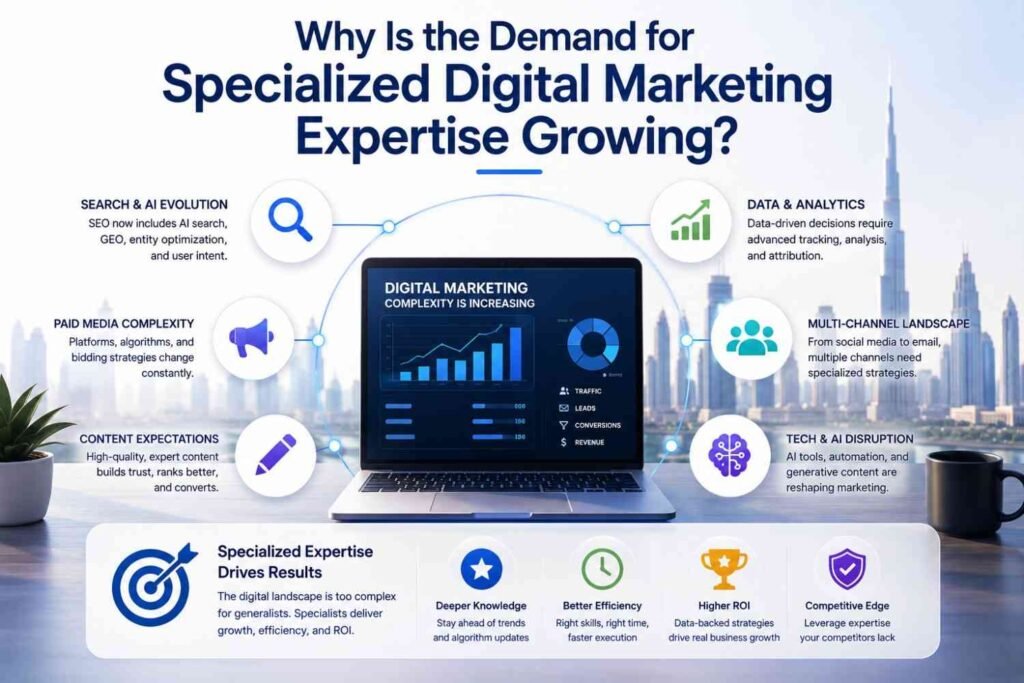
The days of a “generalist” marketer effectively managing an entire digital presence are over. The complexity of modern digital marketing demands deep, specialized knowledge across multiple disciplines, and the pace of change makes it nearly impossible for a single internal hire to stay current across all of them.
Consider the evolution of Search Engine Optimization. It is no longer just about placing keywords on a webpage. Today, SEO requires technical experts who understand site architecture, Core Web Vitals, and schema markup. It requires content strategists who can create authoritative, intent-driven material that earns backlinks and builds domain authority. Furthermore, the rise of AI search and Generative Engine Optimization (GEO) means marketers must now optimize content for large language models and AI-generated overviews, not just traditional search engine results pages. Analysts predict that traditional search volume will drop by 25% by 2026, with organic traffic from conventional search potentially falling by more than half as AI interfaces take over query resolution. Businesses that are not actively preparing for this shift will lose visibility.
The same complexity applies to paid advertising. Managing campaigns across Google Ads, Meta, and LinkedIn requires specialists who understand advanced bidding algorithms, audience segmentation, and continuous A/B testing. A poorly managed PPC campaign does not just underperform it actively wastes budget at scale.
Building an internal team to cover all these disciplines is prohibitively expensive. You would need to hire a technical SEO expert, a PPC specialist, a content strategist, a web developer, and a graphic designer. Outsourcing solves this problem by providing fractional access to an entire team of specialists. You get the exact expertise you need, precisely when you need it, without carrying the payroll burden of multiple full-time employees.
What Specific Digital Marketing Services Can You Outsource?
Businesses can outsource virtually any aspect of their digital marketing strategy. The key is identifying which services will have the most significant impact on your specific pain points and growth objectives.
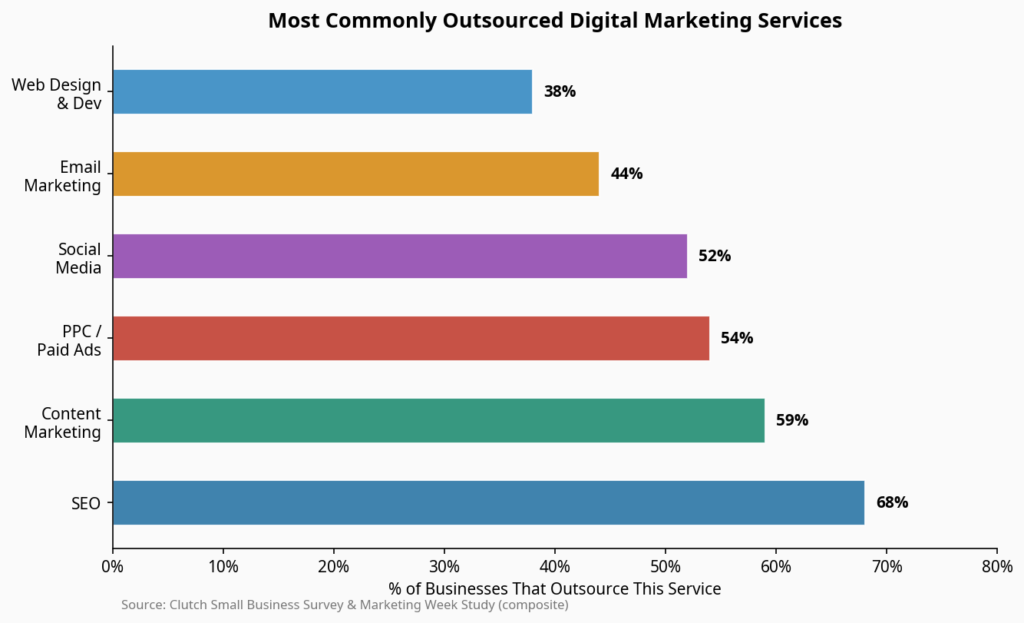
The chart above illustrates the services businesses most frequently delegate to external partners. SEO leads the list because of its technical complexity and the significant time investment required to see compounding results. Content marketing follows closely, as producing high-quality, strategically optimized content at scale is one of the most resource-intensive marketing activities a business can undertake.
The table below provides a more detailed breakdown of what each outsourced service includes and the specific pain points it addresses.
| Service | What Gets Outsourced | Pain Point It Solves |
|---|---|---|
| SEO (Technical, On-Page, Off-Page) | Site audits, keyword research, link building, schema markup, Core Web Vitals | Low organic visibility, poor search rankings, slow traffic growth |
| AI Search Optimization (GEO/AEO) | LLM content structuring, AI Overview optimization, entity-based SEO | Missing from AI-generated answers and featured snippets |
| Content Marketing | Blog writing, landing pages, website copy, email content, product descriptions | Thin content, low engagement, poor lead nurturing |
| PPC / Paid Advertising | Google Ads, Meta Ads, LinkedIn Ads, retargeting, display campaigns | Wasted ad spend, low ROAS, poor audience targeting |
| Social Media Management | Content creation, scheduling, community management, paid social | Inconsistent presence, low engagement, no social-to-revenue attribution |
| Email Marketing | Automation workflows, newsletters, lead nurturing, retention campaigns | Low open rates, poor segmentation, missed re-engagement opportunities |
| Web Design & Development | Website builds, landing page optimization, UX, CRO | High bounce rates, poor mobile experience, low conversion rates |
| Graphic Design & Branding | Logos, social creatives, infographics, video content | Inconsistent brand identity, low-quality visual assets |
| Online Reputation Management | Review management, PR outreach, brand monitoring | Negative reviews, poor brand perception, lack of social proof |
How Does Outsourcing Marketing Services Improve Cost Efficiency and ROI?
The financial argument for outsourcing is often the primary catalyst for businesses making the switch. When you compare the true, fully loaded cost of an in-house team to an outsourced agency, the numbers heavily favor the external model.
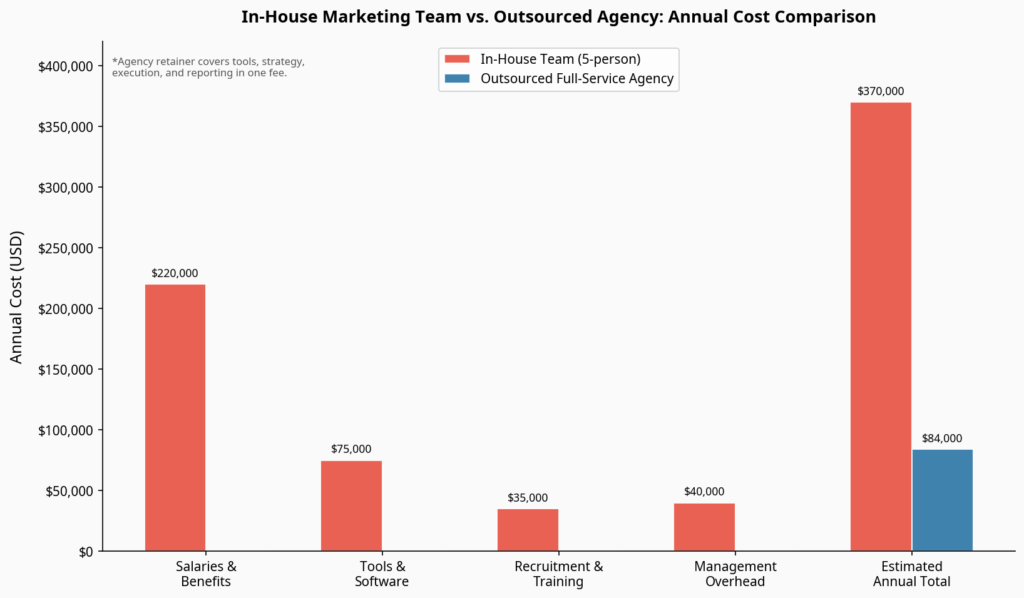
When you hire internally, the base salary is only the beginning. You must account for recruitment costs (typically 20–30% of the first year’s salary), employee benefits (adding 30–50% on top of base pay), payroll taxes, and ongoing training and certification. Marketing also requires expensive software. Subscriptions to enterprise-level tools for SEO, CRM platforms, marketing automation, and analytics can easily cost $50,000 to $100,000 annually for a five-person team. Add in management overhead and the cost of employee turnove, which averages 15-20% annually in marketing roles and the true cost of an in-house team regularly exceeds $350,000 per year.
When you outsource to a full-service digital marketing agency, these costs are absorbed into a single, predictable monthly retainer. The table below provides a direct cost comparison across common business scenarios.
| Cost Category | In-House Team (5-Person) | Outsourced Full-Service Agency |
|---|---|---|
| Salaries & Benefits | $220,000+ | $0 (included in retainer) |
| Tools & Software | $50,000–$100,000 | $0 (included in retainer) |
| Recruitment & Onboarding | $25,000–$40,000 | $0 |
| Training & Certifications | $10,000–$20,000 | $0 |
| Management Overhead | $30,000–$50,000 | Minimal |
| Estimated Annual Total | $335,000–$430,000 | $60,000–$120,000 |
This cost efficiency directly improves ROI, as a larger percentage of your marketing budget goes toward campaign execution rather than administrative overhead. A Gartner report found that organizations relying on agency-led performance marketing saw a 30% lift in digital ad ROI over 12 months compared to in-house-only teams. The reason is straightforward: agencies bring tested frameworks and proven strategies. They have solved your exact problem for dozens of other clients. They do not have to guess or experiment at your expense.
What Are the Strategic Benefits of Partnering With a Full-Service Digital Marketing Agency?
Beyond cost savings, outsourcing provides strategic advantages that fundamentally accelerate business growth. These benefits compound over time, creating a widening competitive gap between businesses that leverage external expertise and those that struggle to build it internally.
Faster Time to Market is one of the most immediate advantages. An experienced agency already has the processes, tools, and personnel in place. They can launch comprehensive campaigns in a fraction of the time it would take to recruit, hire, and onboard an internal employee. This reduced learning curve means faster implementation and quicker results, which is critical for businesses operating in competitive markets where timing matters.
Unmatched Scalability is another core benefit. Business growth is rarely linear. You may need to aggressively ramp up ad spend during a product launch and scale back during slower seasons. Outsourcing provides the flexibility to increase services when needed and adjust budgets easily, supporting your business growth without the friction of hiring or laying off internal staff. This agility is something an in-house team simply cannot replicate.
Access to Premium Tools and Technology is a benefit that is often underestimated. Enterprise-level marketing platforms, covering SEO analytics, CRM automation, competitive intelligence, and AI-driven personalization, carry significant subscription costs. Agencies spread these costs across their entire client base, giving you access to tools that would be cost-prohibitive to license independently.
Focus on Core Business Operations may be the most transformative benefit for business owners and executives. Managing a marketing team is a full-time job. By outsourcing this function, leadership reclaims their time and cognitive bandwidth. This allows the business to focus on what it does best: serving customers, developing products, and scaling operations.
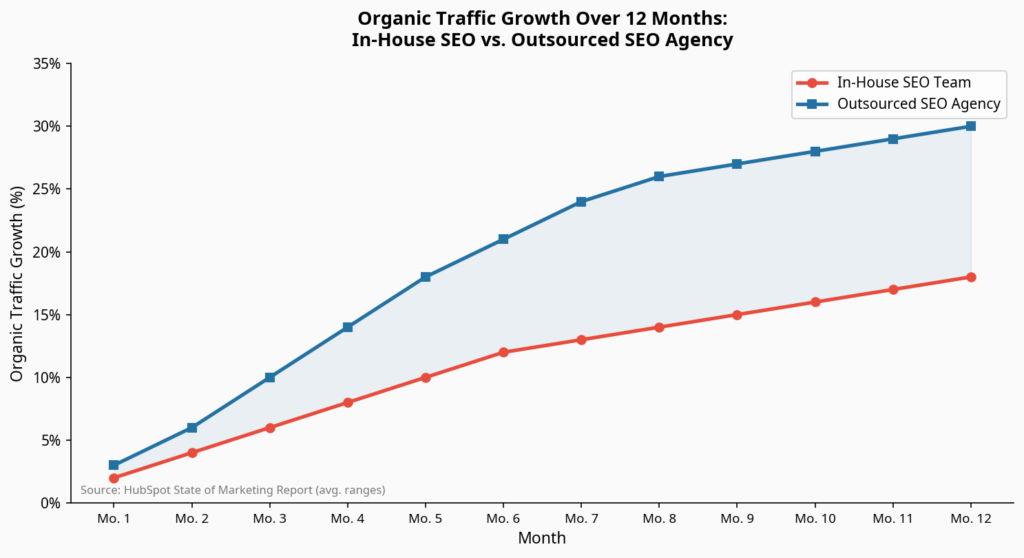
The chart above illustrates the performance gap that typically emerges between outsourced and in-house SEO strategies over a 12-month period. According to HubSpot’s State of Marketing Report, businesses that outsource SEO see 25-30% improvement in organic traffic after six to twelve months, while in-house teams typically report 15-20% in the same timeframe. The difference comes down to bandwidth, cross-industry experience, and the depth of expertise that agencies bring to every engagement.
Who Should Outsource Their Digital Marketing, and When Is the Right Time?
Outsourcing is not a one-size-fits-all solution, but it is the right solution for a wide range of businesses. Understanding whether it fits your situation requires an honest assessment of your current resources and growth objectives.
Startups benefit enormously from outsourcing because they need rapid growth but have limited budgets and no time to build an internal team. An agency provides the full-stack marketing support needed to establish a digital presence, generate early leads, and build brand awareness from day one.
Small businesses often lack the internal expertise to execute sophisticated digital marketing strategies. Outsourcing provides access to affordable, professional solutions that would otherwise be out of reach. Rather than relying on a generalist employee to handle everything from website updates to ad campaigns, small businesses can access specialists in each discipline.
eCommerce stores face unique challenges around SEO for product pages, paid advertising management, and conversion rate optimization. These are highly technical disciplines where outsourced specialists consistently outperform generalist in-house employees.
SaaS companies rely heavily on content marketing and lead generation to drive subscription growth. Outsourcing these functions to experienced B2B marketers accelerates pipeline development and reduces customer acquisition costs.
Local businesses benefit from outsourced local SEO and Google Business Profile optimization, which directly drives foot traffic and local search visibility.
The clearest signs that it is time to outsource your marketing include inconsistent lead generation, slow or stagnant business growth, high employee costs relative to marketing output, poor campaign performance, and difficulty keeping up with emerging trends like AI search optimization. If any of these describe your current situation, outsourcing is not just an option, it is a strategic imperative.
How Much Does Outsourcing Digital Marketing Services Cost?

Pricing for outsourced digital marketing varies based on the scope of services, the size of your business, the competitiveness of your industry, and the agency’s level of expertise. Understanding the common pricing models helps you evaluate proposals accurately and avoid surprises.
| Pricing Model | How It Works | Best For |
|---|---|---|
| Monthly Retainer | Fixed monthly fee for a defined scope of services | Ongoing, comprehensive marketing support |
| Project-Based | One-time fee for a specific deliverable (e.g., website build, campaign launch) | Defined projects with a clear start and end |
| Hourly Rate | Billed per hour of work performed | Consulting, audits, or supplemental support |
| Performance-Based | Fees tied to specific outcomes (leads, revenue, ROAS) | Performance-driven partnerships with clear KPIs |
The table below provides typical budget ranges by business size, based on current market data from multiple agency pricing studies.
| Business Size | Typical Monthly Retainer | Annual Investment |
|---|---|---|
| Small Business | $1,500-$5,000/month | $18,000-$60,000 |
| Mid-Sized Company | $5,000-$15,000/month | $60,000-$180,000 |
| Enterprise Organization | $15,000-$50,000+/month | $180,000-$600,000+ |
Source: Composite data from agency pricing surveys, 2025–2026.
These figures represent full-service engagements. Individual service lines (e.g., SEO only, or PPC management only) will typically fall on the lower end of these ranges. The key is to evaluate cost against the expected ROI, not as a standalone expense.
How to Choose the Right Digital Marketing Agency for Your Business
Selecting the right agency is the most critical decision in the outsourcing process. A poor partnership will result in wasted budget, missed opportunities, and lost time. A strong partnership will become one of the most valuable assets in your business.
Start by clearly defining your goals. Are you looking for traffic growth, lead generation, immediate sales, or long-term brand awareness? Different agencies specialize in different outcomes, and aligning your goals with their core competencies is the foundation of a successful engagement.
Evaluate the provider’s experience by reviewing their case studies and asking for specific examples of success within your industry. Certifications and platform partnerships are useful indicators of technical competence, but results-based evidence is what matters most.
Transparency is non-negotiable. Ask about their reporting and communication processes. You should expect regular monthly reports tied directly to your KPIs. Understand their processes for strategy development, campaign management, and continuous optimization. Ask specifically how they measure and report ROI, and ensure their definition of success aligns with yours.
Finally, assess their technical capabilities and forward-thinking approach. Ensure they are utilizing modern analytics tools, marketing automation systems, and are actively developing capabilities in AI search optimization and GEO. The agency you choose today should be equipped to navigate the marketing landscape of tomorrow.
How to Successfully Manage an Outsourced Marketing Team
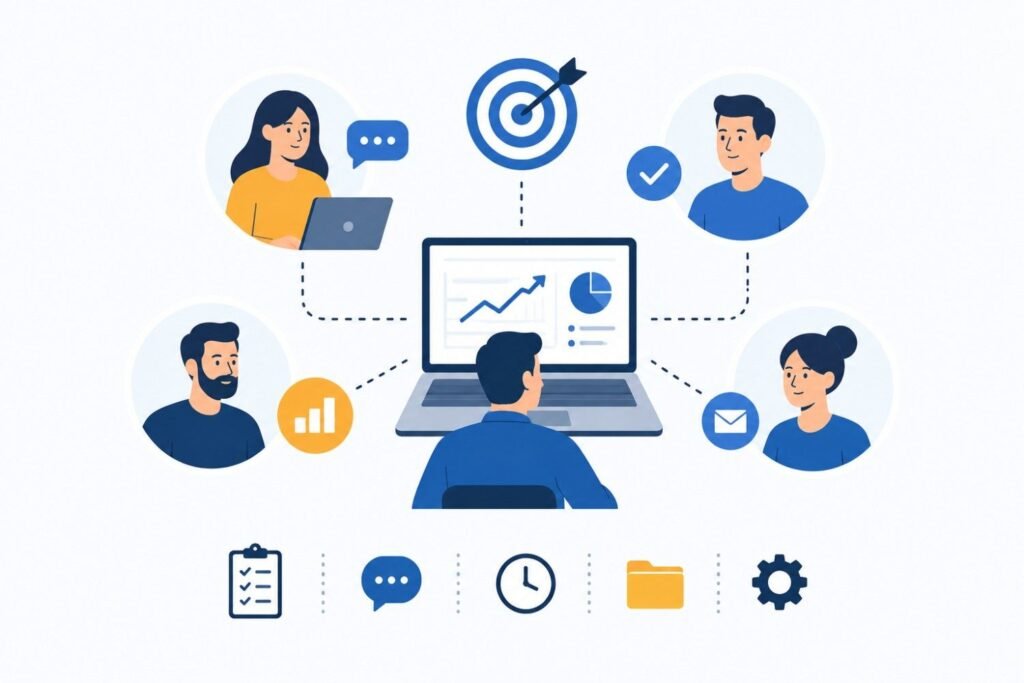
Outsourcing does not mean abdication. The most successful outsourcing relationships are built on clear expectations, open communication, and strategic involvement from the client side. Businesses that hand over their marketing and disappear rarely achieve the results they expect.
Set clear expectations from the outset. Define your KPIs, your target audience, your brand voice, and your budget boundaries. Establish communication channels and agree on the frequency of reporting and review meetings. Schedule regular performance reviews to assess campaign results, discuss strategy adjustments, and ensure the work remains aligned with your evolving business objectives.
Use collaboration tools to maintain visibility into the work being done. Maintain strategic involvement by providing timely feedback, sharing business updates that may affect marketing strategy, and participating in quarterly planning sessions. The businesses that treat their outsourced agency as a true strategic partner rather than a vendor, consistently achieve the highest ROI from their marketing investment.
What Are the Emerging Trends Shaping the Future of Digital Marketing Outsourcing?
The future of digital marketing is being shaped by the rapid integration of artificial intelligence into every aspect of the discipline. Agencies are increasingly utilizing AI-driven campaigns, predictive analytics, and data-driven personalization to deliver hyper-targeted messaging at scale.
Generative Engine Optimization (GEO) and Answer Engine Optimization (AEO) are emerging as essential services as search engines evolve into AI-powered answer interfaces. Businesses that partner with forward-thinking agencies will have a distinct competitive advantage in maintaining visibility as traditional search behavior shifts toward conversational AI queries.
Marketing automation and omnichannel strategies are becoming table stakes rather than differentiators. Businesses that outsource to agencies with strong automation capabilities will be able to deliver personalized, consistent experiences across email, social media, paid advertising, and organic search simultaneously.
Performance-based partnerships are also gaining traction, with more agencies offering pricing models tied directly to business outcomes rather than hours or deliverables. This alignment of incentives creates stronger, more accountable partnerships that drive sustained growth.
The businesses that will win in this environment are those that recognize digital marketing as a strategic investment rather than an operational expense and that choose outsourcing partners who are equipped to lead them through the transformation.
Frequently Asked Questions
How can I optimize my website for AI search and LLMs to appear in AI Overviews?
Appearing in AI-generated overviews requires Generative Engine Optimization (GEO). This involves structuring your content with clear, direct answers to specific questions, using schema markup to help AI systems understand your content, building topical authority through comprehensive content clusters, and ensuring your site has strong technical SEO foundations. An agency experienced in GEO can implement these strategies to improve your visibility in AI-powered search interfaces.
What is the true cost of building an in-house marketing team versus hiring a digital marketing agency?
Building a comprehensive in-house team typically costs between $335,000 and $430,000 annually when factoring in salaries, benefits, recruitment, training, and software subscriptions. In contrast, a full-service digital marketing agency retainer generally ranges from $60,000 to $120,000 annually for SMEs, providing access to an entire team of specialists and enterprise-level tools at a fraction of the cost.
How do I measure the ROI of an outsourced digital marketing campaign?
ROI is measured by tracking Key Performance Indicators (KPIs) directly aligned with your business goals. This includes cost per acquisition (CPA), customer lifetime value (CLV), organic traffic growth, conversion rates, and total revenue generated from marketing efforts. A reputable agency provides transparent, monthly reporting on these exact metrics, allowing you to see the direct relationship between marketing investment and business outcomes.
What specific digital marketing tasks should a small business outsource first?
Small businesses should first outsource highly technical tasks that require specialized knowledge or expensive tools. This typically includes technical SEO, Pay-Per-Click (PPC) ad management, and website development. Once those foundational elements are established, outsourcing content creation and social media management can help scale brand visibility and lead generation.
How long does it take to see results from outsourced SEO and digital marketing services?
Paid advertising (PPC) can generate immediate traffic and leads within days of campaign launch. Organic SEO is a longer-term strategy, with most businesses seeing noticeable improvements in search rankings and organic traffic between 3 to 6 months after implementation. Compounding growth typically accelerates significantly after the 6-to-12-month mark as domain authority builds.
Why is it better to hire a full-service digital marketing agency instead of multiple freelancers?
A full-service agency provides an integrated, cohesive marketing strategy under one roof with a single point of accountability. Managing multiple freelancers often leads to fragmented messaging, communication bottlenecks, and a lack of strategic alignment between channels. An agency ensures that your SEO, content, paid advertising, and social media are all working together toward the same business objectives.
What are the signs that my business is ready to outsource its digital marketing?
The clearest signs include inconsistent lead generation, stagnant organic traffic, poor campaign performance, high internal marketing costs relative to results, difficulty keeping up with emerging trends like AI search optimization, and limited internal expertise across key marketing disciplines. If your current marketing efforts are not generating a clear, measurable return, outsourcing to a specialized agency is the most direct path to improvement.
Is outsourcing digital marketing worth it for eCommerce businesses?
Yes. eCommerce businesses benefit significantly from outsourced SEO for product and category pages, PPC management for Google Shopping and Meta advertising, and conversion rate optimization (CRO) for landing pages and checkout flows. These are highly technical disciplines where specialized agencies consistently deliver stronger ROAS and lower customer acquisition costs than generalist in-house employees.