Enterprise SEO is the structured, scalable approach large organizations use to manage organic search visibility across thousands of pages. This guide covers the core strategies, technical priorities, and content frameworks that help enterprise brands grow qualified traffic, compete in AI-driven search, and turn organic performance into measurable business outcomes. It is written for marketing leaders, SEO managers, and digital teams managing complex websites.
Managing SEO for a large website is not a bigger version of managing a small one. It is a fundamentally different discipline. When a site has thousands or millions of pages, a single technical error can suppress rankings across entire sections. A well-executed strategy, on the other hand, can compound organic growth at a scale that no paid channel can match.
The challenge most enterprise teams face is not a lack of effort. It is a lack of structure. Without scalable systems for technical management, content production, and performance tracking, even the most talented SEO teams lose ground to competitors who operate more efficiently. The strategies below address each of these areas directly.
What Makes Enterprise SEO Different from Regular SEO?
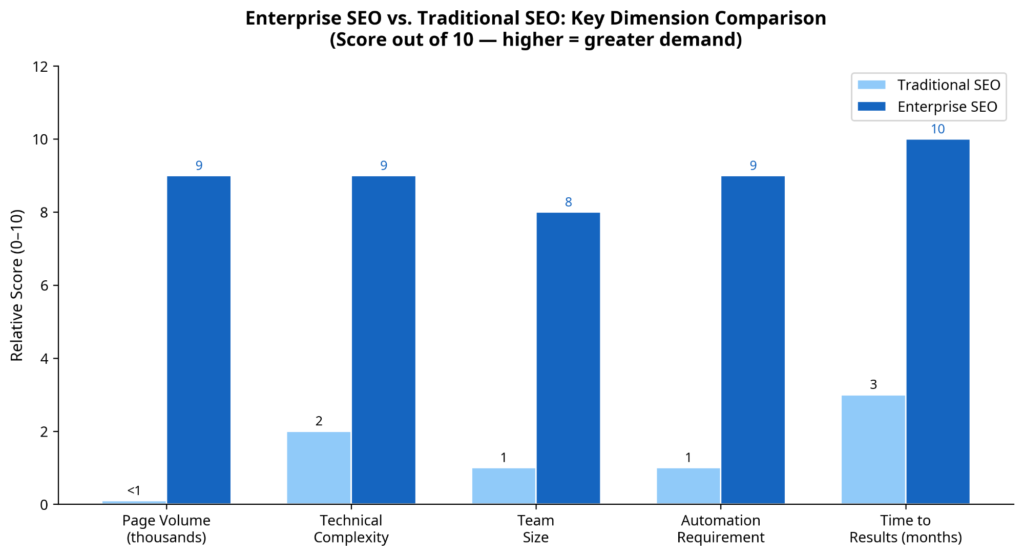
Enterprise SEO differs from traditional SEO in three core ways: scale, complexity, and organizational alignment.
At the page level, the difference is stark. A small business might optimize 50 pages. An enterprise site may manage 500,000. Every process that works manually at small scale must be systematized and automated at enterprise scale. Internal linking, content updates, technical audits, and reporting all require structured workflows rather than one-off tasks.
The organizational dimension is equally significant. Enterprise SEO does not live in a single team. It requires alignment across marketing, IT, legal, and product departments. Decisions that take minutes on a small site can require months of cross-functional coordination on an enterprise platform.
| Dimension | Traditional SEO | Enterprise SEO |
|---|---|---|
| Page Volume | Tens to hundreds | Thousands to millions |
| Technical Complexity | Minimal | High (crawl budget, legacy systems) |
| Team Structure | One or two people | Cross-functional teams |
| Content Production | Ad hoc | Systematic, templated workflows |
| Reporting | Manual | Automated dashboards |
| Primary Risk | Low visibility | Technical errors at scale |
Why Does Technical SEO Determine Enterprise Performance?
Technical SEO is the foundation. Without it, no content strategy or link-building effort will reach its potential. For large websites, the most critical technical priorities are crawlability, indexability, and page performance.
Crawl budget management is the first priority. Search engines allocate a finite number of crawl requests to each site. If that budget is wasted on low-value pages, duplicate URLs, or broken redirects, important content goes undiscovered. Optimizing XML sitemaps, blocking unnecessary pages via robots.txt, and resolving redirect chains directly improves how efficiently search engines index the site.
Core Web Vitals are the second priority. Page speed and user experience metrics directly influence rankings. For enterprise sites with dynamic content and heavy media, this requires systematic optimization: image compression, server-side caching, JavaScript deferral, and continuous monitoring via performance tools.
Duplicate content is the third priority. Large sites are especially prone to content duplication across product pages, faceted navigation, and regional variants. Canonical tags, hreflang implementation for international sites, and regular content audits are the primary controls.
How Does a Topic Cluster Strategy Build Topical Authority?
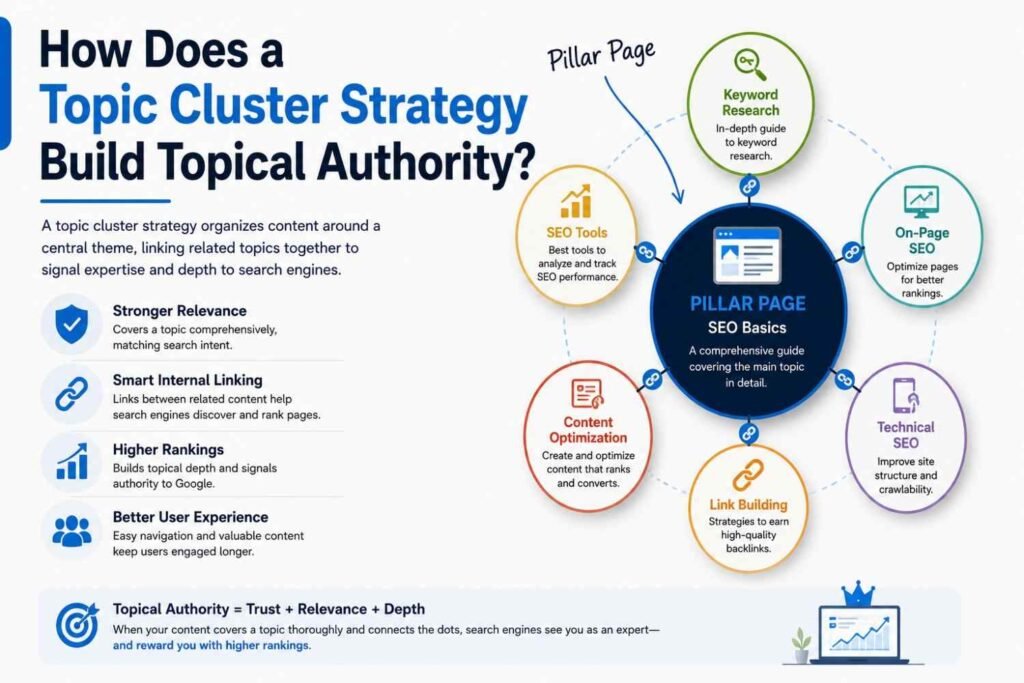
Isolated pages targeting individual keywords are not sufficient for enterprise-level authority. The most effective content architecture uses topic clusters: a central pillar page covering a broad subject, supported by a network of related cluster articles that address specific subtopics in depth.
This structure serves two purposes. First, it signals topical authority to search engines by demonstrating comprehensive coverage of a subject. Second, it creates a logical user journey, guiding visitors from broad awareness to specific answers. Internal links between the pillar and cluster pages reinforce both purposes simultaneously.
For enterprise teams, the practical implementation requires mapping content to the full customer journey. Top-of-funnel informational content builds brand authority and captures early-stage demand. Mid-funnel content addresses evaluation and comparison needs. Bottom-of-funnel content converts. A balanced topic cluster strategy covers all three stages.
What Is the Right Way to Approach Keyword Research at Enterprise Scale?
Keyword research at the enterprise level must be driven by intent and revenue potential, not search volume alone. High-volume keywords are often the most competitive and the least likely to convert. The more valuable approach identifies keywords that align with specific stages of the buying journey and map directly to pages that can convert.
Content gap analysis is the most actionable starting point. By identifying topics where competitors rank but the site does not, enterprise teams can prioritize content investments with the highest probability of organic gain. Clustering keywords by parent topic reduces redundancy and ensures that each page targets a distinct and well-defined intent.
How Can Enterprise Teams Scale Content Without Losing Quality?
Scaling content production is one of the most common failure points for enterprise SEO programs. The pressure to produce volume often comes at the cost of consistency, accuracy, and brand voice. The solution is not more writers. It is a better system.
Editorial standards, content templates, and structured approval workflows are the foundation. When every piece of content follows the same framework for structure, tone, and optimization, quality becomes a function of the process rather than the individual. Regular content audits identify underperforming assets that can be updated or consolidated, extending the value of existing investments.
How Should Enterprise Content Be Optimized for AI Overviews and Answer Engines?
AI-driven search features, including AI Overviews and answer engines, extract content differently than traditional search. They prioritize direct answers, factual clarity, and structured formatting. Content that buries its main point in lengthy introductions is less likely to be cited.
The BLUF principle applies directly here: state the answer first, then provide supporting context. Use structured headings that mirror the questions users actually ask. Include FAQ sections with concise, direct responses. Define key entities clearly. Avoid jargon. These practices improve performance in both traditional SERP features like featured snippets and AI-generated summaries.
What Does a Strong Enterprise SEO Performance Framework Look Like?
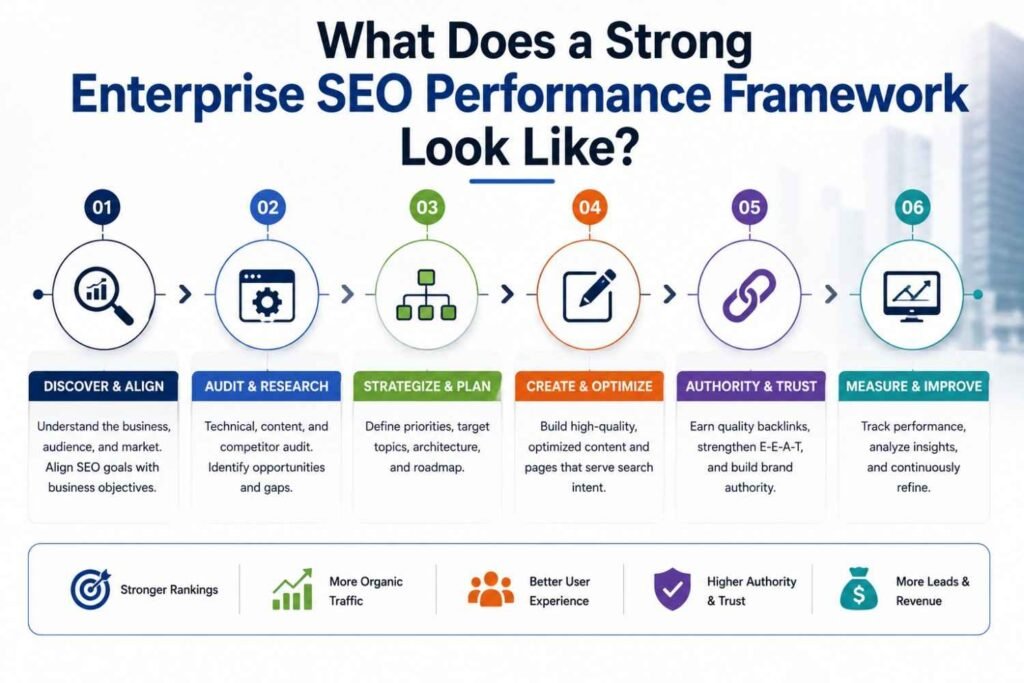
Continuous monitoring is not optional at enterprise scale. Rankings shift, technical issues emerge, and algorithm updates can affect thousands of pages simultaneously. A strong performance framework tracks the metrics that matter most to the business, not just the ones that are easiest to measure.
The table below outlines the key performance categories and the metrics that should be tracked within each.
| Performance Category | Key Metrics to Track |
|---|---|
| Organic Visibility | Keyword rankings, impressions, click-through rate |
| Traffic Quality | Organic sessions, bounce rate, pages per session |
| Technical Health | Crawl errors, index coverage, Core Web Vitals scores |
| Revenue Impact | Organic conversions, assisted revenue, cost per acquisition |
| Competitive Position | Share of voice, competitor ranking changes |
Competitor tracking is an underused component of this framework. Understanding where competitors are gaining or losing ground provides early signals for strategic adjustments before traffic losses materialize.
What Are the Most Common Enterprise SEO Mistakes That Cost Rankings?
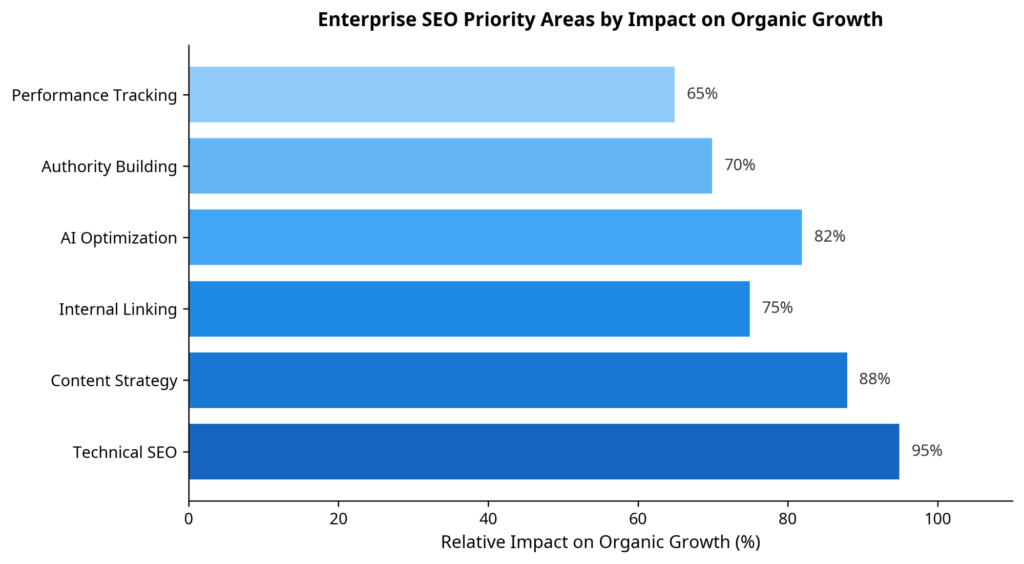
The most damaging enterprise SEO mistakes are structural, not tactical. They compound over time and are often invisible until significant traffic loss has already occurred.
Ignoring technical debt is the most prevalent. Legacy platforms, unresolved redirect chains, and accumulated duplicate content create a ceiling on organic performance that no amount of new content can break through. Addressing technical issues must be treated as an ongoing operational priority, not a one-time project.
Poor internal linking is the second most common failure. On large sites, orphan pages (pages with no internal links pointing to them) are common and represent wasted investment. A systematic internal linking strategy ensures that every page is discoverable and that link equity flows to the pages that matter most.
The third mistake is measuring the wrong outcomes. Focusing on keyword rankings as the primary success metric disconnects SEO from business value. Organic revenue, lead quality, and conversion rate are the metrics that justify investment and guide strategy.
Frequently Asked Questions
What is an enterprise SEO strategy and how does it work?
An enterprise SEO strategy is a scalable, systematic approach to managing organic search visibility for large websites. It works by combining technical SEO infrastructure, structured content production, and cross-functional team alignment to drive consistent organic growth across thousands of pages.
How is enterprise SEO different from regular SEO?
Enterprise SEO differs in scale, complexity, and organizational scope. It requires automated processes, advanced technical management, and coordination across multiple departments, whereas traditional SEO is typically managed by one or two people on a smaller site.
Which types of businesses need enterprise SEO?
Large corporations, global e-commerce platforms, multi-location businesses, SaaS companies, and any organization managing websites with thousands of URLs and complex technical architectures require enterprise SEO to maintain and grow organic performance.
How important is technical SEO for large enterprise websites?
Technical SEO is the foundation of enterprise performance. On large sites, technical errors multiply across thousands of pages. Crawl budget management, duplicate content control, and Core Web Vitals optimization directly determine how much of the site search engines can discover and rank.
How do you optimize enterprise content for AI Overviews and featured snippets?
Write direct answers at the start of each section. Use structured headings that mirror real user questions. Include FAQ sections with concise responses. Define entities clearly and avoid jargon. This structure makes content easier for AI systems to extract and cite.
How long does it take for enterprise SEO to show results?
Enterprise SEO typically requires 6 to 12 months to produce measurable results. The timeline reflects the scale of implementation, the depth of technical changes required, and the time search engines need to re-crawl and re-index large sites.
What metrics should enterprise SEO teams track to prove ROI?
The most meaningful metrics are organic revenue, conversion rate from organic traffic, cost per acquisition compared to paid channels, and share of voice against key competitors. Rankings and traffic are supporting indicators, not primary measures of success.