
The search landscape has shifted fundamentally from traditional ten blue links to dynamic, AI-generated answer layers. With over 60% of searches now resulting in zero clicks and AI Overviews answering queries directly on the search engine results page (SERP), content optimization must evolve. This comprehensive guide explores the new optimization framework: Search Engine Optimization for rankings, Generative Engine Optimization for AI answers, Answer Engine Optimization for featured snippets, and AI Optimization for discoverability. Designed for business owners, marketing managers, and digital strategists, this article breaks down how modern search works, why traditional tactics fall short, and how to build a resilient content strategy that captures both human attention and AI citations.
The way people find information online has changed permanently. We have moved past the era where search engines acted simply as directories pointing users to external websites. Today, search engines function as destination platforms, resolving queries directly on the page using artificial intelligence. This shift has massive implications for businesses relying on organic traffic to drive growth.
If your content strategy still revolves entirely around ranking number one for informational keywords, you are likely seeing a drop in website visits, even if your rankings remain stable. The reality is that users no longer need to click a link to get a basic answer. To stay visible and relevant, businesses must rethink content optimization. It is no longer just about search engine optimization. Success now requires a multi-layered approach that includes generative engine optimization, answer engine optimization, and AI optimization.
This guide breaks down exactly how these new systems work and provides actionable strategies to ensure your content remains visible, authoritative, and capable of driving real business results.
What Is The Definition Of Content Optimization In Modern Search?
Content optimization is the process of structuring, writing, and refining digital content so that it achieves maximum visibility across all search surfaces while providing an exceptional user experience. Historically, this meant tweaking title tags, adding keywords, and building backlinks to rank higher in traditional search results. While those elements still matter, the definition has expanded significantly.
Today, optimizing content means making it easily understandable for large language models and answer engines. It involves structuring data so AI systems can extract and cite your insights directly in their summaries. It also requires a deep understanding of user intent, ensuring that when a user does click through to your website, the content delivers immediate value, answers their questions completely, and guides them toward a logical next step.
For businesses, the goal of content optimization is no longer just generating raw traffic. The goal is to capture visibility where it matters most, whether that is inside an AI Overview, within a featured snippet, or at the top of commercial search results where users are ready to take action.
Why Does Content Optimization Matter More Now Than Ever Before?

The urgency around content optimization stems from a rapid evolution in user behavior and search engine technology. The competition for visibility has intensified, and the mechanics of how visibility is awarded have fundamentally changed.
The Rise Of Zero-Click Searches
The most significant change in the digital landscape is the rise of zero-click searches. Recent data indicates that approximately 60% of global Google searches result in no clicks to external websites. When users search for quick facts, definitions, or basic instructions, AI-powered summaries provide the answer immediately. If your business relies on top-of-funnel, purely informational content to drive traffic, that traffic is disappearing.
AI-Generated Search Experiences
Search engines are deploying generative AI to synthesize information from multiple sources and present a cohesive answer. Google’s AI Overviews, for example, appear in roughly 25% of all searches. These overviews do not just push traditional organic results further down the page; they often replace the need for them entirely. However, AI Overviews also cite sources. Being cited within an AI-generated answer is now one of the most valuable positions a brand can secure, often resulting in higher click-through rates than traditional organic rankings.
Changing User Expectations
Users expect fast, accurate, and direct answers. They no longer have the patience to scroll through a 2,000-word article to find a single piece of information. Content must be structured to deliver value immediately. If a visitor lands on your page and cannot find what they need within seconds, they will leave, increasing your bounce rate and signaling to search engines that your content is not helpful.
What Are The Four Main Types Of Search Intent?
Before writing a single word, you must understand why a user is searching. Search intent dictates the format, depth, and structure of your content. Misaligning your content with user intent is one of the most common reasons pages fail to rank or convert.
- Informational Intent: The user wants to learn something. They are asking questions like “how to,” “what is,” or “why.” Informational queries are highly susceptible to zero-click resolution by AI engines. To win here, your content must offer unique insights, original data, or expert perspectives that an AI cannot simply scrape and summarize.
- Navigational Intent: The user is looking for a specific website or page. They might search for “Eyes On Solution login” or “Eyes On Solution contact page.” Optimization here ensures your brand assets are clearly labeled and easily accessible.
- Commercial Intent: The user is researching options before making a purchase decision. They use terms like “best,” “top,” “reviews,” or “compare.” This is a critical stage for content optimization. Users are looking for detailed comparisons, pros and cons, and expert recommendations.
- Transactional Intent: The user is ready to buy or take a specific action. They search for terms like “buy,” “hire,” “price,” or “services.” Transactional pages must be highly optimized for conversions, with clear calls-to-action, straightforward pricing, and frictionless user experiences.
Understanding these intents allows you to map your content strategy effectively. While informational content builds authority, commercial and transactional content drives revenue.
How Do You Conduct Keyword Research For AI And Traditional Search?
Keyword research remains the foundation of content optimization, but the approach has shifted from finding high-volume exact-match phrases to understanding topics, entities, and the questions users ask.
Targeting Primary And Long-Tail Keywords
Your primary keyword represents the core topic of your page. However, relying solely on broad, high-competition keywords is rarely effective. Long-tail keywords, longer, more specific phrases, are crucial. They often have lower search volume but significantly higher conversion rates because they capture users with precise intent. For example, instead of targeting “digital marketing,” a more effective long-tail keyword would be “SEO content writing services in Dubai.”
Integrating Semantic And LSI Keywords
Search engines use natural language processing to understand the context of a page. Latent Semantic Indexing (LSI) keywords are terms conceptually related to your primary topic. Including these helps search engines and AI models grasp the depth and relevance of your content. If you are writing about “content optimization,” semantic keywords might include “search intent,” “readability,” “structured data,” and “user engagement.”
Optimizing For Conversational Queries
With the rise of voice search and conversational AI assistants, users are asking full questions rather than typing fragmented keywords. Keyword research must now include identifying the exact questions your audience asks. Tools like “People Also Ask” sections in search results are excellent sources for these conversational queries. Incorporating these questions directly into your content, particularly in headers and FAQ sections, improves your chances of being cited by answer engines.
What Makes Content High-Quality, Helpful, And Original?
Search engines and AI models prioritize content that demonstrates real expertise and provides a genuinely helpful experience. Generic, regurgitated information no longer cuts it.
Demonstrating Experience And Expertise
Content must showcase firsthand knowledge. This means moving beyond surface-level summaries and providing practical insights, case studies, and real-world examples. If you are explaining a complex SEO strategy, detail how you implemented it for a client and the specific results achieved. This level of detail proves to search engines and users that you are an authoritative source.
Answering Questions Clearly And Completely
When a user lands on your page, they have a problem they need solved. Your content must provide a complete solution. Do not force readers to dig for the answer; place the most critical information near the top of the page. Use the inverted pyramid style of writing, starting with the conclusion and following up with supporting details.
Maintaining Accuracy And Freshness
Content optimization is not a one-time task. Information decays quickly, especially in fast-moving industries like digital marketing. Regularly review and update your content to ensure statistics are current, links are functional, and strategies remain relevant. Search engines favor fresh content, and updating an existing article often yields faster ranking improvements than publishing a new one.
How Should You Structure Content For Better Readability And AI Extraction?
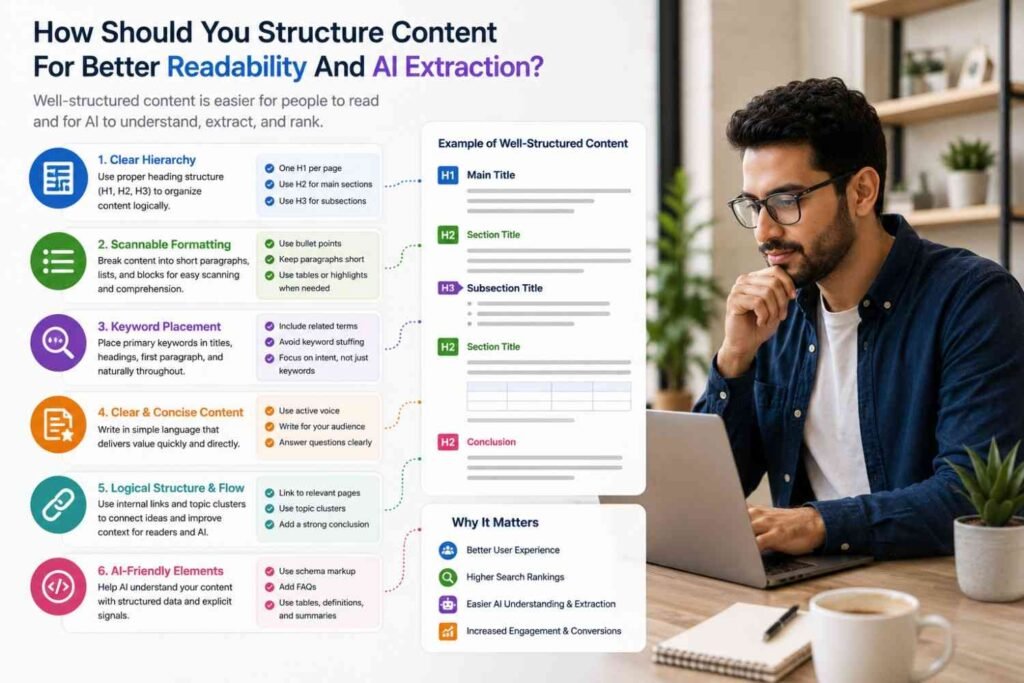
The way your content is formatted is just as important as what it says. Proper structure improves readability for human users and makes it easier for AI systems to parse and extract your information.
Implementing A Clear Heading Hierarchy
Use heading tags (H1, H2, H3) to create a logical outline. The H1 tag is your main title, H2 tags introduce major sections, and H3 tags break down subtopics. This hierarchy acts as a roadmap for both readers and search engine crawlers, helping them understand the relationship between different concepts on the page.
Enhancing Scannability With Formatting
Most users do not read articles word-for-word; they scan. To accommodate this behavior:
- Keep paragraphs short, ideally no more than three or four sentences.
- Use bulleted and numbered lists to break up dense information.
- Highlight key terms or important takeaways in bold text.
- Include descriptive subheadings that summarize the section’s content.
Utilizing Tables And Data Visualizations
Answer engines frequently cite structured data. If you are comparing options, presenting statistics, or outlining a step-by-step process, use a Markdown table. Tables organize complex information cleanly, making it highly extractable for AI Overviews.
| Feature | Traditional SEO | Generative Engine Optimization (GEO) |
|---|---|---|
| Primary Goal | Rank highly in organic search results (10 blue links). | Be cited as a source in AI-generated answers and overviews. |
| Target Audience | Human searchers browsing results pages. | AI models synthesizing information for direct answers. |
| Key Metrics | Organic traffic, keyword rankings, click-through rate. | Brand mentions, citation frequency, visibility in AI summaries. |
| Content Focus | Keyword density, backlinks, meta tags. | Direct answers, structured data, original statistics, expert quotes. |
| Format Preference | Long-form articles, comprehensive guides. | Concise answer blocks, FAQs, lists, tables, clear hierarchies. |
What Are The Essential On-Page SEO Best Practices?
On-page SEO remains a critical component of content optimization. These technical elements help search engines categorize and index your pages accurately.
Optimizing Title Tags And Meta Descriptions
Your title tag is the most important on-page SEO element. It must accurately describe the page content and include your primary keyword. The meta description, while not a direct ranking factor, acts as your ad copy in the search results. A compelling meta description increases your click-through rate by clearly explaining the value the user will get by clicking your link.
Using Keyword-Optimized URLs
URLs should be short, descriptive, and include the primary keyword. Avoid using long strings of numbers or irrelevant characters. A clean URL structure helps users and search engines understand the page’s context before it even loads.
Implementing Internal And External Linking
Internal linking connects your content, distributing page authority throughout your site and helping users discover related information. When you mention a topic covered in another article, link to it. External linking to authoritative, high-quality sources demonstrates that your content is well-researched and credible.
Adding Schema Markup And Structured Data
Schema markup is code you add to your website to help search engines return more informative results. It explicitly tells search engines what your content means. Implementing FAQ schema, article schema, or review schema increases the likelihood of your content appearing as a rich snippet or being pulled into an AI answer.
What Is Generative Engine Optimization And Why Does It Matter?
Generative Engine Optimization is the practice of optimizing content specifically for AI-driven search engines and conversational interfaces like Google’s AI Overviews, ChatGPT, and Perplexity.
Understanding How AI Engines Generate Answers
Unlike traditional search engines that retrieve and rank existing web pages, generative engines read multiple sources, synthesize the information, and generate a new, original answer. They look for consensus across authoritative sites, extract factual data, and cite the sources that provided the most clear and structured information.
Best Practices For GEO
To optimize for generative engines, your content must be authoritative and easily digestible by machines.
- Provide Direct Answers: State the answer to a question clearly and concisely before expanding on the details.
- Include Original Statistics: AI models favor unique data points. Conducting original research or surveys makes your content highly citeable.
- Feature Expert Insights: Include quotes from subject matter experts. AI systems use these signals to determine the credibility of the information.
- Use Clear Formatting: As mentioned earlier, tables, lists, and strong heading structures are essential for GEO.
How Do You Win Featured Answers With Answer Engine Optimization?
Answer Engine Optimization focuses on securing featured snippets, knowledge panels, and direct answer boxes. These are the elements that appear at the absolute top of the search results, often referred to as “position zero.”
How Answer Engines Select Content
Answer engines select content that provides the most direct, accurate, and well-formatted answer to a specific query. They look for high-authority domains, strong on-page optimization, and content structured specifically to answer the user’s question.
AEO Optimization Techniques
To improve your chances of winning featured answers:
- Create Dedicated FAQ Sections: Group common questions and provide concise, one-paragraph answers.
- Use Question-Based Headings: Format your H2 and H3 tags as the exact questions users are asking.
- Write Concise Answer Blocks: Immediately following a question heading, provide a clear, 40-to-60-word answer. You can elaborate further down, but the initial block must be definitive.
What Is AI Optimization For Content Discoverability?
AI Optimization (AIO) is the broader strategy of making your entire digital footprint understandable to artificial intelligence systems. It goes beyond individual pages and focuses on how AI perceives your brand and topical authority.
Entity-Based Content Creation
Search engines increasingly understand the web through entities, people, places, concepts, and things, rather than just keywords. AIO involves clearly defining the entities relevant to your business and establishing the relationships between them. This means using consistent terminology and linking related concepts together.
Building Topic Clusters
Topic clustering is a powerful AIO strategy. Instead of creating isolated articles, build a comprehensive “pillar” page that covers a broad topic extensively. Then, create smaller “cluster” pages that dive deep into specific subtopics. Link all the cluster pages back to the pillar page, and vice versa. This architecture signals to AI systems that you have deep, comprehensive expertise on the subject.
How Can You Improve User Engagement Signals?
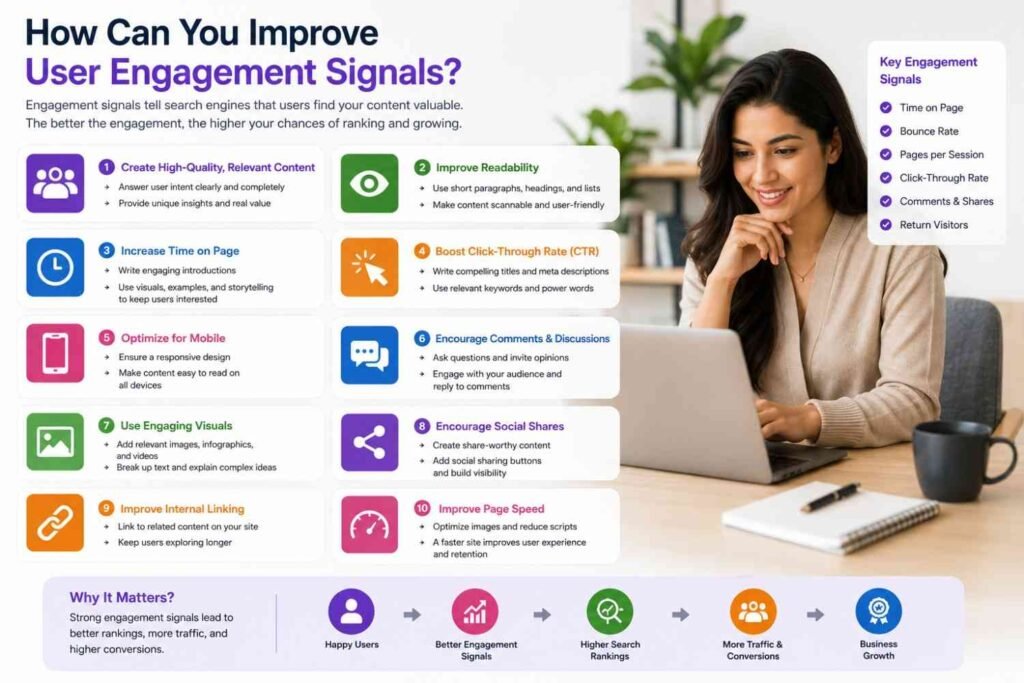
Search engines monitor how users interact with your content to determine its quality. High engagement signals indicate that your content is helpful and relevant.
Reducing Bounce Rate And Increasing Time On Page
If users immediately leave your site after arriving (a high bounce rate), it suggests your content did not meet their expectations. To keep users engaged, ensure your page loads quickly, matches the search intent perfectly, and provides immediate value. Use engaging multimedia, clear formatting, and compelling introductions to draw readers in and encourage them to spend more time on the page.
Encouraging Interaction And Optimizing CTAs
Interactive elements, such as calculators, quizzes, or embedded videos, increase engagement and time on site. Additionally, every piece of content should have a clear purpose. What do you want the user to do next? Optimize your Calls to Action to guide users toward subscribing to a newsletter, downloading a resource, or contacting your team.
How Do You Measure Content Optimization Success?
With the shift away from purely click-based metrics, measuring success requires a more nuanced approach.
- Organic Traffic Growth: While zero-click searches are rising, organic traffic remains a key indicator of overall visibility and health, particularly for commercial queries.
- Keyword Rankings: Track your positions for target keywords, but focus on the business value of those keywords rather than just the volume.
- Featured Snippet Visibility: Monitor how often your content appears in position zero.
- AI Overview Mentions: Use advanced tracking tools to see if your brand or content is being cited in AI-generated answers.
- Engagement Metrics: Analyze bounce rate, time on page, and pages per session to understand how users interact with your content.
- Conversion Tracking: Ultimately, the success of content optimization is measured by its impact on the bottom line. Track leads, sales, and inquiries generated from organic search.
What Are The Common Content Optimization Mistakes To Avoid?
Avoid these outdated tactics that can actively harm your visibility in modern search:
- Keyword Stuffing: Forcing keywords unnaturally into text makes content unreadable and can trigger search engine penalties.
- Ignoring Search Intent: Writing a comprehensive guide when the user just wants a quick definition will result in poor performance.
- Publishing Thin Content: Pages with little value or depth will not rank and will never be cited by AI engines.
- Neglecting Updates: Allowing content to become outdated damages your credibility and authority.
- Weak Internal Linking: Failing to connect your content makes it harder for search engines to crawl your site and understand your topical authority.
The Future Of Content Optimization: Search Everywhere Optimization
SEO is no longer enough. We are moving toward a framework of “Search Everywhere Optimization.” Visibility depends on a unified approach that combines traditional SEO for rankings, GEO for AI answers, AEO for featured snippets, and AIO for overall brand discoverability.
The businesses that succeed will be those that balance the technical requirements of machine readability with the human need for engaging, expert, and trustworthy information. By focusing on deep topical authority, structured data, and original insights, you can build a content strategy that withstands algorithm updates and captures attention across every search surface.
Frequently Asked Questions (FAQs)
How do I optimize content for AI search engines like ChatGPT and Perplexity?
To optimize for AI search engines, focus on Generative Engine Optimization. This involves providing direct, concise answers to specific questions, using clear formatting like lists and tables, and incorporating original data or expert quotes. AI models prioritize content that is highly structured, factual, and easy to extract.
What is the difference between SEO and GEO in digital marketing?
Traditional SEO focuses on optimizing content to rank high in organic search results (the blue links) by using keywords, backlinks, and technical site structure. GEO (Generative Engine Optimization) focuses on structuring content so that AI engines will cite it as a source when generating direct answers or summaries for users.
How can my website appear in Google AI Overviews?
Appearing in Google AI Overviews requires establishing strong topical authority and providing clear, accurate answers. Ensure your content directly addresses user queries early on the page, utilizes structured data (schema markup), and includes credible statistics or expert insights that AI models find valuable for synthesis.
Why is my organic traffic dropping even though my keyword rankings are the same?
This is often due to the rise of zero-click searches and AI Overviews. Search engines are increasingly answering informational queries directly on the results page. If your content targets top-of-funnel questions, users may be getting their answers without needing to click through to your website, resulting in lower traffic despite stable rankings.
How do I write content that ranks well but still sounds human and natural?
Write in an active voice and focus on clarity rather than cleverness. Avoid keyword stuffing and instead use natural, semantic language. Structure your content logically with clear headings, short paragraphs, and direct answers. High-quality content prioritizes the user’s experience and solves their problem efficiently, which search engines also reward.
What are the best content formats for Answer Engine Optimization?
The most effective formats for AEO include comprehensive FAQ sections, step-by-step how-to guides, comparative listicles, and data-rich tables. These formats provide information in the structured, easily digestible manner that answer engines prefer when selecting content for featured snippets and direct answers.