When building authority for your website, choosing between a link insertion and a guest post is a critical decision that impacts your budget, timeline, and SEO results. This comprehensive guide explores the core differences between these two powerful link-building strategies, analyzing their costs, speed of acquisition, and long-term impact on search engine rankings. Designed for business owners, marketing managers, and SEO professionals, this article provides data-driven insights to help you determine which approach aligns best with your growth goals and how to effectively integrate them into your digital marketing campaigns.
Why Backlinks Still Matter in Modern SEO
In the ever-evolving landscape of digital marketing, building a robust online presence requires more than just publishing great content on your own website. Search engines, particularly Google, continue to rely heavily on backlinks as a primary indicator of a website’s credibility, authority, and relevance. When another reputable site links back to yours, it serves as a vote of confidence, signaling to search algorithms that your content is valuable and trustworthy. As a result, securing high-quality backlinks remains a foundational pillar of any successful Search Engine Optimization strategy.
However, the methods used to acquire these crucial backlinks have diversified significantly over the years. Gone are the days when simply accumulating a high volume of low-quality links would guarantee a top spot in search results. Today, with the rise of AI-driven search experiences, strict editorial standards, and an emphasis on Experience, Expertise, Authoritativeness, and Trustworthiness (E-E-A-T), the quality and context of a link matter far more than the sheer quantity. This shift has led to a prominent debate among SEO professionals and business owners alike: when it comes to acquiring high-quality backlinks, should you invest your resources in link insertions or guest posts?
Both link insertions and guest posts are proven, effective strategies for improving search visibility, but they operate very differently in terms of execution, cost, speed, and overall impact. A link insertion involves placing your link into an already published, authoritative article, whereas a guest post requires crafting an entirely new piece of content to be published on another site. Understanding the nuances, benefits, and potential drawbacks of each approach is essential for developing a link-building campaign that not only drives traffic but also aligns with your specific business objectives and budget constraints. This guide will dissect both strategies, providing the clarity needed to make informed decisions for your brand’s growth.
What is a Link Insertion and How Does it Work?
A link insertion, frequently referred to in the SEO industry as a “niche edit” or “contextual link,” is the strategic process of adding a backlink pointing to your website into an article or page that is already published and indexed on another website. Instead of writing a brand new piece of content from scratch, you or your digital marketing agency reach out to the owner or editor of a relevant website and propose adding your link to their existing content. This approach leverages the historical authority and established traffic of a page that search engines already recognize and value.
The mechanics of securing a link insertion typically involve a targeted outreach campaign. SEO specialists identify high-quality articles that discuss topics closely related to your business but perhaps lack a specific resource, tool, or expanded explanation that your website provides. The outreach pitch highlights how adding your link would enhance the existing article, providing more value to the reader. If the website owner agrees, they simply log into their Content Management System, highlight relevant anchor text within the article, and insert the hyperlink pointing back to your site.
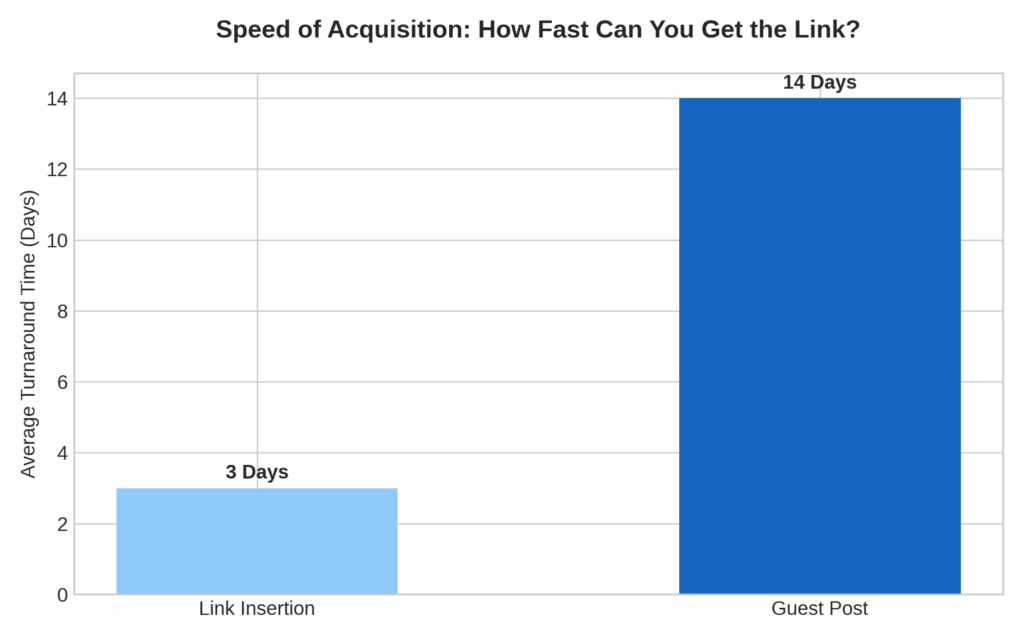
Because this method bypasses the entire content creation phase, it is notably faster to execute than other link-building strategies. As illustrated in the chart above, link insertions can often be completed in a matter of days, compared to the weeks it might take to pitch, write, edit, and publish a new guest post. This rapid turnaround makes link insertions an attractive option for businesses looking to see quicker movements in their search engine rankings, as the link is placed on a page that is already crawled and evaluated by Google.
There are several variations of link insertions that cater to different contextual needs:
- Contextual Backlinks: These are links seamlessly integrated into the body paragraphs of an article, naturally flowing with the surrounding text. They are highly valued because search engines prioritize links that appear editorially given within the main content area.
- Resource Page Links: Many websites maintain dedicated “Resource” or “Helpful Links” pages. Reaching out to have your comprehensive guide, tool, or service added to a relevant list is a common and effective form of link insertion.
- Broken Link Building: Link rot is a very real phenomenon that affects every website in existence. According to a link rot study by Ahrefs, approximately 66.5% of links placed in the last 9 years are now dead. This involves finding a dead or broken link on an authoritative website, notifying the site owner, and suggesting your active, relevant page as a replacement. It provides immediate value to the webmaster by fixing an error while securing a strong backlink for you.
- Unlinked Brand Mentions: Even if your site isn’t a household name, there are likely instances where other websites mention your brand online but fail to link to you. It could be that a blog mentioned your business or a website may have reviewed one of your products. They mention your brand, which is great, but they didn’t link back to your website. These are known as unlinked brand mentions, and they’re excellent targets for link insertions.
What is a Guest Post and How Does it Work?
A guest post, also known as guest blogging, is a more intensive link-building strategy where you write and publish an original article on someone else’s website or blog. Unlike a link insertion where you leverage existing content, a guest post requires you to contribute fresh, valuable insights to a third-party platform. In exchange for providing them with high-quality, free content that serves their audience, the hosting website allows you to include a backlink to your own site, typically within the body of the article or in an author bio section at the end.
The process of guest posting is comprehensive and relationship-driven. It begins with prospecting; finding reputable websites within your industry or a closely related niche that accept external contributions. Once a target is identified, you must pitch a compelling topic idea that aligns with their editorial guidelines and appeals to their specific readership. If the pitch is accepted, the content creation phase begins. This involves researching, writing, and editing an article that not only meets the host site’s quality standards but also naturally incorporates your target backlink in a way that provides genuine value to the reader, rather than appearing overly promotional. In general, your guest posts should always be long-form and contain at least 2,000 – 3,000 words.
Guest posts are highly regarded because they offer benefits that extend far beyond a simple SEO backlink. When you publish an article under your name or brand on an authoritative industry site, you are actively building thought leadership and establishing your E-E-A-T credentials. You have complete control over the narrative, the surrounding context of your link, and the overall message being delivered to a new, targeted audience. This makes guest posting an excellent strategy for brand awareness and establishing your business as an expert voice in your field.
Common types of guest posts include:
- Expert Contributions: Deep-dive articles where you share specialized knowledge, unique data, or professional opinions on complex industry topics.
- Educational Guides: “How-to” articles or tutorials that solve a specific problem for the host site’s audience, positioning your brand as a helpful resource.
- Case Studies: Detailed breakdowns of how you helped a client achieve success, demonstrating your capabilities while naturally linking back to your services.
- Opinion Pieces: Thought-provoking articles discussing industry trends, future predictions, or controversial topics that generate engagement and discussion.
What Are the Key Differences Between Link Insertions and Guest Posts?
While both link insertions and guest posts aim to secure valuable backlinks, the paths they take to achieve that goal are distinctly different. Understanding these differences is crucial for allocating your marketing budget effectively and setting realistic expectations for your SEO campaigns. The primary distinctions lie in cost, speed of acquisition, content ownership, and the type of SEO value they deliver.
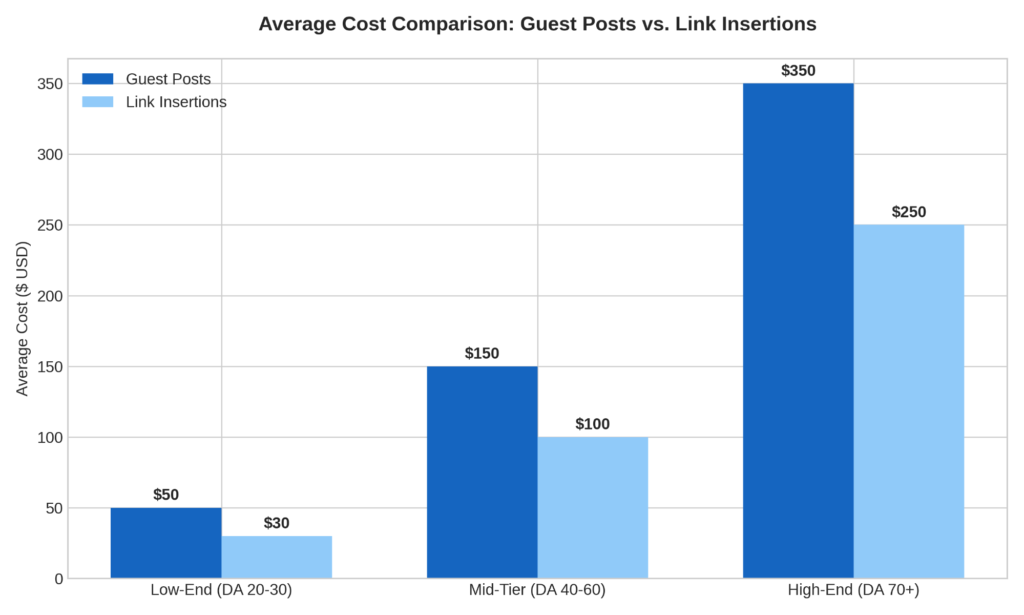
One of the most significant differences is the financial investment required. As the chart above demonstrates, guest posts are generally more expensive across all tiers of website authority. This cost discrepancy is primarily due to the content creation requirement. When executing a guest post campaign, you must account for the time and resources needed to research, write, and edit a high-quality article, in addition to any administrative or placement fees charged by the hosting site. Link insertions, on the other hand, eliminate the content creation costs, making them a more budget-friendly option, particularly when trying to secure links on mid-tier or high-end authoritative domains.
Beyond cost, the two strategies differ fundamentally in how they impact your brand and SEO profile. The table below outlines a direct comparison of the key attributes of each approach:
Feature | Link Insertion (Niche Edit) | Guest Post |
|---|---|---|
Speed of Acquisition | Very Fast (Days). The content is already published; the link just needs to be added. | Slow (Weeks to Months). Requires pitching, writing, editing, and waiting for the publisher’s editorial calendar. |
Cost | Generally Lower. You only pay for the outreach and placement, not content creation. | Generally Higher. Includes the cost of professional copywriting plus potential placement fees. |
SEO Value (Authority) | Immediate transfer of authority from an aged, indexed page that may already have its own backlinks. | Authority builds over time as the new page gets indexed, ranks, and acquires its own links. |
Content Control | Low. You have no control over the surrounding article’s narrative or future updates. | High. You control the topic, the message, the anchor text context, and the brand voice. |
Brand Exposure | Minimal. The link is often buried in existing text; readers may not notice your brand specifically. | High. You get an author bio, introduce your brand to a new audience, and establish thought leadership. |
Topical Relevance | Can be highly relevant if placed in a perfectly matched existing article. | Guaranteed relevance, as you write the article specifically to align with your target link. |
Ultimately, link insertions are a tactical maneuver designed for speed and efficiency in passing link equity. They are an excellent way to quickly boost the authority of a specific page on your site. Guest posts, conversely, are a strategic, brand-building exercise. They require more effort and investment but offer broader marketing benefits, including referral traffic, audience building, and enhanced industry credibility.
Which Strategy Provides Better SEO Results?
When business owners ask which strategy provides “better” SEO results, the answer is rarely straightforward. Both link insertions and guest posts are highly effective, but they influence search engine algorithms in slightly different ways. To determine which is better for your specific situation, it is essential to understand how Google evaluates backlinks and what factors carry the most weight in modern SEO.
Search engines do not simply count the number of links pointing to your site; they evaluate the quality, context, and relevance of those links. A link is considered valuable if it comes from a website with high domain authority, relevant topical focus, and strict editorial standards. Furthermore, the link must make sense contextually within the content and provide genuine usefulness to the user.
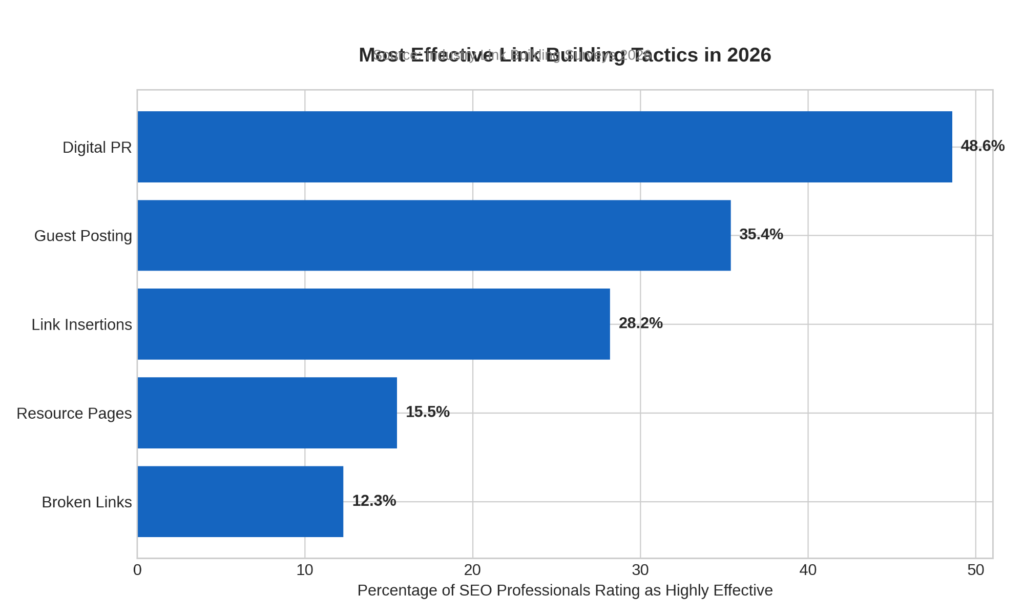
According to recent industry data on link-building effectiveness, both tactics remain highly regarded by SEO professionals. While broader strategies like Digital PR often take the top spot for sheer authoritative impact, guest posting and link insertions consistently rank as core, reliable methods for driving sustained SEO growth. Guest posting is frequently favored for its ability to build comprehensive topical authority, while link insertions are prized for their efficiency in passing “link juice” from established pages.
Link insertions offer a unique SEO advantage: they leverage the “age” and existing authority of a published page. When you secure a link on a page that has been live for years, already ranks for keywords, and has accumulated its own backlinks, a portion of that established authority flows directly to your site almost immediately upon indexing the change. This can lead to faster improvements in your own rankings for targeted keywords.
Guest posts, however, provide a different type of SEO strength. Because you are creating a new page, it starts with zero page-level authority. However, guest posts allow for perfect contextual relevance. You can craft the entire narrative around your target keyword and ensure the anchor text flows naturally within a highly relevant discussion. Over time, as the guest post itself begins to rank and attract traffic, the value of that link increases. Furthermore, guest posts are unparalleled for building “entity recognition.” By consistently publishing expert content across various industry platforms, you signal to search engines that your brand is a recognized entity and an authority in your specific niche, which is a crucial factor in the E-E-A-T framework.
How Do These Strategies Align With Different Business Goals?
The decision between a link insertion and a guest post should not be made in a vacuum; it must be dictated by your specific business goals, target audience, and available resources. Different types of businesses face unique marketing challenges and require tailored SEO strategies to achieve optimal growth.
Here is a breakdown of how these strategies align with various business models:
Business Type | Primary Goal | Recommended Strategy Focus | Rationale |
|---|---|---|---|
Local Businesses (e.g., Plumbers, Dentists) | Local map pack rankings, immediate visibility for service keywords. | Link Insertions (Local citations, local directories, regional blogs). | Local SEO relies heavily on consistent citations and regional authority. Insertions on established local sites provide quick, relevant signals without the need for extensive content creation. |
SaaS Companies | Product awareness, establishing industry authority, driving qualified leads. | Guest Posts (Industry blogs, tech publications, review sites). | SaaS relies on educating the market. Guest posts allow you to demonstrate product use cases, share data, and build trust with a highly targeted, tech-savvy audience. |
eCommerce Stores | Ranking category and product pages, driving direct sales. | Link Insertions (Gift guides, product roundups, “best of” lists). | Getting products added to existing, high-ranking listicles or review pages (insertions) drives direct, high-intent traffic ready to purchase. |
B2B Service Providers (e.g., Agencies, Consultants) | Lead generation, thought leadership, showcasing expertise. | Guest Posts (Business magazines, niche industry forums). | B2B sales cycles are long and require immense trust. Publishing authoritative guest posts proves expertise and builds the credibility necessary to close high-ticket clients. |
New Startups | Rapid brand awareness, establishing initial domain authority. | Balanced Mix (Guest posts for brand introduction, insertions for quick authority). | Startups need both the PR aspect of guest posting to introduce their brand and the rapid authority boost of insertions to get their new website ranking. |
For a company like Eyes On Solution, a premier digital marketing agency in Dubai, the strategy would likely lean heavily toward a balanced approach. To rank for competitive terms like “SEO company Dubai,” leveraging link insertions on established regional business directories and marketing blogs provides necessary local authority. Simultaneously, publishing high-level guest posts on international marketing platforms establishes their team as global thought leaders, attracting larger enterprise clients.
How Do AI Search Engines Evaluate Link Insertions and Guest Posts?
The landscape of search is undergoing a massive transformation with the integration of Artificial Intelligence. Traditional SEO is expanding to include Generative Engine Optimization and Answer Engine Optimization. AI-driven search engines, such as Google’s AI Overviews, Perplexity, and ChatGPT, process information differently than traditional algorithmic search. They aim to synthesize information from multiple sources to provide direct, conversational answers to user queries.
In the age of AI search, the concept of a backlink is evolving into the concept of a “citation” or “mention.” AI engines scour the web for authoritative sources to formulate their answers. If your brand or content is frequently cited by high-trust websites, AI models are more likely to use your information and reference your site in their generated responses.
Guest posts are incredibly powerful for GEO and AEO. Because AI engines prioritize comprehensive, expert-led content, publishing detailed guest posts helps establish your brand as a primary source of truth for specific topics. When you write an in-depth article on an industry site, you are feeding the AI models structured, high-quality data associated with your brand entity. This increases the likelihood that an AI will pull from your insights when answering a user’s complex question.
Link insertions also play a vital role in AI search visibility, primarily through the reinforcement of authority. AI models rely on traditional authority metrics to determine which sources to trust. By securing link insertions on highly authoritative, frequently crawled pages, you signal to the AI that your website is a trusted destination. Furthermore, if your link is inserted into a page that an AI engine already uses as a primary reference source, your site gains secondary credibility by association. Both strategies are essential: guest posts provide the expert context AI engines crave, while link insertions build the foundational trust required to be considered a reliable source.
What Are the Common Mistakes to Avoid When Building Links?
Whether you choose to pursue link insertions, guest posts, or a combination of both, the execution must be flawless to yield positive results. Poorly executed link building can not only waste your budget but also actively harm your website’s rankings, potentially leading to manual penalties from search engines. Avoiding common pitfalls is essential for a safe and effective SEO campaign.
One of the most frequent mistakes is choosing websites based solely on third-party metrics like Domain Authority or Domain Rating. While these metrics provide a general snapshot of a site’s strength, they are easily manipulated and do not reflect the true quality of a website. A site might have a high DA but zero organic traffic, meaning a link from that site will provide little to no real SEO value. Always prioritize websites that have consistent, genuine organic traffic and a healthy backlink profile of their own.
Another critical error is prioritizing quantity over relevance. Acquiring 50 links from random, unrelated websites is far less effective and much riskier, than securing five links from highly relevant, industry-specific platforms. Search engines are adept at identifying unnatural link patterns. If a digital marketing agency suddenly gets an influx of backlinks from cooking blogs and auto repair sites, it raises a massive red flag. The context of the link must make sense.
Furthermore, using over-optimized, exact-match anchor text is a dangerous practice. In the past, if you wanted to rank for “best SEO services,” you would try to make every backlink use that exact phrase. Today, this looks highly manipulative to search algorithms. A natural backlink profile consists of a mix of branded anchor text (e.g., “Eyes On Solution”), naked URLs, descriptive phrases, and only occasional exact-match keywords. When securing guest posts or insertions, ensure the anchor text flows naturally within the sentence and provides clear context to the user about what they will find when they click.
How Can You Evaluate a High-Quality Link Opportunity?
To ensure your link-building efforts drive positive ROI and protect your website from penalties, you must rigorously evaluate every potential link opportunity. Not all websites are created equal, and a link from a low-quality or “spammy” site can be detrimental. Before agreeing to a guest post placement or paying for a link insertion, ask yourself a series of critical questions to assess the site’s true value.
First, evaluate the relevance. Does the target website operate in the same industry or a closely related niche as your business? If you are a digital marketing agency, a link from a business technology blog is highly relevant; a link from a lifestyle blog is not. Relevance is a primary signal to search engines that the link is natural and valuable.
Next, analyze the site’s organic performance. Use SEO tools to verify that the website actually ranks for real keywords and receives consistent organic traffic from search engines. A site with zero traffic is often a “link farm” , a site created solely for the purpose of selling links, which search engines actively devalue and penalize.
Green Flags (Signs of a High-Quality Opportunity):
- The website has a strict editorial process and clear guidelines for contributors.
- The content on the site is well-written, engaging, and regularly updated.
- The site has an active, engaged audience (comments, social shares).
- The site’s outbound links are natural and point to other reputable sources.
Red Flags (Signs of a Low-Quality Opportunity):
- The website advertises “Write for Us” or “Buy Links” aggressively on the homepage.
- The content is thin, poorly written, or clearly generated by low-quality AI without human editing.
- The site covers a chaotic mix of unrelated topics (e.g., casinos, health, tech, and fashion all on one blog).
- The site has a sudden, massive drop in organic traffic, indicating a potential search engine penalty.
Ultimately, the best test of a link opportunity is the “real user” test. Ask yourself: If a real human being were reading this article, would they genuinely find my link useful, and would they be likely to click on it? If the answer is yes, it is a high-quality opportunity.
Which Strategy Delivers Better ROI for Your Business?
Determining the Return on Investment for link building can be challenging, as the results are not always immediate and the value of a higher search ranking compounds over time. However, analyzing the cost versus the long-term benefits of link insertions and guest posts reveals different ROI profiles for different business needs.
Link insertions typically offer a higher short-term ROI, particularly for businesses with limited budgets. Because the cost of content creation is removed, you can acquire more links for the same budget compared to guest posting. Furthermore, because the links are placed on aged, indexed pages, the SEO impact is often realized faster, leading to quicker improvements in keyword rankings and subsequent organic traffic. For small businesses or local service providers looking for an immediate boost in visibility for specific commercial keywords, link insertions provide a highly cost-effective solution.
Guest posts, while requiring a larger initial investment of time and money, often deliver a superior long-term ROI. The value of a guest post extends beyond the backlink itself. A well-crafted guest post on an authoritative site can drive continuous referral traffic for years. It builds brand awareness, establishes thought leadership, and can directly generate leads or sales from the host site’s audience. Additionally, as the guest post ages and acquires its own authority, the value of the backlink pointing to your site increases. For businesses focused on long-term brand building, establishing industry authority, and expanding their digital footprint, the comprehensive benefits of guest posting justify the higher initial cost, resulting in a stronger overall return over the lifespan of the business.
The Final Verdict: How to Choose the Right Strategy
The best choice depends entirely on your campaign goals. Here is a structured breakdown to help you decide:
Choose Guest Posting if:
- Goal: You want to build authority, generate brand exposure, and drive referral traffic in addition to a link.
- Process: You pitch and write a unique, high-quality article for someone else’s blog.
- Pro: Provides a branded, contextual link within relevant content. It’s a top-tier white-hat tactic.
- Con: Time-consuming and requires significant effort (pitching, writing, editing).
Choose Link Insertion if:
- Goal: Your primary focus is efficiency and scaling your backlink profile quickly.
- Process: You find existing, high-quality relevant articles and negotiate to have your link placed into the content.
- Pro: Faster, less labor-intensive, and often more cost-effective than a full guest post.
- Con: Offers less brand building and thought leadership.
Verdict: For a balanced, authoritative strategy, Guest Posting is generally preferred. For scaling a diverse link profile efficiently, Link Insertion is a powerful supplemental tactic. The most successful SEOs use a mix of both.
By partnering with an experienced agency like Eyes On Solution, businesses can ensure that this mixed strategy is executed flawlessly. Professional outreach teams understand how to balance the portfolio, secure placements on genuinely authoritative sites, and align the entire link-building effort with the overarching goals of the business, ensuring sustainable, long-term success in the digital landscape.
Frequently Asked Questions (FAQ)
What is the difference between a link insertion and a guest post?
A link insertion involves adding your backlink to an existing, already published article on another website. A guest post requires writing an entirely new, original article and publishing it on another website with a link back to your site included in the content. For link building services, both are valuable.
Which is better for fast SEO results, link insertions or guest posts?
Link insertion generally provide faster SEO results. Because the link is placed on a page that is already indexed by search engines and has established authority, the SEO value transfers to your website much quicker than waiting for a new guest post to be indexed and ranked.
How much does a guest post cost compared to a link insertion?
Guest posts are typically more expensive because you must factor in the cost of creating high-quality, original content, in addition to any placement fees. Link insertions are generally cheaper because they bypass the content creation phase, requiring only outreach and placement negotiation.
Are link insertions safe for my website’s SEO?
Link insertions are safe and highly effective when executed correctly. The key is to ensure the link is placed on a highly relevant, authoritative website with real organic traffic, and that the anchor text flows naturally within the existing content. Avoiding low-quality sites and spammy link farms is crucial for safety.
How do guest posts help with AI search visibility?
Guest posts are excellent for AI search visibility because they provide comprehensive, expert-led content that AI engines rely on to formulate answers. Publishing in-depth articles on trusted industry sites builds your brand’s “entity recognition,” making AI models more likely to cite your brand as an authoritative source.