SEO programming is the practice of using code, automation, and technical development to make a website easier for search engines and AI engines to crawl, read, understand, and rank. It combines SEO knowledge with web development to fix technical problems, automate repetitive work, and build sites that are search-friendly from the ground up.
Here is the problem it solves. You can launch a well-designed website with strong content and still get almost no traffic. Often the reason is not your content, it is your code. If search engines struggle to crawl your pages, render your JavaScript, or understand your structure, even your best content stays invisible. SEO programming closes that gap. This guide explains what it is, how it works, who needs it, and how to get started, without assuming you already write code.
What Is SEO Programming, Exactly?
SEO programming is the point where SEO and web development meet. It is not keyword stuffing or hidden tricks; it is the work of writing and adjusting code so search engines can access your content and present it correctly in results.
Every website runs on code, whether it is custom-built or sits on a platform like WordPress or Shopify. That code decides how fast your pages load, how cleanly they render, and how clearly search engines can interpret what each page is about. When the code is messy, search performance suffers no matter how good the marketing is. When the code is clean and structured, your content has a real chance to rank.
In short, SEO programming makes your website legible; to search engines, and increasingly to the AI systems that now answer questions on their behalf. That second audience is why this skill matters more today than it did even a year ago.
Why SEO Programming Matters More Than Ever
SEO programming matters because search engines and AI engines read code, not just words. Two shifts have made the technical side of SEO impossible to ignore. First, manual SEO hits a ceiling. You can optimize a handful of pages by hand, but a growing site with hundreds or thousands of pages needs automation to stay healthy. Checking every title tag, redirect, and canonical manually is slow and error-prone; code does it in minutes.
Second, AI-driven search has changed what “findable” means. Tools like Google’s AI Overviews, ChatGPT, Gemini, and Perplexity pull answers directly from web pages they can parse easily. They rely on clean HTML, structured data, and fast rendering to decide which sources to trust and cite. A site with weak technical foundations does not just rank lower; it can be left out of AI answers entirely.
For businesses in competitive markets like Dubai, where many companies chase the same customers, these technical advantages often decide who gets found first. That makes the next question the important one: how does SEO programming actually work?
How SEO Programming Works
SEO programming works by shaping a website’s code so search engines can complete four steps without friction: crawl the site, render the pages, index the content, and understand what it means. When any step breaks, rankings drop.
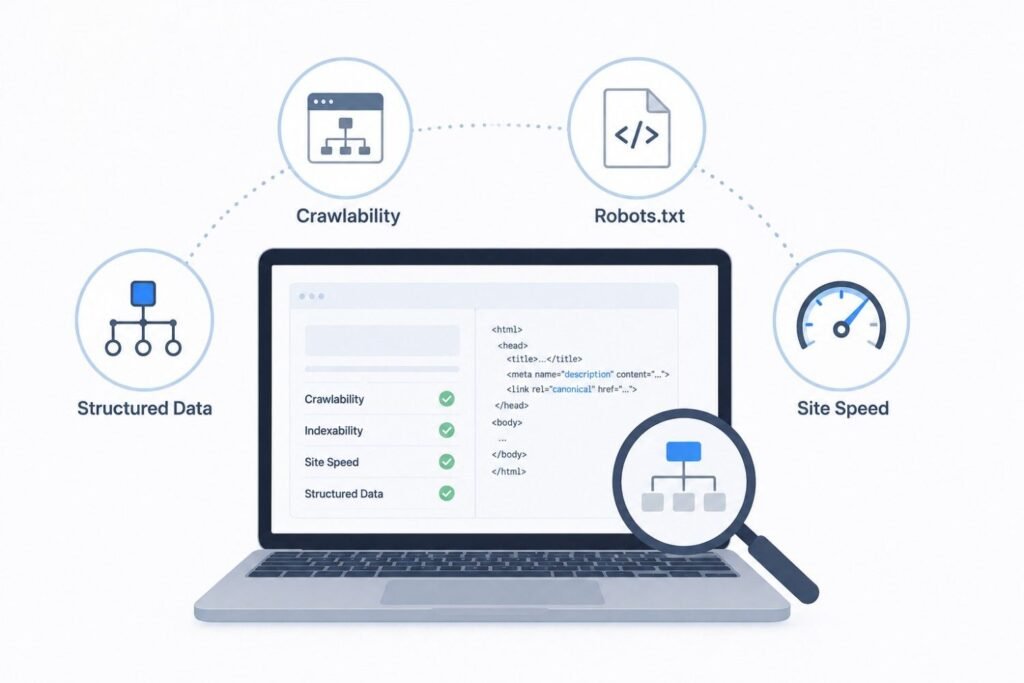
The work usually falls into a few core areas:
- Crawlability; clean XML sitemaps, correct robots.txt rules, and tidy redirects so crawlers reach the right pages and skip the wrong ones.
- Rendering; making sure content built with JavaScript still appears when a crawler loads the page, rather than showing a blank screen.
- Speed and page experience; optimizing scripts, images, and code so pages load fast and stay stable, which Google measures through Core Web Vitals.
- Structured data; adding schema markup so engines know exactly what a page contains.
- Internal linking and canonicalization; guiding crawlers to important pages while resolving duplicate URLs.
The table below shows how these fixes map to common problems.
| Common Technical Problem | How SEO Programming Solves It |
|---|---|
| Search engines can’t find key pages | Clean XML sitemaps and corrected robots.txt rules guide crawlers to the right pages |
| JavaScript content loads as a blank page | Server-side rendering or pre-rendering makes content visible to crawlers |
| Slow, unstable pages hurt rankings | Optimized scripts, images, and code improve Core Web Vitals |
| Search engines misread page content | JSON-LD schema markup defines exactly what each page contains |
| Duplicate URLs split ranking signals | Canonical tags consolidate signals onto one preferred URL |
| Orphan pages get no traffic | Internal-link audits surface and connect overlooked pages |
Fixing these issues is partly about knowledge and partly about skill, which raises the question of what you actually need to know to do this work.
Which Skills Does SEO Programming Require?
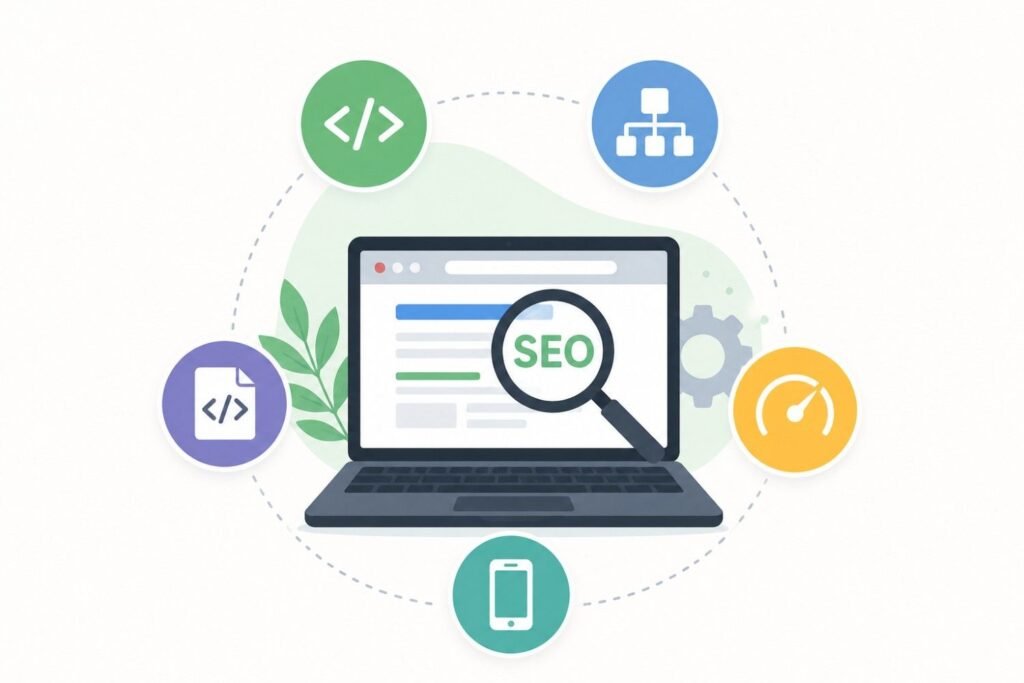
SEO programming requires a blend of SEO understanding and practical coding ability. You do not need to be a senior software engineer, but you do need enough fluency to read code, spot problems, and either fix them or explain them clearly to a developer.
The core skills are HTML and CSS for structure and layout, JavaScript for handling dynamic content, and Python for automation and data work. On top of that, comfort with APIs and analytics lets you pull data from tools like Google Search Console to find issues across a whole site at once.
| Skill | What It Does for SEO |
|---|---|
| HTML | Structures pages so crawlers and AI engines understand content hierarchy |
| CSS | Controls layout for a fast, stable, mobile-friendly experience |
| JavaScript | Manages dynamic content and rendering so pages don’t appear blank to crawlers |
| Python | Automates audits, reporting, and large-scale data tasks |
| APIs and data analysis | Pulls data from Search Console and analytics to find issues at scale |
| Technical SEO knowledge | Connects all of the above to crawling, indexing, and structured data |
These skills are expressed through specific programming languages, and each language has a clear role in SEO.
Which Programming Languages Are Used in SEO?
Several languages support SEO, and each handles a different part of the job. You rarely need all of them; most technical SEO work centers on HTML, JavaScript, and Python.
| Language | Primary SEO Use |
|---|---|
| HTML | Website structure and metadata |
| CSS | Layout, page experience, and mobile responsiveness |
| JavaScript | Dynamic content and rendering control |
| Python | Automation, crawling, and data analysis |
| SQL | Querying large datasets and log files |
| PHP | CMS and server-side optimization (e.g., WordPress) |
| JSON-LD | Structured data and schema markup |
Of these, Python deserves a special mention. It has become the most popular language for SEO automation because it makes repetitive tasks effortless; crawling websites, extracting metadata, processing keyword lists, analyzing backlinks, and generating reports. A task that would take hours by hand can run in seconds with a short Python script, which frees up time for strategy.
Knowing which language does what is useful, but it only matters if SEO programming is relevant to your situation in the first place.
Who Needs SEO Programming?
SEO programming is most valuable for anyone managing a large, growing, or technically complex website. If your site has more than a few dozen pages, depends on organic traffic, or runs on a framework that leans heavily on JavaScript, technical SEO will directly affect your results.
It tends to matter most for:
- E-commerce stores with large product catalogs, where pages are generated at scale.
- SaaS companies whose sites rely on JavaScript-heavy frameworks.
- Online publishers managing thousands of articles and internal links.
- Enterprise websites with complex structures and frequent updates.
- Agencies that manage technical SEO on behalf of clients.
A small five-page brochure site may never need custom scripts. A 5,000-product store, on the other hand, cannot stay healthy without automation. That said, “needing” SEO programming does not mean you personally have to learn it; which leads to a question most business owners eventually ask.
Do You Need to Code to Succeed at SEO?
No; you do not need to code to succeed at SEO, but someone working on your site does. SEO has two halves. One half is content and authority: keyword research, writing, on-page optimization, and earning links. None of that requires programming. The other half is technical: making sure your content can be crawled, rendered, and understood. That half depends on code.
| What You Can Do Without Code | What Needs Code or a Technical Partner |
|---|---|
| Keyword research | Fixing crawl and indexing errors |
| Content creation | Improving Core Web Vitals and page speed |
| Basic on-page SEO | Generating schema markup at scale |
| Writing meta titles and descriptions | Automating audits and reporting |
| Manual link building | Resolving duplicate content and canonical issues |
This is where many businesses make a practical decision. You can build coding skills in-house, or you can partner with a team that handles the technical side while you focus on running your business. At Eyes On Solution, this is exactly the gap we fill; combining content, web development, and technical SEO so the marketing and the code work together instead of against each other.
Whichever path you choose, there is now a third reason to take the technical side seriously: AI search.
How SEO Programming Powers AI Search and GEO
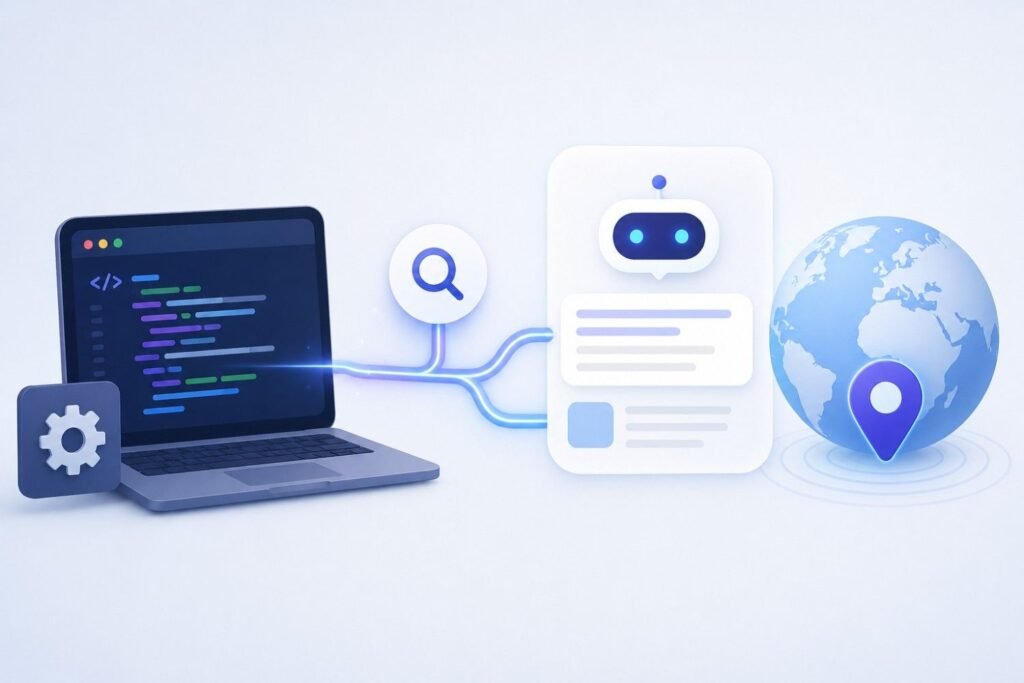
SEO programming is the foundation of getting found in AI search, because generative engines read the same clean, structured code that traditional crawlers do. This newer discipline is often called Generative Engine Optimization or Answer Engine Optimization, and it is quickly becoming central to staying visible.
When someone asks ChatGPT, Gemini, or Google’s AI Overviews a question, those systems scan pages, judge how trustworthy and well-structured they are, and pull from the clearest sources. The same technical work that helps you rank also helps you get cited:
- Semantic HTML tells AI engines what each part of your page means.
- Schema markup spells out facts about your business, products, and content in a format machines read directly.
- Fast, cleanly rendered pages are easier for AI crawlers to parse and trust.
- A clear heading structure with direct answers makes your content easy to quote.
In other words, GEO is not a separate project bolted onto your site. It is what good SEO programming naturally produces. Businesses that get the technical foundation right are the ones AI engines reach for first, and that advantage compounds over time. If getting found in AI results matters to you, the technical groundwork is where it starts.
How to Start With SEO Programming
Start with an audit, then fix the highest-impact problems first. You do not need to learn everything before you see results; you need to find what is broken and address it in order of importance.
A sensible path looks like this. Begin with the fundamentals of technical SEO; crawling, indexing, canonical tags, and structured data; so you understand what you are looking for. Next, get comfortable reading HTML and JavaScript so you can see how pages are built and where rendering breaks. Then learn the basics of Python, the easiest way to start automating audits and reports. From there, connect to SEO APIs like Google Search Console to pull data at scale, and write small scripts that solve real problems, such as a sitemap generator, a metadata extractor, or an internal-link checker.
If that sounds like a lot, remember that you can start by fixing one issue at a time, or hand the technical work to specialists while you focus on content and strategy. Either way, you will need a handful of reliable tools.
Which Tools Do SEO Programmers Use?
SEO programmers rely on a small set of tools for crawling, performance testing, data, and automation. Most of the essentials are free.
| Purpose | Common Tools |
|---|---|
| Crawling and site audits | Screaming Frog, Sitebulb |
| Performance testing | Google PageSpeed Insights, Lighthouse |
| Search and traffic data | Google Search Console, Google Analytics |
| Automation and scripting | Python and custom scripts |
| Code editing and version control | VS Code, Git and GitHub |
Together, these tools let you find technical issues, measure performance, and automate the fixes. They form the working toolkit behind almost every technical SEO project, large or small.
The Bottom Line: SEO Programming Is Your Technical Foundation
SEO programming is the technical engine behind search visibility. It uses code and automation to make your website easy for search engines and AI systems to crawl, render, understand, and rank; and it scales that work in a way manual effort never can. Content earns attention; technical SEO makes sure that content can actually be found.
You do not have to write the code yourself. What matters is that the technical side gets the same care as your content and design. Get all three working together, and your website stops being invisible and starts competing; in traditional search results and in the AI answers that increasingly sit above them.
Frequently Asked Questions About SEO Programming
Is SEO programming hard to learn?
No. Most people start with HTML and basic Python before moving on to automation. You can learn enough to fix common issues without becoming a full software developer.
Do SEO specialists need to know how to code?
No, coding is not required, but it is a major advantage. A specialist who can read and write code fixes technical problems faster and relies less on developers.
Which programming language is best for SEO?
Python is the most widely used because it makes automation and data analysis simple. HTML and JavaScript matter most for understanding how pages are built and rendered.
Can you do SEO without programming?
Yes. Keyword research, content creation, on-page SEO, and link building need no code. Technical fixes, automation, and large-scale audits are where programming or a technical partner becomes necessary.
Is SEO programming worth it for a small business?
Yes. Even small sites benefit from clean code, fast load times, and basic structured data. The larger and more competitive your site, the more the technical side pays off.
How is SEO programming different from web development?
Web development builds the website; SEO programming makes sure that website is easy for search engines and AI engines to find, read, and rank. They overlap, but the goals are different.
Does SEO programming help with AI search and AI Overviews?
Yes. Clean HTML, schema markup, and fast rendering help AI engines understand and cite your content, which is the core of Generative Engine Optimization (GEO).
How long does it take to learn SEO programming?
You can learn to fix basic technical issues in a few weeks. Building real automation skills with Python takes a few months of consistent practice.