
Email marketing is the practice of sending targeted messages to subscribers to build relationships, generate leads, increase sales, and retain customers.
Unlike other channels, email is permission based communication. Your audience has explicitly chosen to hear from you. This provides direct access to prospects and customers, making it highly suitable for both B2B and B2C businesses. A strong email strategy supports every stage of the customer journey, from initial awareness to post-purchase retention. For businesses looking to maximize their online presence, combining email with professional SEO services creates a comprehensive digital marketing approach.
Why Does Email Marketing Still Deliver Results in 2026?
Email marketing works because it reaches people in a personal space where they actively receive information and make decisions.
The digital landscape is crowded with ever-changing social media algorithms and rising ad costs. Email marketing bypasses these hurdles, offering a high return on investment and a direct communication channel. You have greater control over your messaging compared to social media platforms. It also provides personalized messaging opportunities and measurable performance, allowing you to track exactly what works and refine your strategy. This level of control is essential for custom outreach and targeted campaigns.
How Does Email Marketing Help Businesses Grow and Increase Revenue?
Email marketing supports growth by generating leads, nurturing prospects, and increasing customer lifetime value.
By capturing interested prospects, you build an owned audience and reduce dependence on paid advertising. As you nurture these prospects, you educate potential buyers, address common objections, and guide users toward conversion. Furthermore, email marketing increases repeat purchases by promoting new products and services, recovering abandoned carts, and encouraging customer loyalty. Integrating these efforts with targeted content writing ensures your messages are compelling and action-oriented.
What Are the Top Benefits of Email Marketing for Your Business?
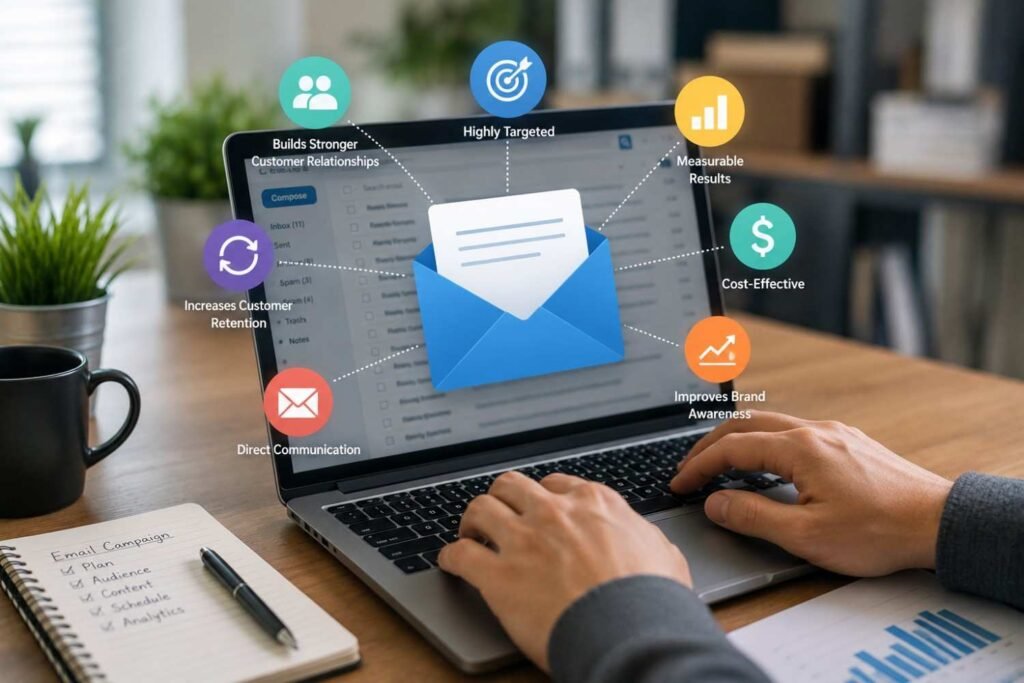
The biggest advantage of email marketing is its ability to deliver personalized, measurable, and cost effective communication.
It stands out as a highly cost effective marketing channel. You can leverage audience segmentation to deliver personalized customer experiences. This leads to better customer retention and improved brand awareness. With easy performance tracking, you can continuously optimize your campaigns for better results.
| Benefit | Description | Impact on Business |
|---|---|---|
| Cost Effectiveness | Low cost per send compared to paid ads | Higher overall ROI |
| Audience Ownership | Direct access without algorithm interference | Stable, reliable communication channel |
| Personalization | Tailored messaging based on user data | Increased engagement and conversion rates |
| Measurability | Clear tracking of opens, clicks, and sales | Data-driven strategy optimization |
What Types of Email Marketing Campaigns Should You Send?
Different email campaigns serve different business goals, from lead generation to customer retention.
Your strategy should include a mix of campaigns to engage users at various touchpoints. Welcome emails set the tone for new subscribers. Newsletter campaigns keep your audience informed and engaged. Promotional emails and product launch emails drive immediate sales. Abandoned cart emails recover lost revenue, while re engagement campaigns and customer retention emails keep your brand top-of-mind for existing customers.
How Does Email Marketing Support SEO and Content Marketing Efforts?
Email marketing amplifies content visibility and helps drive qualified traffic to websites.
It plays a crucial role in supporting your broader digital strategy. By promoting blog content, email marketing drives returning visitors and increases content engagement. This increased traffic supports brand searches and encourages content sharing, which can indirectly boost your search rankings. Understanding how HTTP status codes work and ensuring your linked pages are healthy is vital for maintaining this traffic flow.
What Are the Best Practices for Effective Email Marketing?
Effective email marketing focuses on relevance, personalization, and value.
To succeed, you must build a permission based email list and segment your audiences appropriately. Write clear subject lines that prompt users to open your messages. Personalize the content to make it relevant to the recipient. Ensure your emails are optimized for mobile devices, as a significant portion of users check email on their phones. Always include strong calls to action and test and improve campaigns regularly to maximize performance.
What Common Email Marketing Mistakes Should You Avoid?
Poor targeting and irrelevant messaging are the most common reasons email campaigns fail.
Avoid buying email lists, as this damages your sender reputation and leads to low engagement. Sending too many emails can cause subscriber fatigue and increase opt-outs. Ignoring audience segmentation results in generic messages that don’t resonate. Using misleading subject lines breaks trust with your audience. Finally, not tracking performance metrics and failing to optimize for mobile users will severely limit your campaign’s success.
Which Key Metrics Should You Track to Measure Email Marketing Success?
Tracking the right metrics helps businesses improve campaign performance and maximize ROI.
To understand how your campaigns are performing, monitor the Open Rate to gauge subject line effectiveness. The Click Through Rate (CTR) shows how engaging your content is. The Conversion Rate tracks how many users took the desired action. Keep an eye on the Bounce Rate and Unsubscribe Rate to monitor list health. Ultimately, Revenue Per Email and Customer Retention Rate will show the true financial impact of your efforts.
| Metric | What It Measures | Why It Matters |
|---|---|---|
| Open Rate | Percentage of recipients who opened the email | Indicates subject line effectiveness and brand recognition |
| Click Through Rate (CTR) | Percentage of recipients who clicked a link | Shows content relevance and engagement |
| Conversion Rate | Percentage of recipients who completed a desired action | Measures the ultimate success of the campaign |
| Unsubscribe Rate | Percentage of users who opted out | Highlights potential issues with frequency or content quality |
Is Email Marketing Worth the Investment for Small Businesses?
Yes. Email marketing offers an affordable and scalable way for small businesses to attract, convert, and retain customers.
It is ideal for local businesses, ecommerce stores, SaaS companies, professional services, B2B organizations, and agencies. Regardless of your industry, email provides a direct line to your most engaged audience, allowing you to build lasting relationships and drive consistent revenue. For businesses in competitive markets, combining email with local SEO can significantly boost visibility and customer acquisition.
The power of email marketing lies in its ability to build direct relationships, generate consistent revenue, and deliver measurable business results. Businesses that invest in audience growth, personalization, and strategic email campaigns can create a reliable channel for long term growth. By focusing on delivering value and utilizing data to refine your approach, email marketing remains an indispensable tool in your digital marketing arsenal.
FAQs
Why is email marketing important for businesses?
Email marketing helps businesses communicate directly with customers, generate sales, and build long term relationships. It provides a reliable channel that you control, independent of external platform changes.
What makes email marketing powerful?
Its ability to deliver personalized messages, measurable results, and high ROI makes it one of the most effective marketing channels. You can tailor your approach based on specific user behaviors and preferences.
Is email marketing better than social media marketing?
Email marketing provides greater control over audience communication, while social media depends on platform algorithms. Most businesses benefit from using both to maximize reach and engagement.
How often should businesses send marketing emails?
The ideal frequency depends on audience expectations, but consistency is more important than volume. Testing different frequencies will help you find the sweet spot for your specific audience.
Can email marketing increase sales?
Yes. Well targeted email campaigns can generate leads, recover lost opportunities, and encourage repeat purchases. By delivering the right message at the right time, you can significantly boost your bottom line.