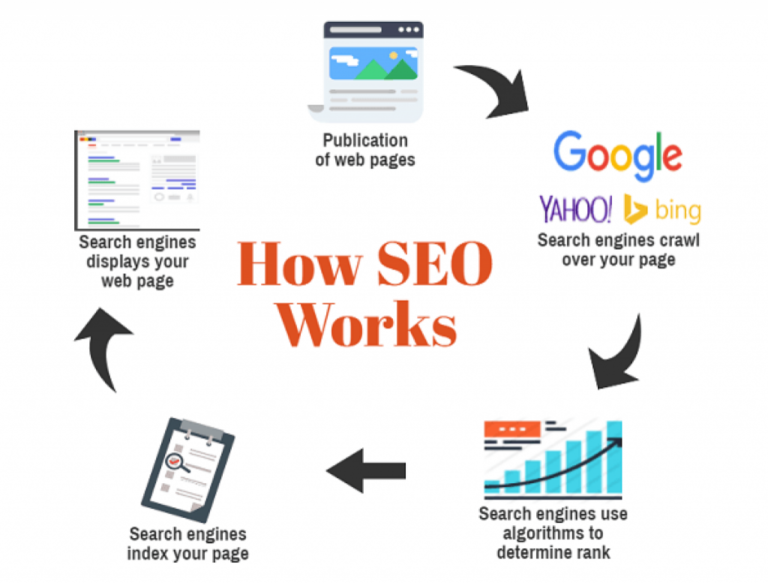
At its core, Search Engine Optimization is the strategic process of ensuring your website gets found by customers who are actively searching for the products or services you offer. It operates through three interconnected stages: crawling (discovering your pages), indexing (understanding and storing your content), and ranking (delivering the best answers to users).
SEO has evolved significantly. It is no longer solely about securing the top spot on traditional Google search result pages; it now encompasses visibility within AI-powered answer engines, generative overviews, and conversational interfaces. For businesses, particularly those in competitive markets like Dubai and the wider UAE, understanding and investing in modern SEO is not just a marketing tactic; it is a fundamental requirement for sustainable growth. Companies that build a foundation of helpful content, robust technical infrastructure, and strong brand authority consistently outperform competitors who rely exclusively on paid advertising. This comprehensive guide breaks down exactly how SEO works today, providing a clear roadmap to turn search visibility into tangible business revenue.
Your Customers Are Already Searching, Are You Showing Up?
Imagine owning a beautifully designed storefront in the busiest district of Dubai, but the windows are tinted black, there is no signage, and the entrance is hidden in an alleyway. Inside, you offer the best products and exceptional service, but foot traffic is practically zero because no one knows you are there. In the digital landscape, this is exactly what happens when a business operates without Search Engine Optimization.
Every single day, your potential customers are turning to search engines to solve problems, compare products, and find local service providers. They are actively typing queries into Google, asking voice assistants for recommendations, and increasingly, querying AI platforms like ChatGPT and Perplexity. If your website does not appear when they search for the exact solutions you provide, you are not just missing out on website traffic, you are handing revenue directly to your competitors.
SEO is the discipline of making your website visible, relevant, and authoritative to both search engines and human users. Historically, businesses invested in SEO simply to “rank higher on Google.” While that remains a core objective, the definition of search has expanded dramatically. Today, SEO is about capturing real estate wherever your audience is seeking answers. It is about ensuring that when an AI overview summarizes the best digital marketing agencies in the UAE, or when a user searches for technical SEO services, your brand is the one presented as the definitive, trustworthy choice.
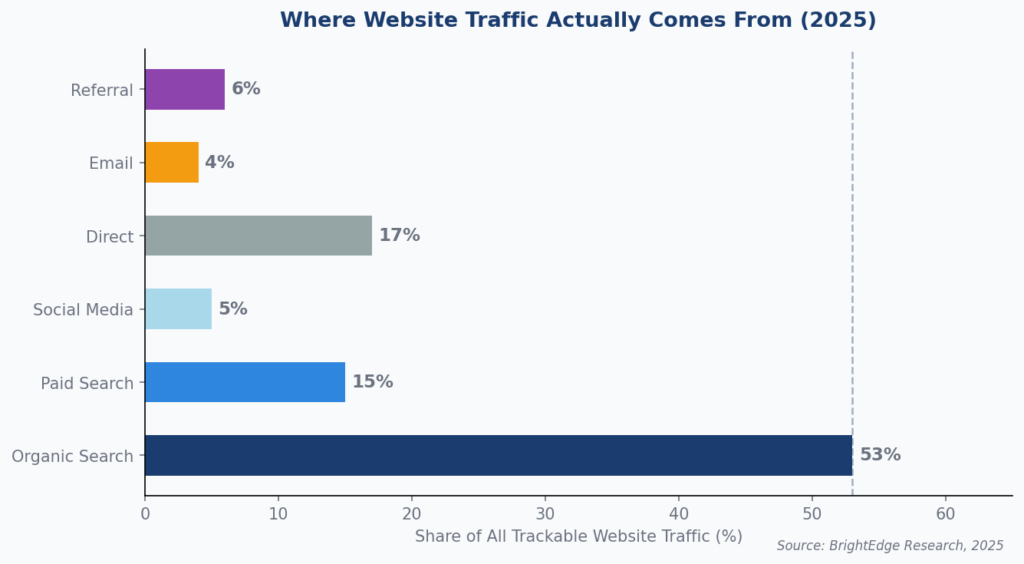
The importance of this visibility cannot be overstated. According to 2025 industry data, organic search drives approximately 53% of all trackable website traffic. More importantly, this traffic is highly qualified. Unlike disruptive outbound marketing, search traffic consists of individuals who have already expressed intent. When a business aligns its online presence with that user intent, the results are transformative. At Eyes On Solution, we have seen firsthand how transitioning from digital obscurity to search prominence can redefine a company’s growth trajectory.
To truly leverage this potential, businesses must understand that SEO is not a singular action or a one-time setup. It is a continuous, cohesive process.
SEO vs. Paid Advertising: Understanding the Difference
Many business owners ask whether they should invest in SEO or simply run paid advertisements. The reality is that both serve different, complementary purposes, but they operate on entirely different financial models.
Paid advertising operates like a faucet: you pay for placement, and traffic flows immediately. However, the moment you stop spending money, the traffic drops to zero. You are essentially renting your visibility. SEO, on the other hand, is an investment in digital equity. It requires time, effort, and strategic execution upfront, but the visibility you build compounds over time. Once you establish authority and secure high rankings, you generate consistent, long-term traffic without paying for every single click.
| Feature | Organic SEO | Paid Advertising (PPC) |
|---|---|---|
| Traffic Source | Earned through relevance and authority | Purchased through bidding |
| Cost Model | Upfront investment; clicks are free | Pay per click or impression |
| Time to Results | Months (compounds over time) | Immediate (stops when budget ends) |
| User Trust | High (users trust organic results more) | Moderate (users know it is an ad) |
| Long-Term ROI | Exceptionally high (averages 748%) | Moderate (margins decrease as bids rise) |
For businesses looking for sustainable growth, SEO provides a foundation that paid ads simply cannot replicate.
How Search Engines Actually Find and Rank Your Website
To understand how SEO works, you must first understand how search engines function. Google and other search platforms are essentially massive digital librarians. Their goal is to organize the world’s information and present the most useful, relevant answers to users as quickly as possible. To achieve this, search engines operate through a continuous, three-stage pipeline: Crawling, Indexing, and Ranking.
These are not isolated concepts; they are sequential steps. If a search engine cannot crawl your site, it cannot index it. If it is not indexed, it is physically impossible for it to rank.
Stage 1: Crawling (Discovery)
The internet is a vast, ever-expanding network of billions of pages. To navigate this, search engines use automated software programs known as crawlers, spiders, or bots (such as Googlebot). Crawling is the discovery phase. These bots travel across the web by following links from one page to another, constantly looking for new or updated content.
Think of crawling as a scout mapping a new city. The scout needs clear roads to find all the buildings. In SEO terms, these “roads” are your internal and external links. If your website has pages that are not linked from anywhere else (often called “orphan pages”), the crawler may never find them.
Several technical elements guide this discovery process. An XML Sitemap acts as a direct directory, providing search engines with a list of all the important pages you want them to find. Conversely, a robots.txt file acts as a set of instructions telling crawlers which areas of your site they should ignore (such as private admin portals or staging environments). Furthermore, search engines allocate a specific “crawl budget” to websites, meaning they will only spend a certain amount of time and resources crawling your site. Optimizing your site architecture ensures that bots spend their time discovering your most valuable content rather than getting lost in broken links or endless redirect loops.
Stage 2: Indexing (Understanding and Storing)
Once a crawler discovers a page, the search engine must understand what that page is about. This is the indexing phase. During indexing, the search engine analyzes the content, the images, the video files, and the underlying code. It attempts to categorize the page based on its topic, context, and relevance.
If the search engine determines the page is valuable and unique, it stores it in its massive database, the index. When a user performs a search, the search engine does not scour the live internet; it searches its own index to find the fastest answers.
However, not everything that is crawled gets indexed. Search engines are highly selective. If your website contains massive amounts of duplicate content, thin pages with little value, or relies heavily on complex JavaScript that the crawler struggles to render, the search engine may choose to exclude those pages from the index. Utilizing canonical tags correctly tells search engines which version of a duplicate page is the “master” copy, ensuring your SEO value is not diluted. If a page is not in the index, it does not exist as far as search results are concerned.
Stage 3: Ranking (Delivering Answers)
Ranking is the final, and most visible, stage of the process. When a user types a query into the search bar, the search engine scours its index for highly relevant content and then orders that content in the hopes of solving the user’s query.
This ordering is determined by incredibly complex algorithms that evaluate hundreds of ranking factors in milliseconds. The search engine is trying to determine two main things: Relevance and Authority. Does this page directly answer the user’s specific question? And is this website a trustworthy, authoritative source of information?
As highlighted in Google’s own SEO Starter Guide, search engines prioritize content that is created for users, not just for algorithms. The algorithms have evolved far beyond simply matching keywords. Today, they utilize advanced machine learning to understand the nuance of human language, the context of the search, and the overall user experience provided by the website.
| Stage | What It Means | Why It Matters for Business |
|---|---|---|
| Crawling | Search bots discovering your pages via links. | If bots cannot navigate your site, your content remains invisible. |
| Indexing | Analyzing and storing your page in the database. | Only indexed pages are eligible to be shown to potential customers. |
| Ranking | Ordering indexed pages based on relevance and trust. | Higher rankings equal more visibility, clicks, and revenue. |
What Does SEO Actually Consist Of? The Three Pillars
Modern SEO is a multidisciplinary effort. It cannot be reduced to simply writing blog posts or tweaking code. To build a robust, high-performing website, businesses must address three core pillars: Technical SEO, On-Page SEO, and Off-Page SEO. These pillars do not operate independently; they are deeply interconnected.
Pillar 1: Technical SEO (The Foundation)
Technical SEO refers to website and server optimizations that help search engine spiders crawl and index your site more effectively. It is the foundation upon which everything else is built. If your technical SEO is flawed, even the best content in the world will struggle to rank.
At Eyes On Solution, we frequently see beautifully designed websites that are practically invisible to search engines due to technical oversights. Key components of technical SEO include:
- Website Architecture: A logical, hierarchical structure ensures that both users and search bots can easily navigate your site. Important pages should be accessible within a few clicks from the homepage.
- Page Speed and Core Web Vitals: Speed is a direct ranking factor. If your site takes too long to load, users will bounce, signaling to Google that your page provides a poor experience. Core Web Vitals measure loading performance, interactivity, and visual stability.
- Mobile-Friendliness: With the majority of global searches occurring on mobile devices, Google uses mobile-first indexing. Your site must function flawlessly on smartphones.
- Structured Data (Schema Markup): This is code added to your site that helps search engines understand the context of your content. It enables rich results, such as review stars, product prices, or FAQ dropdowns directly in the search results.
- Security (HTTPS): A secure connection is a basic requirement for trust, both from users and search engines.
Pillar 2: On-Page SEO (The Content Layer)
On-Page SEO involves optimizing the individual pages on your website to rank higher and earn more relevant traffic. This pillar focuses on the content itself and the HTML source code of a page. It is about ensuring your content is highly relevant to what the user is searching for and provides a superior user experience.
Key elements of On-Page SEO include:
- Search Intent Optimization: Understanding why a user is searching and ensuring your page fulfills that need.
- Title Tags and Meta Descriptions: These HTML elements dictate how your page appears in the search results. While meta descriptions do not directly impact rankings, they heavily influence click-through rates.
- Heading Structure (H1 to H6): Using headings logically to structure your content makes it easier for humans to read and for search engines to comprehend the hierarchy of information.
- Content Quality: Creating comprehensive, accurate, and engaging content that genuinely solves the user’s problem.
- Internal Linking: Linking to other relevant pages within your own website helps distribute authority and keeps users engaged longer.
- Image Optimization: Ensuring images are compressed for speed and utilize descriptive alt text for accessibility and context.
Pillar 3: Off-Page SEO (The Authority Layer)
Off-Page SEO refers to actions taken outside of your own website to impact your rankings within search engine results pages. It is primarily concerned with building your website’s authority, trust, and relevance in the eyes of search engines.
If Technical and On-Page SEO ensure your site is relevant, Off-Page SEO proves to search engines that your site is important. The primary driver of Off-Page SEO is backlinks.
- Backlinks: When a reputable, authoritative website links to your site, search engines view it as a “vote of confidence.” The quality of these links matters far more than the quantity.
- Digital PR and Brand Mentions: Getting your brand mentioned in industry publications, news sites, and relevant blogs builds authority, even if a direct link is not provided.
- Social Signals: While not a direct ranking factor, a strong social media presence drives traffic and increases brand visibility, which indirectly supports SEO efforts.
- Citation Building: For local businesses, ensuring your business name, address, and phone number are consistent across online directories is crucial for local authority.
Why Keyword Research Is the Starting Point for Every SEO Strategy
Before you can optimize a website or write a piece of content, you must know what your audience is actually looking for. Keyword research is the process of discovering the specific words and phrases people use in search engines. However, in 2026, keyword research is no longer about finding a high-volume word and stuffing it onto a page. It is about understanding the psychology behind the search.
Understanding Search Intent
Search intent is the primary goal a user has when typing a query into a search engine. Google’s algorithms have become incredibly adept at deciphering intent, and they will only rank pages that satisfy it. Intent generally falls into four categories:
- Informational Intent: The user wants to learn something. (e.g., “How does SEO work?”) They are looking for guides, tutorials, and comprehensive answers.
- Navigational Intent: The user is trying to find a specific website or page. (e.g., “Eyes On Solution login”).
- Commercial Intent: The user is researching before making a purchase decision. (e.g., “Best SEO agency in Dubai”). They want comparisons, reviews, and detailed service information.
- Transactional Intent: The user is ready to buy or take action right now. (e.g., “Hire SEO consultant Dubai”). They need clear pricing, contact forms, and strong calls to action.
If a user searches with informational intent, but you present them with a hard-sell transactional landing page, they will immediately leave. Search engines recognize this poor user experience and will drop your rankings accordingly.
The Power of Long-Tail Keywords and Topic Clusters
While many businesses obsess over broad, highly competitive “head terms” (like “SEO”), the reality is that the vast majority of search traffic comes from long-tail keywords. Data indicates that 95% of all search queries are long-tail terms. These are longer, more specific phrases (like “affordable local SEO services for real estate in Dubai”). While they have lower individual search volumes, they demonstrate much higher intent and convert at significantly higher rates.
Furthermore, modern SEO strategy has shifted away from targeting single keywords toward building “Topic Clusters.” Instead of writing ten disjointed articles about different SEO keywords, a business should create one comprehensive “Pillar Page” (like this ultimate guide to SEO) and link it to several detailed “Cluster Pages” that cover subtopics (like technical SEO, local SEO, etc.). This semantic grouping signals deep topical authority to search engines, elevating the rankings of the entire cluster.
How Content Drives SEO Results and What “Helpful Content” Actually Means
Content is the vehicle that delivers your SEO strategy to the user. Without high-quality content, there is nothing for search engines to index and nothing for users to read. However, search engines are increasingly penalizing thin, generic, or purely AI-generated content that offers no unique value. Google’s algorithms are heavily focused on rewarding “Helpful Content” content created primarily to benefit human readers, not to manipulate search rankings.
Establishing Topical Authority and EEAT Signals
To rank competitively, your website must demonstrate that it is an expert in its field. This is achieved by building Topical Authority, covering a specific subject so comprehensively that search engines recognize your site as the definitive source.
This ties directly into Google’s EEAT framework, which stands for Experience, Expertise, Authoritativeness, and Trustworthiness.
- Experience: Does the content demonstrate first-hand, real-world experience with the topic?
- Expertise: Does the author possess the necessary knowledge or credentials to write about this subject?
- Authoritativeness: Is the website recognized as a go-to source for this topic within its industry?
- Trustworthiness: Is the site secure, accurate, and transparent about who is publishing the information? (This is the most critical component of EEAT).
For a digital marketing agency like Eyes On Solution, demonstrating EEAT means publishing case studies showing real client results, having content written by seasoned professionals, and maintaining a secure, highly functional website.
Content Formats That Perform Best
Different search intents require different content formats. To maximize visibility, businesses should utilize a diverse content strategy:
- Comprehensive Blog Posts and Guides: Ideal for capturing informational intent and building topical authority.
- Service and Landing Pages: Designed for commercial and transactional intent, focusing on clear value propositions and conversions.
- Comparison Articles: Highly effective for users in the consideration phase who are weighing their options.
- Case Studies: Powerful tools for demonstrating Expertise and Trustworthiness by showcasing real-world problem-solving.
- FAQ Sections: Excellent for capturing long-tail conversational queries and appearing in featured snippets or AI overviews.
How Link Building Builds the Authority Your Website Needs to Rank
If content is the engine of your SEO strategy, backlinks are the fuel. Link building is the process of acquiring hyperlinks from other websites to your own. In the eyes of search engines, a backlink is essentially a citation. If many high-quality, relevant websites link to your content, search engines infer that your content must be valuable and authoritative.
However, not all links are created equal. The landscape of link building has evolved significantly to prioritize quality over sheer volume. A single editorial link from a highly respected industry publication carries exponentially more weight than hundreds of links from low-quality, spammy directories.
Why Backlinks Matter and How to Earn Them
Backlinks serve as the primary indicator of Authoritativeness within the EEAT framework. They signal to search engines that others in your industry vouch for your content. The most effective link-building strategies focus on earning links naturally by creating exceptional content that others genuinely want to reference.
Key strategies for acquiring authoritative backlinks include:
- Editorial Links: Earning links naturally because your content (like original research, statistics, or an in-depth guide) is highly valuable.
- Digital PR Campaigns: Creating newsworthy content or data studies and pitching them to journalists and industry publications.
- Guest Posting: Writing high-quality articles for reputable websites in your niche in exchange for a contextual link back to your site. This is a core service offered by Eyes On Solution, ensuring businesses gain exposure on trusted platforms.
- Link Reclamation: Finding instances where your brand is mentioned online without a link, and reaching out to request one, or finding broken links pointing to your site and updating them.
It is also vital to understand the difference between external and internal links. While external links (backlinks) build overall domain authority, a strong internal linking structure distributes that authority throughout your site, helping search engines understand the hierarchy and relationship between your pages.
How Local SEO Works for Businesses in Dubai and the UAE
For many businesses, competing on a global scale is unnecessary; their primary goal is to dominate their immediate geographic area. This is where Local SEO becomes critical. Local SEO is the process of optimizing your online presence to attract more business from relevant local searches. These searches occur on Google, but also heavily on Google Maps.
If you run a clinic, a law firm, or a home service company in Dubai, your potential customers are actively searching for “services near me” or specific location-based queries. Data shows that 76% of “near me” mobile searches lead to a store visit within 24 hours. If your business is not optimized for local search, you are invisible to the people closest to you.
The Core Elements of Local Search
Local SEO relies on slightly different ranking signals than traditional organic SEO. Search engines prioritize proximity, relevance, and local prominence.
- Google Business Profile Optimization: Your GBP is arguably the most important asset for local SEO. It is the listing that appears in Google Maps and the local “map pack” in search results. A fully optimized profile includes accurate categories, high-quality images, comprehensive service descriptions, and regular updates.
- NAP Consistency: Search engines verify your local existence by cross-referencing your Name, Address, and Phone number (NAP) across the web. If your NAP information is inconsistent across different directories, it erodes trust and damages your local rankings.
- Local Citations: These are mentions of your business on local business directories, industry-specific portals, and review sites. Building strong local citations signals prominence to search engines.
- Reviews and Reputation Management: Customer reviews on your GBP and other platforms are a massive ranking factor. They provide social proof to potential customers and signal trustworthiness to search engines. Actively managing and responding to reviews is essential.
- Local Landing Pages: If your business serves multiple areas within the UAE, creating dedicated, highly relevant landing pages for each location helps capture hyperlocal search traffic.
At Eyes On Solution, our local SEO strategies are designed specifically to help businesses capture this high-intent, location-based traffic, ensuring that when someone nearby needs your service, you are the first option they see.
How AI Has Changed SEO and What That Means for Your Business
The search landscape is undergoing its most significant transformation in decades due to the integration of Artificial Intelligence. In 2026, traditional search results are increasingly sharing real estate with AI-generated answers. Google’s AI Overviews, alongside platforms like ChatGPT, Perplexity, and Gemini, are fundamentally changing how users interact with information online.
This shift has profound implications for businesses. When an AI Overview appears at the top of a search result, it often directly answers the user’s query without requiring them to click through to a website. Recent data indicates that when an AI Overview is present, the top-ranking organic result experiences a 58% drop in its average click-through rate. Furthermore, an astonishing 68% of US Google searches now end without a single click to an external website.
Adapting to the AI Era: GEO and AEO
Because rankings alone are no longer enough to guarantee traffic, businesses must adapt their strategies to ensure visibility within these AI ecosystems. This requires a shift toward Answer Engine Optimization (AEO) and Generative Engine Optimization (GEO).
Answer Engine Optimization: This involves structuring your content so that it is easily digestible by AI models looking for direct answers. It means formatting content clearly, utilizing FAQ schema, and providing concise, authoritative answers to specific questions before diving into deeper details (the BLUF principle: Bottom Line Up Front).
Generative Engine Optimization: This focuses on ensuring your brand and your content are cited as sources within AI-generated responses. AI models rely on vast amounts of training data and real-time web access. To be cited, your business must establish undeniable topical authority, possess strong brand mentions across the web, and utilize clear entity recognition so the AI understands exactly who you are and what you do.
The businesses that thrive in the AI search era will be those that focus on human experience signals, deep expertise, and building a brand that AI models recognize as the definitive authority in their space.
How Long Does SEO Take, and What Results Should You Expect?
One of the most common questions business owners ask is, “When will I see results?” Because SEO is an organic process that relies on search engines discovering, evaluating, and trusting your site, it is inherently a long-term strategy. It is not a switch you can flip for instant traffic.
However, the compounding nature of SEO means that the results you achieve are sustainable and highly cost-effective over time. The timeline below outlines the typical trajectory of a comprehensive SEO campaign.
| Phase | Timeframe | What Is Happening | Expected Results |
|---|---|---|---|
| Foundation | Months 1–3 | Technical audits, fixing critical errors, initial keyword research, and baseline content creation. | Improved indexing, initial movement in rankings for low-competition keywords, minor traffic bumps. |
| Growth | Months 3–6 | Consistent content publishing, aggressive link building, and local SEO optimization. | Noticeable improvements in keyword rankings, steady increases in organic traffic, initial growth in leads/inquiries. |
| Compounding | Months 6–12+ | Establishing topical authority, earning high-quality editorial links, and dominating core search terms. | Significant, compounding organic traffic, strong ROI, established brand authority, and consistent lead generation. |
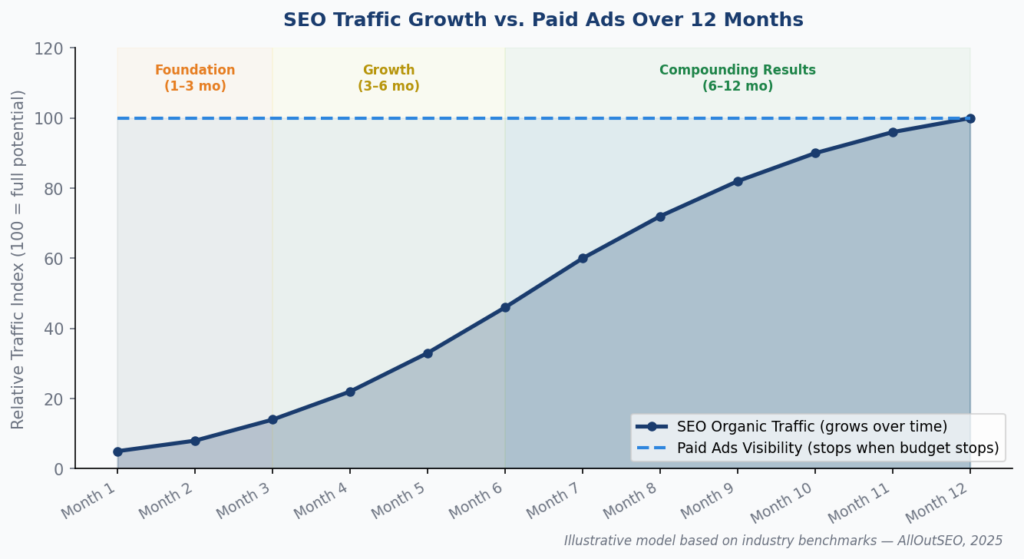
Several factors can influence this timeline, including the age and history of your website, the competitiveness of your industry, and the resources dedicated to content creation and technical improvements. However, data consistently shows that businesses that commit to a long-term SEO strategy see an average ROI of 748%, breaking even within 6 to 12 months.
How Do You Measure Whether SEO Is Working?
To ensure your investment in SEO is driving actual business growth, you must track the right Key Performance Indicators (KPIs). Focusing solely on rankings for vanity keywords is a common mistake; the ultimate goal of SEO is revenue.
Key metrics to monitor include:
- Organic Traffic: The total number of visitors arriving at your site from non-paid search engine results. This is the clearest indicator of growing visibility.
- Keyword Rankings: Tracking the positions of your target keywords helps gauge the effectiveness of your optimization efforts, but should be viewed as a leading indicator, not the final goal.
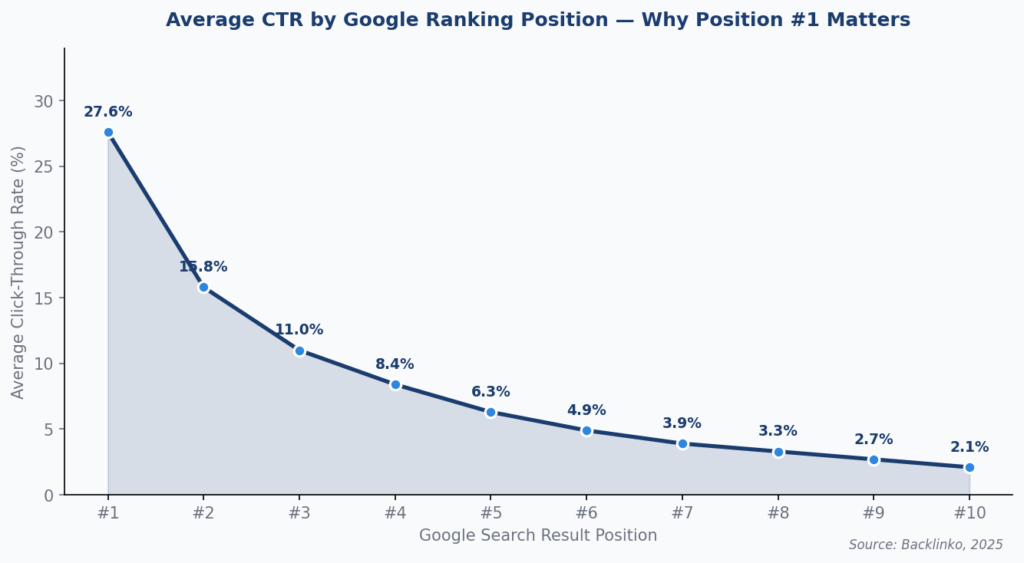
- Click-Through Rate (CTR): The percentage of users who click on your link after seeing it in the search results. A low CTR despite high rankings indicates poor meta descriptions or a mismatch in search intent.
- Conversion Rate: The percentage of organic visitors who take a desired action (e.g., filling out a contact form, making a purchase). This measures the quality and relevance of your traffic.
- Revenue Generated: The ultimate metric. By utilizing robust analytics, businesses can tie organic traffic directly to closed sales and calculate their true SEO ROI.
Professional SEO agencies, like Eyes On Solution, utilize advanced tools such as Google Search Console, Google Analytics 4, Ahrefs, and Semrush to track these metrics comprehensively and adjust strategies based on hard data.
The Most Common SEO Mistakes That Are Costing You Customers
Many businesses attempt SEO internally or hire inexperienced providers, leading to critical errors that stifle growth. Avoiding these common pitfalls is essential for success:
- Publishing Thin Content: Creating short, superficial pages that offer no real value to the user. Search engines penalize content that exists solely to house keywords.
- Ignoring Search Intent: Optimizing a page for a specific keyword without understanding what the user actually wants to accomplish.
- Keyword Stuffing: Unnaturally forcing keywords into content in an attempt to manipulate rankings. This creates a terrible user experience and violates search engine guidelines.
- Neglecting Technical SEO: Focusing entirely on content while ignoring a slow website, broken links, or mobile usability issues.
- Missing Structured Data: Failing to implement schema markup, which prevents search engines from fully understanding your content and limits your ability to appear in rich results.
- Focusing Only on Rankings: Chasing the #1 spot for a broad keyword while ignoring long-tail opportunities and actual conversion metrics.
What the Future of SEO Looks Like and How to Stay Ahead
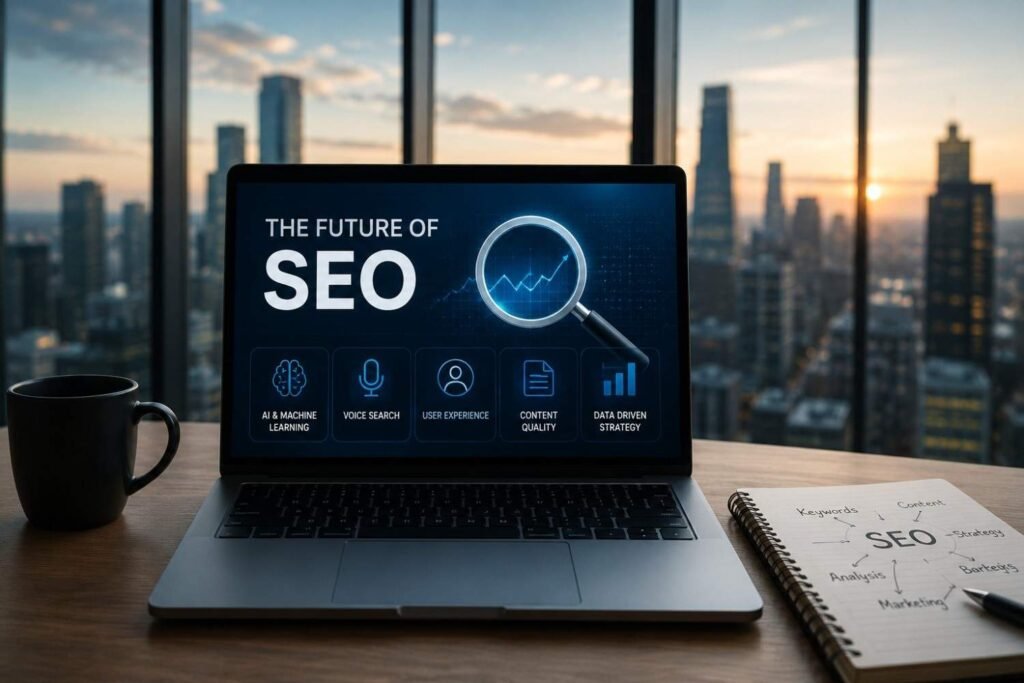
The future of SEO is not about tricking algorithms; it is about Search Everywhere Optimization. Users are no longer confined to a single search bar. They are searching on social platforms, utilizing voice assistants, and engaging with conversational AI.
To stay ahead, businesses must focus on Entity-Based SEO. This means moving away from optimizing for isolated keywords and instead establishing your brand as a recognized “entity” within your industry. When search engines and AI models clearly understand the relationship between your brand, your expertise, and your services, you become the authoritative answer regardless of where or how the search takes place.
The integration of traditional SEO, Generative Engine Optimization (GEO), and Answer Engine Optimization (AEO) is the new standard. Businesses must prioritize creating genuinely helpful, experience-based content, building undeniable brand authority, and maintaining a flawless technical foundation. SEO is not dying; it is evolving into a more sophisticated, user-centric discipline.
SEO Is Not Optional for Businesses That Want to Grow
SEO works through a complex but logical process of crawling, indexing, and ranking. It requires a cohesive strategy that blends technical excellence, authoritative content, and strong off-page signals. In 2026, modern SEO extends far beyond traditional Google rankings, encompassing visibility across AI search platforms and diverse digital ecosystems.
For businesses in Dubai and beyond, the reality is simple: your customers are searching for you right now. If your website is not optimized to meet them where they are, your competitors will gladly take their business.
At Eyes On Solution, we specialize in turning search traffic into sustainable business growth. Our data-driven, results-focused digital marketing strategies are designed to elevate your brand, capture high-intent traffic, and drive measurable revenue. If you are ready to stop missing out on potential customers and start dominating your local market, it is time to invest in a proven SEO strategy.
Contact Eyes On Solution today for a free consultation and let us build a roadmap to your digital success.
FAQs
Frequently Asked Questions
What is SEO and how does it actually work?
SEO (Search Engine Optimization) is the process of improving your website’s visibility on search engines. It works through three main stages: search engines crawl the web to discover your pages, index them in their database if the content is valuable, and rank them based on relevance and authority when a user searches for a related query. A comprehensive strategy involves technical optimization, high-quality content creation, and building backlinks. Learn more about our SEO services.
How long does it take for SEO to start working?
SEO is a long-term strategy. While technical fixes can yield quick improvements, noticeable growth in organic traffic and keyword rankings typically takes 3 to 6 months. For highly competitive industries, it may take 6 to 12 months to see compounding results and a strong return on investment. The timeline depends on your website’s current state, competition, and the consistency of your optimization efforts. Contact us for a custom timeline assessment.
Is SEO better than paid advertising (PPC)?
SEO and paid advertising serve different purposes. Paid ads provide immediate visibility but stop generating traffic the moment you stop paying. SEO requires an upfront investment of time and resources, but it builds compounding, long-term authority, resulting in free, sustainable traffic over time. For most businesses, a balanced approach works best, but SEO provides a significantly higher long-term ROI. View our affordable SEO packages.
Why is local SEO important for my business in Dubai?
Local SEO ensures your business appears when nearby customers search for your services on Google and Google Maps. Because a large percentage of mobile “near me” searches result in a store visit or contact within 24 hours, optimizing your Google Business Profile and local citations is critical for capturing high-intent, local traffic in competitive markets like Dubai. Explore our Local SEO solutions.
How is AI changing the way SEO works?
AI is transforming SEO by introducing AI Overviews and conversational answer engines (like ChatGPT) directly into the search experience. This means users often get answers without clicking through to a website. To remain visible, businesses must focus on Answer Engine Optimization (AEO) by providing clear, direct answers, and Generative Engine Optimization (GEO) by building undeniable brand authority so AI models cite them as trusted sources. See how our content strategies adapt to AI search.
What is the difference between technical SEO, on-page SEO, and off-page SEO?
Technical SEO is the foundation, it ensures search engines can crawl and index your site correctly. On-page SEO is the content layer, it optimizes the actual pages for relevance and search intent. Off-page SEO is the authority layer, it builds your site’s credibility through backlinks and brand mentions. All three must work together for a successful SEO strategy. Learn about our Technical SEO services.
What are the most important Google ranking factors in 2026?
The most important Google ranking factors in 2026 include content quality and search intent alignment, EEAT signals (Experience, Expertise, Authoritativeness, Trustworthiness), Core Web Vitals and page speed, mobile-friendliness, high-quality backlinks from authoritative domains, and structured data implementation. Google’s own SEO Starter Guide consistently emphasizes creating content for users first, not for algorithms. See how we optimize for these factors.
How do I choose the right SEO agency for my business in Dubai?
When choosing an SEO agency in Dubai, look for a proven track record with verifiable case studies, transparent reporting, and a strategy that covers all three pillars: technical SEO, on-page content, and link building. Avoid agencies that promise instant results or guaranteed #1 rankings, as these are red flags. Eyes On Solution offers dedicated account management, clear deliverables, and strategies built around your specific business goals. Request a free consultation today.