
Marketing is essential because it helps businesses attract customers, build trust, increase sales, create brand awareness, and stay competitive. Without effective marketing, even great products and services struggle to reach the right audience and achieve sustainable growth.
Imagine pouring your heart, soul, and capital into developing an incredible product, only to launch it into a void of silence. Without a strategic bridge connecting your solution to the people who need it, even the most innovative businesses struggle to survive. This bridge is marketing, and it is far more than just flashy advertisements or catchy slogans. It is the lifeblood of customer acquisition, brand longevity, and sustainable market presence.
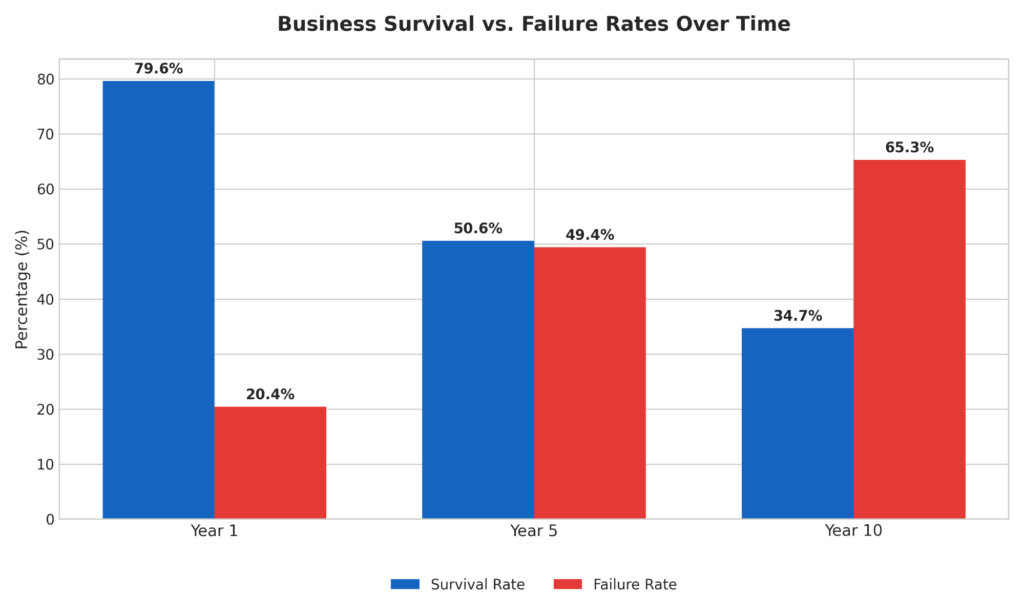
The importance of marketing for business growth cannot be overstated. According to data from the U.S. Bureau of Labor Statistics, 20.4% of businesses fail in their first year, and nearly half (49.4%) fail within five years. A significant driver of this failure rate is a lack of market need and poor customer acquisition strategies. Marketing is the strategic function that prevents this outcome. It is the continuous process of understanding customer pain points, communicating value, building trust, and ultimately driving the revenue that keeps the doors open and the business expanding.
In today’s hyper-competitive digital landscape, relying on word-of-mouth or a “build it and they will come” mentality is a recipe for stagnation. Effective marketing acts as the foundational pillar for sustainable growth, transforming unknown entities into trusted brands and casual browsers into loyal advocates. When businesses fail to invest in marketing, they are essentially deciding to remain invisible to the very people who are actively searching for the solutions they provide. Marketing is not an expense to be minimized; it is an investment in the future viability of the organization.
How Does Marketing Connect Businesses With Customers?
At its core, marketing is the systematic process of identifying, anticipating, and satisfying customer requirements profitably. While sales focuses on the transaction, marketing focuses on the relationship. It encompasses everything from initial market research and product development to brand positioning, pricing strategies, and customer experience. It is the comprehensive system that ensures a business remains relevant to its target audience.
Modern marketing has shifted dramatically from traditional outbound interruption (like cold calling or billboard ads) to inbound attraction. It is a customer-focused business function that seeks to provide value before asking for a sale. By understanding the target audience’s demographics, behaviors, and pain points, businesses can tailor their messaging to resonate deeply, creating a seamless journey from brand discovery to purchase. This connection is not built overnight; it requires a consistent, strategic approach across multiple touchpoints, ensuring that the customer feels understood and valued at every stage of their interaction with the brand.
The Four Pillars of Marketing Strategy
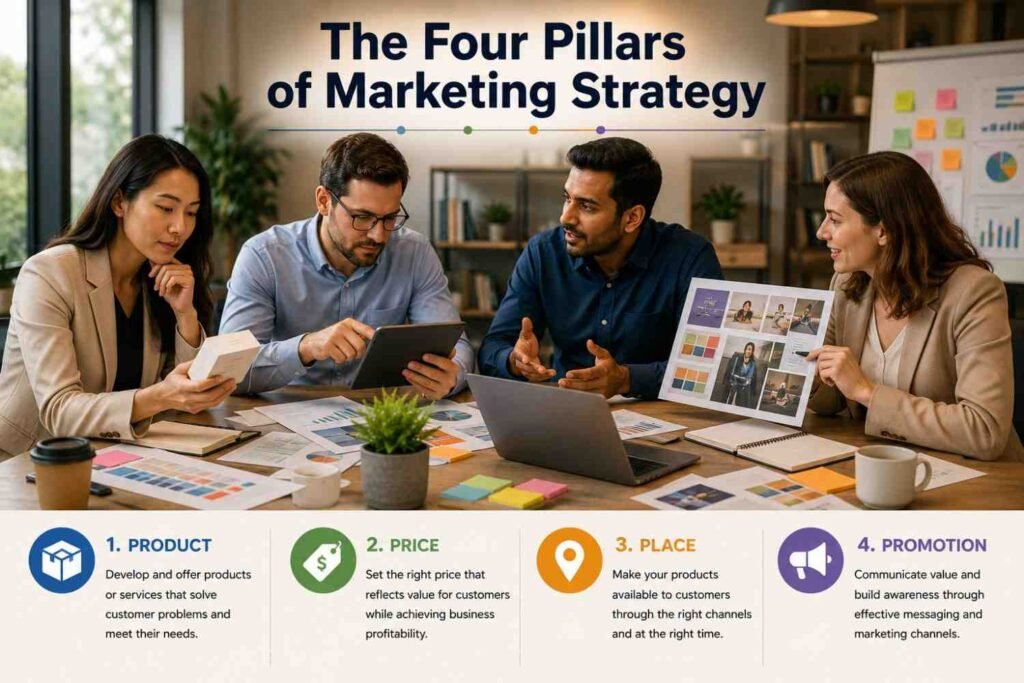
A robust marketing strategy is traditionally built upon the “Four Ps,” which dictate how a business positions itself in the market. These pillars provide a framework for ensuring that every aspect of the offering is optimized for the target audience:
| Component | Definition | Strategic Role |
|---|---|---|
| Product | The good or service being offered. | Ensuring the offering actually solves a specific customer problem or fulfills a need. |
| Price | The cost to the consumer. | Determining perceived value, competitive positioning, and profit margins. |
| Place | Where the product is sold or distributed. | Making the buying process as convenient and accessible as possible for the target audience. |
| Promotion | How the product is communicated. | Utilizing channels like SEO, social media, and content marketing to reach and engage prospects. |
Understanding these four pillars is crucial because they ensure that your marketing efforts are aligned with your overall business objectives. If your product does not meet a real need, no amount of promotion will save it. Conversely, an incredible product priced incorrectly or sold in the wrong channels will also fail to gain traction. A holistic marketing strategy harmonizes all four elements to create a compelling offer that resonates with the market.
Why Is Brand Awareness Critical for Market Survival?
Brand awareness is the degree to which consumers recognize and remember your business. It is the very first step in the customer acquisition funnel. If your target audience does not know you exist, they cannot buy from you. This is why brand building must be a continuous, deliberate effort rather than an afterthought or a one-time campaign.
Creating brand awareness makes your products and services visible in a crowded marketplace. It builds familiarity, which is a powerful psychological driver of consumer behavior. People naturally gravitate toward what they know. When a consumer faces a purchasing decision, a recognized brand has a significant competitive advantage over an unknown competitor. This psychological principle, known as the mere-exposure effect, dictates that people tend to develop a preference for things merely because they are familiar with them. Marketing is the tool that generates this crucial familiarity.
This visibility directly impacts credibility. Consistent, high-quality marketing signals to the market that your business is active, professional, and reliable. Over time, this brand recognition translates into better customer recall and higher conversion opportunities, as prospects are more likely to click on a search result or social media ad from a brand they recognize. Brand awareness also lowers the barrier to entry for new products; if customers already trust your core brand, they are much more likely to try your new offerings, reducing the cost of launching new initiatives.
How Does Marketing Build Trust and Credibility?
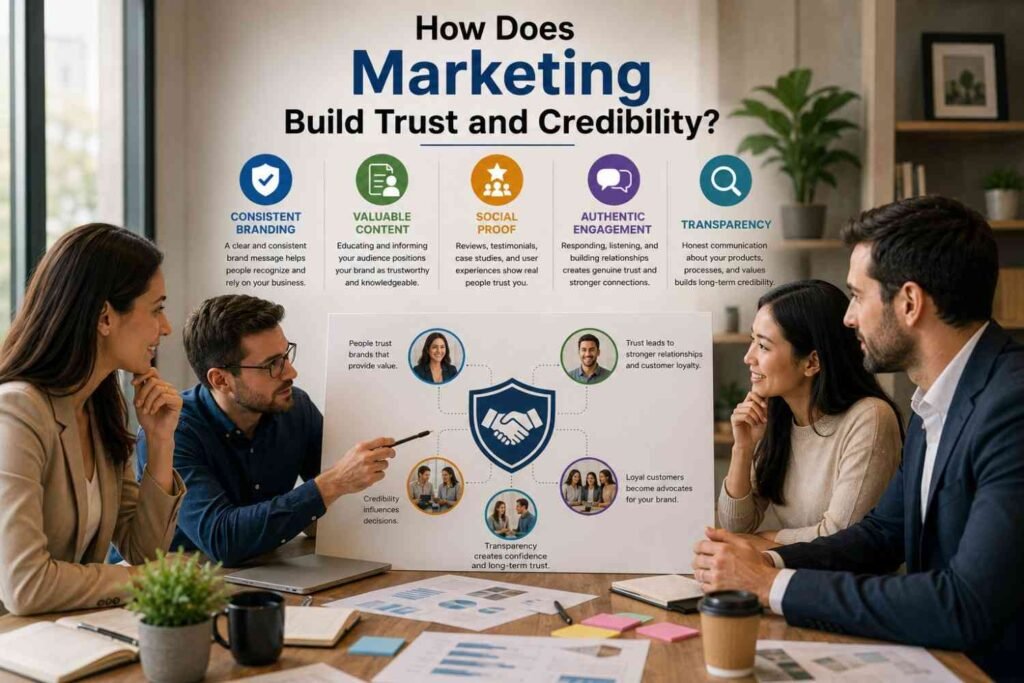
In the modern digital economy, trust is a brand’s most valuable asset. Consumers are bombarded with thousands of marketing messages daily, leading to widespread skepticism. A recent survey indicates that approximately 80% of consumers prefer to buy products and services from brands they trust, and 81% of consumers state that they need to trust a brand before considering a purchase. Building this trust is not a passive activity; it requires active, strategic marketing that prioritizes authenticity and value.
Marketing builds this trust through consistent messaging, transparency, and the delivery of value. Content marketing, in particular, plays a massive role in establishing credibility. By producing educational resources, thought leadership articles, and insightful videos, a business positions itself as an industry authority rather than just a vendor pushing a product. When you give away valuable information for free, you signal to the consumer that you are invested in their success, not just their wallet. This educational approach disarms skepticism and fosters a genuine connection.
Furthermore, marketing amplifies social proof. Showcasing customer reviews, testimonials, and case studies provides tangible evidence that your product delivers on its promises. When potential buyers see that others have successfully solved their problems using your solution, their perceived risk decreases, and their trust in your brand increases. In an era where consumers rely heavily on peer validation, actively marketing your success stories is one of the most effective ways to build a credible reputation in the marketplace.
How Does Marketing Drive Sales and Revenue?
While marketing and sales are distinct functions, they are inextricably linked. The primary objective of marketing is to generate qualified leads and nurture them until they are ready to buy, thereby making the sales process significantly more efficient. Without marketing, the sales team is forced to rely on cold outreach, which is notoriously inefficient, expensive, and demoralizing. Marketing warms up the audience so that when the sales conversation happens, the prospect is already receptive.
Marketing drives revenue by creating demand. Through targeted campaigns, whether via search engine optimization, paid advertising, or email marketing, businesses can reach consumers actively searching for solutions. This targeted approach ensures that marketing budgets are spent on individuals who have a high likelihood of converting, maximizing the return on investment. By intercepting prospects at the exact moment they are looking for a solution, marketing dramatically shortens the sales cycle.
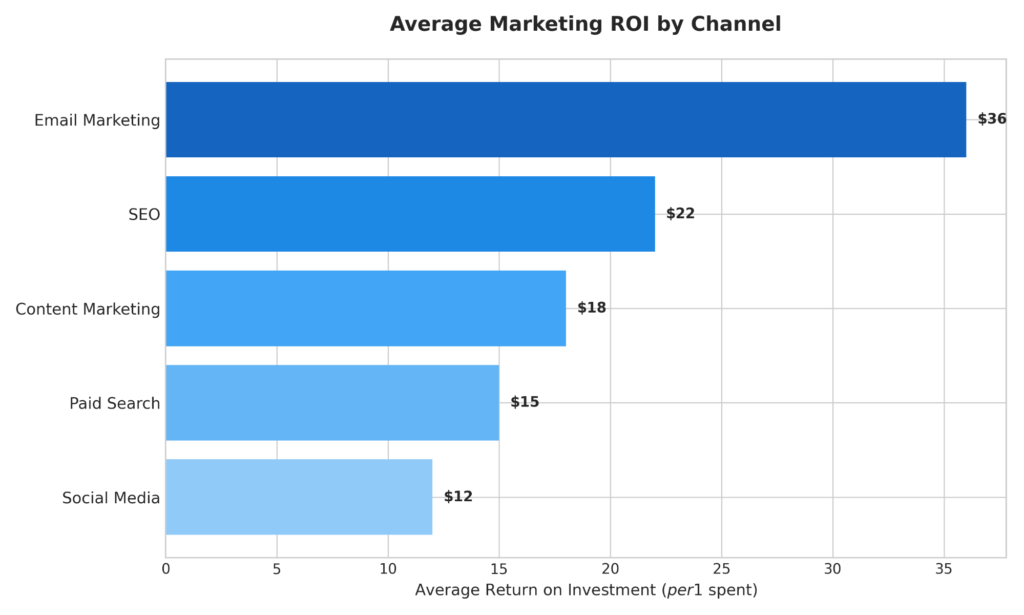
Consider the impact of email marketing. Data shows that email marketing consistently delivers one of the highest returns on investment, generating an average of $36 for every $1 spent [3]. By capturing a prospect’s contact information and nurturing them with personalized, relevant content over time, marketing keeps the brand top-of-mind, encouraging both initial purchases and repeat business. This increases the Customer Lifetime Value (CLV), which is crucial for long-term profitability. Furthermore, effective marketing reduces the Customer Acquisition Cost (CAC) by optimizing conversion rates across all channels, ensuring that the business grows profitably rather than just increasing top-line revenue at the expense of margins.
What Makes Content Marketing So Effective?
Content marketing has emerged as one of the most powerful and cost-effective strategies available to modern businesses. Instead of pitching products, content marketing involves creating and sharing relevant, valuable content to attract and retain a clearly defined audience. This approach represents a fundamental shift in how businesses communicate with their prospects, moving from interruption to attraction.
The efficiency of content marketing compared to traditional outbound methods is staggering. Statistics reveal that content marketing generates three times as many leads as traditional outbound marketing while costing 62% less. This dramatic difference in efficiency is why so many forward-thinking companies are reallocating their budgets away from traditional advertising and toward content creation. It is a strategy that builds a compounding asset; a well-written, SEO-optimized article can continue to generate leads for years after it is published, whereas a paid ad stops working the moment the budget runs out.
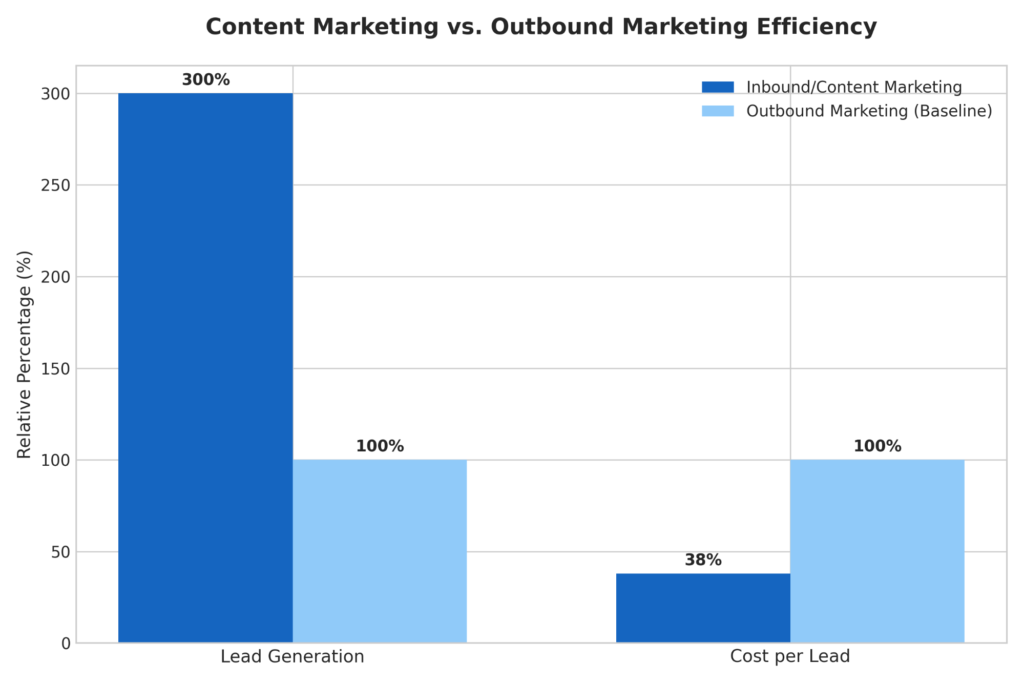
Content marketing works because it aligns with how modern consumers make purchasing decisions. Today’s buyers conduct extensive online research before ever speaking to a sales representative. By providing high-quality blog posts, guides, and FAQs that answer their specific questions, businesses capture organic search traffic and build a relationship based on helpfulness rather than pressure. Furthermore, robust content is essential for AI search visibility, ensuring that your brand is referenced when users query AI answer engines like ChatGPT or Perplexity. When your content provides the best, most comprehensive answers, you become the default authority in your space, naturally attracting the highest quality leads.
How Does Marketing Support Product Development?
Marketing is not a one-way street of communication; it is a vital listening tool. Effective marketing involves continuous market research and consumer behavior analysis. By monitoring engagement metrics, reading social media comments, and analyzing customer feedback, businesses gain invaluable insights into what their audience truly wants. This feedback loop is essential for staying ahead of market trends and anticipating shifts in consumer demand.
This data is the lifeblood of product development. It helps businesses identify customer pain points that are currently unaddressed in the market. By understanding market demand, companies can refine existing products, identify opportunities for new features, and ensure that new product launches are aligned with actual consumer needs, significantly reducing the risk of a failed launch. Marketing essentially acts as the voice of the customer within the organization, ensuring that engineering and development teams are building solutions that the market actually wants to buy, rather than developing features in a vacuum.
Furthermore, marketing can be used to test new product concepts before they are fully developed. By running targeted ads or creating landing pages for upcoming features, businesses can gauge interest and collect pre-orders, validating the product-market fit before committing significant resources to production. This agile approach to product development, driven by marketing data, minimizes financial risk and maximizes the probability of commercial success.
Why Is Marketing Important for Different Types of Businesses?
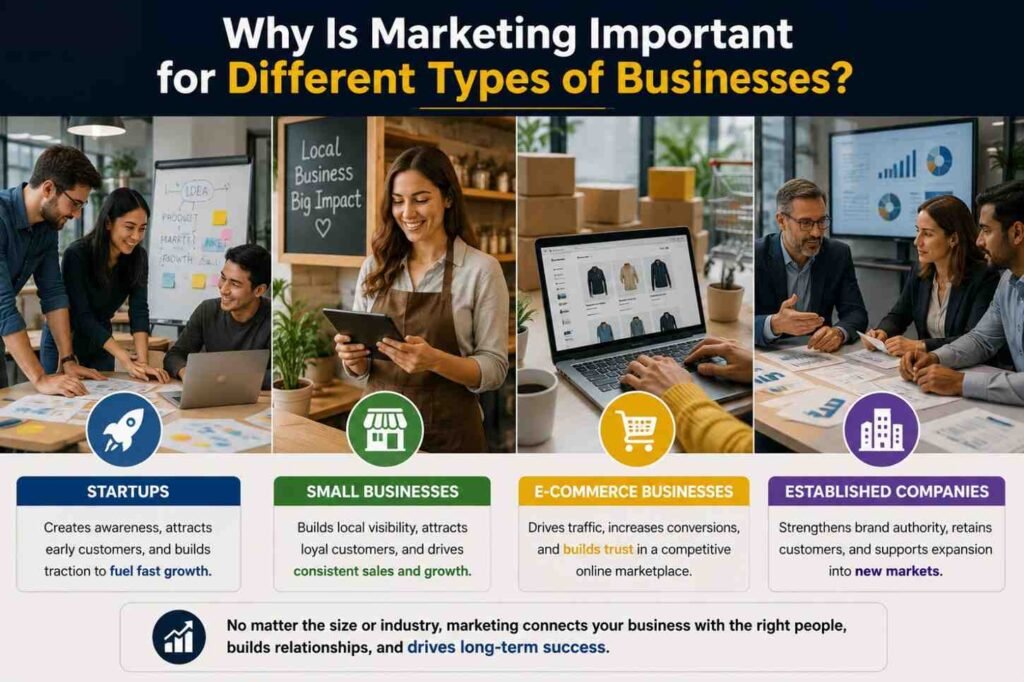
The fundamental principles of marketing apply universally, but the specific importance and application vary depending on the business type and stage of growth. A strategy that works for a local bakery will not necessarily work for a global enterprise software company, highlighting the need for tailored marketing approaches.
Small Businesses and Startups
For small businesses and startups, marketing is about survival and establishing a foothold in the market. The focus is often on building local awareness, generating affordable leads, and competing with larger, more established brands. Startups rely heavily on marketing to acquire their crucial early customers, prove their business model, and build the investor confidence necessary for further funding. Agile marketing tactics, such as community engagement, highly targeted digital ads, and scrappy PR campaigns, are essential for these businesses to punch above their weight class and disrupt established markets.
Large Enterprises
For large enterprises, the marketing objective shifts toward maintaining market share, expanding into new global markets, and fiercely protecting brand reputation. At this scale, marketing is about staying relevant, fending off agile competitors, and managing complex omnichannel campaigns that provide a consistent customer experience across all touchpoints. Enterprise marketing requires sophisticated data analysis, massive budgets, and the ability to coordinate messaging across dozens of different departments and geographical regions to ensure brand consistency at a global scale.
Service-Based and Ecommerce Businesses
Service-based businesses rely on marketing to demonstrate expertise and build the high level of trust required when selling an intangible offering. Content marketing, webinars, and speaking engagements are highly effective here, as they allow the service provider to showcase their knowledge before the client commits. Ecommerce businesses, on the other hand, use digital marketing to drive targeted online traffic, optimize conversion rates, and reduce shopping cart abandonment through retargeting and personalized email flows. For ecommerce marketing is deeply intertwined with the user experience of the website itself, where every click and interaction is measured and optimized for maximum revenue.
| Business Type | Primary Marketing Goal | Key Strategies |
|---|---|---|
| Startups | Establish presence and prove market fit | PR, Content Marketing, Social Media |
| Small Business | Local awareness and lead generation | Local SEO, Community Engagement, PPC |
| Enterprise | Market share retention and global expansion | Brand Campaigns, Omnichannel Marketing |
| Ecommerce | Traffic generation and conversion optimization | SEO, Retargeting, Email Automation |
What Are the Consequences of Ignoring Marketing?
Choosing to view marketing as an optional expense rather than a vital investment is a dangerous gamble. The consequences of ignoring marketing are severe and often compound over time, creating a downward spiral that is difficult to escape. Many business owners make the mistake of cutting marketing budgets during economic downturns, failing to realize that this is exactly when marketing is most critical for survival and capturing market share from retreating competitors.
A lack of marketing leads to a lack of brand visibility. Without visibility, customer reach is severely restricted, resulting in fewer leads and declining sales. In a competitive environment, stronger competitors who are actively marketing will dominate the conversation, capturing market share and building the customer relationships that your business is neglecting. Once a competitor establishes dominance in the minds of your target audience, it becomes exponentially more difficult and expensive to win those customers back.
Furthermore, ignoring marketing means you are flying blind. Without the data and insights generated by marketing campaigns, you have no way of knowing how consumer preferences are shifting or what new threats are emerging in the market. You lose touch with your audience’s evolving needs. Ultimately, ignoring marketing results in limited business growth, missed opportunities, and a high risk of business failure. It is the equivalent of trying to drive a car with your eyes closed, hoping you don’t hit an obstacle.
How to Build an Effective Marketing Strategy
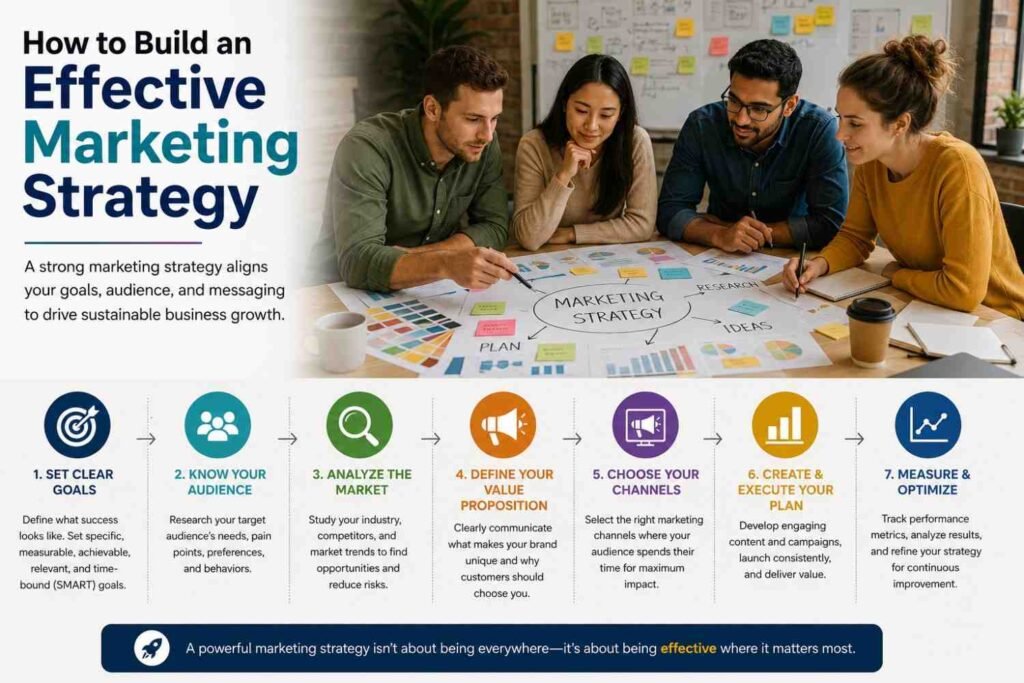
Building a successful marketing engine requires a systematic approach rather than random acts of promotion. It is not enough to simply “do marketing”; you must have a clear, documented strategy that aligns with your broader business goals and provides a roadmap for execution.
- Define Business Goals: Start with clear, measurable objectives. Are you aiming for a specific revenue target, a certain number of new leads, or a percentage increase in brand awareness? Without clear goals, you cannot measure success or determine the ROI of your efforts.
- Identify Your Target Audience: Create detailed customer personas. Understand their demographics, psychographics, online behavior, and primary pain points. The more specific you can be about who you are targeting, the more effective your marketing will be. Generic messaging appeals to no one.
- Choose the Right Channels: Don’t try to be everywhere at once. Focus on the channels where your audience actually spends their time, whether that is organic search SEO, specific social media platforms, or industry publications. A focused approach on two or three channels is far more effective than a diluted presence across ten.
- Create Valuable Content: Develop resources that educate, entertain, or solve problems for your audience. Content is the fuel that powers modern marketing campaigns. It should be high-quality, relevant, and consistently delivered to keep your audience engaged.
- Measure and Optimize: Marketing requires continuous improvement. Track key performance indicators (KPIs) like traffic, conversion rates, and Customer Acquisition Cost (CAC). Use data-driven insights to refine your campaigns and scale what works. A successful marketing strategy is never truly “finished”; it is always evolving based on performance data and market feedback.
Frequently Asked Questions
Why is marketing important for a business?
Marketing is essential because it connects your products or services with the target audience who needs them. It builds brand awareness, establishes trust, generates qualified leads, and ultimately drives the sales and revenue required for business survival and growth. Without marketing, even the best products will struggle to find buyers, and the business will fail to reach its potential.
How does marketing increase sales?
Marketing increases sales by creating market demand and guiding potential customers through the buying journey. Through strategies like SEO, content marketing, and targeted advertising, marketing attracts prospects, educates them on the value of your solution, and nurtures them until they are ready to make a purchase, making the final sales process much more efficient and effective.
What is the importance of content marketing?
Content marketing is highly important because it generates three times as many leads as traditional outbound marketing while costing significantly less. It builds industry authority, improves organic search rankings, and earns customer trust by providing valuable information before asking for a sale. It is the foundation of modern inbound marketing and is crucial for long-term SEO success.
Why is digital marketing important today?
Digital marketing is critical today because the vast majority of consumers conduct online research before making purchasing decisions. It allows businesses to reach a global audience cost-effectively, target specific demographics with precision, and measure campaign performance in real-time, offering a level of agility and data-driven insight that traditional marketing cannot match.
Can small businesses succeed without marketing?
It is highly unlikely for a small business to achieve sustainable success without marketing. Without a strategy to attract and retain customers, businesses rely solely on chance or limited word-of-mouth, which is rarely sufficient to compete against proactive competitors or survive long-term in a dynamic market. Marketing is the proactive step required to ensure a steady stream of new business.