
Programmatic SEO helps businesses increase search traffic by creating structured, search-focused pages at scale. Instead of relying only on manually written content, this approach uses templates, keyword patterns, and organized data to target large numbers of specific search queries efficiently. It is commonly used for service pages, location pages, comparison pages, category pages, and industry-focused content.
This guide explains how programmatic SEO works, how it improves organic visibility, and what elements make the strategy successful. You will learn how to target long tail keywords, build topical authority, improve crawlability, avoid thin content, and create scalable SEO landing pages that align with search intent. The article also covers internal linking, technical SEO, content quality control, and performance tracking to help businesses build a structured SEO strategy tha
What Is Programmatic SEO?
Programmatic SEO is a method used to create large numbers of search-focused pages with the help of automation, structured data, and SEO templates. Instead of building every page manually, businesses create systems that generate pages around keyword patterns and user searches. You can often spot this on SaaS platforms, ecommerce websites, job portals, and travel websites where thousands of pages target highly specific queries. The structure stays consistent while the content changes based on the keyword and intent behind the search.
This strategy helps websites cover more search opportunities without spending months writing every page individually. It works especially well for long tail keywords because search behavior today is much more detailed. People search for very exact phrases now, not only broad topics. A well-built programmatic SEO setup helps search engines understand those pages clearly while giving readers quick answers without making the content feel stuffed or repetitive.
Understanding the Core Concept
The core idea behind programmatic SEO is simple. A business creates a content template, connects it with organized data, and generates multiple pages automatically. For example, a software website can create pages for different industries, features, or use cases without redesigning every page from the beginning. The layout remains mostly the same, while headings, keywords, descriptions, and supporting details adjust based on the topic being targeted.
What makes this useful is the ability to scale content while still matching search intent closely. Someone searching “SEO software for small business” expects something very different from “SEO software for enterprise companies.” Programmatic SEO allows websites to answer both searches with focused pages instead of one broad article trying to cover everything at once. When the information feels clear and organized, users stay longer and search engines notice that behavior too.
How Programmatic SEO Differs From Traditional SEO
Traditional SEO content is usually written page by page. Writers research keywords, create outlines, optimize headings, and publish manually. That approach gives more flexibility, but it also takes more time. Programmatic SEO changes the process by using templates and automation to create many targeted pages faster. The goal is not just speed though. It is about covering search variations that would be difficult to manage manually.
There is also a difference in keyword targeting. Traditional SEO often focuses on broader topics like “content marketing tips” or “SEO guide.” Programmatic SEO targets more specific searches such as “SEO tool for lawyers” or “email software for startups.” These focused searches usually have clearer intent because users already know what they are looking for. The pages feel more direct, and that often improves engagement as well.
Why Search Engines Reward Programmatic Content
Search engines prefer content that matches user intent clearly and covers topics in an organized way. Programmatic SEO helps websites build hundreds of connected pages around related subjects, which strengthens topical authority. Instead of publishing random articles across unrelated categories, businesses create structured content clusters that support one another through internal linking and keyword relevance.
Another reason this strategy performs well is consistency. Search engines can crawl and understand structured websites more efficiently when pages follow a logical format. Still, quality matters a lot. If the pages look thin or repetitive, rankings usually drop quickly. Good programmatic SEO focuses on usefulness first by making pages informative, readable, and aligned with what users actually want to find.
You May Also Like: SEO vs PPC: Which Digital Marketing Strategy Delivers Better Results for Your Business?
How Programmatic SEO Increases Search Traffic
Programmatic SEO helps websites capture traffic from a large number of specific searches instead of relying only on a few competitive keywords. Rather than publishing broad pages that try to rank for everything, this method creates focused pages around clear user queries. That makes it easier for Google to understand page relevance and match content with what people are actually searching for.
It also helps websites build stronger topic coverage. When pages are grouped properly through categories and internal links, search crawlers move through the site more efficiently. Over time, this improves visibility across related searches and increases the chances of ranking for more keyword combinations.
Targeting Long Tail Keywords at Scale
Long tail keywords are detailed search phrases people use when they already have a clear need in mind. Searches like “technical SEO service for SaaS company” or “CRM software for small business” usually face less competition because they target narrower queries.
Programmatic SEO makes it easier to build pages around these searches in a structured way. A single page may bring modest traffic, but hundreds of focused pages can collectively drive strong search visibility from many different keyword paths.
Building Topic Authority Across a Niche
Google pays attention to how well a website covers a subject. If content is scattered randomly, it becomes harder for search engines to understand the website’s main focus. Programmatic SEO solves this by organizing related pages into connected topic clusters.
For example, an SEO website may publish separate pages around technical SEO, content optimization, link building, and local SEO. When these pages support each other through internal linking, the overall topic structure becomes clearer and easier to crawl.
Improving Organic Visibility With Search Intent Pages
Not every search comes from the same intent. Some users want answers, while others are comparing services or searching for a specific solution. Creating separate pages for each type of query helps search engines understand which page should appear for a particular search.
Informational pages explain topics and answer questions. Transactional pages focus on services or tools. Navigational pages help users reach a specific category or brand page quickly. This separation improves relevance and often increases visibility because the content matches the query more directly.
Creating SEO Landing Pages for Every Search Variation
Programmatic SEO allows websites to create targeted landing pages around different keyword combinations without building every page manually. This often includes service pages, industry pages, location pages, and comparison pages.
These focused pages perform better because they align closely with user searches. A page targeting “SEO service for healthcare company” gives clearer context than a general SEO page covering unrelated industries together. Small keyword adjustments across many pages can gradually expand search reach across an entire website.
Learn More About: Ahrefs vs Semrush: Which Is a Better SEO Tool?
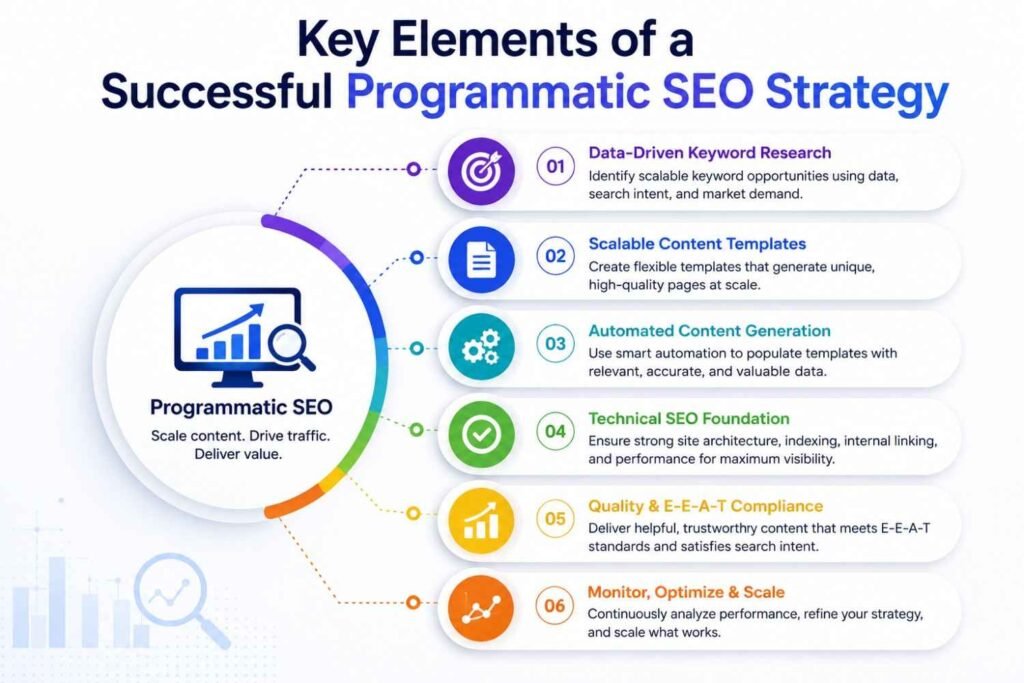
Key Elements of a Successful Programmatic SEO Strategy
Programmatic SEO works best when content, structure, and technical setup support each other properly. Publishing large numbers of pages without planning often creates indexing problems, weak content, and confusing site structures. A strong setup focuses on organized keyword targeting, clear page templates, and useful internal connections.
Search engines now pay closer attention to page quality and topical relevance. That is why successful programmatic SEO is not only about scale. Pages need to answer specific searches clearly while staying easy to crawl and navigate.
Keyword Research and Data Collection
Good programmatic SEO starts with scalable keyword patterns. Instead of targeting random terms, websites group similar searches by industry, service, category, or location. This makes it easier to create focused pages around repeated search structures. Organized data also matters. Keywords, metadata, search intent, and page categories should stay structured before content generation begins. Poor data organization usually leads to duplicate topics and overlapping pages.
SEO-Friendly Templates and Page Structure
Templates help keep pages consistent and easier for search engines to understand. A clean structure usually includes optimized title tags, headings, metadata, short URLs, and content sections aligned with the target query. Schema markup can also improve context by helping search engines identify page elements more clearly. The main goal is readability and relevance, not repeating the same keywords excessively across every section.
Internal Linking for Better Crawling
Internal links help search engines discover related pages and understand topic relationships across a website. Without internal linking, many programmatic pages become isolated and harder to crawl efficiently. For example, content related to technical SEO can connect naturally with pages like SEO Optimisation, SEO Link Building, Content Writing Services, Blogger Outreach Service, and Custom Outreach. These links improve navigation and strengthen topic relevance across the site.
Technical SEO and Site Performance
Technical SEO helps large websites stay crawlable and index-friendly. Search engines need clear site structures, XML sitemaps, and proper indexing signals to process programmatic pages efficiently. Page speed and duplicate content control are also important. Since many programmatic pages follow similar layouts, canonical tags and content differentiation help prevent indexing conflicts and ranking issues.
Common Programmatic SEO Mistakes to Avoid
Programmatic SEO can drive strong search growth, but poor structure and weak content often limit results. Many websites publish large numbers of pages without checking quality, intent, or crawlability. That usually leads to low engagement and indexing issues. A better approach focuses on useful pages, clear topic relevance, and organized internal structure. Search engines reward pages that answer specific searches clearly and provide a smooth user experience.
Publishing Thin or Duplicate Content
Thin pages usually contain repeated wording with little useful information. When multiple pages look almost identical, search engines may ignore them or reduce their visibility. Each page should target a separate search query with unique context. Small keyword changes alone are not enough to make pages valuable.
Ignoring Search Intent
Some pages target keywords without matching what users actually want to find. This often increases bounce rates because visitors leave quickly after landing on the page. Content performs better when it aligns with the search purpose. A comparison query needs comparisons, while a service query needs solution-focused information.
Weak Internal Linking Structure
Pages without internal links become harder for search engines to discover and understand. Weak linking also reduces topic connection across the website. Linking related blogs, categories, and service pages improves crawl paths and helps search engines understand content relationships more clearly.
Scaling Without Content Quality Control
Automation speeds up page creation, but unchecked scaling often creates repetitive content and formatting issues. Large websites still need content reviews and template testing. Quality control helps maintain readability, metadata accuracy, and page relevance. Clean, useful pages usually perform better than large volumes of unreviewed content.
Tip: Focus on Quality Before Scale
Start with a small group of well-optimized pages before generating hundreds of URLs. Testing page structure, search intent alignment, and internal linking early helps prevent indexing and content quality issues later.
How to Build a Programmatic SEO Strategy That Delivers Results
A successful programmatic SEO strategy starts with structure, not page volume. Websites that scale too quickly without clear keyword organization or content planning often face indexing and quality issues. Strong setups usually focus on topic relevance, organized templates, and pages built around specific search intent.
Programmatic SEO also needs regular monitoring and refinement. Search behavior changes, rankings shift, and some pages lose visibility over time. Reviewing performance data helps improve weaker pages and keeps the overall content structure aligned with what users are searching for.
Start With a Focused Content Framework
Start with a specific niche or topic cluster instead of targeting unrelated keywords across multiple categories. A focused structure helps search engines understand the website more clearly and improves topical relevance.
Content hierarchy is equally important. Main pages, supporting pages, and subtopics should connect naturally through internal linking and category structure. Organized content usually performs better than scattered page generation.
Combine Automation With Human Optimization
Automation helps speed up page creation, but content still needs human review. Pages generated without optimization often sound repetitive, unclear, or too broad for competitive search results. A balanced workflow works better. Automation can manage templates and structured data, while SEO specialists improve readability, metadata, internal linking, and search intent alignment.
Track SEO Performance and Traffic Growth
Performance tracking helps identify which pages attract traffic and which pages need improvement. Rankings, impressions, click-through rate, and indexed pages are useful indicators when reviewing programmatic SEO performance.
Monitoring also helps detect crawl issues, duplicate content, or pages losing visibility after updates. Small improvements to internal linking, metadata, or page structure can gradually improve search performance.
- Track keyword rankings to measure visibility changes
- Monitor indexed pages to identify crawl or duplication issues
- Review click-through rate to improve titles and meta descriptions
Invest in Sustainable SEO Growth
Programmatic SEO works best when the focus stays on useful content instead of only increasing URL count. Search engines favor websites with clear topic coverage, organized structures, and pages that answer specific searches properly.
Well-structured programmatic content can continue attracting traffic across many keyword variations while improving visibility within a focused niche. Consistent optimization usually performs better than rapid scaling without quality checks.
Tip: Build Topic Clusters Before Expanding
Create strong category and supporting pages first before generating large numbers of keyword variations. A connected structure improves crawl efficiency and makes future scaling easier.
Turn Search Demand Into Scalable Organic Growth
Programmatic SEO is no longer just an advanced SEO tactic. It has become a practical way to capture high-intent searches, expand keyword reach, and grow visibility faster. The earlier you build a structured strategy, the easier it becomes to outperform slower competitors. If you want scalable SEO pages that attract qualified traffic and support business growth, now is the right time to connect with the Eyes On Solution team for a tailored SEO strategy.
You May Also Like: What are SEO Services?
FAQs About Programmatic SEO
What is programmatic SEO in simple words?
Programmatic SEO is a method of creating large numbers of search-focused pages using templates, structured data, and automation. Instead of writing every page manually, websites generate pages around specific keyword patterns and search intent. This helps businesses target more search queries and increase organic visibility more efficiently.
Is programmatic SEO good for small businesses?
Yes, programmatic SEO can work well for small businesses when used correctly. It helps target niche keywords with lower competition and creates focused pages around services, industries, or locations. Small businesses often benefit by covering more search opportunities without needing to publish every page manually from scratch.
Does Google penalize programmatic SEO content?
Google does not penalize programmatic SEO simply because pages are generated at scale. Problems usually happen when pages contain thin, repetitive, or low-value content. Pages should provide useful information, clear intent matching, and unique context. Quality matters far more than the method used to create the content.
How many pages should a programmatic SEO strategy create?
There is no fixed number. Some websites create a few hundred pages, while others publish thousands. The focus should stay on relevance and usefulness rather than volume alone. It is usually better to start with smaller topic clusters, test performance, and expand gradually after identifying what works well.
What types of websites benefit most from programmatic SEO?
Programmatic SEO works best for websites with scalable content opportunities such as SaaS platforms, ecommerce websites, marketplaces, directories, job boards, and service providers. These websites often target many keyword combinations across categories, industries, features, or locations, making structured page generation more effective for increasing search visibility.