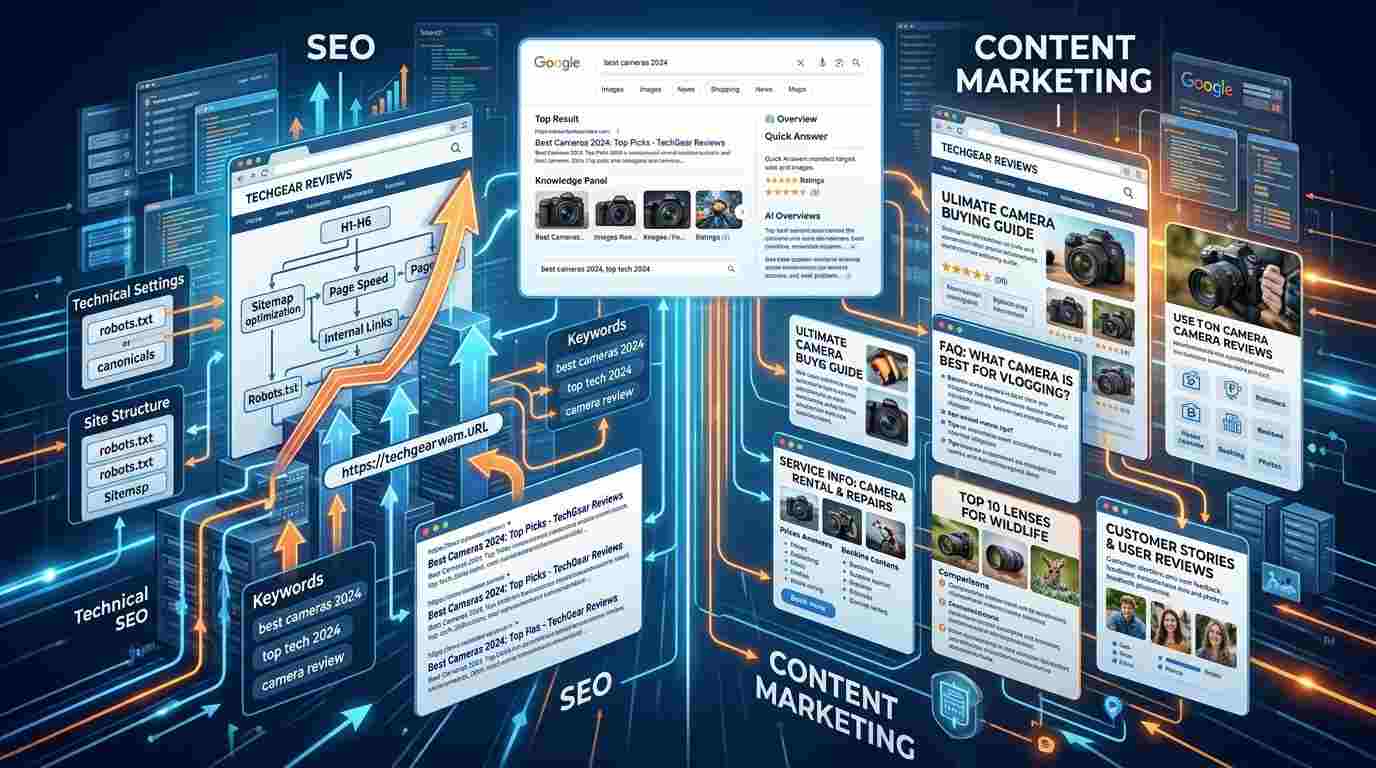
SEO gets your pages found in Google and AI search. Content marketing is what people actually read once they get there. One rarely works without the other, so for most businesses the question isn't which to pick. It's which one is holding you back right now.
Maybe you've paid for dozens of blog posts and traffic hasn't moved. Or you rank fine, but the phone doesn't ring. Those are two different problems with two different fixes, and this guide will help you tell them apart.
Who Is This Guide For?
It's for business owners and marketing managers with a fixed budget who need to spend it in the right place. If one agency pitched you SEO, another pitched you content, and you can't tell who's right, start here.
What Is SEO and How Does It Work?
SEO is the work that helps search engines find your pages, understand them, and decide they're worth showing. Much of it happens behind the scenes.
In practice it comes down to three areas. Your site has to load quickly, work on phones, and let Google crawl the pages you care about. That's technical SEO. Each page also needs one clear topic, a sensible title, proper headings, and links to related pages, which is on-page SEO. Off-page SEO covers links and mentions from other reputable sites.
What SEO can't do is make a weak page useful. It only helps good pages get seen. Our guide on what SEO is and how to optimize your site covers the basics in more depth.
What Is Content Marketing and How Does It Work?
Content marketing means publishing things your customers want to read or watch, then using that trust to win their business. Blog posts that answer real questions count. So do service pages that explain pricing honestly, case studies, short videos, and a monthly email.
It doesn't depend on Google. Some brands grow through LinkedIn or a newsletter alone. On your website, though, content written without search in mind usually gets very few visitors.
SEO vs Content Marketing: What Are the Key Differences?
SEO is about how search engines see your site. Content marketing is about how people react to it.
SEO | Content Marketing | |
|---|---|---|
Focus | Being found | Being worth reading |
Measured by | Rankings, impressions, clicks | Leads, sign ups, time on page |
Skills | Technical, analytical | Writing, editing, audience research |
Works alone? | Only for basic fixes | Yes, but rarely in search |
Is SEO Part of Content Marketing?
Partly. They overlap on your blog and service pages, and that's where most of the useful work happens. But SEO also includes things like site speed and schema markup that have nothing to do with writing. Content marketing, on the other hand, includes email and events where search doesn't matter.
How Can You Tell Which One Your Business Is Missing?
Look at what your numbers are telling you. The symptom usually points straight at the weak side.
What you're seeing | Likely gap | Where to start |
|---|---|---|
Good articles, almost no Google traffic | SEO | Check indexing, pick clear keywords, add internal links |
Plenty of traffic, very few enquiries | Content | Rewrite pages around buyer questions and add a clear next step |
Pages stuck on page two | Both | Add depth, answer related questions, earn a few relevant links |
Rankings dropped suddenly | SEO | Run a rankings drop check before touching content |
Competitors show up in AI answers and you don't | Both, plus GEO | Add direct answers, cleaner structure, and outside mentions |
Two of your pages chase the same keyword | SEO | Keep one page per keyword and merge the rest |
Not sure how to match keywords to pages? Our guide to improving keyword targeting walks through it.
Should You Do SEO or Content Marketing First?
That depends on where your website stands today. A brand new site should sort out the technical basics and do keyword research before the first post goes live. Adding SEO to fifty old articles later takes longer and costs more than getting it right at the start.
An older site with lots of content usually needs SEO first. Go through what's there, update the pages sitting on page two, and combine posts that cover the same thing. That often pays off faster than writing anything new.
For a local business, say a clinic in Jumeirah or a plumber in Al Quoz, the Google Business Profile and local SEO come first, with content supporting them. Our local SEO in Dubai guide goes into detail.
B2B firms and anyone selling high value services should run both together, since buyers often research for weeks before they call.
Whatever your situation, if Google can't crawl your site, nothing else will work.
How Do SEO and Content Marketing Work Together?
Keep it simple: SEO research decides what to write, content answers it, and your data shows what to fix next.
A workflow that suits most small teams:
Collect the questions buyers ask. Check Google's People Also Ask box, your sales calls, and how people phrase prompts in ChatGPT.
Group related topics so one main page is backed by a few shorter articles linking to it.
Put the keyword, intent, and internal links in the brief before anyone starts writing.
Answer the question at the top of each section, then add detail.
Open Search Console once a month and look for pages with lots of impressions but few clicks. Those are usually the easiest wins.
How Does AI Search Change SEO and Content Marketing?
AI tools like ChatGPT, Perplexity, and Google's AI Overviews pull from pages that are easy to crawl and clearly useful. You need both SEO and solid content at the same time, and that's what Generative Engine Optimization (GEO) builds on.
Pages that get cited tend to use question style headings, short direct answers, tables or FAQs, and visible expertise such as a named author. Mentions on other trusted sites help as well. Our comparison of GEO vs AEO vs AIO explains how they differ.
What Mistakes Waste the Most Budget?
We see the same few problems again and again. Businesses publish lots of short posts when one thorough page would do better. They chase big keywords that don't match what they sell. Writers and SEO people never talk, so both end up guessing. Some publish AI drafts without editing them, which rarely helps. If you're weighing options, see how content writing services compare with in-house writers and AI content. And plenty of owners give up after two months, when both usually need closer to six to show real movement.
The Bottom Line
You don't have to choose between SEO and content marketing. Use the table above to find the weaker one, fix it, then run both as a single process.
If you'd rather hand it all to one team, read how an SEO agency compares with a freelancer or in-house team, or get in touch with Eyes On Solution for a free website audit.
Frequently Asked Questions
What is the difference between SEO and content marketing?
SEO helps search engines and AI tools find and rank your pages. Content marketing is the useful material on those pages that earns trust and brings in leads.
Which is better, SEO or content marketing?
Neither does well alone. Put your money into whichever one your business is weaker at right now.
Can I do SEO without content marketing?
To a point. Technical fixes, a stronger Google Business Profile, and cleaner service pages all help. Growing past that takes new content.
Is content marketing still worth it with AI search?
Yes. AI answers are built from web pages, and clear, well organized content is what they tend to quote.
How long do SEO and content marketing take to work?
Expect early signs, like more impressions, within three to six months. Leads often take a little longer, depending on your competition.
Do I still need SEO if I run Google Ads?
Yes. Ads stop the day your budget does, while organic traffic keeps coming.