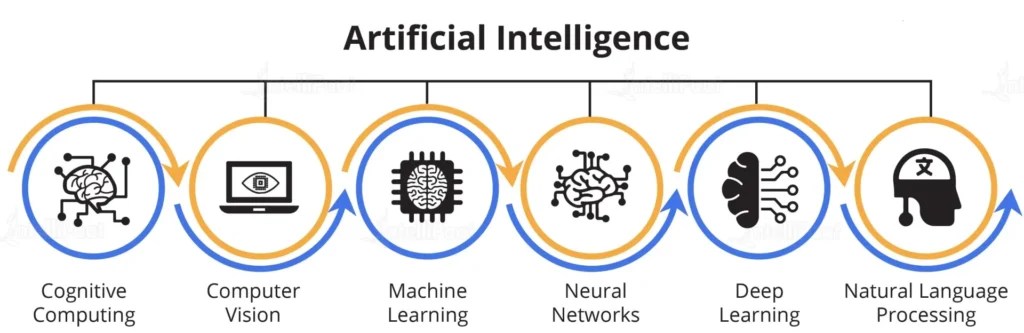
Today, AI is widely used in search engines, digital marketing, automation, and data analysis, helping businesses operate faster and more efficiently. In simple terms, AI works by analyzing large amounts of data, identifying patterns, and making predictions or decisions with minimal human input. From chatbots and recommendation systems to advanced SEO strategies, AI is transforming how companies grow and compete online.
This article explains what AI is, how it works, its key types, real-world applications, and why it has become essential for modern businesses looking to scale and succeed in competitive digital environments.

What is Artificial Intelligence?
Artificial Intelligence (AI) is a branch of computer science that focuses on building systems capable of performing tasks that normally require human intelligence. These tasks include understanding language, recognizing patterns, solving problems, learning from experience, and making decisions.
Unlike traditional software, which follows fixed instructions, AI systems are designed to adapt and improve over time. They process large volumes of data, identify patterns, and use those insights to generate predictions or actions. This ability to learn and evolve makes AI significantly more powerful than rule-based programming.
Core Components of Artificial Intelligence
AI is not a single technology. It is a combination of multiple systems and methodologies that work together to simulate intelligent behavior.
Machine Learning (ML)
Machine learning enables systems to learn from data without being explicitly programmed. Instead of following static rules, AI models improve their accuracy over time by identifying patterns and refining predictions.
Natural Language Processing (NLP)
Natural language processing allows machines to understand, interpret, and respond to human language. This is the technology behind chatbots, voice assistants, and AI-generated content.
Data Analytics and Pattern Recognition
AI relies heavily on data. It analyzes structured and unstructured data to detect trends, behaviors, and anomalies that humans might miss.
Types of Artificial Intelligence
AI can be classified based on its capabilities and level of intelligence. Understanding these categories helps clarify how AI is used today and where it is heading.
Narrow AI (Weak AI)
Narrow AI is designed to perform specific tasks. It is the most common form of AI used today.
Examples include:
- Search engine algorithms
- Recommendation systems
- Voice assistants
These systems are highly efficient but limited to predefined functions.
General AI (Strong AI)
General AI refers to systems that can perform any intellectual task that a human can do. Unlike Narrow AI, it is not limited to a single function.
This level of AI is still under development and has not yet been fully realized.
Super AI
Super AI is a theoretical concept where machines surpass human intelligence in all aspects, including creativity, reasoning, and emotional understanding.
While widely discussed, this form of AI does not yet exist in practice.
Real-World Presence of Artificial Intelligence
Artificial Intelligence is already integrated into everyday digital experiences. It plays a critical role in how users interact with technology and how businesses operate.
Everyday Applications
- Search engines delivering relevant results
- E-commerce platforms recommending products
- Smart assistants responding to voice commands
Business and Marketing Use
Businesses use AI to:
- Automate customer interactions
- Analyze user behaviorOptimize marketing
- campaignsImprove decision-making speed
For companies operating in competitive digital markets, AI has become a key driver of efficiency and growth.
Why Artificial Intelligence Matters for Businesses
AI is more than just a technological advancement. It is a strategic asset that helps businesses scale and stay competitive.
Operational Efficiency
AI automates repetitive tasks, reducing manual effort and saving time.
Data-Driven Insights
It uncovers patterns and insights that support smarter decision-making.
Competitive Advantage
Businesses that leverage AI can respond faster to market changes and customer needs.
Brief History of Artificial Intelligence
Artificial intelligence has evolved over time from simple concepts into powerful technologies that drive innovation across industries. Its journey reflects continuous improvements in data processing, algorithms, and computing capabilities.
Early Development
1950s to 1980s
In the early years, AI research focused on creating systems that could solve structured problems. Scientists developed programs like chess-playing machines and rule-based expert systems designed for specific tasks. These early models laid the foundation for modern AI by introducing logic, reasoning, and automated decision-making.
Modern Advancements
2000s to Present
With the growth of big data and advanced computing power, AI has rapidly progressed. Machine learning and neural networks now enable systems to process large datasets, detect patterns, and generate accurate predictions, making AI more practical and widely adopted.
How Artificial Intelligence Works
Artificial Intelligence works by combining data, algorithms, and computing power to simulate human intelligence. It processes large volumes of information, identifies patterns, and uses those patterns to make decisions or predictions with minimal human intervention.
At a basic level, AI follows a structured process that involves data collection, training, decision-making, and continuous improvement. This process allows AI systems to evolve over time and become more accurate.
The Core Process Behind AI Systems
AI does not function randomly. It follows a systematic workflow that transforms raw data into intelligent outcomes.
Data Collection and Input
AI systems rely on large datasets as their foundation. This data can be:
- Text
- Images
- Videos
- User behavior data
The quality and quantity of data directly impact how well an AI system performs.
Data Processing and Pattern Recognition
Once data is collected, AI analyzes it to identify patterns and relationships.
This involves:
- Sorting data into meaningful categories
- Detecting trends and correlations
- Identifying anomalies or unusual behavior
This step is critical because it enables AI to “understand” the data rather than just store it.
Model Training
AI systems are trained using algorithms that learn from data. During this phase, the system:
- Processes historical data
- Adjusts internal parameters
- Improves accuracy through repeated iterations
The more data the model processes, the better it becomes at making predictions.
Key Technologies That Power AI
AI is powered by several underlying technologies that enable it to perform complex tasks efficiently.
Machine Learning Algorithms
Machine learning is the backbone of AI. It allows systems to learn from data and improve without manual programming.
Examples include:
- Classification algorithms
- Regression models
- Clustering techniques
Neural Networks
Neural networks are inspired by the human brain. They consist of layers of interconnected nodes that process information.
Deep Learning
Deep learning is an advanced form of neural networks that uses multiple layers to analyze complex data such as images, speech, and language.
Natural Language Processing (NLP)
NLP enables AI to understand and respond to human language. It is widely used in:
- Chatbots
- Voice assistants
- Content generation tools
How AI Makes Decisions
AI decision-making is based on probability, patterns, and learned behavior rather than emotions or intuition.
Predictive Analysis
AI uses historical data to predict future outcomes. For example:
- Recommending products
- Forecasting trends
- Identifying customer behavior
Rule-Based Logic vs Learning Models
Rule-Based Systems
These systems follow predefined instructions and do not adapt over time.
Learning-Based Systems
These systems improve continuously by learning from new data and feedback.
Continuous Learning and Improvement
One of the most powerful aspects of AI is its ability to improve over time.
Feedback Loops
AI systems use feedback to refine their predictions and decisions.
Model Optimization
Performance is continuously enhanced by:
- Updating data
- Adjusting algorithms
- Reducing errors
Real-World Example of How AI Works
To simplify the concept, consider how AI works in a search engine:
Step-by-Step Process
- A user enters a query
- AI analyzes keywords and intent
- It scans billions of pages
- It ranks results based on relevance
- It improves results based on user behavior
This entire process happens within seconds and improves continuously as more users interact with the system.
Why Understanding AI Workflow Matters
For businesses, understanding how AI works is essential for leveraging its full potential.
Better Strategy Development
Knowing how AI processes data helps businesses create more effective marketing and SEO strategies.
Improved Decision-Making
AI-driven insights allow companies to make faster and more accurate decisions.
Scalable Growth
AI enables automation and optimization at scale, reducing manual effort while increasing efficiency.
Other Info: Grow Traffic Organically – An Ultimate Guide to WordPress SEO Services
Real-World Applications of Artificial Intelligence
Artificial Intelligence is no longer a future concept. It is actively shaping how industries operate, how businesses grow, and how users interact with digital platforms. From automation to personalization, AI is integrated into everyday systems that improve efficiency, accuracy, and decision-making.
Understanding real-world applications of AI helps businesses identify where and how to implement it for maximum impact.
AI in Everyday Life
AI is deeply embedded in daily digital experiences, often working behind the scenes without users realizing it.
Smart Assistants and Voice Search
AI powers voice assistants that understand and respond to user queries in real time.
Examples include:
- Voice-based search queries
- Smart home devices
- Mobile assistants
These systems use natural language processing to deliver accurate and relevant responses.
Recommendation Systems
AI analyzes user behavior to suggest personalized content and products.
Common use cases:
- Product recommendations on e-commerce platforms
- Movie and music suggestions
- Personalized content feeds
This improves user experience and increases engagement.
Navigation and Mapping
AI enhances navigation systems by analyzing real-time data.
It helps with:
- Traffic prediction
- Route optimization
- Travel time estimation
AI in Business and Marketing
AI plays a critical role in helping businesses scale operations and improve performance in competitive markets.
Customer Experience Automation
AI-powered chatbots and virtual assistants handle customer queries instantly.
Benefits include:
- 24/7 customer support
- Faster response times
- Reduced operational costs
Data Analysis and Insights
AI processes large datasets to uncover actionable insights.
Businesses use this for:
- Customer behavior analysis
- Market trend prediction
- Performance tracking
AI in SEO and Digital Marketing
AI is transforming how digital marketing strategies are planned and executed.
Search Engine Optimization (SEO)
AI helps in:
- Keyword analysis
- Search intent identification
- Content optimization
This aligns directly with advanced strategies used in SEO optimisation and link building campaigns, where data-driven decisions improve rankings.
Content Creation and Optimization
AI assists in:
- Content ideation
- Topic clustering
- Performance tracking
When combined with professional content writing services, AI can enhance both efficiency and quality.
Outreach and Link Building
AI supports:
- Prospect identification
- Email personalization
- Campaign automation
This strengthens strategies like blogger outreach and guest posting, helping businesses gain high-quality backlinks.
AI in Healthcare
AI is improving accuracy and efficiency in the healthcare sector.
Medical Diagnosis
AI analyzes medical data to assist in diagnosing diseases more accurately.
Predictive Healthcare
It helps predict potential health risks based on patient data.
Administrative Automation
AI reduces manual workload by automating scheduling and data management.
AI in Finance
AI is widely used in financial systems to improve security and decision-making.
Fraud Detection
AI identifies unusual patterns and prevents fraudulent activities.
Risk Assessment
It evaluates financial data to assess risks and guide investment decisions.
Automated Trading
AI systems analyze market trends and execute trades with speed and precision.
AI in E-commerce
AI enhances online shopping experiences and drives higher conversions.
Personalized Shopping Experience
AI recommends products based on user preferences and browsing history.
Inventory Management
It predicts demand and optimizes stock levels.
Dynamic Pricing
AI adjusts prices based on demand, competition, and user behavior.
AI in Education
AI is transforming how people learn and access knowledge.
Personalized Learning
AI adapts content based on individual learning pace and preferences.
Automated Assessment
It evaluates assignments and provides instant feedback.
Virtual Tutors
AI-powered systems provide guidance and support to students.
Challenges and Limitations of AI
Although artificial intelligence delivers strong benefits, it also comes with challenges that businesses must understand before full adoption.
Data Dependency
AI systems rely heavily on large, high-quality datasets to function accurately. If the data is incomplete, outdated, or biased, the results can be misleading and affect decision-making.
Limited Human Judgment
AI lacks emotional intelligence, creativity, and intuition. It can analyze patterns but cannot fully understand context or human behavior, which is essential for branding, storytelling, and complex problem-solving.
Ethical and Privacy Concerns
Using AI raises concerns around data privacy, security, and ethical use. Businesses must ensure compliance, protect user data, and use AI responsibly to maintain trust and avoid potential risks.
Unlock the Future with AI-Powered Innovation
Artificial Intelligence is becoming a core part of modern business and technology. It helps improve efficiency, automate processes, and deliver better customer experiences. As AI continues to evolve, its impact on industries will only grow stronger. Businesses that adopt AI early can gain a competitive advantage and improve long-term performance.
Want to use AI to grow your business and marketing strategy? Contact Eyes On Solution today and let our experts help you build a smarter digital future.
Learn More About: Best Digital Marketing Strategies for Startups (2026)