Search engine optimization (SEO) remains one of the most powerful investments a business can make, delivering a median ROI of 748% and capturing customers precisely when they search for solutions. As the digital landscape shifts toward AI-powered search engines and generative answers, organic visibility is no longer just about blue links—it is about establishing brand authority across the entire digital ecosystem. This article explores why SEO is critical for sustainable traffic, high-quality lead generation, and competitive advantage in 2026 and beyond.
Imagine your ideal customer is actively looking for the exact service you offer. They pull out their phone, open Google or ChatGPT, and type in a question. If your business doesn’t appear in those crucial top results or AI summaries, that customer is going to your competitor. This scenario plays out billions of times a day, highlighting exactly why SEO is important for business growth.
The digital marketing landscape has evolved dramatically over the last few years. We have moved from a world of traditional search results to complex, AI-powered search experiences. Yet, despite the rise of generative AI and zero-click searches, SEO remains the foundation of digital visibility. In fact, organic search continues to produce around 33% of overall website traffic across key industries.
For businesses in Dubai and worldwide, ignoring SEO means risking lost visibility, fewer leads, and shrinking market share. Let’s explore how SEO influences visibility across Google, AI platforms, and beyond, and why it remains the most sustainable marketing investment you can make.
How Does SEO Capture Customers at the Start of Their Buying Journey?
SEO is fundamentally about being present where your customers start their buying journey. When users turn to search engines, they have a specific intent. They aren’t passively scrolling through a social media feed; they are actively searching for solutions to their problems.
Search Intent Reflects Real Demand
Search intent is the driving force behind organic traffic. When someone searches for “best SEO company Dubai,” they are expressing a clear, immediate need for digital marketing services. By optimizing your website for these intent-driven queries, you capture customers at the exact moment of need. This high-intent traffic is far more likely to convert into paying clients than traffic generated through interruptive advertising.
Organic Search Influences Every Stage of the Funnel
A well-crafted SEO strategy doesn’t just target buyers at the very end of their journey. It influences every stage of the marketing funnel:
- Awareness: Informational content helps users understand their problems and introduces them to your brand.
- Consideration: Comparison guides and in-depth articles help users evaluate their options.
- Decision-making: Service pages and case studies convince users that your business is the right choice.
By maintaining visibility across all these stages, your brand becomes a trusted resource long before the customer is ready to make a purchase.
Why Does SEO Build Sustainable Traffic Without Paying for Every Click?
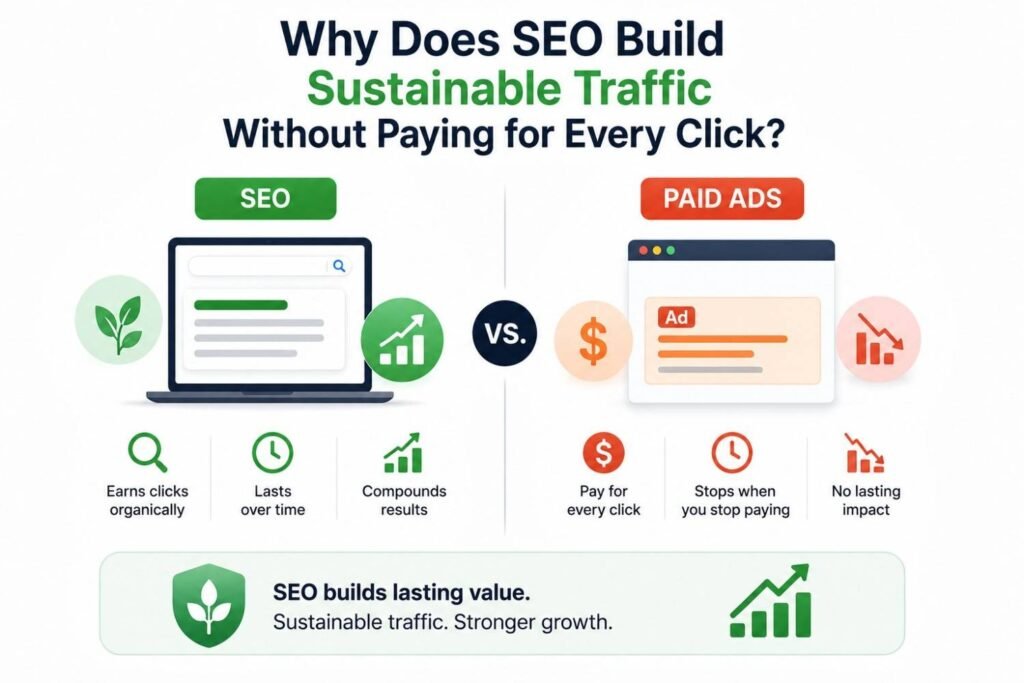
One of the most compelling arguments for SEO is its ability to build sustainable, long-term traffic. While paid advertising can generate immediate results, it operates on a pay-to-play model. The moment you stop funding your ad campaigns, your traffic drops to zero.
The Difference Between Organic Traffic and Paid Traffic
Organic traffic is earned through merit, relevance, and authority. When you invest in SEO, you are building digital assets that continue to deliver value over time. A high-ranking, optimized piece of content can drive traffic and leads for years without requiring a constant influx of ad spend.
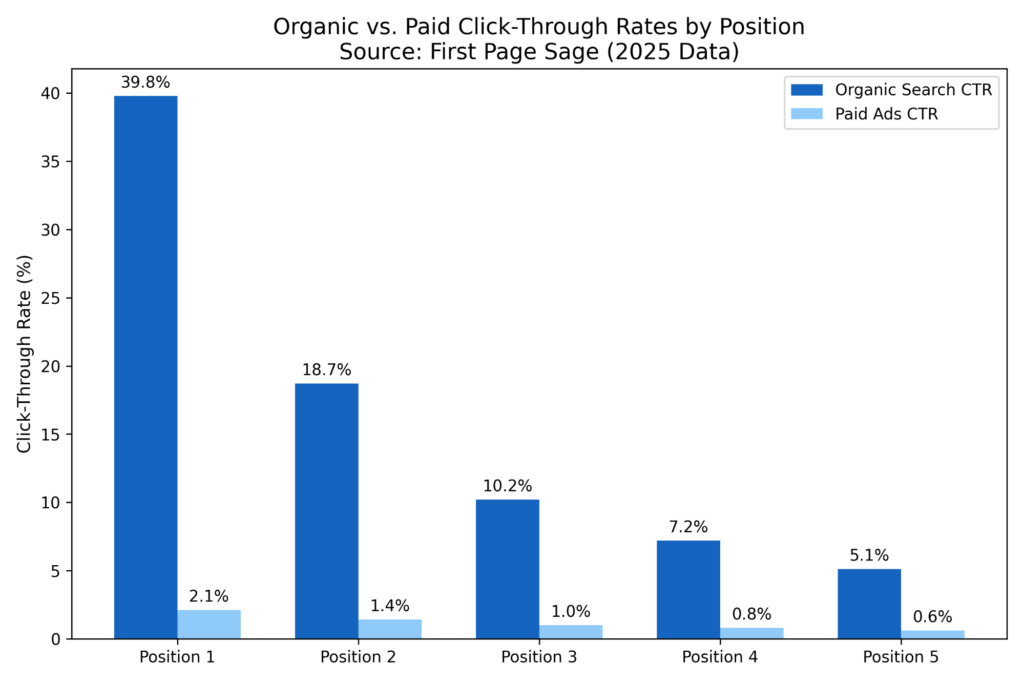
As the chart above illustrates, organic search results command a significantly higher click-through rate than paid ads. The first organic position on Google receives nearly 40% of all clicks, while the top paid ad receives only a fraction of that attention. Users inherently trust organic results more than sponsored placements.
How SEO Creates Long-Term Marketing Assets
Think of SEO as real estate development. When you optimize your website, publish high-quality content, and earn authoritative backlinks, you are building equity in your digital property. This compound effect of organic growth means that your marketing ROI improves over time.
Why SEO Delivers Better Long-Term ROI Than Many Marketing Channels
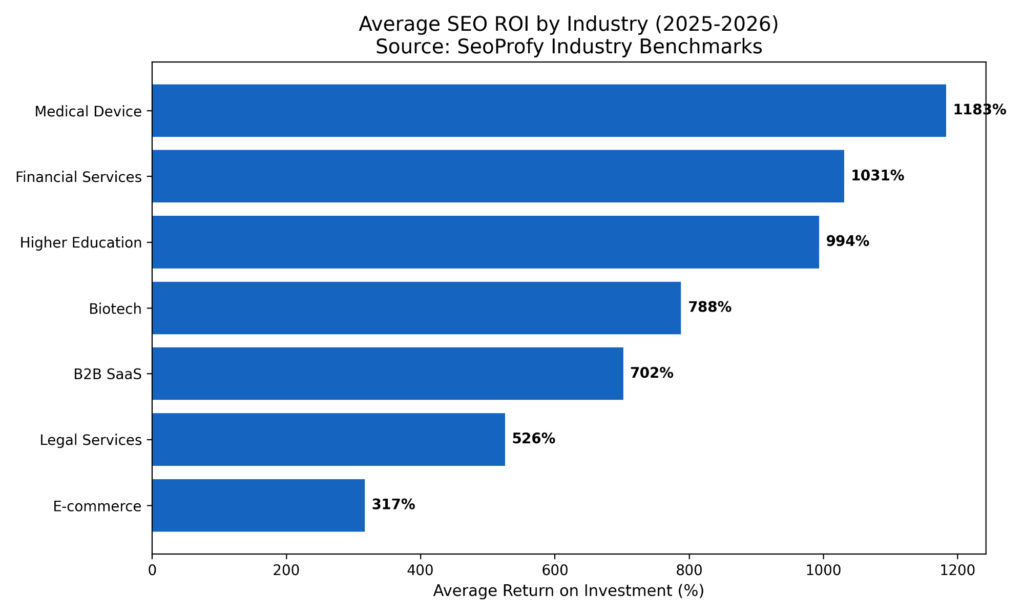
The return on investment for SEO is staggering when viewed through a long-term lens. According to recent industry benchmarks, a well-executed SEO campaign can yield an average ROI of 748%, meaning businesses see roughly $7.48 back for every $1 spent.
| Industry | Average SEO ROI | Break-Even Timeline |
|---|---|---|
| Medical Device | ~1,183% | 12–24 months |
| Financial Services | ~1,031% | 12–18 months |
| B2B SaaS | ~702% | ~7 months |
| Legal Services | ~526% | 9–12 months |
| E-commerce | ~317% | 12 months+ |
Furthermore, SEO leads close at an impressive 14.6%, compared to just 1.7% for outbound marketing tactics like cold calling or direct mail. This stark difference underscores the power of inbound, intent-driven traffic.
How Does SEO Increase Brand Visibility Across the Entire Digital Ecosystem?
SEO is no longer confined to ranking ten blue links on Google. Today, search optimization is about maximizing your brand’s footprint across a diverse digital ecosystem.
Google Search Results and AI Overviews
Google remains the undisputed leader in search, processing billions of queries daily. However, the introduction of Google AI Overviews has fundamentally changed the search engine results page. These generative AI summaries provide direct answers at the top of the page, often pushing traditional organic links further down.
While this shift has led to an increase in zero-click searches, being featured within these AI Overviews or ranking prominently beneath them is crucial for brand visibility.
AI Search Platforms
The rise of AI search platforms has created new frontiers for SEO. Users are increasingly turning to tools like ChatGPT, Perplexity, Gemini, and Microsoft Copilot to find information and recommendations. In fact, ChatGPT reached over 800 million active users by mid-2025. Optimizing your content to be cited by these AI models is becoming a critical component of modern digital marketing.
Voice Search and Smart Assistants
Voice search continues to grow as smart speakers and mobile assistants become ubiquitous. Optimizing for voice search requires a focus on natural language, conversational queries, and direct answers, strategies that align closely with modern SEO best practices.
Social Search Platforms
Search behavior is also fragmenting across social media platforms. Users frequently use YouTube Search for tutorials, TikTok Search for product discovery, and LinkedIn Search for B2B networking. A comprehensive SEO strategy must account for how your target audience searches across these diverse platforms.
Why Does SEO Build Trust Before Customers Contact You?
Trust is the currency of digital business. If a potential customer doesn’t trust your brand, they won’t convert, no matter how much traffic you drive to your site. SEO plays a vital role in establishing this trust long before a user ever reaches out to your sales team.
Why High Visibility Creates Credibility
Users subconsciously associate high search rankings with industry authority. If Google or an AI search engine consistently recommends your website for relevant queries, users assume your business is a credible, leading player in your field.
The Role of E-E-A-T in Modern Search
Google evaluates content quality using the E-E-A-T framework: Experience, Expertise, Authoritativeness, and Trustworthiness. Demonstrating E-E-A-T is critical for ranking well, particularly for businesses offering services that impact users’ financial or physical well-being.
By publishing expert-driven content, showcasing client success stories, and maintaining a technically sound website, you send strong trust signals to both search engines and human readers.
How Brand Authority Influences Rankings and AI Citations
Brand authority is increasingly recognized as a significant ranking factor. Search engines and AI models look for entities, recognized brands, people, and concepts that are frequently mentioned and cited across the web. Building digital authority through guest posting, digital PR, and consistent content marketing helps solidify your brand as a trusted entity, increasing your likelihood of being recommended by AI systems.
How Has SEO Evolved Beyond Just Rankings?
For years, the primary goal of SEO was simply to rank number one for target keywords. While high rankings are still important, the metric of success has shifted toward overall visibility and user engagement.
From Blue Links to AI Generated Answers
The SERP has evolved from a simple list of links to a dynamic, interactive experience featuring knowledge panels, local packs, video carousels, and AI-generated answers. This evolution means that visibility matters even when users don’t click through to your website.
The Rise of Zero-Click Search
A zero-click search occurs when a user finds the answer to their query directly on the search results page without needing to click a link. Recent data suggests that over 64% of Google searches now end without a click.
While this might seem alarming, it underscores the importance of Answer Engine Optimization. If your brand provides the direct answer featured in a zero-click search, you still gain valuable brand impressions and establish authority in the user’s mind.
Why Is SEO Critical in the Era of AI Search?
The integration of generative AI into search engines represents the most significant shift in SEO in decades. AI systems like ChatGPT and Google’s AI Overviews synthesize information from multiple sources to provide comprehensive answers.
How AI Search Engines Are Changing User Behavior
Users are adapting to AI search by asking more complex, conversational questions. Instead of searching for “digital marketing Dubai,” a user might ask an AI, “What are the best digital marketing agencies in Dubai for a growing e-commerce startup?”
Why AI Systems Need Trusted Sources
AI models do not generate information out of thin air; they rely on training data and real-time web retrieval. To provide accurate answers, these systems need to pull from trusted, authoritative sources.
How SEO Helps Brands Become AI Citations
By implementing robust SEO strategies, such as publishing high-quality, data-backed content and building strong backlink profiles, you position your brand as a reliable source of information. When AI models crawl the web for answers, they are more likely to cite websites that have established strong topical authority and E-E-A-T signals.
What Is GEO and Why Does It Matter?
Generative Engine Optimization is the next evolution of SEO. While traditional SEO focuses on ranking in standard search engine results, GEO focuses on optimizing content to be understood, favored, and cited by generative AI models.
Why GEO Matters for Business Visibility
As more users turn to AI for answers, appearing in AI-generated responses becomes crucial for maintaining market share. If your competitors are cited by ChatGPT and Google AI Overviews while your brand is ignored, you will lose a significant portion of your potential audience.
How AI Models Select Sources
AI models prioritize content that is clear, structured, factually accurate, and highly relevant to the user’s prompt. They look for strong entity associations and consensus across multiple authoritative websites.
GEO Best Practices
To succeed in GEO, businesses must adopt specific strategies:
- Entity optimization: Clearly define your brand, products, and key personnel using schema markup and consistent terminology.
- Expert-driven content: Publish content authored by recognized experts in your field to build E-E-A-T.
- Original insights: Provide unique data, case studies, and perspectives that AI models cannot easily find elsewhere.
- Data-backed content: Support your claims with statistics and research to enhance credibility.
- Brand authority building: Earn mentions and backlinks from high-authority publications to signal trust to AI systems.
What Is AEO and How Does It Win Direct Answers?
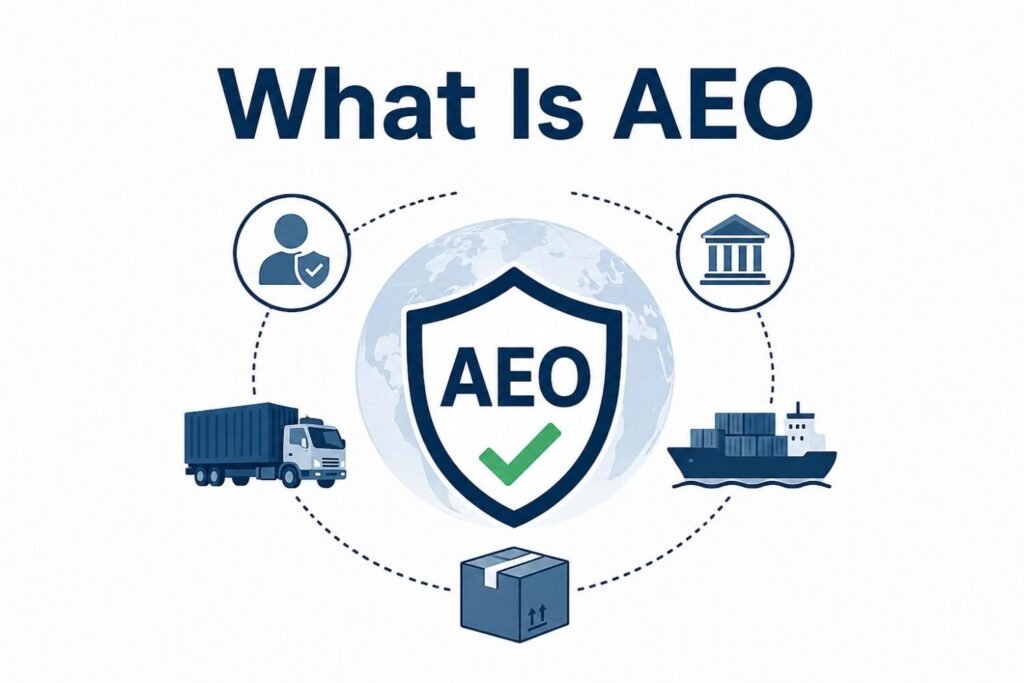
Answer Engine Optimization (AEO) is a subset of SEO focused on optimizing content specifically to answer user questions concisely and accurately. The goal of AEO is to be featured in Google’s Featured Snippets, AI Overviews, and voice search results.
Why Search Engines Prioritize Direct Answers
Search engines want to provide the best possible user experience, which often means delivering the answer as quickly as possible. By providing direct answers at the top of the SERP, search engines keep users engaged on their platforms.
Benefits of Becoming the Preferred Answer Source
Becoming the preferred answer source positions your brand as the ultimate authority on a topic. Even in zero-click scenarios, providing the featured answer builds brand recall and trust. When users eventually need more in-depth services, they are more likely to turn to the brand that has consistently answered their questions.
Key AEO Strategies
To optimize for answer engines, focus on:
- FAQ optimization: Identify common questions your audience asks and provide clear, direct answers.
- Structured content: Use clear headings (H2s and H3s) and bulleted lists to make your content easy for machines to parse.
- Schema markup: Implement FAQ and Article schema to help search engines understand the context of your content.
- Concise answer formatting: Provide a direct, 2-3 sentence answer immediately following a question header, before expanding into more detail.
Why Does Appearing in Google AI Overviews Matter?
Google AI Overviews (formerly Search Generative Experience) are reshaping how users interact with Google. These AI-generated summaries appear at the top of the SERP for many complex queries, synthesizing information from multiple websites.
How AI Overviews Impact Organic Visibility
The introduction of AI Overviews has had a noticeable impact on traditional organic traffic. When an AI Overview is present, the CTR for the top traditional organic result can drop significantly.
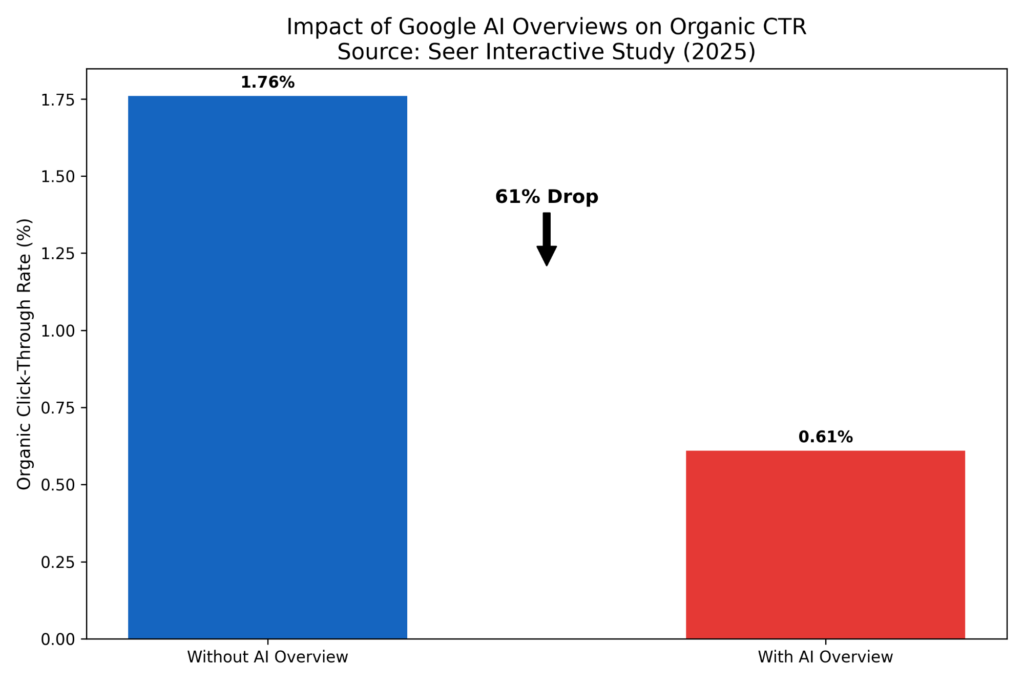
According to recent studies, organic CTR on queries with Google AI Overviews fell by 61% compared to queries without them. This data highlights a critical reality: if you aren’t featured in the AI Overview or optimizing for queries where AI doesn’t dominate, your traffic will suffer.
Optimization Strategies for AI Overview Inclusion
To increase your chances of being featured in AI Overviews, focus on comprehensive, conversational content. Answer the “why” and “how” behind user queries. Use structured data and ensure your website has high technical performance and strong authority signals.
How Does SEO Help Businesses Generate Higher Quality Leads?

Traffic is meaningless if it doesn’t convert. Fortunately, SEO is one of the most effective channels for generating high-quality, sales-ready leads.
Intent-Driven Traffic Converts Better
Because SEO targets users who are actively searching for solutions, the traffic it generates is inherently high-intent. A user searching for “affordable SEO services package Dubai” is much closer to making a purchasing decision than someone who happens to see a banner ad while browsing a news site.
Improving Lead Quality Through Search Visibility
By creating highly targeted content that addresses specific pain points, you attract a more qualified audience. For example, a detailed guide on “technical SEO audits” will attract marketing managers and business owners who understand their needs and are looking for expert help, resulting in higher-quality leads for your agency.
Reducing Customer Acquisition Costs
Because SEO traffic compounds over time, the cost per lead (CPL) and customer acquisition cost (CAC) tend to decrease as your organic visibility grows. Unlike paid ads, where you pay for every click regardless of conversion, SEO provides a sustainable flow of leads that improves your overall marketing efficiency.
How Does SEO Create a Competitive Advantage?
In the digital arena, visibility is a zero-sum game. If you aren’t ranking for your target keywords, your competitors are.
What Happens When Competitors Invest in SEO and You Don’t
If your competitors invest heavily in SEO while you rely solely on referrals or paid ads, they will steadily capture market share. They will become the recognized authority in your industry, build a larger audience, and generate leads at a lower cost. Over time, this organic dominance becomes incredibly difficult to overcome.
Dominating High-Value Search Topics
SEO allows you to target and dominate high-value search topics within your niche. By consistently publishing superior content and building authority around specific themes, you can establish a competitive moat that protects your market position.
Building Topical Authority Within Your Industry
Topical authority is achieved when search engines recognize your website as a comprehensive, expert source of information on a specific subject. By covering all aspects of your industry, from basic definitions to advanced strategies, you signal to Google and AI models that your business is the definitive leader in your space.
How Does SEO Support Every Other Marketing Channel?
SEO does not operate in a vacuum. A strong organic search strategy enhances and supports every other aspect of your digital marketing efforts.
| Marketing Channel | How SEO Supports It |
|---|---|
| Content Marketing | SEO provides the data and keyword research needed to ensure content reaches the right audience. |
| Digital PR | High-ranking content attracts natural backlinks, amplifying the reach of PR campaigns. |
| Social Media | SEO-optimized content provides valuable material to share across social platforms, driving engagement. |
| Paid Advertising | SEO insights help identify high-converting keywords for PPC, while organic rankings can lower overall ad costs. |
| Conversion Rate Optimization | SEO focuses on improving site speed and user experience, which directly boosts conversion rates. |
Why Has Brand Authority Become an SEO Ranking Factor?
As search algorithms become more sophisticated, they rely less on traditional metrics like keyword density and more on holistic signals of brand authority.
The Shift Toward Entity-Based Search
Search engines now understand the web as a massive Knowledge Graph composed of interconnected entities (people, places, brands, concepts). When your business is recognized as a strong entity within your industry, search engines are more confident in recommending your content.
Building Digital Authority Across the Web
Building digital authority requires a multi-faceted approach. It involves earning high-quality backlinks from reputable websites, garnering positive customer reviews, maintaining active social media profiles, and being mentioned in industry publications.
Why Mentions Matter Beyond Backlinks
In the era of entity-based search and AI models, unlinked brand mentions (co-citations) are increasingly valuable. When authoritative websites mention your brand in the context of your industry, it reinforces your topical authority, even if they don’t provide a direct link to your site.
What Is the Cost of Ignoring SEO?
Choosing not to invest in SEO carries significant opportunity costs that can stifle business growth.
- Lost Visibility: Your business becomes invisible to the majority of consumers who begin their buying journey with a search engine.
- Lost Leads: High-intent prospects will find and convert with your competitors instead of you.
- Lost Market Share: Competitors who dominate organic search will establish stronger brand awareness and capture a larger share of the market.
- Reduced AI Search Presence: Without strong SEO and GEO foundations, your brand will be excluded from the AI-generated answers that are shaping the future of search.
- Increased Dependence on Paid Advertising: You will be forced to rely entirely on paid channels, leading to higher acquisition costs and vulnerable profit margins.
What Is the Future of SEO?
The future of SEO is dynamic, complex, and deeply integrated with artificial intelligence.
Search Everywhere Optimization
Users are searching across a wider variety of platforms than ever before. The future of SEO requires a “Search Everywhere” approach, optimizing visibility across Google, AI chatbots, social media networks, and voice assistants.
AI First Search Experiences
As Google rolls out AI Overviews globally and platforms like ChatGPT integrate real-time web search, optimizing for generative AI will become the primary focus for digital marketers.
GEO, AEO, and Traditional SEO Working Together
Success in the future will require a holistic strategy that combines traditional technical SEO, Answer Engine Optimization for direct answers, and Generative Engine Optimization for AI citations.
Why Human Expertise Will Continue to Matter
Despite the rise of AI, human expertise will remain the most critical differentiator. AI models rely on original, human-generated insights, data, and experiences to form their answers. Brands that produce genuinely helpful, expert-driven content will continue to thrive in the evolving search landscape.
Why Should Businesses Invest in SEO Now?
Investing in SEO today is an investment in the long-term viability and growth of your business.
- SEO drives sustainable growth: It builds digital assets that provide compounding returns over time.
- SEO supports visibility in AI-powered search: It ensures your brand is cited by the generative models shaping the future of information discovery.
- SEO builds trust and authority: It establishes your business as a credible leader in your industry.
- SEO improves lead generation and revenue: It captures high-intent traffic that converts at a significantly higher rate than outbound marketing.
- SEO future-proofs digital marketing efforts: It creates a strong foundation that supports all other marketing channels and adapts to changing consumer behaviors.
For businesses looking to turn their website into a powerful growth engine, partnering with a reliable digital marketing company like Eyes On Solution is the first step toward dominating the search results and securing sustainable success.
Frequently Asked Questions (FAQ)
Why is SEO important for business growth?
SEO is crucial for business growth because it connects your brand with customers actively searching for your products or services. By improving organic visibility, SEO drives high-intent traffic, generates qualified leads, and builds long-term brand authority, resulting in a higher, more sustainable ROI compared to paid advertising.
Is SEO still important with AI search?
Yes, SEO is more important than ever in the age of AI search. AI models like ChatGPT and Google AI Overviews rely on highly optimized, authoritative, and trusted web content to generate their answers. Without strong SEO foundations, your brand will not be cited as a source by these generative AI platforms.
How does SEO help generate leads?
SEO generates leads by targeting users at the exact moment they express a need or intent through a search query. By optimizing your website for relevant keywords and providing valuable content, you attract highly qualified visitors who are already interested in your solutions and more likely to convert.
What is the difference between SEO and GEO?
Traditional SEO focuses on optimizing content to rank high in standard search engine results pages (SERPs) using keywords and backlinks. Generative Engine Optimization focuses on structuring and writing content so that AI models (like ChatGPT or Google AI Overviews) can easily understand, favor, and cite it in their generative answers.
How does AEO improve visibility?
Answer Engine Optimization improves visibility by formatting content to directly and concisely answer specific user questions. This increases the likelihood of your content being featured in Google’s Featured Snippets, voice search results, and AI-generated summaries, capturing attention even in zero-click search scenarios.
Why are AI Overviews important for SEO?
Google AI Overviews appear at the very top of the search results, often pushing traditional organic links down the page. Being featured in these AI-generated summaries is vital for maintaining visibility, as queries with AI Overviews can significantly reduce the click-through rate to standard organic results.
Can businesses rank in AI search results?
Yes, businesses can appear in AI search results by implementing Generative Engine Optimization strategies. This involves building strong brand authority (E-E-A-T), using structured data, providing original expert insights, and ensuring your content directly answers complex user queries.
Is SEO better than paid advertising?
While paid advertising provides immediate, short-term results, SEO is generally considered better for long-term, sustainable growth. SEO delivers a significantly higher average ROI (around 748%), builds compounding digital assets, and earns more trust from users, whereas paid traffic stops the moment you stop spending.
How long does it take to see SEO results?
SEO is a long-term strategy. Most businesses begin to see meaningful improvements in rankings and traffic within 6 to 12 months. However, the exact timeline depends on the competitiveness of your industry, the current state of your website, and the aggressiveness of your SEO campaign.
What will SEO look like in the future?
The future of SEO will be a “Search Everywhere” approach, blending traditional optimization with GEO and AEO. Marketers will need to optimize for AI chatbots, voice assistants, and social search platforms, focusing heavily on brand authority, original human expertise, and providing direct, structured answers to user queries.